WATER: ART MEETS SCIENCE W HAT A RE W E G IVING UP BY IGNORING IT ? M - - PowerPoint PPT Presentation

water art meets science w hat a re w e g iving up by
SMART_READER_LITE
LIVE PREVIEW

WATER: ART MEETS SCIENCE W HAT A RE W E G IVING UP BY IGNORING IT ? M - - PowerPoint PPT Presentation

WATER: ART MEETS SCIENCE W HAT A RE W E G IVING UP BY IGNORING IT ? M USEUM OF S CIENCE O CTOBER 1, 2014 P ROFESSOR S HAFIQUL I SLAM C IVIL AND E NVIRONMENTAL E NGINEERING AND THE F LETCHER S CHOOL OF L AW AND D IPLOMACY , T UFTS U NIVERSITY A


slide-1
SLIDE 1

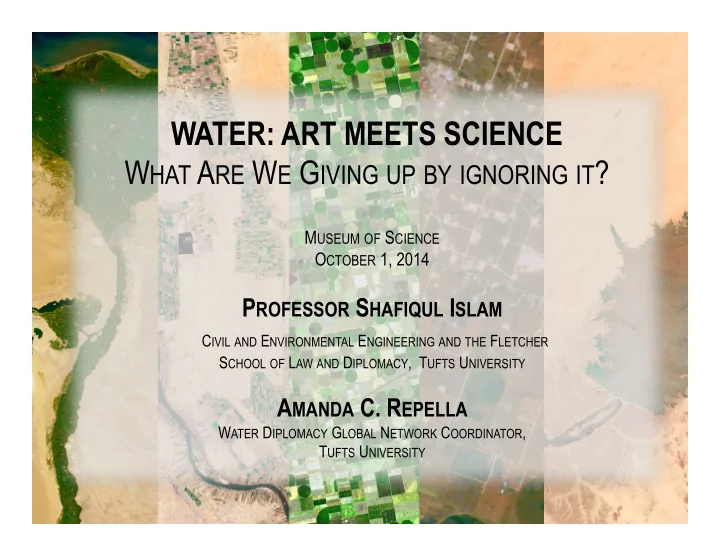
WATER: ART MEETS SCIENCE WHAT ARE WE GIVING UP BY IGNORING IT?

MUSEUM OF SCIENCE OCTOBER 1, 2014

PROFESSOR SHAFIQUL ISLAM CIVIL AND ENVIRONMENTAL ENGINEERING AND THE FLETCHER

SCHOOL OF LAW AND DIPLOMACY, TUFTS UNIVERSITY

AMANDA C. REPELLA

WATER DIPLOMACY GLOBAL NETWORK COORDINATOR, TUFTS UNIVERSITY

slide-2
SLIDE 2

THE NILE DELTA

(FALSE COLOR MODIS, NASA VISIBLE EARTH )

slide-3
SLIDE 3

A wealthy man willed his herd of camels to his three sons, allocating half for the first, one-third for the middle, and one-ninth for the youngest

  • son. The man owned 17 camels.

How could they divide 17 camels according to the father’s wishes? Killing all the camels and dividing the meat may be an optimal solution that could meet the requirements of the will, but it is not a desirable

  • ne, as the live camels are more valuable than

their meat. One of the sons could concede a portion of his own inheritance to his brothers, but that wouldn’t meet his own interests and would violate his father’s will. ¡

slide-4
SLIDE 4

A dispute started among brothers; the feud became heated; cousins were no longer playing with each other; the families were not talking to each other. They couldn’t find a mathematical solution that would meet the requirements of the will and the positions of each brother to get their “fair” share. The problem was unsolvable. In desperation, brothers visited a wise woman in the neighboring village. After hearing about the dispute, the woman agreed that it was a difficult problem; she would reflect on it, and advise them the next day. ¡

slide-5
SLIDE 5

The brothers were puzzled, but pleased to have an additional camel, and began to walk home. On the long walk home, they calculated how a herd of 18 camels might be divided… ¡ The next morning, the woman told the brothers she could not solve the problem, but she would give them her own camel, in hopes that it could help them resolve their problem and end the feud. ¡

slide-6
SLIDE 6

1/2 1/3 ¡ 1/9 ¡

Half, or nine, would go to the oldest, the middle would get a third (six), and after the youngest received his ninth (two), there was still one more camel. ¡

slide-7
SLIDE 7

TO SOLVE SEEMINGLY INTRACTABLE WATER

PROBLEMS WE HAVE TO FIND THE 18TH CAMEL.

slide-8
SLIDE 8

http://waterdiplomacy.org/framework Many water management problems stem from competition, interconnection, and feedback among Natural and Societal processes within a Political Domain (NSPD). A key goal of our work has been to create a framework to facilitate production and use of “actionable knowledge” for the characterization and management of complex water networks.

slide-9
SLIDE 9

MEROWE DAM, NILE RIVER, REPUBLIC OF THE SUDAN

This photograph was taken in 2010, as the reservoir was filling for a dam completed in

  • 2008. The primary goal for this project was to be

a 1250 MW power plant that could provide electricity that supports water pumping for irrigated agriculture. ¡

slide-10
SLIDE 10

THE CONVERGENCE OF THE BLUE AND WHITE NILE, KHARTOUM REPUBLIC OF THE SUDAN

Irrigation can increase land productivity in relatively arid regions, feeding nations and improving economic outputs and individual livelihoods… ¡

slide-11
SLIDE 11

FINNEY COUNTY, KANSAS, UNITED STATES, OGALLALA AQUIFER

Irrigated agriculture produces food for people and livestock, but overdrawing groundwater resources can lead to disastrous consequences. Irrigation is the largest user of groundwater in the United States. ¡

slide-12
SLIDE 12

Application of fertilizers – particularly phosphate and nitrate compounds dramatically improve yield – an important consideration for a planet that will need to feed nine billion people… But fertilizer use includes questions of environmental outcomes, sustainability, economics, values and ethics. ¡

slide-13
SLIDE 13

ALGAL BLOOM, LAKE ERIE, UNITED STATES, 2011

Agricultural runoff carries excess or unused nutrients that can have devestating impacts on aquatic ecosystems. The blue-green algae visible here produces toxins, making water unsafe for people. These blooms contribute to eutrophication, the removal of dissolved oxygen from the water, which causes sickness and death for animals that live in the lake.

slide-14
SLIDE 14

¡ ¡ The development and systematic application of fertilizers improved yields and had positive impacts on human nutrition, but we’ve also experienced negative outcomes. And while the rate of application

  • f fertilizers varies around the

world, it is more closely tied with economics – the expense of fertilizer application – than to the environmental costs.

slide-15
SLIDE 15

Finding the 18th camel to address challenges like these requires many people and perspectives to come together. This involves including stakeholders beyond scientists, industry leaders or politicians - such as people who live in the communities impacted by these problems and the consumers who purchase products that are grown using groundwater and synthetic fertilizer. And it starts with broadening perspectives, gaining and sharing knowledge, and connecting to opportunities to learn, act, and produce measurable outcomes.

slide-16
SLIDE 16

WATER DIPLOMACY

WATERDIPLOMACY.ORG

AQUAPEDIA CASE STUDY DATABASE

AQUAPEDIA.WATERDIPLOMACY.ORG

MIT SCIENCE IMPACT COLLABORATIVE

SCIENCEIMPACT.MIT.EDU

CHARLES RIVER WATERSHED ASSOCIATION

WWW.CRWA.ORG

slide-17
SLIDE 17

http://waterdiplomacy.org

slide-18
SLIDE 18

CROWDSOURCING PUBLIC WATER FOUNTAINS

hp://wetap.org/ ¡

AQUAPEDIA CASE STUDY DATABASE

hp://aquapedia.waterdiplomacy.org ¡

CITIZEN SCIENCE INITIATIVE FOR WATER PROJECTS

hp://scistarter.com/ ¡

GET INVOLVED - FIND THE 18TH CAMEL ¡

slide-19
SLIDE 19

Remote sensing products and landscape images (public domain) are products from NASA ( http://www.nasa.gov/multimedia/index.html) “TVA Results of Fertilizer” (public domain), “Blue Green Algae” (Felix Andrews, http://creativecommons.org/licenses/by-sa/3.0/deed.en) and “Runoff of soil and Fertilizer” (Public Domain) images from Wikimedia Commons. 18th camel illustrations and Water Diplomacy images courtesy of Water Diplomacy (waterdiplomacy.org)