SLIDE 1
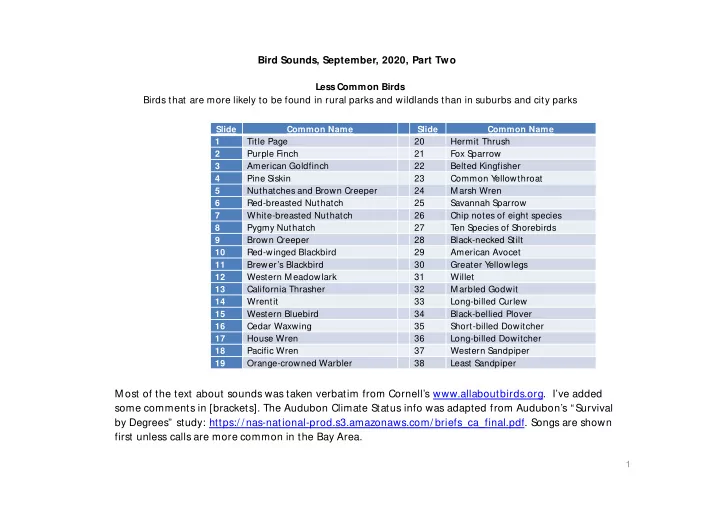
Less Common Birds Birds that are more likely to be found in rural parks and wildlands than in suburbs and city parks
1 Slide Common Name Slide Common Name 1 Title Page 20 Hermit Thrush 2 Purple Finch 21 Fox Sparrow 3 American Goldfinch 22 Belted Kingfisher 4 Pine Siskin 23 Common Y ellowthroat 5 Nuthatches and Brown Creeper 24 Marsh Wren 6 Red-breasted Nuthatch 25 Savannah Sparrow 7 White-breasted Nuthatch 26 Chip notes of eight species 8 Pygmy Nuthatch 27 T en Species of Shorebirds 9 Brown Creeper 28 Black-necked Stilt 10 Red-winged Blackbird 29 American Avocet 11 Brewer’s Blackbird 30 Greater Y ellowlegs 12 Western Meadowlark 31 Willet 13 California Thrasher 32 Marbled Godwit 14 Wrentit 33 Long-billed Curlew 15 Western Bluebird 34 Black-bellied Plover 16 Cedar Waxwing 35 Short-billed Dowitcher 17 House Wren 36 Long-billed Dowitcher 18 Pacific Wren 37 Western Sandpiper 19 Orange-crowned Warbler 38 Least Sandpiper
Most of the text about sounds was taken verbatim from Cornell’s www.allaboutbirds.org. I’ve added some comments in [brackets]. The Audubon Climate Status info was adapted from Audubon’s “Survival by Degrees” study: https:/ / nas-national-prod.s3.amazonaws.com/ briefs_ca_final.pdf. Songs are shown first unless calls are more common in the Bay Area. Bird Sounds, September, 2020, Part Two
SLIDE 2
Audubon climate status:
Purple Finch
Haemorhous purpureus
Y ear-round resident Fringillidae (Finches) Pieplow Guide Page No.:
Songs
Males sing three kinds of songs, all including the rich, slurred warbling characteristic of finch songs. There's the "warbling song," a fast, rising and falling string of 6-23 notes often sung while flocking. Males usually sing a "territory song" alone; it begins with a few notes on the same pitch before breaking into warbling and ending with a high, emphatic note. The third is an up-and-down cadence of 2-5 notes that sounds similar to a Red-eyed Vireo’s whistled hear-me?-see-me?-here-i-am. Females sing their own songs, a long 1-2 minute warbling from the nest.
Calls
Typical call note is a short, low tek.
Wendy Hogan, Macaulay Lib. Scott Martin, Macaulay Lib.
Family: 402 Moderately Vulnerable
6/ 25/ 2020 2
Bay Area Status: Male/ Female
SLIDE 3
Audubon climate status: American Goldfinch S pinus tristis Y ear-round resident Fringillidae (Finches) Pieplow Guide Page No.: Songs Males sing a long and variable series of twitters and warbles that can be several seconds long. The notes and phrases are variable and repeated in a seemingly random order. Birds continue to learn song patterns throughout life. Calls The American Goldfinch’s most common call is its contact call, often given in flight. It sounds like the bird is quietly saying po-ta-to-chip with a very even cadence. Birds sometimes give harsh threat calls when in feeding flocks or at the nest. Males make a tee-yee courtship call upon landing near a female in spring or early summer, often followed by a burst of song. Females brooding nestlings make a rapid sequence of high notes when they hear their mate approaching with food. Birds at their nest make a loud, two-parted bay-bee call if they feel threatened.
Adam Jackson, Macaulay Lib. Matt Davis, Macaulay Lib.
Family: 407 Moderately Vulnerable
6/ 25/ 2020 3
Bay Area Status: Male/ Female
SLIDE 4
Audubon climate status: Pine Siskin S pinus pinus Coast: Y ear-round resident Inland: Mainly winter Fringillidae (Finches) Pieplow Guide Page No.: Songs Males string together husky, whispering trills, slurs, and short ascending notes into songs lasting 3–13 seconds. Songs are generally more nasal or wheezy than those of other finches. Song phrases are sometimes punctuated by "watch-winding" or "churry" notes (see Calls Description). Adult males can continue to add songs to their repertoires. Calls Pine Siskin flocks are constantly atwitter with wheezy contact calls while feeding or in flight. Their most recognizable call is a "watch-winding" note, a harsh, upsweeping zreeeeeeet lasting most of a second, tossed in amidst shorter calls. They utter a distinctive flight call, an explosive zwee or psee that initiates startled flight. In flight, a tit-a-tit call often accompanies each flap-and-glide undulation. A single siskin can call back the flock with a solitary note. Females solicit copulation by uttering soft calls while bowing and fluttering tail and wing feathers. The female solicits feeding from the male with a low twittering call that carries well through the trees.
Douglas Faulder, Macaulay Lib.
Family: 406 Breeding T erritory Moderately Vulnerable
6/ 25/ 2020 4
Bay Area Status: Male/ Female
SLIDE 5
Red-breasted Nuthatch Pygmy Nuthatch Brown Creeper White-breasted Nuthatch
In Size Order, Largest to Smallest
5
SLIDE 6 Audubon climate status: Red-breasted Nuthatch S itta canadensis Resident but scarce in summer except in Oakland hills Sittidae (nuthatches) Pieplow Guide Page No.: Songs Red-breasted Nuthatches sing a fast series of nasal, hornlike notes that sound like yank-yank. Songs can have 6 or more of these notes each, and the songs themselves can be repeated up to 16 times per
- minute. It’s unmated males that sing this most frequently. M ales and females sometimes sing a similar
but slower and harsher version of this song when they are defending their territory. Calls The yank note can also be given as a call by both sexes (though more often by the male) as a way of communicating between the pair. This note can be sped up until it sounds like a vibrating trill, typically given from near the nest just at the end of nest excavation or beginning of egg-laying. During confrontations, chases or copulation, nuthatches may make a phew call, and agitated birds sometimes make a wrenlike scolding call.
Scott Martin, Macaulay Lib.
Family: 341 Moderately Vulnerable
6/ 25/ 2020 6
Bay Area Status: Adult Male
SLIDE 7 Audubon climate status: White-breasted Nuthatch S itta carolinensis Resident Sittidae (nuthatches) Pieplow Guide Page No.: Calls The White-breasted Nuthatch’s most common call is a loud, nasal yank often repeated a few times in a
- row. Both sexes make this call, and it often has a more trembling, almost bleating quality, than either the
bird’s song or the Red-breasted Nuthatch’s call. When looking for food, males and females exchange a soft yink. Songs Male White-breasted Nuthatches sing in late winter and spring, a rapid, nasal, fairly low-pitched wha- wha-wha that lasts 2-3 seconds. It’s made up of a half-dozen to a dozen nearly identical notes. M ales sing these songs at two rates, with the faster version packing in twice as many notes in the same amount of
- time. The fast version is thought to be the main one used for mate attraction.
Ryan Schain, Macaulay Lib.
Family: 342 Moderately Vulnerable
6/ 25/ 2020 7
Bay Area Status: Adult Male
SLIDE 8
Audubon climate status: Pygmy Nuthatch S itta pygmaea Resident Sittidae (nuthatches) Pieplow Guide Page No.: Calls The most frequent call is a shrill, staccato piping, sounding a bit like Morse code or a rubber ducky being repeatedly squeezed. Pygmy Nuthatches also have other calls, including titters and high-pitched trills, which combine in a large flock to create a steady, conversation-like chattering. Songs As in other nuthatch species, there is no concrete division between songs and calls. The Pygmy Nuthatch’s song is a continuous repetition of its “piping” call, lasting for more than 2 minutes.
Gordon Karre, Macaulay Lib.
Family: 345 Highly Vulnerable
6/ 25/ 2020 8
Bay Area Status: Adult
SLIDE 9 Audubon climate status: Brown Creeper Certhia americana Resident Certhiidae (treecreepers) Pieplow Guide Page No.: Songs Only the male sings, and usually only on the breeding grounds, though sometimes during migration as
- well. His song is a jumble of high (8 KHz), thin notes that lasts up to 1.5 seconds. It’s sometimes likened
to singing the phrase trees, beautiful trees. Creepers may join single songs together two or three times in a row. Although the delicate song carries well through the woods the thin, high notes can be easily missed. Calls Males and females make high, wavering call notes that sound like a small chain being dropped into a heap; these notes are noticeably longer than the very short call notes of many other birds. Creepers give these calls all year long and especially while foraging. Their calls can be hard to distinguish from the calls
- f Golden-crowned Kinglets. They use other variations of calls during flight, courtship chases, courtship
feeding rituals, and aggressive interactions.
David Turgeon, Macaulay Lib.
Family: 346 Moderately Vulnerable
6/ 25/ 2020 9
Bay Area Status: Adult
SLIDE 10 Audubon climate status: Red-winged Blackbird Agelaius phoeniceus Y ear-round but nomadic Icteridae (“ Troupials,” blackbirds,
Pieplow Guide Page No.: Songs The male Red-winged Blackbird’s conk-la-ree! is a classic sound of wetlands across the continent. The 1- second song starts with an abrupt note that turns into a musical trill. Males often sing from a high perch while leaning forward, drooping their wings, spreading their tail feathers, and fluffing their bright shoulder patches to show them off. Females give a very different song in response to a singing male, a series of three to five short chit or check notes. Calls The typical call of a Red-winged Blackbird is a distinctive, matter-of-fact check that’s fairly easy to
- recognize. Males and females make these calls all year round, in flight and while feeding, when
confronting rivals and to raise an alarm. They also give a more intense alarm call, a fast, scolding chak chak chak.
Steve Kelling, Macaulay Lib. David Trescak, Macaulay Lib.
Family: 470 Neutral
6/ 25/ 2020 10
Bay Area Status: Male (bicolored)/ Female
SLIDE 11 Audubon climate status: Brewer’s Blackbird Euphagus cyanocephalus Y ear-round Icteridae (“ Troupials,” blackbirds,
Pieplow Guide Page No.: Songs Both males and females sing two kinds of rather rudimentary songs. The first is a shrill, rising squee that lasts about 0.8 second, with a metallic sound. It’s reminiscent of the ree part of the Red-winged Blackbird’s conk-la-ree call. The second song is a nonmusical rushing gurgle, also lasting less than a second. Calls Brewer’s Blackbirds often make a tchup or chuk similar to the calls of other blackbirds, and used in a manner scientists have called “conversational in nature.” A more intense, slightly higher pitched version
- f this call is used as an alarm, to chase off intruders, and when carrying food for young. Males make a
clear, descending whistle, about 0.5 second long, when they sight hawks or large birds. Quarreling females chatter at each other with a kit-tit-tit-tit call.
Mark Ludwig, Macaulay Lib. Shawn Billerman, Macaulay Lib.
Family: 477 Neutral
6/ 25/ 2020 11
Bay Area Status: Male/ Female
SLIDE 12
Audubon climate status: Western M eadowlark S turnella neglecta Mainly winter (summer breeders in eastern parts of counties) Icteridae (blackbirds, “troupials”) Pieplow Guide Page No.: Songs Male Western Meadowlarks have a complex, two-phrase “primary” song that begins with 1–6 pure whistles and descends to a series of 1–5 gurgling warbles. Males develop a repertoire of up to a dozen songs, and may switch the songs they sing in response to an intruder. When chasing competing males or responsive females, male Western Meadowlarks give a hurried, excited “flight song” of short- spaced whistles and warbles. Although Western Meadowlarks seldom sing more than 10–12 songs, their eastern counterparts exhibit a much larger repertoire of 50–100 song variations. Calls The Western Meadowlark’s most common call is a low, bell-like pluk or chupp which they use when disturbed and during courtship and territorial displays. Female Western Meadowlarks also give a soft rattle during courtship and egg laying, as well as a low intensity tee-tee-tee when building the nest and laying eggs. For their first few weeks after leaving the nest, young birds give a simple, high-pitched location call, which is replaced by a weet note once the birds are independent. Adults use the weet note when migrating.
Susan Disher, Macaulay Lib.
Family: 473 Low Risk
6/ 25/ 2020 12
Bay Area Status: Adult
SLIDE 13 Audubon climate status: California Thrasher T
Y ear-round Mimidae (thrashers, mockingbirds) Pieplow Guide Page No.: Songs Males sing a series of twice-repeated phrases with 2–3 syllables each, usually with a sweet quality [Sweet? They always sound harsh and mechanical to me.], often including imitations of other bird species around them, including California Quail, Wrentit, California Scrub-Jay, Bewick’s Wren, Nuttall’s Woodpecker, Spotted T
- whee, and Lesser Goldfinch. Females sometimes join males in song, and their
songs are of similar type and volume. Calls Both sexes give a low chup call that is often heard, as well as a rising churreep and harsher chak.
Joan Tisdale, Macaulay Lib.
Family: 382 Vulnerable
6/ 25/ 2020 13
Bay Area Status: Adult
SLIDE 14
Audubon climate status: Wrentit Chamaea fasciata Y ear-round Silviidae (sylviid warblers) Pieplow Guide Page No.: Songs Wrentits sing a distinctive song reminiscent of a ball bouncing that lasts for about 4 seconds. In males this starts out as 3 to 5 pits followed by an accelerating trill; the ball bounces away. Females also sing but they catch the ball and sing only 3 to 14 pits without the accelerating trill. Both sexes sing at all hours of the day, all year long, although they are more vocal within the first hour after sunrise and early in the breeding season. Calls Wrentits give a churring call which sounds similar to someone rolling their r's. Wrentits give louder more emphatic calls when scolding a predator or intruder.
DigiBirdTrek, Macaulay Lib.
Family: 365 Vulnerable
6/ 25/ 2020 14
Bay Area Status: Adult
SLIDE 15
Audubon climate status: Western Bluebird S ialia mexicana Y ear-round resident Turdidae (thrushes) Pieplow Guide Page No.: Songs Western Bluebird songs tend to be a string of various call notes, particularly the kew note (sounds like a muffled sneeze) along with other stuttering or whistled notes. The result is a soft, hesitant song that can last 1-2 seconds. Calls The most common call is a soft, quavering kew that may be given from a perch or in flight and is often given several times in succession. They also make a harsher, double-noted che-check when changing position and a chattering call when disturbed. Other Sounds Western Bluebirds clap their bill mandibles together in aggressive situations, making a clicking sound.
Brooke Miller, Macaulay Lib. Erica Rutherford, Macaulay Lib.
Family: 368 Moderately to Highly Vulnerable
6/ 25/ 2020 15
Bay Area Status: Male/ Female
SLIDE 16
Audubon climate status: Cedar Waxwing Bombycilla cedrorum Winter resident Bombycillidae (waxwings) Pieplow Guide Page No.: Calls Cedar Waxwings have two common calls: a high-pitched, trilled bzeee and a sighing whistle, about a half- second long, often rising in pitch at the beginning. Cedar Waxwings call often, especially in flight. Songs None.
Ian Davies, Macaulay Lib.
Family: 390 Little Concern
6/ 25/ 2020 16
Bay Area Status: Adult
SLIDE 17 Audubon climate status: House Wren Troglodytes aedon Mainly summer; a few
Troglodytidae (wrens) Pieplow Guide Page No.: Songs Both males and females sing. Males often sing 9-11 times per minute during breeding season. Songs are a long, jumbled bubbling introduced by abrupt churrs and scolds and made up of 12-16 recognizable
- syllables. Females sing mainly in answer to their mates shortly after pairing up; their songs can include
high-pitched squeals unlike any sounds males make. Calls House Wrens make a variety of harsh sounds: churrs, chatters, rattles, and scolds, often in response to large animals that might be predators. For this reason, they can often be coaxed into view with squeaks
- r pishing sounds. [IM O, the most obvious call is what Pieplow terms “Beert.” It sounds like someone
blowing a “raspberry.” ] Other Sounds Adults may snap beaks softly while harassing predators near the nest.
Andy Witchger, Macaulay Lib.
Family: 349 Moderately Vulnerable
6/ 25/ 2020 17
Bay Area Status: Adult
SLIDE 18 Audubon climate status: Pacific Wren
Troglodytes pacificus
Y ear round Troglodytidae (wrens) Pieplow Guide Page No.: Songs Their song is a sweet series of tumbling, trilling notes with a staccato quality. Pacific Wrens have a large catalog of complex songs. M ales sing for 5 to 10 seconds, stringing together as many as 50 different
- phrases. They sing regularly during the breeding season from mid-April to August but irregularly during
the nonbreeding season. Calls M ale and female Pacific Wrens give one sharp check call similar to the call of a Wilson’s Warbler [which may be found in the same habitat].
Cameron Eckert, Macaulay Lib.
Family: 348 Low Vulnerability
6/ 25/ 2020 18
Bay Area Status: Adult
SLIDE 19 Audubon climate status: Orange-crowned Warbler
Leiothlypis celata
Y ear-round (but relatively few in winter) Parulidae (New World warblers) Pieplow Guide Page No.: Calls The Orange-crowned Warbler call is a simple, sharp, high-pitched chip, distinctive from that of other
- warblers. M ales and females give the call when foraging, and females call when flushed from the nest or
when the nest is threatened. Songs M ale Orange-crowned Warblers sing a trilling song of sweet, clear notes. The song can remain on a single pitch or it can rise slightly in the middle and end on a distinctive rising or falling note—chee chee chee
chew chew. The song pattern varies enough that individual males can be told apart by the version they
- sing. [Typically doesn’t sing in winter. Begins singing in late February.]
Blair Dudeck, M acaulay Lib.
Family: 492 Vulnerable on breeding grounds
6/ 25/ 2020 19
Bay Area Status: Adult
SLIDE 20
Audubon climate status: Hermit Thrush
Catharus guttatus
Winter resident Turdidae (thrushes) Pieplow Guide Page No.: Calls The Hermit Thrush's most frequently heard call is a low-pitched tchup or quoit to signal attack or escape and a Cedar Waxwing-like eeee when in danger. Adults may tell their young to stay still with a two-syllable chuck and lisp. Songs The Hermit Thrush’s beautiful, haunting song begins with a sustained whistle and ends with softer, echo-like tones, described as oh, holy holy, ah, purity purity eeh, sweetly sweetly. It pauses between each phrase, and the song is about 1.5 seconds long. Hermit Thrushes also deliver an extremely faint “whisper song” in spring. Other Sounds During territorial displays Hermit Thrushes may snap their bills loudly or make a whistling sound with their wings while in flight. Their feet can produce rattlesnake-like sounds as they scratch in vegetation for food.
Yves Gauthier, Macaulay Lib.
Family: 373 Highly Vulnerable (breeding habitat)
6/ 25/ 2020 20
Bay Area Status: Adult
SLIDE 21 Audubon climate status: Fox Sparrow
Passerella iliaca
Winter resident Passerellidae (sparrows) Pieplow Guide Page No.: Calls When fighting over territory or when a human approaches the nest, Fox Sparrows give smack calls (which vary from population to population). Their other calls include chu-chu calls and sip calls. Songs M ale Fox Sparrows sing a sequence of about a dozen rich, whistled notes lasting 2–3 seconds in all, usually from a concealed perch a few feet from the top of a spruce or fir tree. During summer they sing vigorously at any time from before dawn until long after dark, in fair weather or foul. Northern and eastern populations of Fox Sparrows sing one or two song types each, while western populations sing three or four. Western songs tend to be less rich and more burry than eastern songs. The female
- ccasionally sings a softer, briefer version of the male’s song.
Joshua Rudolph, Macaulay Lib.
Family: 455 Highly Vulnerable (breeding habitat)
6/ 25/ 2020 21
Bay Area Status: Adult (“Sooty” subspecies)
SLIDE 22 Audubon climate status: Belted Kingfisher
Megaceryle alcyon
Y ear-round Alcedinidae (Kingfishers) Pieplow Guide Page No.: Calls M ale and female Belted Kingfishers give strident, mechanical rattles [that sound somewhat like Nuttall’s Woodpecker] in response to the slightest disturbance. When threatened they may give screams, which males sometimes combine with harsh calls. Songs None.
- S. K. Jones, Macaulay Lib.
Family: 232 Neutral
6/ 25/ 2020 22
Bay Area Status:
Ilya Povalyaev , Macaulay Lib.
M ale/ Female
SLIDE 23
Audubon climate status: Common Y ellowthroat Geothlypis trichas Y ear-round Parulidae (new world warblers) Pieplow Guide Page No.: Songs The male sings a distinctive witchety-witchety-witchety song, about 2 seconds long, to defend the territory and attract females. They give these songs very frequently during summer, averaging as high as 125 songs per hour and sometimes reaching 300 songs per hour. [In spite of this common description of Y ellowthroat song, the song is a musical whistle and does NOT sound mechanical or “ratchety.” ] Calls Both males and females give a strong chuck when potential predators approach. M ales give an aggressive chatter call when other males are singing, and females give a fast series of chipping notes when they’re ready to mate.
David Turgeon, Macaulay Lib.
Family: 498 Neutral
6/ 25/ 2020 23
Bay Area Status:
Ryan Schain, Macaulay Lib.
M ale/ Female
SLIDE 24
Audubon climate status: M arsh Wren Cistothorus palustris Y ear-round Troglodytidae (wrens) Pieplow Guide Page No.: Songs M ales sing a rapid series of gurgling and buzzy trills. Though each note may only last for 1–2 seconds, they can carry on for up to 20 minutes, hardly ever repeating the same note. M ales in the eastern United States sing a more liquid and less harsh song than males in the West. Eastern males begin each song with a nasal buzz, whereas western males begin with a sharp chuck. Western males also have a more complex set of vocalizations. [Occasionally sings in winter. Singing increases late Jan. – Feb.] Calls M ales and females call to alert each other of danger and to indicate their location. The call is a grating, somewhat buzzy chit. In flight, males and females give a longer series of nasal calls.
Tony Varela, Macaulay Lib.
Family: 354 Low Vulnerability
6/ 25/ 2020 24
Bay Area Status: Adult
SLIDE 25
Audubon climate status: Savannah Sparrow Passerculus sandwichensis Y ear-round Passerellidae (New World sparrows) Pieplow Guide Page No.: Calls Like many grassland sparrows, this species uses short chip notes when alarmed, warding off intruders, or approaching its nest. A typical chip note is a soft, hissing tss. Songs During breeding season, the male sings a three-part song that lasts 2 to 3 seconds: opening with a few quick notes; then a high, thin, insect-like buzzy middle; and ending with a quick lower trill. [Singing begins in spring.]
Kirk Swenson, Macaulay Lib.
Family: 461 Highly Vulnerable on Breeding Grounds
6/ 25/ 2020 25
Bay Area Status: Adult
SLIDE 26
Chip Notes of Birds in this Class
Species Winter Habitat Chip Warblers Y ellow-rumped Warbler Anywhere, especially in eucalyptus Sharp, medium-pitched (5 KHz), clean Orange-crowned Warbler M ixed shrubs and woodland Quick, higher-pitched than Y ellow-rump (8 KHz) Common Y ellowthroat Reeds or other vegetation near water Lower pitched (4 KHz), harsh, raspy Other Species Hermit Thrush Almost anywhere (parks, yards) “Chup, chup-chup” given frequently Fox Sparrow Prefers shady, thick plant covering Somewhat like Y ellowthroat; harsh “smack” Pacific Wren M oist, shady Quick, medium-pitched (4-5 KHz), somewhat harsh Song Sparrow Anywhere with shrubs (parks, yards) “Chimp” sounds like tiny dog bark Savannah Sparrow Grasslands or salt marshes High-pitched (9 KHz), quick, clean “tick” 26
SLIDE 27
Source of population percentages: Abundance and Distribution of Wintering Shorebirds in San Francisco Bay, 1990-2008: Population Change and Informing Future M onitoring; PRBO, Oct. 13, 2010 Least Sandpiper, 6.0”, 11%
Ten Species Constitute 74% of the SF Bay Shorebird Population Birds Shown in Order by Length (Bill to T ail) Percentages are percent of total SF Bay shorebird population
Western Sandpiper, 6.5”, 30% Black-bellied Plover, 11.5”, 4% Short-billed Dowitcher, 11”, 6% Greater Yellowlegs, 14”, 0% Black-necked Stilt, 14”, 1% American Avocet, 18”, 9% Willet, 15”, 7% M arbled Godwit, 18”, 5% Long-billed Curlew, 23”, 1%
27
SLIDE 28 Audubon climate status: Black-necked Stilt Himantopus mexicanus Y ear-round Recurvirostridae (stilts, avocets) Pieplow Guide Page No.: Calls Very vocal [unlike American Avocet]. M ost calls are sharp [harsh-sounding] and rather high- pitched, yap, keek, or similar, sometimes doubled and often given in series when
- alarmed. Quieter versions of the call, heard
between adults and young, serve as contact calls. Songs None.
Dorian Anderson, M acaulay Lib.
Family: 127 Neutral
6/ 25/ 2020 28
Bay Area Status:
Christian Fernandez, Macaulay Lib.
In flight, its long pink legs stick out far beyond the tail. Note black wings and a white V on the back (not visible in these photos). Adult M ale (female slightly duller)
SLIDE 29
Audubon climate status: American Avocet Recurvirostra americana Y ear-round Recurvirostridae (stilts, avocets) Pieplow Guide Page No.: Calls The call of male and female American Avocets is a repeated, high-pitched kleet. They are generally silent, calling only when disturbed.
Joel S trong, Macaulay Lib.
Family: 128 Neutral
6/ 25/ 2020 29
Bay Area Status:
Paul Fenwick, M acaulay Lib.
Breeding/ Non-breeding or Imm.
Darren Clark, M acaulay Lib.
Note distinctive black & white pattern in flight.
SLIDE 30
Audubon climate status: Greater Y ellowlegs Tringa melanoleuca “Winter” resident (shorebirds begin arriving in July) Scolopacidae (sandpipers and allies) Pieplow Guide Page No.: Calls The typical call of the Greater Y ellowlegs is a clear, ringing tew tew tew, given in sequences of three or more (sometimes described as if the bird is saying its name: "yel-low-legs"). During the male’s elaborate courting display, he gives an insistent tuu-whee tuu-whee yodel that is rarely heard away from the breeding grounds. Songs Song a repeated, rolling kee-lee-wee.
Jay M cGowan, M acaulay Lib.
Family: 152 Neutral
6/ 25/ 2020 30
Bay Area Status:
William L. Newton, Macaulay Lib.
Breeding/ Non-breeding
Frank King, Macaulay Lib.
Tall, slender bird. In flight note white rump, plain wings.
SLIDE 31 Audubon climate status: Willet Tringa semipalmata “Winter” resident (shorebirds begin arriving in July) Scolopacidae (sandpipers and allies) Pieplow Guide Page No.: Calls Willets make a kyah-yah call when crossing another’s territory or as a way to maintain contact during migratory flights and when shuttling between foraging and breeding areas [note that this is the most commonly heard call in winter]. When approached, Willets may react with high-pitched, agitated kip-kip-kip, wiek, and kreeliii alarm calls. Songs In springtime, the Willet’s signature pill-will-willet call rings out over its breeding territory in the morning and evening, with competing males calling throughout the day. Eastern Willets give a slightly higher-pitched, more rapidly repeated version of the song than Western birds.
Dorian Anderson, M acaulay Lib.
Family: 152 Neutral
6/ 25/ 2020 31
Bay Area Status:
Allee Forsberg, Macaulay Lib.
Large, plain gray bird with striking black & white wing
dark tail.
Brian L. Sullivan, Macaulay Lib.
Breeding/ Non-breeding
SLIDE 32 Audubon climate status: M arbled Godwit Limosa fedoa “Winter” resident (shorebirds begin arriving in July) Scolopacidae (sandpipers and allies) Pieplow Guide Page No.: Calls On the breeding grounds, males give a ger-whit
- ften during display flights, but also from the
- ground. M ales and females also give a rad-i-ca
call on the breeding grounds, especially during
- courtship. On the nonbreeding grounds, males
and females give a nasal call that sounds a bit like they are laughing.
Jeff Timmons, Macaulay Lib.
Family: 139 Neutral
6/ 25/ 2020 32
Bay Area Status:
Frank Lehman, M acaulay Lib. Dorian Anderson, M acaulay Lib.
Large bird with broad wings. Cinnamon pattern on upper primaries and underwings. Breeding/ Non-breeding
SLIDE 33 Audubon climate status: Long-billed Curlew Numenius americanus “Winter” resident (shorebirds begin arriving in July) Scolopacidae (sandpipers and allies) Pieplow Guide Page No.: Calls The alarm and contact call of male and female Long-billed Curlews is a harsh whistled cur-lee [i.e. cur-lew], rising on second note; given year-
- round. They also give a rapid whistled tremolo
with a slight stuttering quality to it. Song [breeding season only] Song starts with a low whistled prreee and builds into a louder prprprprpr prrreeep prrreeep prrreeerr.
Ian Davies, Macaulay Lib.
Family: 136 Vulnerable on breeding grounds
6/ 25/ 2020 33
Bay Area Status:
Chris McReedy, Macaulay Lib.
Adult Large bird with enormous bill. In flight, wings broad and rounded. Rusty patches on upper flight feathers. Underwing cinnamon-colored.
SLIDE 34 Audubon climate status: Black-bellied Plover Pluvialis squatarola “Winter” resident (shorebirds begin arriving in July) Charadriidae (plovers and lapwings) Pieplow Guide Page No.: Calls The most commonly heard call is the mellow, mournful- sounding flight call, a far-carrying pleeoooee, falling and then rising in tone. M ales give a piping trill when landing after the aerial display, and males in conflict utter a harsh kleeeeerr. Adults disturbed at the nest give a variety of threat and alarm calls. Songs [breeding only] Males sing a burry but musical kooodleeooo while displaying, similar to songs of golden-plovers.
Dorian Anderson, Macaulay Lib.
Family: 135 Neutral
6/ 25/ 2020 34
Bay Area Status:
Roy Netherton, Macaulay Lib.
Breeding Nonbreeding
Davey Walters, Macaulay Lib.
In flight, all ages show distinctive black
white tail.
SLIDE 35 Audubon climate status: Short-billed Dowitcher Limnodromus griseus “Winter” resident (shorebirds begin arriving in July) Scolopacidae (sandpipers and allies) Pieplow Guide Page No.: Calls The most commonly heard call from all three subspecies is a distinctive, soft tu-tu-tu, very unlike the high keek of Long-billed Dowitcher and more similar to the more strident call of Greater Y
billed Dowitchers are generally silent on the ground, i.e., when feeding, unlike Long-billed, which are vocal while feeding. Short-bills are vocal when they fly.] Songs [Generally does not sing outside of breeding season.] The three subspecies have somewhat similar trilling or grating songs, a series of rising and falling phrases that repeat themselves with varying length and emphasis.
Joshua Haas, Macaulay Lib.
Family: 148 Vulnerable
6/ 25/ 2020 35
Bay Area Status:
Tom Edell, Macaulay Lib.
Breeding/ Non-breeding
SLIDE 36 Audubon climate status: Long-billed Dowitcher Limnodromus scolopaceus “Winter” resident (shorebirds begin arriving in July) Scolopacidae (sandpipers and allies) Pieplow Guide Page No.: Calls Diagnostic call is a quick, high-pitched keek, sometimes given several times in succession. A feeding flock
- ften calls incessantly but softly (Short-billed flocks do not), sounding almost like an excited group of
woodland birds. Less often heard is a quiet tu, which can also be given in series and superficially resembles call of Short-billed. Songs [Sings only during breeding season.] Males sing a complex series of piping phrases such as peet-peet; pee-ter-wee-too, lasting about 1.5 seconds.
Tyler Ficker, Macaulay Lib.
Family: 148 Vulnerable
6/ 25/ 2020 36
Bay Area Status:
Caroline Lambert, Macaulay Lib.
White “rump” extends halfway up back on both Dowitcher species Breeding/ Non-breeding
SLIDE 37 Audubon climate status: Western Sandpiper Calidris mauri “Winter” resident (shorebirds begin arriving in July) Scolopacidae (sandpipers and allies) Pieplow Guide Page No.: Calls A harsh jeet is the most commonly heard call, usually from flying or feeding birds. They make various distress, alarm, and contact calls mostly
Songs [breeding season only] Displaying males sing a brief song that begins with a high, thin, rising te-e-e-e-e tweer-tweer-
tweer and closes with a falling, buzzy trill.
Thomas Barbin, Macaulay Lib.
Family: 147 Neutral (winter)
6/ 25/ 2020 37
Bay Area Status:
Patrick Maurice, Macaulay Lib. Logan Lalonde, Macaulay Lib.
Small bird. Short, dark wings. White line extends toward outer wing. Western and Least difficult to distinguish in flight. Breeding/ Non-breeding
SLIDE 38
Audubon climate status:
Least Sandpiper
Calidris minutilla “Winter” resident (shorebirds begin arriving in July) Scolopacidae (sandpipers and allies) Pieplow Guide Page No.:
Calls
Outside of the breeding season, Least Sandpipers give a high-pitched creep call. They also give loud trills as part of predator distraction displays, as well as thin seeet alarm calls.
Songs
On the breeding grounds, Least Sandpipers make a songlike sequence of rich trills and high notes, sung by males (and sometimes females).
Evan Lipton, Macaulay Lib.
Family: 146 Neutral (winter)
6/ 25/ 2020 38
Bay Area Status:
Ian Davies, Macaulay Lib. Brooke Miller, Macaulay Lib.
Small bird. Short, dark wings. White line extends toward outer wing. Western and Least difficult to distinguish in flight. Breeding/ Non-breeding