Washington County Chamber of Commerce Nuclear Energy in the - - PowerPoint PPT Presentation

washington county chamber of commerce nuclear energy in
SMART_READER_LITE
LIVE PREVIEW

Washington County Chamber of Commerce Nuclear Energy in the - - PowerPoint PPT Presentation

Washington County Chamber of Commerce Nuclear Energy in the Commonwealth CLARK HILLS ENERGY PRACTICE Our clients come from many segments of the energy sector, r, start rting with large energy users, s, including: HEAVY EQUIPMENT


slide-1
SLIDE 1

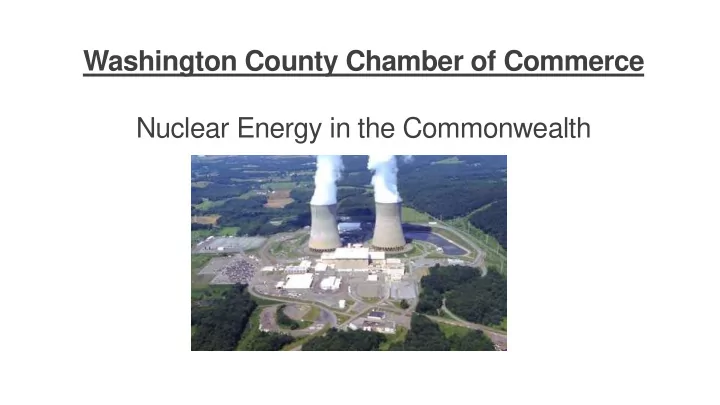
Washington County Chamber of Commerce Nuclear Energy in the Commonwealth

slide-2
SLIDE 2

Our clients come from many segments of the energy sector, r, start rting with large energy users, s, including:

CLARK HILL’S ENERGY PRACTICE

HEAVY EQUIPMENT M ANUFACTURERS

TECHNOLOGY COM PANIES

DATA CENTERS

UNIVERSITIES

MUNICIPALITIES

OFFICE PARKS

MEDICAL FACILITIES

ONLINE RETAILERS

BRICK-AND-MORTAR RETAILERS

WAREHOUSE FACILITIES

MINING

WATER TREATMENT FACILITIES

AIRLINESAND AIRPORTS

STEEL AND CAST IRON MANUFACTURERS

PAPER MILLS

REFINERIESAND CHEMICAL PLANTS

MUSEUMS

OFFICE BUILDINGS

FOOD MANUFACTURERS

CASINOS

PHARM ACEUTICAL COM PANIES

NON-PROFIT AND RELIGIOUSINSTITUTIONS

2

slide-3
SLIDE 3

CLARK HILL’S ENERGY PRACTICE

In addition to our years of experience advising individual large energy users and coalitions of large energy users, we also have extensive experience working with:

  • Energy developers
  • Lenders and investors
  • Power producers (wind, solar, biogas, nuclear, and fossil fuel)
  • Transmission companies
  • Alternative energy suppliers
  • M unicipal utilities
  • Rural electric cooperatives
  • Retail electric providers

3

slide-4
SLIDE 4

MARCELLUSCOALITION.ORG | @MARCELLUSGAS

Member driven organization representing companies involved in all segments of the Natural Gas Industry

  • Unconventional Exploration and Production
  • Midstream and Pipeline
  • Utility and End Use
  • Industry related: Engineering, Law, Construction, Site Reclamation, Geotechnical,

etc. How do we represent our members?

  • Technical, Regulatory and Government Affairs
  • Advocacy and Communications

4

Who We Are

slide-5
SLIDE 5

MARCELLUSCOALITION.ORG | @MARCELLUSGAS

Our Membership

  • 200+ diverse members
  • Producers, midstream and suppliers

Our Focus

  • Long-term development
  • End use opportunities
  • Addressing landowner and

public issues

  • Maximizing benefits to secure our

region’s energy future

Associate Members are an integral part of the MSC and the industry's robust supply chain. More than 95% of the natural gas in Pennsylvania is produced by MSC member companies. The MSC Board

  • f Directors

consists of 34 major producer and midstream companies in the Appalachian Basin.

About MSC

5

slide-6
SLIDE 6

Industrial Energy Consumers of

  • f Pennsylvania

IECPA is a trade organization formed in 1982 by large, energy-intensive customers with

  • ne or more facilities in the Commonwealth of Pennsylvania. IECPA regularly monitors

Public Utility Commission (PUC) activities, participates in the PUC regulatory process, and participates in the legislative process at the General Assembly on matters impacting large energy users. IECPA plays a critical role in shaping energy policy in the Commonwealth of Pennsylvania for all consumers, especially large energy-intensive businesses and industry. IECPA is the recognized voice of large energy consumers in Pennsylvania and played a critical role in the restructuring of both the electric and natural gas industries as well as the enactment of distribution system improvement legislation (DSIC). IECPA supports and promotes competitive energy markets and regulatory structures that facilitate consumers’ use of these markets. Where competitive supply conditions do not exist, IECPA supports regulated monopoly service rates that are based on cost of service principles that reflect the embedded costs of serving individual customer classes.

IE CPA

INDUSTRIAL ENERGYCONSUM ERSOF PENNSYL VANIA

6

slide-7
SLIDE 7

Industrial Energy Consumers of

  • f Pennsylvania

Background

Electricity Generation Customer Choice and Competition Act of 1996

 Restructured electric power industry  Retail choice for power effectuated

"Restructuring" Cases for Each M ajor Electric Utility

 "stranded cost" recovery awarded for utility power plants in the

billions of dollars to offset projected market losses

 Included payments to PECO and FirstEnergy for their nuclear plants  Costs recovered from all ratepayers until expiration of each utility's

rate cap (last rate caps expired December 31, 2010)

7

slide-8
SLIDE 8

Industrial Energy Consumers of

  • f Pennsylvania

Background

Alternative Energy Portfolio Standards Act of 2004 ("AEPS")

 Intended to create competitive market for renewables  Paid for by customers to this day

Tiers 1 and 2 address:

 Tier 1: Wind, solar, biomass (8%)  Tier 2: Waste coal, waste-to-energy, hydro, etc. (10%)

Percentage of electricity sold up to 18% by 2021

8

slide-9
SLIDE 9

Industrial Energy Consumers of

  • f Pennsylvania

Background

Source: PJM Independent M arket M onitor

9

slide-10
SLIDE 10

Industrial Energy Consumers of

  • f Pennsylvania

House Bill 11 & Senate Bill 510

Creates a new Tier III AEPS category

 50% of all electricity sold in the Commonwealth  Defined in such a way to insure this requirement is fulfilled by nuclear

power (in or out-of-state)

Creates a program to establish new capacity payments

 Allow alternative energy systems (including nuclear) to opt out of the P

JM capacity market

 Establishes a new capacity charge for these units with cost collected from

all customers

Charges and cost collected by distribution utilities:

 Approx. $500 million annual cost  $2.5 to $3.3 billion over the first 6 years

10

slide-11
SLIDE 11

MARCELLUSCOALITION.ORG | @MARCELLUSGAS

Why not…

  • Successful bailouts in Illinois, New York & New Jersey

Consumer costs are too low…corporate profits not high enough

  • Low natural gas prices to blame

Asset sale

  • Beaver Valley – First Energy Solutions

Uneconomic unit

  • Three Mile Island

11

Nuclear Bailout? Why?!

slide-12
SLIDE 12

MARCELLUSCOALITION.ORG | @MARCELLUSGAS

Wholesale electric prices down 41% since 2008 Natural gas prices for end-use customers down 54% - 73% since 2008 Average annual savings > $1,200 per household

12

Benefiting Consumers

Lower Prices = Customer Savings

slide-13
SLIDE 13

MARCELLUSCOALITION.ORG | @MARCELLUSGAS

Increased cost to consumers Government interference in marketplace

  • 68% of electric generation

mandated

Jobs & capital investment to PA

  • $13 Billion+ in private capital

investment just for power generation

Significantly reduced downstream opportunities for end use of natural gas Loss of diversity in portfolio

13

The Risk

slide-14
SLIDE 14

Industrial Energy Consumers of

  • f Pennsylvania

Impacts of Nuclear Bailout

14

slide-15
SLIDE 15

Industrial Energy Consumers of

  • f Pennsylvania

Impacts of Nuclear Bailout

Skews the market

 Picks a fuel source winner for P

A with impacts on other power sources in the market

 Totally undermines purpose of opening up retail electric power market in

1996

Undermines the purpose of the AEPS Act

 To create competition-based incentives for renewable energy sources  To incentivize new renewable energy development, not to pay for existing

zero-emissions plants

15

slide-16
SLIDE 16

Industrial Energy Consumers of

  • f Pennsylvania

Impacts of Nuclear Bailout

Not about fixing a reliability problem

 P

JM Interconnection, the regional transmission organization that coordinates the movement of wholesale electricity in all or parts of 13 states, including Pennsylvania, has confirmed that the electricity grid will remain reliable and resilient, even with the planned closure of the plants in our nuclear fleet that are not cost-efficient.

 Pennsylvania’s competitive markets are driving private investment in the

growth of renewables as well as 16 new natural gas power plants in

  • peration or currently under construction in the state. These new plants

alone will generate nearly 15,000 megawatts of power.

Will provide billions of dollars to the already profitable nuclear power industry.

16

slide-17
SLIDE 17

Industrial Energy Consumers of

  • f Pennsylvania

Impacts of Nuclear Bailout

Places Pennsylvania business & manufacturing jobs at risk

 Establish a charge of approx. $3.04 per M Wh to $3.95 per M Wh on top of

the price for power available to customers in the market.

 The closure of a higher cost, inefficient nuclear facility will not result in

energy market price increases.

Creates an artificial cost on carbon just on Pennsylvania utility customers

 There has not been a universal market cost (nationally or internationally)

placed on carbon dioxide.

17

slide-18
SLIDE 18

Industrial Energy Consumers of

  • f Pennsylvania

Proponents:

  • Exelon (TM I, et al.)
  • FirstEnergy (Beaver Valley; see Ohio)
  • Unions, Governor Ridge, P

A Rural Electric Association, Politicians with plants in district, Nuclear Energy Caucus Opponents:

  • Ratepayer interests: IECP

A, PECA, OCA, OSBA

  • Industry interests: P

A Chamber, P A Coal Alliance, American Petroleum Institute, M arcellus Shale Coalition

  • M arket interests: P

JM , GT Power, PPL

  • Others: AARP

, Commissioner Place, Citizens Against Nuclear Bailout

Key Players

18

slide-19
SLIDE 19

MARCELLUSCOALITION.ORG | @MARCELLUSGAS 19

Source: PA Department of Environmental Protection – Energy Assessment Report

PA: A Balanced Portfolio

slide-20
SLIDE 20

MARCELLUSCOALITION.ORG | @MARCELLUSGAS 20

Source: M SC Analysis of Proposed Legislation Amending AEPSAct

Dictating PA’s Energy Portfolio

slide-21
SLIDE 21

Industrial Energy Consumers of

  • f Pennsylvania
  • Highly unlikely to pass the bills in their current form
  • Exelon has announced the shut down of TM I
  • Senate Bill 600 to "M odernize" AEPS

 Increase Tier 1 to 30% by 2030

  • Governor Wolf State Climate Action Plan

 Boost renewables  Craft carbon cap-and-trade policy  "Save" nuclear power plants (Gov. Wolf says he's neutral on bailout bill…

for now)

 Includes joining the USClimate Alliance

Risk: Potential teaming of renewable and nuclear interests could be a powerful tandem that results in a ‘deal’ being included in the legislative budget process.

Current Status

21

slide-22
SLIDE 22

Industrial Energy Consumers of

  • f Pennsylvania

Signed into law on October 15, 2008, P A Act 129 requires P A Public Utility Commission to develop an Energy Efficiency and Conservation Program (EE&C Program) for electric distribution companies serving >100,000 customers. Utilities are required to achieve electric demand and electric consumption reductions as stated by the law. Utilities manage programs to reduce consumption and demand by collecting money through a monthly EE&C Program surcharge and then using this money to issue grants to utility customers to implement energy efficiency projects. We are currently in Phase 3

  • f the program:

Phase 1 6/ 1/ 09 – 5/ 31/ 13 Phase 2 6/ 1/ 13 – 5/ 31/ 16 Phase 3 6/ 1/ 16 – 5/ 31/ 21

Other Issues – EE&C Program

22

slide-23
SLIDE 23

Industrial Energy Consumers of

  • f Pennsylvania
  • Each EDC files an EE&C Surcharge reconciliation for a calendar year from April through M arch

during the Phase 3 program period. These filings are generally subject to review and audit by the Commission’s Bureau of Audits and are not actively litigated proceedings.

  • Each EDC made such a filing on April 30, 2019, for the period April 1, 2018, through M arch 31,

2019.

  • The cumulative totals represented by the reconciliation filings indicate that the seven EDC’s

recovered about $223 million over that 12-month reconciliation period, with about $53 million of that recovered from customers classified as “ Industrial.”

  • The cumulative totals represented by the rate change filings indicate that the EDCs intend to

collect about $245 million for the 12-month period (June 2019 through M ay 2020), and of that, about $62 million is targeted to be recovered from customers classified as Industrial.

  • For all of the EDCs except PPL and West Penn, large users will see a rate increase pursuant to

these filings; some of those increases are significant on a relative basis.

Other Issues – EE&C Program

23

slide-24
SLIDE 24

Industrial Energy Consumers of

  • f Pennsylvania
slide-25
SLIDE 25

Industrial Energy Consumers of

  • f Pennsylvania

Why should my company join IECPA…

IECP A is the voice representing the interest of large energy users.

There is significant benefit in getting advanced notice of time sensitive matters.

Regulatory and energy policy issues can be complicated with many nuances. IECP A takes positions that reflect the benefit of its members. If you are not a member, your specific concerns or needs may not be addressed.

IECP A provides member companies with current business, regulatory, and legislative information that can directly affect your bottom line.

Problems come from unmitigated risk. IECP A helps identify the risk and implement strategies to address these risk.

There is greater strength in numbers. Legislators and regulators pay attention when we can show the

  • verall economic impact that our members have on the Commonwealth of Pennsylvania.

IECP A needs a strong membership in order to remain a viable voice. Y

  • u just can’t depend on “others

will do it”.

IE CPA

INDUSTRIAL ENERGYCONSUM ERSOF PENNSYL VANIA

slide-26
SLIDE 26

Industrial Energy Consumers of

  • f Pennsylvania

Rod Williamson, Executive Director rwilliamson@clarkhill.com 910-444-8883 www.IECP A-Energy.org

slide-27
SLIDE 27

MARCELLUSCOALITION.ORG | @MARCELLUSGAS

Washington County Chamber

Thank you! David J. Spigelmyer President Marcelluscoalition.org

27