LOS ANGELES CHAMBER LOS ANGELES CHAMBER ORCHESTRA ORCHESTRA Los - - PowerPoint PPT Presentation

los angeles chamber
SMART_READER_LITE
LIVE PREVIEW

LOS ANGELES CHAMBER LOS ANGELES CHAMBER ORCHESTRA ORCHESTRA Los - - PowerPoint PPT Presentation

LOS ANGELES CHAMBER LOS ANGELES CHAMBER ORCHESTRA ORCHESTRA Los Angeles Chamber Orchestra (LACO) was founded in 1968 as an artistic outlet for the recording industrys most talented musicians. LACO founders wanted to create an ensemble that


slide-1
SLIDE 1

LOS ANGELES CHAMBER ORCHESTRA

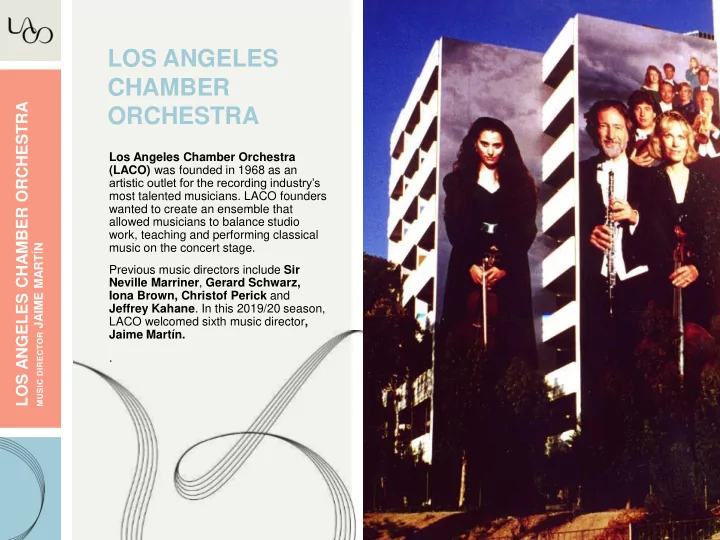
Los Angeles Chamber Orchestra (LACO) was founded in 1968 as an artistic outlet for the recording industry’s most talented musicians. LACO founders wanted to create an ensemble that allowed musicians to balance studio work, teaching and performing classical music on the concert stage. Previous music directors include Sir Neville Marriner, Gerard Schwarz, Iona Brown, Christof Perick and Jeffrey Kahane. In this 2019/20 season, LACO welcomed sixth music director, Jaime Martín. .

LOS ANGELES CHAMBER ORCHESTRA

MUSIC DIRECTOR JAIME MARTÍN

slide-2
SLIDE 2

LOS ANGELES CHAMBER ORCHESTRA

MUSIC DIRECTOR JAIME MARTÍN

MEET THE MUSIC

slide-3
SLIDE 3

RHYTHM TONE COLOR HARMONY

LOS ANGELES CHAMBER ORCHESTRA

MUSIC DIRECTOR JAIME MARTÍN

slide-4
SLIDE 4

A Beat is a steady, unaccented pulse.

When we put accents on certain beats, we create METER. Meter based on groups of 2 is called duple. Meter based on groups of 3 is called triple. Meter based on groups of 4 is called quadruple.

LOS ANGELES CHAMBER ORCHESTRA

MUSIC DIRECTOR JAIME MARTÍN

BEAT

slide-5
SLIDE 5

TIME

LOS ANGELES CHAMBER ORCHESTRA

MUSIC DIRECTOR JAIME MARTÍN

The time aspect of music has a number of important terms. Beat: the steady pulse that lies underneath most music Rhythm: a unique pattern of long and short notes that is unique to a particular song Accent: a heavier stress on a beat Meter: a repeating pattern of stressed and unstressed beats (common meters include duple and triple) Measure: one unit of stressed and unstressed beats in a meter

slide-6
SLIDE 6

LOS ANGELES CHAMBER ORCHESTRA

MUSIC DIRECTOR JAIME MARTÍN

Rhythms are made up of patterns of long and short beats. In traditional music notation (seen below), the quarter note gets 1 beat. The eighth notes are half a beat long.

1 Quarter note = 1 beat Long-Short-Short-Long-Long Short-Short-Short-Short-Long-Long

RHYTHM

2 Eighth notes = 1 beat

slide-7
SLIDE 7

LOS ANGELES CHAMBER ORCHESTRA

MUSIC DIRECTOR JAIME MARTÍN

Let’s try to perform some simple patterns using long and short sounds.

These examples are in duple meter. You can tell because of the number “2“ you see below. The vertical line in each example separates one group of two beats from another.

RHYTHM EXERCISES

slide-8
SLIDE 8

This is what the different meters look like in very simple notation:

LOS ANGELES CHAMBER ORCHESTRA

MUSIC DIRECTOR JAIME MARTÍN

Duple meter Triple meter Quadruple meter

METER

slide-9
SLIDE 9

KEEPING TIME

LOS ANGELES CHAMBER ORCHESTRA

MUSIC DIRECTOR JAIME MARTÍN

One of the best ways to keep time while performing rhythms is to conduct the

  • beats. In conducting, each beat is represented as a different point in space.

You can visually see where all the beats are when you conduct. We have three basic conducting patterns: patterns for two beats, three beats, and four beats.

slide-10
SLIDE 10

DUPLE METER

This is the pattern for a duple meter. With your right hand, swing down and slightly to the right and then back up. Like a backwards “J” or the shape of a

  • banana. Practice this movement.

LOS ANGELES CHAMBER ORCHESTRA

MUSIC DIRECTOR JAIME MARTÍN

Now try conducting this pattern along with a march by John Philip Sousa. The strong beat is the downbeat.

slide-11
SLIDE 11

TRIPLE METER

LOS ANGELES CHAMBER ORCHESTRA

MUSIC DIRECTOR JAIME MARTÍN

This is the pattern for a triple meter. With your right hand, place the first beat low and in front of you, the second off to the right, and the third traveling up in front of your

  • face. You’re making a triangle.

Practice this pattern. Now try conducting this pattern along with a waltz by Johann Strauss, Jr. The first beat gets the heaviest stress.

slide-12
SLIDE 12

QUADRUPLE METER

LOS ANGELES CHAMBER ORCHESTRA

MUSIC DIRECTOR JAIME MARTÍN

This is a quadruple pattern. With your right hand, place the first beat low and in front of

  • you. Beat 2 is off to the left. Cross over and

place beat 3 off to the right, and swing beat 4 up in front of your face. Practice this pattern. Try to keep the beat steady. Practice this quadruple pattern while listening to a rock song by The Beatles called “Hello Goodbye.”

slide-13
SLIDE 13

LOS ANGELES CHAMBER ORCHESTRA

MUSIC DIRECTOR JAIME MARTÍN

A conductor helps a large ensemble like an orchestra to stay together and express the emotion of the music together.

LACO Music Director Jaime Martín

slide-14
SLIDE 14

LOS ANGELES CHAMBER ORCHESTRA

MUSIC DIRECTOR JAIME MARTÍN

Rhythm is an important part of music, and it’s something we want you to notice about the music you hear in a concert. When you watch a concert, pay close attention to the conductor. You may see some of the patterns you just practiced, and you may see some variations of those patterns.

LACO Artist-Educator + Composer Derrick Spiva Jr.

slide-15
SLIDE 15

LOS ANGELES CHAMBER ORCHESTRA

MUSIC DIRECTOR JAIME MARTÍN

Rhythm is a vital part of music. We experience rhythm when we tap our feet, clap our hands, or dance. We already know a lot about rhythm because it’s just natural to us. Even babies move with music!

slide-16
SLIDE 16

LOS ANGELES CHAMBER ORCHESTRA

MUSIC DIRECTOR JAIME MARTÍN

Timbre (pronounced “tamber”) or tone color refers to the unique quality

  • f a particular sound. Just as you can recognize someone from their

voice, you can recognize an instrument by its timbre. Each musical instrument has a unique timbre or tone

  • color. Even if a trumpet and

a violin play the same note, you will be able to tell them apart because of their unique tone color.

TIMBRE

slide-17
SLIDE 17

LOS ANGELES CHAMBER ORCHESTRA

MUSIC DIRECTOR JAIME MARTÍN

Obviously, it’s much easier to hear tone color than to see it, but there are actual differences in the shapes of the soundwaves. Sound scientists can see these waves using special tools.

slide-18
SLIDE 18

LOS ANGELES CHAMBER ORCHESTRA

MUSIC DIRECTOR JAIME MARTÍN

What are the specific qualities that help you recognize these voices? Now that you understand the concept of tone color, let’s talk about musical instruments.

slide-19
SLIDE 19

LOS ANGELES CHAMBER ORCHESTRA

MUSIC DIRECTOR JAIME MARTÍN

There are four main musical instrument families. They’re grouped into these families based on what they’re made of and how they produce sound. Members of the San Francisco Youth Symphony playing instruments from two of these families. Can you name them?

MUSICAL INSTRUMENTS

slide-20
SLIDE 20

LOS ANGELES CHAMBER ORCHESTRA

MUSIC DIRECTOR JAIME MARTÍN

CAN YOU NAME SOME MEMBERS OF THE STRING FAMILY?

What do you think makes an instrument a member of the string family? What are they made of? How do you play them?

slide-21
SLIDE 21

LOS ANGELES CHAMBER ORCHESTRA

MUSIC DIRECTOR JAIME MARTÍN

THE STRING FAMILY

slide-22
SLIDE 22

LOS ANGELES CHAMBER ORCHESTRA

MUSIC DIRECTOR JAIME MARTÍN

CAN YOU NAME SOME MEMBERS OF THE WOODWIND FAMILY?

What do you think makes an instrument a member of the Woodwind family? What are they made of? How do you play them?

slide-23
SLIDE 23

LOS ANGELES CHAMBER ORCHESTRA

MUSIC DIRECTOR JAIME MARTÍN

THE WOODWIND FAMILY

slide-24
SLIDE 24

LOS ANGELES CHAMBER ORCHESTRA

MUSIC DIRECTOR JAIME MARTÍN

CAN YOU NAME SOME MEMBERS OF THE BRASS FAMILY?

What do you think makes an instrument a member of the Brass family? What are they made of? How do you play them?

slide-25
SLIDE 25

LOS ANGELES CHAMBER ORCHESTRA

MUSIC DIRECTOR JAIME MARTÍN

TU B A S O U S A P H O N E

THE BRASS FAMILY

slide-26
SLIDE 26

LOS ANGELES CHAMBER ORCHESTRA

MUSIC DIRECTOR JAIME MARTÍN

CAN YOU NAME SOME MEMBERS OF THE PERCUSSION FAMILY?

What do you think makes an instrument a member of the Percussion family? What are they made of? How do you play them?

slide-27
SLIDE 27

LOS ANGELES CHAMBER ORCHESTRA

MUSIC DIRECTOR JAIME MARTÍN

Some percussion instruments are unpitched, which means that they don’t play specific notes. Some are pitched, which means they play specific

  • notes. Looking at this sampling of percussion instruments, can you tell

which are unpitched and which are pitched?

THE PERCUSSION FAMILY

slide-28
SLIDE 28

LOS ANGELES CHAMBER ORCHESTRA

MUSIC DIRECTOR JAIME MARTÍN

Percussion instruments are commonly associated with rhythm, but it’s not necessary to have those instruments to feel the beat. You can feel the pulse in music without them at all.

slide-29
SLIDE 29

LOS ANGELES CHAMBER ORCHESTRA

MUSIC DIRECTOR JAIME MARTÍN

You’ve likely seen or even played a piano. It makes sound when a person plays a key and a hammer inside hits a string. Do you think it’s a string instrument or a percussion instrument? A harpsichord looks a little like a regular piano, but it makes sound a different way. The strings inside this keyboard are plucked by a mechanism that activates when you play a key.

slide-30
SLIDE 30

LOS ANGELES CHAMBER ORCHESTRA

MUSIC DIRECTOR JAIME MARTÍN

Just like a painter mixes color, a composer mixes different tone colors together to make new and interesting combinations.

“A parallel between color and music can only be relative – just as a violin can give warm shades of tone, so yellow has shades, which can be expressed by various instruments.”

  • Painter, Wassily Kandinsky
slide-31
SLIDE 31

LOS ANGELES CHAMBER ORCHESTRA

MUSIC DIRECTOR JAIME MARTÍN

How do we talk about tone color or timbre? What are some words we can use? What are some words that don’t describe timbre?

WORDS THAT DO DESCRIBE TIMBRE:

Rich Husky Breathy Light Resonant Piercing Bright Squeaky Clean Harsh Round Thick Nasal Raspy

WORDS THAT DON’T DESCRIBE TIMBRE:

High Low Loud Soft Fast Slow

slide-32
SLIDE 32

LOS ANGELES CHAMBER ORCHESTRA

MUSIC DIRECTOR JAIME MARTÍN

There are so many musical colors to appreciate!

“Art is harmony”

  • Painter, Georges Seurat
slide-33
SLIDE 33

LOS ANGELES CHAMBER ORCHESTRA

MUSIC DIRECTOR JAIME MARTÍN

Our third important musical quality is harmony. Harmony occurs when two

  • r more notes are played together. Notes can be played simultaneously or

in quick succession (one right after the other).

HARMONY

slide-34
SLIDE 34

LOS ANGELES CHAMBER ORCHESTRA

MUSIC DIRECTOR JAIME MARTÍN

Some instruments like the piano and guitar can create harmony by themselves because they can make more than one sound at a time. But many instruments are monophonic, which means that they can create only one sound at a time. Don’t worry! Those instruments can still make harmony, just with other instruments!

slide-35
SLIDE 35

LOS ANGELES CHAMBER ORCHESTRA

MUSIC DIRECTOR JAIME MARTÍN

When notes are played at the same time, sometimes they sound peaceful and pleasant. We call this type of harmony consonance.

Sometimes notes played at the same time sound agitated and

  • unpleasant. We call this type of

harmony dissonance.

slide-36
SLIDE 36

LOS ANGELES CHAMBER ORCHESTRA

MUSIC DIRECTOR JAIME MARTÍN

There are so many great things to learn about

  • music. We hope you’ve had fun learning about

RHYTHM, TIMBRE, and HARMONY! There are so many great things to learn about

  • music. We hope you’ve had fun learning about

RHYTHM, TIMBRE, and HARMONY!

slide-37
SLIDE 37

THANK YOU FROM LOS ANGELES CHAMBER ORCHESTRA!

LOS ANGELES CHAMBER ORCHESTRA

MUSIC DIRECTOR JAIME MARTÍN