walking for 2 nd -year students of architecture and engineering - - PowerPoint PPT Presentation

walking for 2 nd year students of architecture
SMART_READER_LITE
LIVE PREVIEW

walking for 2 nd -year students of architecture and engineering - - PowerPoint PPT Presentation

Royal Geographical Society, annual conference, 31 August 2017 A one-week transdisciplinary course on walking for 2 nd -year students of architecture and engineering Dominique von der Mhll, Derek P.T.H. Christie, Emmanuel Ravalet Urban


slide-1
SLIDE 1

Royal Geographical Society, annual conference, 31 August 2017

A one-week transdisciplinary course on walking for 2nd-year students of architecture and engineering

Dominique von der Mühll, Derek P.T.H. Christie, Emmanuel Ravalet

  • Laboratoire Chôros. Institut d’architecture & Laboratoire de sociologie urbaine (LaSUR)

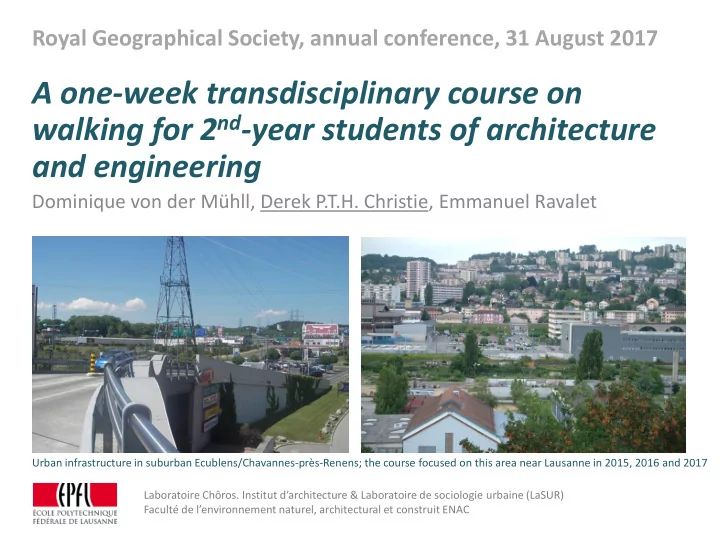
Faculté de l’environnement naturel, architectural et construit ENAC Urban infrastructure in suburban Ecublens/Chavannes-près-Renens; the course focused on this area near Lausanne in 2015, 2016 and 2017

slide-2
SLIDE 2
slide-3
SLIDE 3

When people think of walking…

Dominique von der Mühll_EPFL-ENAC-Chôros Cours « Mobilité durable et aménagements urbains » – Institut géographie et durabilité UNIL – 6 mars 2015

slide-4
SLIDE 4

They don’t usually think of this… Honestly, do you??

Ouest lausannois_Ecublens, Prilly, Crissier

slide-5
SLIDE 5

The study area: Western Lausanne – l’ouest lausannois

  • In central Lausanne, mode shares for walking are already very high (30-40%)
  • The highest potential is elsewhere!
  • Suburbian settings: high populations, jobs+++
  • Heterogeneous and complex territory
  • This is where the new city is emerging
  • Explore the potential for accessibility, proximity, urbanity, in peripheral areas

Source: Guichet cartographique du canton de Vaud – www.geo.vd.ch

slide-6
SLIDE 6

Pioneering a one-week interdisciplinary course on walking for 2nd-year students of architecture and engineering

Main points 1) The idea emerged from a more general one-week course on urban space, given by architect Dominique von der Mühll in 1999-2014. Her meeting the two other authors, who had an interest in walking research and practice, created a critical mass. 2) Led to the creation of a one-week interactive course including observation, field work, qualitative interviewing and statistical and spatial analysis. Given in 2015, 2016 and 2017. 3) Each year ~30 students (architecture, civil and environmental engineering) attended; assorted groups of 4-6 students were given pre-defined topics such as long-distance walking, access to and from the shopping centre, or the train station to campus commute (30 minutes, fast walking!) 4) Study area. Suburban territories are under-researched as regards walking -> choice of a complex and car-oriented study area around EPFL campus: 8.3 km2 with 23'000 inhabitants. 5) Interdisciplinary course management team: urban studies, geography, sociology, transportation science, mathematics, environmental science. A central core of 3 and 4 external teachers and consultants. 6) Evolution of the concept from 2015 to 2016 (confirmed in 2017). Members of a partner civil society organisation with specific sensory handicaps were integrated into the course concept.

BACKGROUND Walking is the most common and natural form of locomotion. However, it is often absent from the curriculum

  • f architects and engineers, who are

ultimately responsible for designing urban space which may or may not be favourable to walking. In a context of rising transport-related greenhouse gas emissions and record levels of overweight and obesity, there is a need for pilot projects that will help architects and engineers integrate walking into their thinking about public space.
slide-7
SLIDE 7

Dominique von der Mühll_EPFL-ENAC-Chôros, Derek Christie & Emmanuel Ravalet, EPFL-ENAC-LaSUR RGS 2017

Teaching unit / Unité d’enseignement (1 week) Entre-deux des villes et urbanité 1999-2014

Various settings: Lausanne, route d’Oron Prés-de-Vidy/Bourdonnette Ouest lausannois…

One-week block courses are part of the standard curriculum at EPFL (2nd year bachelor)

UE: unité d’enseignement (teaching unit)

slide-8
SLIDE 8

The idea of a full week on walking emerged from a course on urban space, part of the: “projeter ensemble” concept (engineers and architects working together on a project) ENAC Faculty = 3 sections: architecture, civil engineering, environmental science Objectives: learn and practice interdisciplinarity Part of 2nd year bachelor curriculum: the ENAC week, usually in May (one-week block course + a couple of lessons before and after) Develop projects together // on a specific territory // for a practical result (product) Students must pick one of the several courses on offer http://enacprojeterensemble.epfl.ch http://enacprojeterensemble.epfl.ch/?p=1065

Dominique von der Mühll (Chôros)_Emmanuel Ravalet (LASUR)_Derek Christie (LASUR) Faculté de l’environnement naturel, architectural et construit – ENAC

slide-9
SLIDE 9

MONDAY TUESDAY WEDNESDAY THURSDAY FRIDAY MATIN 8h15

  • env. 9h30

INTRODUCTION Pecha Kucha by teachers (4x5’). Present the 5-6 themes Minimal explanations before asking the groups to get up and go and walk outside They must be out the door by 9:30 at the latest! GROUP WORK THEMSES: Croset shopping centre Train station to campus _Sorge river Around campus Within campus Mini-questionnaires towalkers on street Helpers : Emmanuel, Derek, Thibault, Dominique + Bettina VISIT URBAN VILLAGE AROUND GENEVA Welcome by representative of local council (if available) Rresentation then guided tour by local urban planner LUNCH ALL TOGETHER AS A GROUP (sitting on the grass) GROUP WORK GROUP WORK APRES-MIDI ROUND TABLE or SHORT LECTURES (if not Wed p.m.) Participants (4-5) : VARIOUS LOCAL STAKEHOLDERS

  • Local residents
  • Representatives of the village

administrations

  • Representative of local

shopping centre

  • etc.

GROUP WORK Around 4 pm: mini-seminar to show how far they got and exchange information. (return from excursion) SHORT LECTURES (if not done on Monday p.m.)

  • r GROUP WORK
  • r time off…

GROUP WORK PRESENTATIONS FINALES In front of panel: Cyril B, urbaniste communal Ecublens Jean-Christophe B, resp. mobilité douce au SDOL/Ouest lausannois Philippe V, resp. DD EPFL Représentante ONG – Association transports et environnement ou Mobilité piétonne Meal at local restaurant, with mayor! SOIR Exporatory walk in the nighttime (Isabelle C)

slide-10
SLIDE 10

SE03

SMC 2016 Piéton et urbanité

Research projects on walking in the Lausanne area

Dominique von der Mühll (Chôros)_Emmanuel Ravalet (LASUR)_Derek Christie (LASUR) Faculté de l’environnement naturel, architectural et construit – ENAC

slide-11
SLIDE 11

The study area – a suburban setting

Dominique von der Mühll (Chôros)_Emmanuel Ravalet (LASUR)_Derek Christie (LASUR) Faculté de l’environnement naturel, architectural et construit – ENAC

What space is there for walking and for walkers in suburban areas undergoing constant change?

slide-12
SLIDE 12

Objectives for the course

One week is short, interdisciplinarity is difficult to practice when only starting to become disciplinary! (2nd year) So: Come to terms with a new scientific topic (walking) Understand the key challenges Work on a practical project Interview local stakeholders Working as a team architects – civil engineers – environmental scientists

Dominique von der Mühll (Chôros)_Emmanuel Ravalet (LASUR)_Derek Christie (LASUR) Faculté de l’environnement naturel, architectural et construit – ENAC

slide-13
SLIDE 13

SE03

SMC 2016 Piéton et urbanité

Local stakeholders are key informants to understand urban space

Meet the people who organise and experience public space Presentations from an expert on walking and an urban planner working on local projects Interviews with key informants (director of social centre, director of logistics at the shopping centre, etc.) Informal contacts with people on the street (mini-interviews) Excursions with frequent walkers (fast walk from train station to campus: 30 minutes!) Excursions with ID-Géo consultants with specific disabilities: auditive, visual; and by wheelchair.

Dominique von der Mühll (Chôros)_Emmanuel Ravalet (LASUR)_Derek Christie (LASUR) Faculté de l’environnement naturel, architectural et construit – ENAC

slide-14
SLIDE 14

Social science methods in a suburban context

Experience fieldwork at night … it’s not only about interviewing "key informants" Walking around, changing and challenging one’s own perspectives

Dominique von der Mühll (Chôros)_Emmanuel Ravalet (LASUR)_Derek Christie (LASUR) Faculté de l’environnement naturel, architectural et construit – ENAC

slide-15
SLIDE 15

Norms … … are exciting!

Understand what norms are and what they are for To guarantee universal access… Experience lack of access in the field beforehand…

Dominique von der Mühll (Chôros)_Emmanuel Ravalet (LASUR)_Derek Christie (LASUR) Faculté de l’environnement naturel, architectural et construit – ENAC L’accessibilité urbaine, un gage de réduction des disparités sociales Kim Brunner, Edgar Minault, Tathalie Camplani, Constance Brouillet May 2016

slide-16
SLIDE 16

SE03

SMC 2016 Piéton et urbanité

Put it on the map!

Reinforce and explain fieldwork using cartography Practical support by a cartographer

Dominique von der Mühll (Chôros)_Emmanuel Ravalet (LASUR)_Derek Christie (LASUR) Faculté de l’environnement naturel, architectural et construit – ENAC

slide-17
SLIDE 17

SE03

SMC 2016 Piéton et urbanité

On the last day (Friday afternoon): present the results

Each group presents its results in front of:

  • Politicians and/or technical officers from the local council

(Ecublens, Chavannes-près-Renens)

  • Person in charge of cycling & walking for the Western

Lausanne conurbation (Ouest Lausannois)

  • Person in charge of sustainable development at EPFL

campus

  • Representatives of NGOs: Association for transport and

environment, Walkers’ association (Mobilité piétonne)

Dominique von der Mühll (Chôros)_Emmanuel Ravalet (LASUR)_Derek Christie (LASUR) Faculté de l’environnement naturel, architectural et construit – ENAC

slide-18
SLIDE 18

SE03

SMC 2016 Piéton et urbanité

5-6 themes (one per group)… … on the same topic (walking) … in the same study area

Les étudiants pendant la semaine

Dominique von der Mühll (Chôros)_Emmanuel Ravalet (LASUR)_Derek Christie (LASUR) Faculté de l’environnement naturel, architectural et construit – ENAC

The new heart of Ecublens, a shopping centre... Accessibility for all – how to reduce situations of handicap (visual, auditory) and understanding obstacles to wheelchairs

EPFL campus in its environment Walking for leisure – but not only! A quantitative approach to walking in situ (mini-questionnaire) A lovely river, but who knows about it ? Long-distance walking trails devised by students

slide-19
SLIDE 19

SE03

SMC 2016 Piéton et urbanité

Creativity in conceiving presentations

  • Mapping
  • Drawing
  • Photography / Film
  • Signposting
  • etc.

Students produce results during the week

Dominique von der Mühll (Chôros)_Emmanuel Ravalet (LASUR)_Derek Christie (LASUR) Faculté de l’environnement naturel, architectural et construit – ENAC

slide-20
SLIDE 20

Conclusion and recommendations

Students rated this course very highly, with a significant progression from 2015 to 2016 (remained high in 2017). Shows the usefulness of social science in architecture and engineering – it’s the first time for these 2nd-year students! Walking more easily understood as a topic by future architects than by future engineers, probably due to its link to public space. This concept could be adapted to other settings. We hope it will be! Requires preparation, a dedicated interdisciplinary team. Choosing a study area close by and touching the campus is a distinct advantage. Disability is a very useful gateway to make students more aware

  • f the challenges in public space relating to walking.

Norms, especially those related to universal access, can be used to make walking of interest for future civil engineers!

Dominique von der Mühll (Chôros)_Emmanuel Ravalet (LASUR)_Derek Christie (LASUR) Faculté de l’environnement naturel, architectural et construit – ENAC

slide-21
SLIDE 21

Thank you for your attention!

Core team: Dominique von der Mühll, Derek P.T.H. Christie, Emmanuel Ravalet Team members and consultants: Thibault Romany, Bettina Schäfli, Sébastien Kessler, Jason Borioli For more information: derek.christie@epfl.ch

Dominique von der Mühll_EPFL-ENAC-Chôros Cours « Mobilité durable et aménagements urbains » – Institut géographie et durabilité UNIL – 6 mars 2015