
SLIDE 1
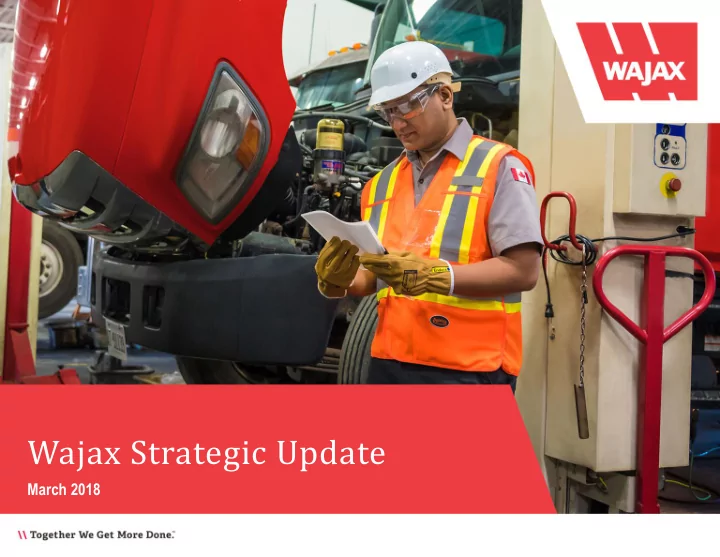
Wajax Strategic Update
March 2018
Wajax Strategic Update March 2018 \\ Cautionary Statement Regarding - - PowerPoint PPT Presentation
Wajax Strategic Update March 2018 \\ Cautionary Statement Regarding Forward-Looking Information This presentation contains certain forward-looking statements and forward-looking information, as defined in applicable securities laws (collectively,
March 2018
Wajax Strategic Update (March 2018)
This presentation contains certain forward-looking statements and forward-looking information, as defined in applicable securities laws (collectively, “forward-looking statements”). These forward-looking statements relate to future events or the Corporation’s future performance. All statements
words such as “plans”, “anticipates”, “intends”, “predicts”, “expects”, “is expected”, “scheduled”, “believes”, “estimates”, “projects” or “forecasts”, or variations of, or the negatives of, such words and phrases or state that certain actions, events or results “may”, “could”, “would”, “should”, “might” or “will” be taken, occur or be achieved. Forward looking statements involve known and unknown risks, uncertainties and other factors beyond the Corporation’s ability to predict or control which may cause actual results, performance and achievements to differ materially from those anticipated or implied in such forward looking statements. There can be no assurance that any forward looking statement will materialize. Accordingly, readers should not place undue reliance on forward looking statements. The forward looking statements in this presentation are made as of the date of this presentation, reflect management’s current beliefs and are based on information currently available to management. Although management believes that the expectations represented in such forward-looking statements are reasonable, there is no assurance that such expectations will prove to be
growth plans, goals and performance expectations for our ten major product and service categories, as well as our planned investments in staffing, inventory and infrastructure to support such growth; our acquisition strategy and criteria for evaluating potential acquisition targets in Canada and the U.S.; our plans to achieve further cost savings and efficiencies through the continued consolidation/optimization of “back office” functions; our plans to increase hiring and grow our sales and service teams; our expectation that, as we execute our updated growth strategy our operating leverage should improve; our goal of managing costs to deliver a target annual sales, general and administrative expense to revenue ratio of between 14.5% to 15.5%, regardless of future revenue levels; our plans to further reduce and consolidate/optimize our branch network, emphasize multi-purpose branch locations and to achieve a target annual facility cost to revenue ratio of between 2% to 2.5%; our planned implementation of a new enterprise resource planning solution, as well as the anticipated timing for completion of, and expected benefits of, such solution; our planned investment in customer support centers, the benefits of such centers and the expected operational date of our first major center; the guiding financial principles we intend to adhere to in executing our updated strategy; our target leverage ratio range of 1.5 – 2.0 times; our expectation that execution of our updated Strategic Plan will lead to higher per share cash flow generation and structurally higher EBITDA margins; and our expectation that improvement in our EBITDA margins will create meaningful shareholder value. These statements are based on a number of assumptions which may prove to be incorrect, including, but not limited to, assumptions regarding general business and economic conditions; the supply and demand for, and the level and volatility of prices for, oil, natural gas and other commodities; financial market conditions, including interest rates; assumptions regarding product or service market size and strength, and the adoption of certain emissions standards; our ability to execute our updated corporate strategy, including our ability to execute on our
platforms, systems and software; our ability to realize the full benefits from our 2016 strategic reorganization, including cost savings and productivity gains; the future financial performance of the Corporation; our costs; market competition; our ability to attract and retain skilled staff; our ability to procure quality products and inventory; and our ongoing relations with suppliers, employees and customers. The foregoing list of assumptions is not
conditions; volatility in the supply and demand for, and the level of prices for, oil, natural gas and other commodities; a continued or prolonged decrease in the price of oil or natural gas; fluctuations in financial market conditions, including interest rates; the level of demand for, and prices of, the products and services we offer; levels of customer confidence and spending; market acceptance of the products we offer; termination of distribution or original equipment manufacturer agreements; unanticipated operational difficulties (including failure of plant, equipment or processes to operate in accordance with specifications or expectations, cost escalation, our inability to reduce costs in response to slow-downs in market activity, unavailability of quality products or inventory, supply disruptions, job action and unanticipated events related to health, safety and environmental matters); our ability to attract and retain skilled staff and our ability to maintain our relationships with suppliers, employees and customers. The foregoing list of factors is not
may be found in our Annual Information Form for the year ended December 31, 2017, filed on SEDAR. The forward-looking statements contained in this presentation are expressly qualified in their entirety by this cautionary statement. The Corporation does not undertake any obligation to publicly update such forward-looking statements to reflect new information, subsequent events or otherwise unless so required by applicable securities laws.
2
Wajax Strategic Update (March 2018)
3
Page Wajax Overview 4 Sustainable Revenue Growth 9 Operating Leverage 18 Investing in Key Infrastructure 21 Optimized Capital Structure 25 Creating Shareholder Value 28
Founded in 1858, Wajax is one of Canada’s longest-standing and most diversified industrial products and services providers offering:
services
partners (OEM’s)
many industries
5
SKILLED TECHNICIANS
SALES & SUPPORT PROFESSIONALS
PARTS & SERVICE SUPPORT
Wajax operates an integrated distribution system providing sales, parts and services to a broad range of customers in diverse sectors of the Canadian economy including construction, forestry, mining, industrial/commercial, oil sands, transportation, metal processing, government/utilities and conventional oil/gas.
Wajax Strategic Update (March 2018)
Wajax Strategic Update (March 2018)
6
2017 revenue
2016 revenue
YoY increase
7
Wajax Strategic Update (March 2018)
LEGACY WAJAX “ONE WAJAX”
increasing operating leverage and asset utilization, streamlining the customer and manufacturer relationship while improving our ability to drive change
costs by ~$20 million
enhance growth, customer service, operational efficiency and leverage technology investments to improve national sales and service capabilities
three business segments that served common end markets
managed its own OEM relationships and product/service portfolios
improve consistency of customer experience, drive higher growth and improve asset utilization.
INVESTING IN KEY INFRASTRUCURE
Wajax Strategic Update (March 2018)
8 SUSTAINABLE REVENUE GROWTH OPERATING LEVERAGE MAXIMIZE SHAREHOLDER VALUE OPTIMIZED CAPITAL STRUCTURE
2 5 3 4 1
potential acquisition targets
initiatives in existing product and service lines
the prosperity of our customers in Western Canada
provide greater stability through the cycle as well as the potential for greater geographic diversity
manufacturers
Wajax Strategic Update (March 2018)
10
1 EBITDA does not have a standardized meaning prescribed by GAAP. See Non-GAAP and Additional GAAP measures in the Appendix.
Construction Material Handling Engineered Repair Services
“Targeted Growth” categories are expected to receive the largest investment in staffing, inventory and infrastructure
Wajax Strategic Update (March 2018)
Targeted Growth
31% of 2017 Revenue
Core Strength
50% of 2017 Revenue
Cyclical/Major Projects
19% of 2017 Revenue
Industrial Parts Forestry On-Highway Transportation Power & Marine Mining Engines & Transmissions Crane & Utility
11
Largest contributor to growth primarily based on increased market share Maintaining strong market position to capitalize on opportunities Expected to grow inline with or greater than the underlying end markets
Wajax Strategic Update (March 2018)
2013 2016
Category Growth Drivers
Market Assumptions
Critical Success Factors
12
Expected to be a major contributor to organic growth objectives and requires focused investment in personnel and inventory to meet market share targets
$289 $273 $207 $170 $231 4,344 4,296 3,426 3,054 4,316 1,000 2,000 3,000 4,000 5,000 $0 $100 $200 $300 $400 2013 2014 2015 2016 2017 Revenue ($millions) Canadian Large Excavator Market (Units)
Wajax Strategic Update (March 2018)
2013 2016
13
Category Growth Drivers
Market Assumptions
Critical Success Factors
Planning based on achievable market share expansion targets and further investment in our rental fleet to capitalize on best in class Hyster-Yale product offerings
2013 2016 $125 $122 $124 $109 $120 14,872 15,839 14,937 14,076 16,613 10,000 20,000 $0 $100 $200 2013 2014 2015 2016 2017 Revenue ($millions) Canadian Lift Truck Market (Units)
Wajax Strategic Update (March 2018)
14
Category Growth Drivers
preventative maintenance
Market Assumptions
repairs, field services and engineered solutions.
Critical Success Factors
Unique market opportunity for Wajax supported by our industrial engineering talent, which can be leveraged nationally to support our key customer partnerships
$38 $63 $25 $58 $63 10,000 20,000 $0 $25 $50 $75 2013 2014 2015 2016 2017 Revenue ($millions)
Wajax Strategic Update (March 2018)
well against growth in their respective end markets
businesses to support given the strength of our teams and the unique customer relationships we have fostered nationally
15
Power & Marine Industrial Parts
$365 $320 $340 Peak Trough 2017
Forestry On-Highway Transportation
$144 $97 $144 Peak Trough 2017 $111 $89 $109 Peak Trough 2017 $80 $72 $72 Peak Trough 2017 2015 2017 2014 2014
Wajax offers its customers expert service and support across a full range of bearings and power transmission, process and fluid power products. Industrial Parts is an important competitive differentiator.
SKF Timken ITT 3M Eaton
Wajax offers an industry-leading range
equipment and aftermarket services to logging contractors and
forestry
strong market share in a number of important product areas.
Tigercat Hitachi
On-highway transportation product support covers a wide range of shop and road services for municipalities, coach operators and large highway vehicle customers. Wajax is an industry leader in large engine and transmission services.
Detroit Allison Transmission
Standby, prime power and co- generation power systems are an important focus for Wajax. Our legacy strengths in resource industries has been augmented to focus on growth areas including data centers, health care and water treatment.
Rolls Royce Volvo
2016 2012 2012 2017 Revenue ($millions)
Wajax Strategic Update (March 2018)
capital projects that are challenging to forecast
16
Mining Engines & Transmissions Crane & Utility
Wajax is a leader in the sales and service of large hydraulic mining shovels used in surface mining
across Canada and continues to develop new opportunities in the rigid frame mining truck market. To expand the range of products and services to our mining customers, Wajax has focused
new underground mining equipment as well as re- build services for other OEM equipment.
Hitachi Fletcher
Wajax supports a very broad range of engines and transmissions used in
applications such as oil and gas drilling, well stimulation and large vehicle or system re-
engineering, systems packaging, shop and field repair and re-build services. Wajax continues to focus on aftermarket and re-power services.
MTU Allison Transmission
Wajax offers a broad range of design and fabrication services to provincial utility and other
capital spending on new equipment, Wajax is regularly reviewing additional crane and utility
Terex Palfinger
$233 $86 $112 Peak Trough 2017 2012 $157 $71 $90 Peak Trough 2017 2012 $57 $41 $41 Peak Trough 2017 2014 2015 2016 2016 Revenue ($millions)
Wajax Strategic Update (March 2018)
17
Targeted acquisition strategy focuses primarily on services businesses in Canada and
CANADA U.S.
Market Overview
consolidation, leaving limited non-competing acquisition opportunities available
ERS growth strategy
continued with manufacturers favoring larger and well- capitalized dealers with clear succession plans
given our financial flexibility and strong manufacturer relationships
Growth Strategy
relationships to expand distribution to adjacent territories
scale to advance our strategy and support customer demands
U.S. entry options
manufacturers with consolidation and to add new categories to a target’s portfolio
Target Categories
1) Engineered Repair Services 1) Material Handling 4) Engines & Transmissions 2) Material Handling 2) Construction 5) On-Highway Transportation 3) Power & Marine 3) Power & Marine
1 EBITDA does not have a standardized meaning prescribed by GAAP. See Non-GAAP and Additional GAAP measures in the Appendix.
approximately 11% of the total workforce
new shared services center which is expected to be implemented starting in 2018
service teams while continuing to focus on the efficiency of personnel costs in support areas
19
Wajax Strategic Update (March 2018)
Our 2016 reorganization was effective in right-sizing Wajax to the then-current market conditions while enabling the implementation of stronger sales and shop management practices SG&A is targeted to remain at 14.5% to 15.5% of revenue driving margin expansion as the top line grows
$1,466 $1,429 $1,451 $1,273 $1,222 $1,319 $208 $212 $217 $203 $195 $199 14.2% 14.8% 14.9% 15.9% 16.0% 15.1% 13.0% 13.5% 14.0% 14.5% 15.0% 15.5% 16.0% 16.5% $0 $200 $400 $600 $800 $1,000 $1,200 $1,400 $1,600 $1,800 2012 2013 2014 2015 2016 2017 2018 2019 2020 Revenue SG&A ($) SG&A (%)
20
Wajax Strategic Update (March 2018)
The impact of our operating leverage and the “One Wajax” business model is geared to drive SG&A ratio improvements going forward
Our goal is to manage expenses to deliver a 14.5% to 15.5% SG&A ratio regardless of future revenue levels As we execute our growth strategy, our operating leverage should improve, increasing our margins and net earnings
an emphasis on multi-purpose locations covering a broader range of product/service offerings to enhance local customer service
markets and ongoing consolidation to improve the customer experience as leases expire
22
Wajax Strategic Update (March 2018)
Wajax has reduced branch count by ~20% since our 2012 peak from 128 to 104, while delivering higher revenue per branch over that period
Existing facility Branch consolidation opportunity
margins is ensuring we have the systems in place to efficiently meet the needs of our team and our customers
technology platforms
systems in use from five to two
remaining systems to a new, best-in-class ERP solution
Q1 2019, with anticipated completion by June 2020 across all branches and locations
and other systems, is a major factor in the next level of our
improves the cost efficiency of our support teams
Wajax Strategic Update (March 2018)
23
fulfillment capabilities and broader market coverage
their ability to support branches and customers across our full range of products and services
facility network change
and outbound customer sales call support
products and services from any location using the channel most convenient to them
Wajax Strategic Update (March 2018)
24
26
Create Shareholder Value
Maintain Earnings Quality
Prioritize Liquidity
Disciplined Risk Management
Optimize Capital Structure
1 4 3 2 5
Wajax Strategic Update (March 2018)
Financial capacity and flexibility are crucial to achieving our strategic goals. Wajax has adopted a disciplined approach to capital allocation and risk management.
27
0.0x 1.0x 2.0x 3.0x 4.0x Debt / EBITDA1
Credit Capacity
Target Range Available Capacity 2.06x Q4 2017
Available Liquidity
credit facility with additional $100 million accordion
strong interest from additional banks to participate
markets
Wajax Strategic Update (March 2018)
Working Capital Efficiency
22.9% 21.8% 21.4% 2.8x 2.5x 3.2x 2.0x 2.5x 3.0x 3.5x 20% 21% 22% 23%
Q4/16 Q3/17 Q4/17
Working Capital to Sales (LHS) Inventory Turns (RHS)
1 EBITDA does not have a standardized meaning prescribed by GAAP. See Non-GAAP and Additional GAAP measures in the Appendix.
robust business plans
competitive dynamics
keep SG&A rates flat as we grow
higher per share cash flow generation and structurally higher EBITDA4 margins
29
Wajax Strategic Update (March 2018)
($ millions) 2017 Low Mid High 2017 Actual Revenue $ 1,319 3 Year Revenue CAGR1 8.0%2 5.0% 7.0% 9.0% Implied Revenue Range $ 1,527 $ 1,616 $ 1,708 Assumed EBITDA4 Margin 6.0%3 7.0% 8.0% 9.0% Implied EBITDA4 $ 793 $ 107 $ 129 $ 154 EBITDA4 CAGR 10.6% 17.8% 24.8% WJX
1 Growth rates shown are illustrative and are based solely on organic growth 2 Year over year increase from December 31, 2016 3 December 31, 2017 reported Adjusted EBITDA margin and Adjusted EBITDA
2018 Consensus EBITDA4 Trading Multiples (based on Feb. 23, 2018 closing share prices)
meaningful shareholder value
0.0x 5.0x 10.0x WJX Peer 1 Peer 2 Peer 3 Peer 4
4 EBITDA does not have a standardized meaning prescribed by GAAP. See Non-GAAP and Additional GAAP measures in the Appendix.
30
Email Phone Mark Foote
President & Chief Executive Officer
mfoote@wajax.com (905) 288-2082 Darren Yaworsky
SVP Finance & Chief Financial Officer
dyaworsky@wajax.com (905) 212-3353 Trevor Carson
VP Financial Planning & Risk Management
tcarson@wajax.com (905) 212-3390
Wajax Strategic Update (March 2018)
32
Wajax Strategic Update (March 2018) Except where noted, all figures are in millions of Canadian dollars, except per share data and ratio calculations. This presentation contains certain non-GAAP and additional GAAP measures that do not have a standardized meaning prescribed by GAAP. Therefore, these financial measures may not be comparable to similar measures presented by other issuers. Investors are cautioned that these measures should not be construed as an alternative to net earnings or to cash flow from operating, investing, and financing activities determined in accordance with GAAP as indicators of the Corporation’s performance. The Corporation’s management believes that: (i) these measures are commonly reported and widely used by investors and management, (ii) the non-GAAP measures are commonly used as an indicator of a company’s cash operating performance, profitability and ability to raise and service debt, and (iii) the additional GAAP measures are commonly used to assess a company’s earnings performance excluding its capital, tax structures and restructuring (recovery) costs. (iv) “Adjusted EBITDA” used in calculating the Leverage Ratio excludes the restructuring (recovery) costs, (gain) loss recorded on sales of properties and senior notes redemption costs which is consistent with the leverage ratio calculation under the Corporation’s bank credit agreement. Non-GAAP financial measures are identified and defined below: Funded net debt Funded net debt includes bank indebtedness, long-term debt and obligations under finance leases, net of cash. Funded net debt is a component relevant in calculating the Corporation’s Funded Net Debt to Total Capital, which is a non-GAAP measure commonly used as an indicator of a company’s ability to raise and service debt. Debt Debt is funded net debt plus letters of credit. Debt is a component relevant in calculating the Corporation’s Leverage Ratio, which is a non-GAAP measure commonly used as an indicator of a company’s ability to raise and service debt. EBITDA Net earnings before finance costs, income tax expense, depreciation and amortization. EBITDA is a non-GAAP measure commonly used as an indicator of a company’s cash
Adjusted EBITDA EBITDA before restructuring (recovery) costs, (gain) loss recorded on sales of properties and senior notes redemption costs. Leverage ratio The leverage ratio is defined as debt at the end of a particular quarter divided by trailing 12-month Adjusted EBITDA. The Corporation’s objective is to maintain this ratio between 1.5 times and 2.0 times. Additional GAAP measures are identified and defined below: Earnings before finance costs and income taxes (EBIT) Earnings before finance costs and income taxes, as presented on the Consolidated Statements of Earnings. Earnings before income taxes (EBT) Earnings before income taxes, as presented on the Consolidated Statements of Earnings.
33
Wajax Strategic Update (March 2018) Reconciliation of the Corporation’s net earnings to EBT, EBIT, EBITDA and Adjusted EBITDA is as follows: For the twelve months ended December 31 2017 Net earnings $ 30.9 Income tax expense 11.8 EBT 42.7 Finance costs 9.8 Senior notes redemption(1) 5.5 EBIT 58.0 Depreciation and amortization 22.4 EBITDA 80.4 Restructuring recovery(2) (0.3) (Gain) recorded on sales of properties (3) (1.5) Adjusted EBITDA $ 78.6
(1) For the twelve months ended December 31, 2017 – Includes the $5.5 million senior notes redemption costs recorded in the fourth quarter of 2017. (2) For the twelve months ended December 31, 2017 – Includes the $0.3 million restructuring recovery recorded in the second quarter of 2017. (3) For the twelve months ended December 31, 2017 – Includes the $1.5 million gain recorded on sales of properties recorded in the fourth quarter of 2017.
Calculation of the Corporation’s funded net debt, debt and leverage ratio is as follows: December 31 2017 Bank indebtedness $ 1.7 Obligations under finance leases 9.5 Long-term debt 143.7 Funded net debt $ 154.9 Letters of credit 7.3 Debt $ 162.2 Leverage ratio(1) 2.06
(1) Calculation uses trailing four-quarter Adjusted EBITDA. This leverage ratio is calculated for purposes of monitoring the Corporation’s objective target leverage ratio of between 1.5 times and 2.0 times. The calculation contains some differences from the leverage ratio calculated under the Corporation’s bank credit facility agreement (“the agreement”). The resulting leverage ratio under the agreement is not significantly different.
wajax.com