SLIDE 1
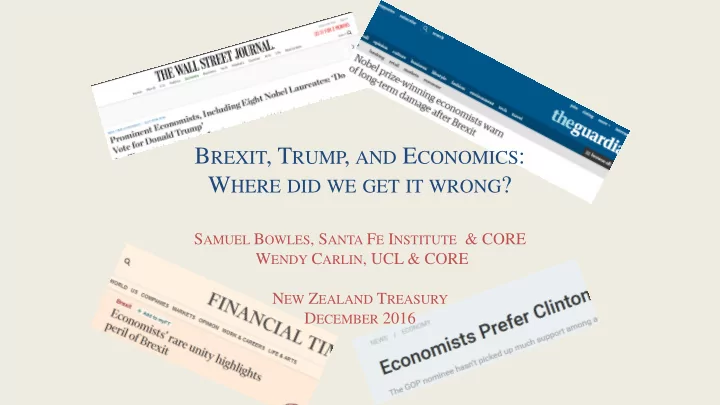
BREXIT, TRUMP, AND ECONOMICS: WHERE DID WE GET IT WRONG?
SAMUEL BOWLES, SANTA FE INSTITUTE & CORE WENDY CARLIN, UCL & CORE NEW ZEALAND TREASURY DECEMBER 2016
SLIDE 2
- What is the most pressing issue that economists today should
address?
Word cloud formed from answers provided by the approximately 100 people in the audience
SLIDE 3
Poll of 673 economists in UK Late May, 2016
Is the old quip true? If you laid all the economists in the world end to end… they would not reach a conclusion?
SLIDE 4 Economics in the dog house
- The financial crisis and the growing
distrust of economists…
- ... large measure due to the advocacy of
substantially unregulated financial markets by many
- Economists opposed Brexit and Trump;
but did anyone listen?
***
SLIDE 5 What we got wrong.
- But the role of economists in the financial crisis was just one among many reasons for
public doubting what we say
- For decades what was held out to the public as “thinking like an economist” …
- …ignored growing inequality and especially the extraordinary income and wealth gains of
the very rich
- …reassured the public that markets are efficient and self regulating (meaning stable)
- …advocated global economic liberalization without implementing policies to protect and
enhance the skills and other endowments of those who would be the losers.
- The claim that this was indeed standard economic logic was buttressed by the fact that as
students earlier, the public, journalists and the policy establishment had mastered the underlying logic in order to pass Econ 101.
- Part of what we got wrong was Econ 101
SLIDE 6
Economics as shopping?
SLIDE 7 New problems and advances in theory go to the back of the book
***
SLIDE 8 A preliminary version has been adopted as the introductory course at University College London, Sciences Po (Paris), Azim Premji University (Bangalore) and elsewhere – Toulouse School of Economics and Humboldt University, Berlin adopted CORE September 2016
Yann Algan CORE-Sciences Po, Paris Antonio Cabrales CORE-UCL Azim Premji University, Bangalore
… and the response? A new vision of ECON101 … from an international collaboration of economists The CORE project
SLIDE 9
- Wealth creation & growth
- Environmental problems
- Inequality
- Unemployment & fluctuations
- Instability
Why did students choose economics? What would their future employers hope that they could reason about?
CORE’s latest donors, Bank of England & HM Treasury: “CORE is good for economics and for economic policy”
SLIDE 10
Bank of England graduate recruits September 27th 2016:
What is the most pressing issue that economists today should address?
SLIDE 11 Graduating students, U. de los Andes, Bogota
… Universidad de los Andes Bogota October 2016
UCL 1st year students Day 1 of term 2016
What is the most pressing issue that economists today should address?
***
SLIDE 12
For decades what was held out to the public as “thinking like an economist” … …ignored growing inequality and especially the extraordinary income and wealth gains of the very rich… …reassured the public that the more general message that markets are efficient and self regulating (meaning stable) and …advocated global economic liberalization without implementing policies to protect and enhance the skills and other endowments of those who would be the losers. What we got wrong:
SLIDE 13
growth
problems
- Inequality
- Unemployment &
fluctuations
- Instability
- Schumpeterian rents, economic profits,
disequilibrium
- Social interactions / other-regarding
preferences
- Rents, bargaining power, institutions
- Incomplete contracts in labour & credit
markets
- Prices as information & dynamics of price-
setting
Problems Key concepts new to Intro If the new problems and questions are at the front of the book there will have to be some changes in the rest of the book…examples.
SLIDE 14
SLIDE 15
One of the first interactive figures the student can manipulate. The distribution of income in the world. Height of the bars is the gross domestic income per capita (measured in purchasing power parity dollars) of the population decile indicated
1980
SLIDE 16
1990
SLIDE 17
2000
SLIDE 18
2014
SLIDE 19 Economic institutions are the rules of the game – who does what and who gets what
SLIDE 20 A B B ′ A′
Gini, Rover 0.06 Gini, Favourite 0.63 10 20 30 40 50 60 70 80 90 100 10 20 30 40 50 60 70 80 90 100 Cumulative share of income (%) Cumulative share of the ship's company from lowest (crew) to highest income (captain) (%)
Constitutions and contracts Inequality in the division of the spoils: pirates and the Royal Navy
SLIDE 21 Technology
A basic framework
Institutions & Policies Differences in endowments Economic inequality
SLIDE 22 How are the benefits of improved technology shared? Two epochs: the post war ‘golden age’ and its demise, and the Industrial Revolution The politics, economics and demography
- f rising living standards from 1800 to
present
SLIDE 23
Every economic transaction involves both mutual gains & conflicts of interest
SLIDE 24
A Rawlsian question (used throughout)
SLIDE 25 The politics of the firm
***
SLIDE 26
For decades what was held out to the public as “thinking like an economist” ……ignored growing inequality and especially the extraordinary income and wealth gains of the very rich… reassured the public that markets are efficient and self regulating (meaning stable) and …advocated global economic liberalization without implementing policies to protect and enhance the skills and other endowments of those who would be the losers. What we got wrong:
SLIDE 27
Market failures at the end of the book!
SLIDE 28 When you consider… …you affect others (conferring benefits
- r costs that you do not experience) ….
…resulting in a market failure Economic terminology … driving your car to work rather than taking public transportation …contribute to the traffic congestion imposed on others … too much use of private transport. Common property resource … training workers who will later quit and find employment elsewhere … confer benefits on firms that employ the workers & the workers … not enough training is provided. Positive external effect …an employee paid a fixed wage considers working a little harder … increases the profits of her employer (not her wage) … on the job effort is too low. Incomplete contract (effort is not covered) … a firm considers using a pesticide that runs off into waterways … decimates fish stocks on which downstream fishermen rely … over-use of pesticide. Negative external effect; no liability for damages caused) … you consider purchasing an item of luxury clothing … others feel their clothing is inadequate … over-use of luxury goods. Public “bad” (Veblen effect) …advising your firm to invest more in R&D … if you successfully innovate, other firms will copy … too little investment in R&D. Public good … inoculating your child with a costly vaccination against an infectious disease … will protect other children from the same disease … too little inoculation. Negative external effect … using the money you borrowed to invest in a highly risky project … impose greater risk of non-payment
- n the bank, if the project fails
… too much risk exposure. Incomplete credit contract (risk taking not covered)
Needed: A unified view of market failures via external effects – connects ‘micro’ and ‘macro’
SLIDE 29
Teach “micro” and “macro” consistently
Involuntary unemployment in equilibrium and credit constraints introduced from the start (in the ‘micro’ part of the course)
SLIDE 30 The principal agent problem
- Conflicts of interest
- Information is asymmetric because
actions are hidden from principal / not verifiable in court
- Uncertainty because actions are in the
future Incomplete contracts
Employer Employee Owner Bank Government + CB Manager Borrower Bank Conflict of interest over? Contract does not cover?
Market failures: The actors, their actions and their interactions
SLIDE 31 The agent has an incentive to take on too much risk This is an external effect because the costs are borne by others (the principal)
Market failures in finance, banking: the principal-agent problem
SLIDE 32 UCL
UCL Day 1: I want to understand the causes of the financial crisis … macroeconomists did not understand housing, money and banking
SLIDE 33 Housing-centred financial cycle build-up of household debt
Household borrowing increases Purchases
increase House price boom Higher value of collateral On the way up
Bank-centred financial cycle build-up of financial sector debt
Bank borrowing increases Purchases of securitized assets increase Asset price boom Stronger balance sheets On the way up: leverage is high and rising
SLIDE 34 …the evolving macroeconomic paradigm
- After the Great Depression, the new paradigm centred on managing aggregate
demand; era of financial repression and the grand bargain on sharing the gains from productivity growth
- After the Great Stagflation, the new paradigm centred on supply side problems,
managing inflation; era of financial and labour market liberalization Low frequency changes in finance did not disturb either the paradigm or the associated policy regime (inflation targeting) … and the role of changes in inequality for macro performance was ignored
SLIDE 35 Fama and Shiller on bubbles One of many “When economists disagree” features ***
SLIDE 36
For decades what was held out to the public as “thinking like an economist” … …ignored growing inequality and especially the extraordinary income and wealth gains of the very rich…reassured the public that the more general message that markets are efficient and self regulating (meaning stable) and … advocated global economic liberalization without implementing policies to protect and enhance the skills and other endowments of those who would be the losers. What we got wrong:
SLIDE 37 Had we taken seriously Rodrik’s trilemma we might have not got it wrong.
free movement of goods, finance, labour.
SLIDE 38 Hyperglobalisation and Democracy at the national level National sovereignty (limited global governance) Hyperglobalisation and National sovereignty (limited global governance) and Democracy at the national level Demands for global governance (e.g. labour standards, global environmental protection, tax treaties, coordinated macro policies) that compromise nationally differentiated policies National sovereignty Democracy ‘Domesticated globalization’ i.e. national economic policies (e.g. stabilisation and redistribution) must be effective leading to … Hyperglobalisation Hyperglobalisation can only survive if democracy does not Global market rules, race to the bottom (e.g. wages), global market failures (e.g. climate), macroeconomic instability Global market rules, race to the bottom, global market failures e.g. labour rights, environment Limits on labour and capital mobility
If we have … then we get … and as a consequence …
National sovereignty Hyperglobalisation Democracy
Figure 16.21. Rodrik’s political trilemma ***
SLIDE 39 Austerity, Brexit and economics
- Cameron-Osborne policy of austerity from 2010
– stagnant incomes and no reduction in inequality – failure to match demand for with supply of public services in high immigrant areas hostility to immigrants
- Austerity was not supported by economists (consensus not as high as in relation to costs of
Brexit, but substantial)
- Austerity at home UK did not support expansionary policies in Europe (which may have
reduced immigration)
- Cameron could not then argue that UK was playing positive role in Europe or that UK
REMAIN would contribute to a better functioning EU
- The only case Cameron-Osborne made for REMAIN was the economic one … it is not
surprising it was not credible
SLIDE 40 Education as a general asset Specific endowments lost due to globalization
Politics matters: Education does not explain Scotland
***
SLIDE 41 BREXIT, TRUMP, AND ECONOMICS: WHERE DID WE GET IT WRONG?
SAMUEL BOWLES, SANTA FE INSTITUTE & CORE WENDY CARLIN, UCL & CORE NEW ZEALAND TREASURY DECEMBER 2016
Take a look at CORE’s ebook at www.core-econ.org It’s free! w.carlin@ucl.ac.uk samuel.bowles@gmail.com