Vulnera bility of the Asia n Region Asia is famous for its great - - PDF document

vulnera bility of the asia n region
SMART_READER_LITE
LIVE PREVIEW

Vulnera bility of the Asia n Region Asia is famous for its great - - PDF document

R. Ra m esh, R. Purv a ja a nd S. Sriniv a sa lu ANNA UNIVERSITY CHENNAI Vulnera bility of the Asia n Region Asia is famous for its great diversities and also for disparities . Half of the total world population live in Eight disaster


slide-1
SLIDE 1

1

  • R. Ra m esh, R. Purv a ja a nd S. Sriniv a sa lu

ANNA UNIVERSITY CHENNAI

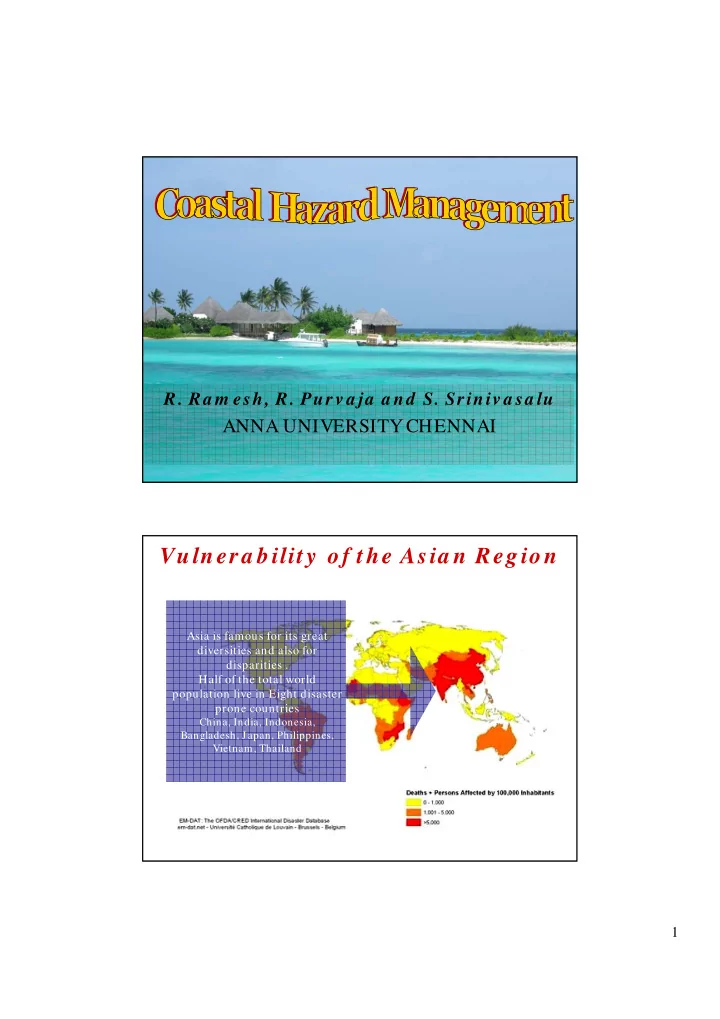
Vulnera bility of the Asia n Region

Asia is famous for its great diversities and also for disparities . Half of the total world population live in Eight disaster prone countries

China, India, Indonesia, Bangladesh, Japan, Philippines, Vietnam, Thailand

slide-2
SLIDE 2

2

Cities are vulnerable to disaster risk because of-

  • Rapid Urbanization
  • Rural - Urban migration
  • Growing population - already stretched resources
  • Poor living standards - build without consideration of

safety (time pressures) + in hazard prone areas

  • Lack of public awareness to hazards/ risks
  • Building codes are poorly enforced or non-existent
  • Environmental degradation - resource depletion -

lowers resilience

El Ni El Niñ ño

  • Weather, w ater and clim ate-related hazards

Hail Hail& &Lightning Lightning Avalanches Avalanches Flash Flash floods floods Tornadoes Tornadoes Wildland Wildland fires fires & & haze haze Hot & cold Hot & cold spells spells Heavy Heavy precipitations precipitations ( (rain rain or

  • r snow

snow) ) Droughts Droughts Storm Storm surges surges Storm ( Storm (winds winds) ) River basin River basin flooding flooding Mud Mud & & landslides landslides Ice Ice Storms Storms Tropical cyclones Tropical cyclones Dust Dust storms storms

slide-3
SLIDE 3

3

Globa l d istribution of na tura l ha za rd s (1993-20 0 2)

Avalanches and landslides 6% Droughts and famines 9% Earthquakes 8% Extreme Temperatures 5% Floods 37% Forest/scrub fires 5% Windstorms 28% Volcanic eruptions 2%

Regional distribution of natural disasters (1993-20 0 2)

Africa 21% Americas 20% Asia 42% Europe 14% Oceania 3%

slide-4
SLIDE 4

4

Distribution of people killed (1993-20 0 2)

High human development 2% Medium human development 32% Low human development 66%

Hydro-m eteorological and geophysical disasters (1993-20 0 2)

20 40 60 80 100 1 2 3

1- Damage (US$billion) 2- Number affected 3- Number killed

Hydrometeorological disasters Geophysical disasters

slide-5
SLIDE 5

5

Hum ans in the Coastal Zone

The coastal areas of the world are very densely populated and center around a large amount of economic activity.

(Source: National Geographic) (Source: NASA)

A satellite view of lights at night displays the dominance of world population along the coastline

How Many People Live in the Coastal Zone?

  • India has a coastline of 7516 km of

which the mainland accounts for 5422 km, Lakshadweep coast extends 132 km and Andaman and Nicobar islands have a coastline of 1962 km

  • Nearly 250 million people live within

a distance of 20 km from the coast

  • Multiple coastal issues both physical

and social occur along the coastline

  • Solution to coastal problems have

always been implemented with an engineering perspective

  • Social conflicts on the rise along the

coast

  • Human and environmental

vulnerabilities need to be addressed

  • n same levels
slide-6
SLIDE 6

6

Who Lives in the Coastal Zone?

Multi-unit dwellings are more common and is constantly expanding

Where do People Live in the Coastal Zone?

(Source:http:/ / www.globalchange.umic h.edu/ globalchange2/ current/ lectures/ c

  • astalenv/ coastal.html)

(Source: http:/ / desip.igc.org/ populationmaps.html)

Settlement patterns by the coastline Top Ten Largest Cities:

Tokyo, Japan - Coastal Mexico City, Mexico - Inland Mum bai, India - Coastal Sáo Paulo, Brazil - Inland New York City, USA - Coastal Shanghai, China - Coastal Lagos, Nigeria - Coastal Los Angeles, USA - Coastal Calcutta, India - Coastal Buenos Aires, Argentina - Coastal

slide-7
SLIDE 7

7

Why do People Live in the Coastal Zone?

Favorable Climate Economic Opportunities Recreation Transportation Communication

What do People do in the Coastal Zone?

Recreation and Tourism

(Source: http:/ / www.weddings-in- keywest.com/ 2-scuba-divers.jpg)

Coastal states together earn 85% tourist revenues in many countries

slide-8
SLIDE 8

8

Trade & Commerce

(Source: http:/ / www.aapa-ports.org/ industryinfo/ gallery.htm)

What do People do in the Coastal Zone? What do People do in the Coastal Zone?

Oil and Gas Production

(Source: www.rfdbase.com/ login/ index.cfm )

slide-9
SLIDE 9

9

(Source:http:/ / webinstituteforteachers.org/ 2000/ teams/ dow neast/ letters/ Cutler.html)

Fisheries & Aquaculture

What do People do in the Coastal Zone?

Aquaculture represents a large source of seafood consumption globally

Ma jor Coa sta l Ha za rd s Ma jor Coa sta l Ha za rd s

slide-10
SLIDE 10

10

Disaster versus Hazard

  • Hazards pose a threat to a community
  • Disasters cause destruction
  • Understanding Hazards and taking

preventive measures form the basis of Disaster Management

Classification of Disasters

Natural Man-made & Human-induced

Disasters occur in varied forms

– Some are predictable in advance – Some are annual or seasonal – Some are sudden and unpredictable

Factors leading to a Disaster

– Meteorological, Geological, Ecological or Environmental, Technological… .

slide-11
SLIDE 11

11

Natural Disasters

  • Floods
  • Earthquakes
  • Cyclones
  • Droughts
  • Landslides, Pest Attacks, Forest Fires,

Avalanches etc

Time duration of Natural Disasters

  • Earthquakes – Seconds/minutes
  • Cyclones – Days
  • Floods – Days
  • Droughts – Months
slide-12
SLIDE 12

12

Disasters in India can be categorised into four types

  • Group I ( SI = 10) - Floods & Earthquakes
  • Group II (8<SI<10) - Cyclones, Drought,

Crop pests and diseases

  • Group III (6<SI<8) - Forest fires,

Epidemics, Thunderstorm, Hailstorm Lightning, Tornado, Landslides etc.

  • Group IV (SI<6) - Dust Storms, Heat &

Cold Waves

Severity Indices (SI) for Disasters in India

About 3% of the country’s area and 7% of the population are in such high vulnerable zones Andhra Pradesh, Maharashtra, Rajasthan and West Bengal are most severely affected

slide-13
SLIDE 13

13

What is a Coastal Hazard?

Coastal Hazards can be defined as natural hazards that occur within the coastal zone. The following are major coastal hazards

  • Hurricanes
  • Coastal Erosion
  • Tsunami
  • Flooding

(Courtesy: www.electrofin.com) (Courtesy: http:/ / www.library.yale.ed u/ MapColl/ hyannis.htm) (Courtesy: www.missouri.edu/ ~geosc mbu/ ocean2003.html )

Hurricane

(Courtesy: http:/ / www.mthurrica ne.com/ hurricanes.ht m) (Courtesy:http:/ / www.weatherstock.c

  • m/ hurricanecat-science2.html)

(Courtesy: http:/ / hpccsun.unl.ed u/ nebraska/ Gtrack.ht ml) (Courtesy: NOAA Photo Library)

Hurricanes can take very variable tracks

slide-14
SLIDE 14

14

Floods

(Courtesy: http:/ / www.sci.muni.cz/ botany/ gallery/ lf109.jpg)

There are two types of floods

  • Flash Floods

Riverine floods are common in low lying, sandy coastal areas, whereas flash floods are more common along rocky coasts

  • Riverine Floods

(Courtesy: www.utahweather.org)

Flood Vulnerability in Asia

Exposure (People/Year) > 100'000 10'000 - 100'000 1'000 - 10'000 100 - 1'000 10 - 100

slide-15
SLIDE 15

15

Flooding in Asia

  • The year 2000 saw the worst flooding in 60 years for

Vietnams’Mekong Delta region, 40 years for Cambodia, 35 years for Laos, and in a century for western Bangladesh and West Bengal, India.

  • Year 2007 August Floods in India, Nepal and Bangladesh

caused significant economic losses

  • Recent events in 2007 show major threat is from flash

floods which is evident from Nepal, Bhutan, Thailand, Philippines

Top Two Worst Disasters in Asia 2004

  • Typhoon Nanmadol, Philippines (November) winds of 220

km/ hr - at least 412 deaths

  • Indian Ocean Tsunami and EQ (December) - Affecting:

Indonesia, Sri Lanka, India, Bangladesh, Malaysia, Thailand, Maldives - death toll at least 212,000

slide-16
SLIDE 16

16

The 2 deadliest disasters of 2006 were both in Asia

  • Indonesian EQ (May) killing 5,778
  • Typhoon Durian (Philippines, Dec) killing 1399

Top Tw o Worst Disasters in Asia in 2006

Cyclones/ Typhoon Exposure in Asia

Exposure (People/year) > 100'000 10'000 - 100'000 1'000 - 10'000 100 - 1'000 10 - 100

slide-17
SLIDE 17

17

Cyclones/ Typhoons in Asia

  • There were 95 major storms in SE Asia and the Pacific

regions between 1980-2000

  • Since 1970, cyclones have killed an estimated 1.5

million in Bangladesh

  • The October 1999 storm surge in Orissa, India,

affected 15 million people, killed 9,500 people, destroyed 3 million homes, and left seven million people homeless

  • Recent major events were in Karachci Pakistan in

2007, Vietnam and Philippines in 2006

Distribution of Hurricanes

(Courtesy: NOAA) (Courtesy: ww2010.atmos.uiuc.edu )

  • Hurricanes can take many different

tracks, but are limited to the Western Hemisphere

  • Cyclones and typhoons are found

elsewhere in the world.

slide-18
SLIDE 18

18

Coastal Erosion

(Black-and-white photographs courtesy of Pacific Studios, Newport, Oregon. Color photographs taken by Parke D. Snavely, Jr. of the USGS.)

1890 1920 1970 1990

Distribution of Coastal Erosion

  • Coastal Erosion is very localized
  • Some sections of sandy beaches will erode, while close

by another section will accrete sand

slide-19
SLIDE 19

19

Tsunam i

(Courtesy: FEMA)

Tsunamis can be triggered by earthquakes, volcanoes or landslides

(Courtesy: users.belgacom.net) (Courtesy: National Weather Service)

Monitoring takes place on buoys

Distribution of Tsunam is

(Courtesy: http:/ / www.geophys.washington.edu/ tsunami/ general/ historic/ historic.html)

A map of large tsunamis of recent history that were generated by earthquakes

slide-20
SLIDE 20

20 The Natural Hazard – How it Happened

(Source: NOAA)

The tsunami of December 26, 2004 is believed to have been caused by a 9.0-9.3 magnitude earthquake, have a wave height of up to 10 meters, and inundated land up to 2 kilometers from the shoreline in some areas. The Disaster – Where it Happened

(Source: www.reliefweb.int)

The tsunami struck a number of countries and took from 15 minutes to seven hours to reach the different coastlines.

slide-21
SLIDE 21

21

slide-22
SLIDE 22

22 The Disaster – Human Loss

(Source: CNN; http://edition.cnn.co m/SPECIALS/2004/t sunami.disaster/)

The Disaster – Property Loss

Before and after satellite images of the damage

(Source: NASA Earth Observatory)

slide-23
SLIDE 23

23 The Disaster – Economic Loss

(Source:http://edition.cnn.com/SPECIALS/2004/tsunami.disaster/)

The impact on coastal fishing communities and fishermen has been devastating with high losses

  • f income earners as well as boats

and fishing gear

Andaman Islands, India: Tsunami, Coastal Ecosystems & Climate

slide-24
SLIDE 24

24

General features of the Andaman & Nicobar Group of Islands

  • Andaman Island group: 324 islands -

24 are inhabited

  • Nicobar Island group: 28 islands - 12

are inhabited

  • Area: Andaman group of islands

6408 km2 and Nicobar group, 1841 km2

  • Climate: tropical monsoon climate

with an annual average rainfall of 3180 mm

  • Flora & Fauna: Evergreen, semi

evergreen, moist deciduous and littoral forests including mangroves, coral reefs, sea grass and sea weeds

  • The coast is very irregular and deeply

indented by innumerable creeks, bays, inlets, estuaries and lagoons - rich biodiversity and high productivity

  • BIODIVERSITY

Bay of Bay of Bengal Bengal Tro Tropical ical EVER EVERGREE GREEN F FORE REST STS Tro Tropical ical EVER EVERGREE GREEN F FORE REST STS LIME MEST STON ONE CAVE CAVES: S: Stalagtites & Stalagtites & Stalagmites Stalagmites LIME MEST STON ONE CAVE CAVES: S: Stalagtites & Stalagtites & Stalagmites Stalagmites MU MUD V D VOLCAN LCANO MU MUD V D VOLCAN LCANO MA MANGROVE VES MA MANGROVE VES ACTIVE VOLCANO ACTIVE VOLCANO CORAL ATOLLS CORAL ATOLLS Sandy & Rocky BEACHES Sandy & Rocky BEACHES CORAL REEFS CORAL REEFS REEF-Associated FAUNA REEF-Associated FAUNA

slide-25
SLIDE 25

25

Indian Ocean Mega Tsunami

December 26, 2004

Indian Ocean Mega Tsunami

December 26, 2004

slide-26
SLIDE 26

26

Basic Facts

48 9.3 West Sumatra-Andaman Islands 26-Dec 2004 004 13 7.6 Java 02-Jun 1994 30 8.3 Java 19-Aug 1977 15 8.1 Makran 27-Nov 1945 7.7 Andaman Islands 26-Jun 1941 941 7.5 Java 11-Sep 1921 7.6 West Sumatra 04-Jan 1907 35 Sunda Strait (Krakatoa) 27-Aug 1883 1 7.9 Nicobar Islands 31-Dec 1881 881 7 8.3 - 8.5 North Sumatra 16-Feb 1681 7.2 North Sumatra 5-6 Jan 1843 8.7 - 9.2 West Sumatra 24-Nov 1833 7.7 Near Cutch 16 Ju 1819 South Sumatra 18-Mar 1818 8.4 West Sumatra 10-11 Feb 1797 Myanmar 02-Apr 1762 Ma Maxi ximu mum m wave ht wave ht (m) (m) Magn Magnit itud ude Source/ Lo urce/ Location cation Date Date Ye Year ar 48 9.3 West Sumatra-Andaman Islands 26-Dec 2004 004 13 7.6 Java 02-Jun 1994 30 8.3 Java 19-Aug 1977 15 8.1 Makran 27-Nov 1945 7.7 Andaman Islands 26-Jun 1941 941 7.5 Java 11-Sep 1921 7.6 West Sumatra 04-Jan 1907 35 Sunda Strait (Krakatoa) 27-Aug 1883 1 7.9 Nicobar Islands 31-Dec 1881 881 7 8.3 - 8.5 North Sumatra 16-Feb 1681 7.2 North Sumatra 5-6 Jan 1843 8.7 - 9.2 West Sumatra 24-Nov 1833 7.7 Near Cutch 16 Ju 1819 South Sumatra 18-Mar 1818 8.4 West Sumatra 10-11 Feb 1797 Myanmar 02-Apr 1762 Ma Maxi ximu mum m wave ht wave ht (m) (m) Magn Magnit itud ude Source/ Lo urce/ Location cation Date Date Ye Year ar

History of Earthquakes in the Indian Ocean History of Earthquakes in the Indian Ocean

n

slide-27
SLIDE 27

27

Details of Coastline Affected

64025 1362 10065 6678 NR 45920 Boats damaged 11827 790 NR 506 NR 10245 Cropped Area (hectares) 927 301 187 33 30 Islands 376 Number of villages affected 5 3-5 10 >15 7-10 Average height of tidal wave in meters 0.5-2.0 1-2 0.3-3.0 1.5 – 7.0 1-1.5 Penetration of water into mainland in km 2260 985 250 25 Almost entire 1000 Coastal length affected in km Total Total And Andhra Pra Pradesh esh Kerala Kerala Po Pondi ndiche herry rry A&N A&N Islan Islands Tamil Tamil Na Nadu Details Details

Note: The Tsunamis have caused extensive damage in the Nicobar Islands, which will require more or less rebuilding/ reconstruction NR: Not Recorded

Maxim um Wave Runup Level (m ) in the Andam an and Nicobar Islands during Tsunam i

(adapted from: ICMAM, Chennai)

Maxim um Wave Runup Level (m ) in the Andam an and Nicobar Islands during Tsunam i

(adapted from: ICMAM, Chennai)

slide-28
SLIDE 28

28

Sequence of events during tsunami and aftershocks

Receding water Complete Recession Incoming wall of water Intense wave height

wave height (cm) tsunami wave travel time

NOAA Tsunami Wave Similations

slide-29
SLIDE 29

29

  • Distance of Nicobar Islands from

Epicenter: 124 km

  • Time taken by the wave to reach

Nicobar from Sumatra = 2 to 3 minutes (180 to 240 sec)

  • Average speed of the wave: 600 - 800

km h-1 (open ocean)

Travel Travel time of tsun time of tsunami ami waves waves Travel Travel time of tsun time of tsunami ami waves waves

Current Scientific Investigations

  • Physical disturbances/ changes
  • Land emergence and submergence & Mapping
  • Tsunami evidences/ proxies that are

considered

– Trenches – Coastal and wetland sediments – Coral reefs

  • Mangrove Sediments
  • Corals as proxies for climate and tsunami (??)
slide-30
SLIDE 30

30

Physical Changes to the Coast Physical Changes to the Coast

Before After

Villages in Nicobar Destroyed Villages in Nicobar Destroyed

slide-31
SLIDE 31

31

Ferry Terminals and Ports Destroyed

Ferry Term inal in Bam boo Flat near Port Blair Ferry Term inal in Bam boo Flat near Port Blair

slide-32
SLIDE 32

32

Buildings Collapsed due to Earthquake Buildings Collapsed due to Earthquake

Average height of tsunami waves (~ 15 m)

Wave Height during Tsunam i Wave Height during Tsunam i

slide-33
SLIDE 33

33

Access Roads Cut off Access Roads Cut off

Destruction of several Fishing Boats, Harbors & Bridges Destruction of several Fishing Boats, Harbors & Bridges

slide-34
SLIDE 34

34

Continuous inundation of water into Cities (Port Blair, South Andaman) during high tide: June 2005 Continuous inundation of water into Cities (Port Blair, South Andaman) during high tide: June 2005

Andaman Islands

slide-35
SLIDE 35

35

Land Emergence Submergence & Tilt

Land Emergence Land Submergence

Tilt Tilt Tilt Tilt

slide-36
SLIDE 36

36

Little Andaman b) North c) South Sentinel Islands Interview Island Great Nicobar

Land Emergence/ Land Emergence/ Uplift Uplift

slide-37
SLIDE 37

37

Luxuriant North Reef Coral Islands of North Andaman

a) December 2, 2004 b) February 4, 2005

Uplift of Flat Island along the western coast of Middle Andaman Upthrow of Coral bed and rock starta in the same place

Coral Reef uplift in Flat Island Middle Andaman Coral Reef uplift in Flat Island Middle Andaman

slide-38
SLIDE 38

38

Dec 26, 2004

(????)

Coral Reefs of North Reef after Land Uplift Coral Reefs of North Reef after Land Uplift Coral Reefs after Land Uplift in the Andaman Seas Coral Reefs after Land Uplift in the Andaman Seas

Termed Coral graveyard

slide-39
SLIDE 39

39

MANGROVE FORESTS IN NORTH ANDAMAN

Exposed m angrove roots at high tide in the Kalighat Creek, North Andam an

MANGROVE FORESTS IN NORTH ANDAMAN

Exposed m angrove roots at high tide in the Kalighat Creek, North Andam an Previous High Tide Line Present High Tide Line 1 – 1.25 m

slide-40
SLIDE 40

40

Land Submergence Land Submergence

Before After

Coral Reefs of Rutland Islands South Andaman Coral Reefs of Rutland Islands South Andaman

Brighter Blue: Healthy Reefs: light penetration high Dull Blue: Reefs submerged and therefore decreased light penetration

slide-41
SLIDE 41

41

The lighthouse tower at Indira Point in Great Nicobar Island before the 26 December earthquake. The tower is surrounded by lush green grass, residences are at the base and a sandy beach is in the foreground. b Flooding of the lighthouse base because of land subsidence. The submergence of 3 m was caused by the 26 December earthquake

Highly turbid w aters covering the coral reefs at Red Skin Islands, South Andam an Highly turbid w aters covering the coral reefs at Red Skin Islands, South Andam an

slide-42
SLIDE 42

42

Mangroves ???

Com plete degradation of m angroves due to subm ergence at Sipighat, South Andam an Com plete degradation of m angroves due to subm ergence at Sipighat, South Andam an

Sea w ater inundation in coconut plantations at South Andam an Sea w ater inundation in coconut plantations at South Andam an

slide-43
SLIDE 43

43

Uprooted Evergreen Forest Trees at North Cinque Island Uprooted Evergreen Forest Trees at North Cinque Island

Salinization of Agriculture Lands Salinization of Agriculture Lands

slide-44
SLIDE 44

44

Field Observations

Port Blair Port Blair Havelock Havelock Island Island North Cinque Island North Cinque Island Red Skin Island Red Skin Island Wrightmyo Wrightmyo

Sam pling Sites...

slide-45
SLIDE 45

45

Trenches.... Pits.... More pits.... big...

big...

and small...

Sediment Cores ....

Sampling Coastal Sediments...

  • sampling for geochronological work
  • focus on dating with the Optically Stimulated Luminescence method (OSL)

7 samples for OSL 11 samples for radiocarbon 5 cores for Pb-210

  • further analyses resulted from new question during the work

sieve analysis Cs-137 x-ray fluoresence analyses GIS-based geological map of the Andaman-Islands

slide-46
SLIDE 46

46

Red Skin Islands

  • The first 20 cm of the section – reliable OSL age

could NOT be determined

  • Activity of caesium-137 in this horizon is lower

than the activity in the horizon below

  • Therefore the first 20 cm should be older than the

sediment below it

  • This reversal of age results possibly from ‘r

‘re- e- de deposit sition

  • n’ during storm events
  • Older sediment from the foreshore was deposited
  • ver younger material at the beach
  • Sedimentological structure of the first 20 cm

suggests these could be two storm events

  • Th

These d ese deposit sits are are NO NOT laid laid do down b wn by the the tsunami tsunami

  • f
  • f 2004

2004

  • At 40cm depth – glass bottle- supports age

between 1940 and 1950

  • Presence of eroded shells at 80cm depth –

probably age between 190 and 200 years

  • Charcoal at 2m depth and thick shell bank at 800

cm depth indicate that there must be times of fast fast su subsid bsiden ence ce interrupted by times with no no mo move veme ment nt

  • AVERAGE

AVERAGE RA RATE OF S SUBS BSIDE IDENCE: CE: 1 mm yr 1 mm yr-1

  • 1

What does the OSL dating of these sediment sections tell us? What does the OSL dating of these sediment sections tell us?

North Cinque Islands

  • Preliminary radiocarbon dating

analysis indicates - deposits are definitely older than 60 years

  • Possibly deposits from former

tsunami events

  • The first calculations of the

radiocarbon ages indicate - horizon below the dark horizon could be deposited before the year 1530 A.D.

  • Coarse grain size and bad sorting

indicate deposit from a high energy event

  • Fragments of corals of 5cm size

probably confirms this

  • Could be a tsunami-laid deposit(!!)
  • Sediments are not laid down

homogeneously by a tsunami - an effect called “fining inland”

Radiocarbon dating of these sediment sections
slide-47
SLIDE 47

47 Sediment Section from Wright Myo Mangroves, South Andaman

  • Mangroves – largely unaffected - BUT -
  • Tidal amplitude has become larger: from 2.0 to 4.0 m
  • Sediment core section – shows interesting light layer

at 20 cm depth

  • Identified to be a PALEOTSUNAMI deposit
  • More work is being done to confirm this!!!

???? ????

Sampling Corals....

slide-48
SLIDE 48

48

Coral Sampling Protocol.....

  • Age determination
  • Stable isotope (δ18O and

δ13C) and elemental (Sr/Ca and Mg/Ca) analysis of coral skeletal material

  • Conduct growth rate

analysis

What do the coral cores tell us??

Some results for the start...

M a r 2 6 D e c 2 5 May 2005 May 2004 D e c 2 4 D e c 2 3 May 2003 May 2002 May 2001 D e c 2 2 D e c 2 1

50 100 150 200 250 200 400 600 800 1000 M ar 2006 Dec 2005 M ay 2005 Dec 2004

(Unclear banding)

M ay 2004 Dec 2003 Dec 2002 M ay 2003 M ay 2002 May 2001 Dec 2001 Dec 2000

December 2004:- Distinct dark banding is not observed like in other monsoon years Peaks pointing right: Summer season (light penetration more; higher SST) Peaks pointing left: Monsoon season (light penertation less; lower SST)

slide-49
SLIDE 49

49

What more would we know...... ??

  • Coral microatolls of Andaman Islands retain – stratigraphic

and morphologic record of relative sea-level change

  • This is because of a vertical tectonic deformation above the

Sumatran subduction zone

  • Seawater levels and their fluctuation produce measurable

changes in coral morphology – limit upward growth of the corals

  • An

Annu nual ring al rings – de derive rived fro d from seasonal v seasonal vari riations in ations in coral coral density density – serve as serve as an an internal chronometer internal chronometer of coral growth

  • f coral growth
  • Microatolls act as natural long-term tide gauges – recording

sea-level variations on time scales of decades (including El Niño events)

  • We will examine the recent displacement history at the

Sumatran subduction zone using living corals as a “coral tide gauge”

  • Possible to determine uplift and submergence of land

Asian Cities at Risk

  • 37% of Asia’s population lived in

cities by 2000; this will rise to 60% by 2025

  • More than 50 cities in Asia with

a population greater than 1,000,000 are at significant risk from an earthquake

  • Rural to urban migration

accounts for 64% of city growth in Asia

  • Of the 10 largest Asian cities; 7

are prone to multi hazard risks and are awaiting a catastrophic event

slide-50
SLIDE 50

50

Increa sing Risks und er Cha nging Clim a te

Intensity Frequency Heatwaves Heavy rainfall / Flood Tropical Cyclones Coastal Marine Hazards Strong Wind

Water Resource Water Resource Management Management Health Health Industry Industry Food Food security security Transport Transport Energy Energy Urban areas Urban areas

Hazard Exposure is increasing !

Need for Prevention and Mitigation Hydro-m eteorological Hazards Warning System s:

PRIORITY ACTIVITIES

  • Capacity building in early warning and

risk reduction through training programmes

  • Technology Transfer
  • Regional Partnership for assessment of

existing observational networks, identification of gaps and addressing these gaps

slide-51
SLIDE 51

51

Ea rly W a rning Sy stem s

National to local disaster risk reduction plans and legislation

slide-52
SLIDE 52

52

Marine Health (etc.)… Geological

Communities at risk warning

National to local governments Hydrological Meteorological NATIONAL SERVICES

post-disaster response Meteorological Hydrological Geological Marine Health (etc.) (coordination)

NATIONAL SERVICES

requirements r e q u i r e m e n t s Community Preparedness warning

National to local governments

supported by DRR plans, legislation and coordination mechanisms warning requirements

Effective Early Warning System s

warning preventive actions

slide-53
SLIDE 53

53

Disa ster Ma na gem ent Cy cle

Response Recovery

Mitigation Prevention

Preparedness Monitoring Forecast and early warnings Vulnerability analysis and risk assessment Applications (agriculture, water resources, etc)

End to End System

slide-54
SLIDE 54

54

Summary Remarks Summary Remarks Summary Remarks Summary Remarks

In Summary...

  • Natural Hazards occur in the natural environment;

they are a part of the world around us; the world we live in.

  • Disasters occur only when a hazard intersects with

human activity; with people, their property and possessions…

  • Natural Hazards cannot be managed.
  • Human activity can be managed.
  • Mitigating the impacts of natural hazards involves

managing human activity

slide-55
SLIDE 55

55

Thank you for your attention... Thank you for your attention...

slide-56
SLIDE 56

56

CYCLONES CYCLONES

Cyclone forecasting

  • Monitoring
  • Location
  • Intensity
  • Prediction
  • Future intensity
  • Movement
  • Landfall
slide-57
SLIDE 57

57

Type of Warnings

  • Maritime interests
  • Port warnings
  • Four Stage warnings

Pre-Cyclone watch Cyclone Alert Cyclone Warning Post Landfall outlook

  • Warnings for designated officials
  • Warnings for Aviation

Dissemination of Cyclone Warnings

  • Landline
  • T/P
  • Telex
  • Telephone
  • Telefax
  • VSAT
  • VHF/HFRT
  • CWDS
  • Police Wireless
  • AFTN
  • Internet (e-mail)
  • Websites
  • Radio/TV

network

slide-58
SLIDE 58

58

Tropical Cyclone - A Few Facts

  • Tropical cyclones are macro-scale

systems with meso-scale impact

  • Probability of correct forecast

decreases with increasing forecast validity period

  • Mean forecast errors for validity

periods of 12, 24, 48 and 72 hours are 104, 205, 415 and 633 km respectively

slide-59
SLIDE 59

59

Effectiveness of Cyclone Warnings

  • When decisions are delayed till the

accuracy of prediction becomes high, only limited lead-time is available which may result in “under under-

  • warning

warning” and possible chaos

  • In case of low accuracy of landfall

prediction, unnecessary large sector of the coastline have to be placed in full warning phase resulting in “over

  • ver-
  • warning

warning”

slide-60
SLIDE 60

60

Expect the Unusual - It Is Normal

Displaying changing trends in motion Rapid changes in intensity specially close to a

populated coastline

Remaining quasi-stationary close to landfall. Displaying erratic tracks such as looping,

sudden acceleration/deceleration, interaction with other systems etc.

Double looping Double looping -

  • Mahabalipuram

Mahabalipuram Cyclone December , 1996 Cyclone December , 1996

slide-61
SLIDE 61

61

Interactive binary cyclones Nagapattinam & Chirala cyclones - November, 1977 Cyclone moving parallel to the coast Machlipatnam cyclone - May ,1990

slide-62
SLIDE 62

62

Econom ic Losses Related to Disasters are increasing

Source: EM-DAT: The OFDA/CRED International Disaster Database - www.em-dat.net - Université Catholique de Louvain - Brussels - Belgium 4 1 1 1 4 2 4 4 7 8 8 1 6 0 3 4 5 1 0 3 4 9 5

5 0 1 0 0 1 5 0 2 0 0 2 5 0 3 0 0 3 5 0 4 0 0 4 5 0 5 0 0 5 6 -6 5 6 6 -7 5 7 6 -8 5 8 6 -9 5 9 6 -0 5 Geological Hydrom eteorological Billions of USD per decade decade

While Casualties related to Hydro- Meteorological Disasters are Decreasing

0 .0 5 2 .6 6 0 .1 7 1 .7 3 0 .3 9 0 .6 5 0 .2 2 0 .2 5 0 .6 7 0 .2 2

0 .5 1 1 .5 2 2 .5 3 5 6 -6 5 6 6 -7 5 7 6 -8 5 8 6 -9 5 9 6 -0 5 Geological Hydrom eteorological Millions of casualties per decade decade

Source: EM-DAT: The OFDA/CRED International Disaster Database - www.em-dat.net - Université Catholique de Louvain - Brussels - Belgium

slide-63
SLIDE 63

63

Making Cities Safer

  • Promote household vulnerability reduction measures
  • Build capacity of local government + emergency

services

  • Decentralization of resources + decision making
  • Democratic means of DRR planning
  • Build capacity of community/ social groups
  • Create institutional framework for action
  • Enforce appropriate building codes + urban planning

guidelines

  • Hazard assessments - physical/ social/ economic
  • Environmental management

Risk Id entifica tion

Monitoring Early warnings for weather water or climate related disasters Adaptation measures Vulnerability assessment and Hazard analysis

slide-64
SLIDE 64

64

Risk Identification: Monitoring (1) Risk Identification: Monitoring (2)

slide-65
SLIDE 65

65

Risk Identification: Monitoring (3) Risk Identification: Monitoring (4)

slide-66
SLIDE 66

66

Risk Identification: m onitoring (5)

9 0 0 Argo floats in operation by m id-20 0 3 By 20 0 5, som e 3 0 0 0 floats are planned

Risk Identification: Early Warnings (1)

Ensemble Pred. tools

120 h 96 h 72 h 48 h 24 h

Global models Limited Area models Nowcasting tools Global models L.A. m odels EPS, Probabilities Warnings Activities Nowcasting

Time dependency of forecast methods used for the preparation and maintenance of warnings at DWD (From Thomas Shuman –DWD)

slide-67
SLIDE 67

67

Risk Identification: Hazard analysis

Improved hazard analysis and hazard mapping are needed to be extended to all countries as a tool for risk communication among policy makers and communities Hazard maps are essential to prepare evacuation efficiently and to allow authorities to adjust land use and city planning

Mitigation Defined Hazard

… .a possible source of danger

The American Heritage Dictionary 1985

slide-68
SLIDE 68

68 Mitigation Defined Natural Hazard

an extreme natural event that poses a threat to people, their property and possessions… ..

Mitigation Defined Disaster

An occurrence causing widespread destruction and distress

The American Heritage Dictionary 1985

slide-69
SLIDE 69

69 Mitigation Defined

  • 1. Mitigation
  • 2. Preparedness
  • 3. Response
  • 4. Recovery

The Four Phases of Em ergency Managem ent:

Mitigation Defined 1. Structural and Non-Structural Mitigation

  • 2. Existing Development and Potential

Development

Approaches to Mitigation

slide-70
SLIDE 70

70 Mitigation Defined

  • Prevention
  • Property Protection
  • Natural Resource Protection
  • Structural Projects
  • Public Information

Types of Mitigation Strategies

Mitigation Defined

  • Purchase of warning systems
  • Stockpiling of food, water and supplies
  • Evacuation of an area
  • Zoning Ordinances
  • Storm Water Management System

Exam ples of Mitigation Activities: