VOLTA FINANCE LIMITED 6.9 6.8800 6.8 6.7 6.6 6.5 Auto J A S - - PDF document

volta finance limited
SMART_READER_LITE
LIVE PREVIEW

VOLTA FINANCE LIMITED 6.9 6.8800 6.8 6.7 6.6 6.5 Auto J A S - - PDF document

26 July 2019 THIS DOCUMENT IS NOT AVAILABLE TO U.S. PERSONS, NOR TO PARTIES Financials WHO ARE NOT CONSIDERED RELEVANT PERSONS IN THE UNITED Daily VTA.AS 26/06/2017 - 21/06/2019 (AMS) KINGDOM, NOR SHOULD IT BE TAKEN, TRANSMITTED OR


slide-1
SLIDE 1

Disclaimer: Attention of readers is drawn to important disclaimers printed at the end of this document Analyst Mark Thomas 020 7194 7622

mt@hardmanandco.com

THIS DOCUMENT IS NOT AVAILABLE TO ‘U.S. PERSONS’, NOR TO PARTIES WHO ARE NOT CONSIDERED ‘RELEVANT PERSONS’ IN THE UNITED KINGDOM, NOR SHOULD IT BE TAKEN, TRANSMITTED OR DISTRIBUTED, DIRECTLY OR INDIRECTLY, TO EITHER OF THESE CATEGORIES. SEE PAGE 2 FOR FURTHER DETAILS.

VOLTA FINANCE LIMITED

Manager’s Hardman & Co Forum presentation

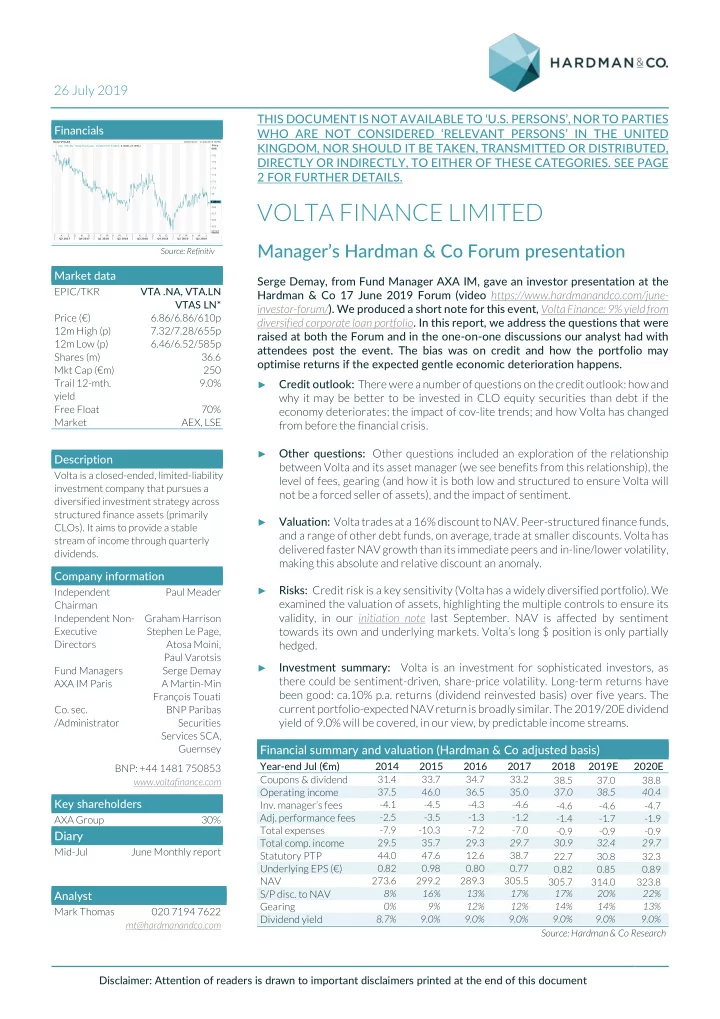
Serge Demay, from Fund Manager AXA IM, gave an investor presentation at the Hardman & Co 17 June 2019 Forum (video https://www.hardmanandco.com/june- investor-forum/). We produced a short note for this event, Volta Finance: 9% yield from diversified corporate loan portfolio. In this report, we address the questions that were raised at both the Forum and in the one-on-one discussions our analyst had with attendees post the event. The bias was on credit and how the portfolio may

  • ptimise returns if the expected gentle economic deterioration happens.

Credit outlook: There were a number of questions on the credit outlook: how and why it may be better to be invested in CLO equity securities than debt if the economy deteriorates; the impact of cov-lite trends; and how Volta has changed from before the financial crisis.

Other questions: Other questions included an exploration of the relationship between Volta and its asset manager (we see benefits from this relationship), the level of fees, gearing (and how it is both low and structured to ensure Volta will not be a forced seller of assets), and the impact of sentiment.

Valuation: Volta trades at a 16% discount to NAV. Peer-structured finance funds, and a range of other debt funds, on average, trade at smaller discounts. Volta has delivered faster NAV growth than its immediate peers and in-line/lower volatility, making this absolute and relative discount an anomaly.

Risks: Credit risk is a key sensitivity (Volta has a widely diversified portfolio). We examined the valuation of assets, highlighting the multiple controls to ensure its validity, in our initiation note last September. NAV is affected by sentiment towards its own and underlying markets. Volta’s long $ position is only partially hedged.

Investment summary: Volta is an investment for sophisticated investors, as there could be sentiment-driven, share-price volatility. Long-term returns have been good: ca.10% p.a. returns (dividend reinvested basis) over five years. The current portfolio-expected NAV return is broadly similar. The 2019/20E dividend yield of 9.0% will be covered, in our view, by predictable income streams. Financial summary and valuation (Hardman & Co adjusted basis)

Year-end Jul (€m) 2014 2015 2016 2017 2018 2019E 2020E Coupons & dividend 31.4 33.7 34.7 33.2 38.5 37.0 38.8 Operating income 37.5 46.0 36.5 35.0 37.0 38.5 40.4

  • Inv. manager’s fees
  • 4.1
  • 4.5
  • 4.3
  • 4.6
  • 4.6
  • 4.6
  • 4.7
  • Adj. performance fees
  • 2.5
  • 3.5
  • 1.3
  • 1.2
  • 1.4
  • 1.7
  • 1.9

Total expenses

  • 7.9
  • 10.3
  • 7.2
  • 7.0
  • 0.9
  • 0.9
  • 0.9

Total comp. income 29.5 35.7 29.3 29.7 30.9 32.4 29.7 Statutory PTP 44.0 47.6 12.6 38.7 22.7 30.8 32.3 Underlying EPS (€) 0.82 0.98 0.80 0.77 0.82 0.85 0.89 NAV 273.6 299.2 289.3 305.5 305.7 314.0 323.8 S/P disc. to NAV 8% 16% 13% 17% 17% 20% 22% Gearing 0% 9% 12% 12% 14% 14% 13% Dividend yield 8.7% 9.0% 9.0% 9.0% 9.0% 9.0% 9.0% Source: Hardman & Co Research

26 July 2019

Financials

Source: Refinitiv

Market data

EPIC/TKR VTA .NA, VTA.LN VTAS LN* Price (€) 6.86/6.86/610p 12m High (p) 7.32/7.28/655p 12m Low (p) 6.46/6.52/585p Shares (m) 36.6 Mkt Cap (€m) 250 Trail 12-mth. yield 9.0% Free Float 70% Market AEX, LSE

Description

Volta is a closed-ended, limited-liability investment company that pursues a diversified investment strategy across structured finance assets (primarily CLOs). It aims to provide a stable stream of income through quarterly dividends.

Company information

Independent Chairman Paul Meader Independent Non- Executive Directors Graham Harrison Stephen Le Page, Atosa Moini, Paul Varotsis Fund Managers AXA IM Paris Serge Demay A Martin-Min François Touati

  • Co. sec.

/Administrator BNP Paribas Securities Services SCA, Guernsey BNP: +44 1481 750853 www.voltafinance.com

Key shareholders

AXA Group 30%

Diary

Mid-Jul June Monthly report

Daily VTA.AS 26/06/2017 - 21/06/2019 (AMS) Line, VTA.AS, Trade Price(Last), 25/06/2019, 6.8800, 0.0000, (0.00%) Price EUR Auto 6.5 6.6 6.7 6.8 6.9 7 7.1 7.2 7.3 7.4 7.5 7.6 6.8800 J A S O N D J F M A M J J A S O N D J F M A M J Q3 2017 Q4 2017 Q1 2018 Q2 2018 Q3 2018 Q4 2018 Q1 2019 Q2 2019
slide-2
SLIDE 2

VOLTA FINANCE LIMITED

26 July 2019 2

IMPORTANT INFORMATION

Due to legal restrictions, the information in this document is not available to any person who is a “U.S. person” (as defined below) or to any person who is physically present in the United States, and it is available only to persons who are "relevant persons" (as defined below) for U.K. regulatory purposes. A “U.S. person” is:

any natural person resident in the United States;

any partnership or corporation organised or incorporated under the laws of the United States;

any estate of which any executor or administrator is a “U.S. person”;

any trust of which any trustee is a “U.S. person”;

any agency or branch of a foreign entity located in the United States;

any non-discretionary account or similar account (other than an estate or trust) held by a dealer or other fiduciary for the benefit or account of a “U.S. person”;

any discretionary account or similar account (other than an estate or trust) held by a dealer or other fiduciary organised, incorporated, or (if an individual) resident in the United States; and

any partnership or corporation if:

  • rganised or incorporated under the laws of any foreign jurisdiction; and

formed by a “U.S. person” principally for the purpose of investing in securities not registered under the U.S. Securities Act, unless it is organised or incorporated, and owned, by accredited investors (as defined in the rules of the U.S. Securities and Exchange Commission) who are not natural persons, estates or trusts. “Relevant persons” are (i) persons who are outside the United Kingdom or (ii) investment professionals falling within Article 19(5) of the Financial Services and Markets Act 2000 (Financial Promotion) Order 2005 (the "Order") or (iii) high net worth companies, and other persons to whom it may lawfully be communicated, falling within Article 49(2) (a) to (d) of the Order. The securities of the Company are only available to, and any invitation, offer or agreement to subscribe, purchase

  • r otherwise acquire such securities will be engaged in only with, relevant persons.

Any person who is not a relevant person should not access, or seek to act or rely

  • n, this report or any of its contents.

This document should not be taken, transmitted or distributed, directly or indirectly, to “U.S. persons” as defined above nor to parties that are not “relevant persons” as defined above. In reading this document the readers also acknowledge that they have read and understood the notices set forth above and the disclaimers contained in the document. If you are not a ‘relevant person’ or you are a “U.S. person”, you should not have received or accessed this document and accordingly should return this document as soon as possible and take no further action. Any investment or investment activity to which this document relates is only available to “relevant persons”. By accepting receipt of this document, each recipient is deemed to confirm, represent and warrant to Hardman & Co that it is a “relevant person” and that it is not a “US person”, and accordingly a person to whom this document can be lawfully communicated.

slide-3
SLIDE 3

VOLTA FINANCE LIMITED

26 July 2019 3

Questions from Hardman & Co Forum

Open forum

The manager’s response to the first four questions can be seen on the video link. https://www.hardmanandco.com/june-investor-forum/.

What happens if you become a forced seller of assets? What proportion could you hold to maturity?

In Volta, there is almost no leverage, and so it is extremely unlikely to be a forced seller. There is no redemption pressure, given the permanent capital of a closed-ended structure and limited gearing. The operating cashflow is around 14% of NAV every year, and there is further cash generated from maturing positions (the portfolio has a short duration of around three years). The sole leverage is a repurchase agreement (providing $40m of financing), which is more than covered by the operating cashflows. In the last 12 months, €120m of cash was generated from the portfolio of ca.€300m. Volta should benefit from volatility when re-deploying cash. Hardman & Co Comment: we discussed gearing on page 40 of our initiation report, noting “The Repo is likely to be stopped by Volta if it asset allocates away from US CLO debt or if there were to be a financial crisis resulting in Volta wanting to reduce risk. In such an event, the collateral is repurchased in three stages: one-third after six calendar months; one-third after nine calendar months; and the final third after 12 calendar

  • months. The timing of repayments means the $40m facility should be repaid from cash

Volta expects to generate in interest, dividend and principal repayments over this

  • timescale. It can thus meet its obligations without being forced to sell assets in a crisis

scenario”. The latest monthly report shows the drawn facility is just €36m – 11% of the portfolio’s gross assets.

Why are you increasing percentage in CLO equity? What are the risks of doing that?

Volta has invested in CLO equity for many years. Looking forward, AXA IM expects more volatility on credit, and one way to benefit is to invest in CLO equity. New CLO equity benefits from higher re-investment returns, while in CLO debt, there is no upside, although the potential mark-to-market drawdown of CLO BB debt and CLO equity might be comparable when incorporating the cashflows that are generated from both types of instruments. The manager recognised that this might appear counter-intuitive, but noted that the actual returns from CLO equity issued just before the financial crisis were around twice those of CLOs equity tranches issued in the years before (see table below). US CLO tranches median annual IRR to June 2017 (%)

Vintage 2001 2002 2003 2004 2005 2006 2007 Wells Fargo Market Data 7.6 10.5 3.6 8.0 14.2 16.4 17.7 AXA IM 16.2 20.4 10.9 12.2 14.9 18.4 21.2 Source: AXA IM

Hardman & Co Comment: we discussed a financial crisis scenario on pages 34 to 35

  • f our initiation report and the impact of a more moderate economic decline in our note,

Investment opportunities at this point of the cycle, published on 14 January 2019. We believe the manager has the necessary experience through the cycle and note the higher returns earned from CLOs issued in the financial crisis. We also believe that the increasing prevalence of “Cov-Lite” documentation, while it will increase the loss in the

Will not be forced seller, as very limited gearing and massive cash generation We agree Volta should not be forced seller and highlight structuring of its Repos funding to ensure this is the case CLO equity can generate incremental returns in times of credit volatility

slide-4
SLIDE 4

VOLTA FINANCE LIMITED

26 July 2019 4 event of default, also reduces the probability of default. It is also expected that this prevalence will increase the volatility in the loan market, having a positive impact on CLO manager ability to create value for the equity position through loan purchases at

  • discount. A lower incidence of default means that the excess sentiment-driven

downside seen in the past may not recur to the same degree in the next downturn.

Fee structure

1.5% of investments Hardman & Co Comment: we discussed fees on page 42 of our initiation report, in which we highlighted that the fees were in line with those of peers. We note that the return of ca.10% p.a. over five years is after these fees have been paid.

Relationship with Axa?

AXA IM is the investment manager for Volta. It manages AXA money as well, with global AUM of ca.€760bn. In the Structured Finance Department, AUMs are north of €40bn. Hardman & Co comment: We discussed the relationship in detail on pages 9 to 10 of

  • ur initiation report. We note the advantages in terms of the following: i) AXA IM’s scale

in structured finance gives greater access and pricing power when negotiating investments; ii) the Volta investment team is physically close to AXA’s CLO managing team, and so derives immediate market intelligence, which can be especially important in times of stress; and iii) the broader AXA IM team has the scale to invest in specialist

  • skills. With regard to the last point, we note that AXA IM has a structuring team of 17,

meaning there are few CLO structures that it is unable to analyse thoroughly. Getting into the detail of a deal is essential to appreciate when it is being mis-priced (or not). The Volta team also has access to AXA IM’s risk department, which regularly reviews valuation assumptions for reasonableness. With regard to potential conflicts of interest with other AXA IM structured funds, there are clear policies to manage this process, and we understand that the Volta Board sees trades retrospectively (unless there are “restricted assets”, which it sees in advance).

Post-forum 1-on-1 discussions with Hardman & Co analyst

In the informal session after the presentations, the following questions were raised with the Hardman & Co analyst by attendees:

How can equity tranches add value in downturn scenarios?

We referred the attendees to our four-page forum note and, in particular, the simple CLO structure copied below. Should the spread on each of the loans increase by, say, 1.5% to 7.5%, but the cost of credit rise by 1% of loans, the return to equity holders would rise from 20% to 25%. This is, of course, very simplistic:

sentiment could also affect the marking to market valuations; and

it clearly depends on the price at which CLO equity positions are being bought and what the market has built into the valuation.

We see competitive advantage in relationship with Axa from tapping into its scale and expertise In downturns, spreads will widen. If gentle and the right CLO vehicles picked, this incremental income can be larger than credit losses

slide-5
SLIDE 5

VOLTA FINANCE LIMITED

26 July 2019 5

Simplified example of a CLO structure

Source: Hardman & Co Research

With these caveats, investing in CLO equity when anticipating more volatility and spread- widening in the loan market, in conjunction with some credit stress, results in making the assumption that, as has always been seen, credit markets (especially the loan markets) will overreact. CLO equities are expected to benefit more from reinvestments in loans at a discount or in new loans with higher spread than the losses that may happen in the underlying loan pools. We believe that to exploit the potential

  • pportunity requires considerable skill, market knowledge and experience from the

manager in picking which CLO vehicle would see the greatest uplift in income and the least increase in impairment. Getting the balance right is critical and plays exactly into the hands of a major player such as AXA IM for all the reasons above. Readers may consider the table on page 3 of this note as proof of the consistent outperformance AXA IM has delivered relative to the market, and evidence that it has the skills, market knowledge and experience to take this opportunity.

What is sentiment impact over real economic changes, especially in a financial crisis scenario?

In our initiation report, we noted that the share price fell from of €9.8 in January 2007 to a trough of €0.38 in November 2008 (i.e. a fall of 96%), but the shares then increased tenfold to ca.€4 by the start of 2011. We also noted that, in terms on NAV in FY’08 and FY’09, Volta reported losses of €71m and €98m, respectively – nearly two-thirds of the shareholders’ FY’18 opening equity position (i.e. well below the share price fall). Profits quickly recovered (FY’10 €40m, FY’11 €31m, FY’12 €51m, i.e. 72% of FY’08-09 losses), with the reversal of many of the provisions/losses taken in the financial crisis reflecting the sentiment impact on the NAV, as well as the discount. There is a totally different portfolio now, with the management and market having been through the crisis, and, as we note below, sentiment is unlikely to play out in the same way. It is a strong belief of the AXA IM Structured Finance department that the environment from Volta’s main asset class, CLO, is totally different from the one that

Axa IM great record on picking CLO structure with good credit track records Portfolio changed enormously since financial crisis. Worth noting that sentiment saw increase in both NAV and share price volatility last time round.

slide-6
SLIDE 6

VOLTA FINANCE LIMITED

26 July 2019 6 existed in 2006/2007, and that this asset class will be far less volatile (ceteris paribus) than what was observed in 2008/2009.

Evolution of portfolio since financial crisis

Source: Volta, Hardman & Co Research

How will more cov-lite loans impact on Volta?

Attendees wanted to explore in more detail how a well-publicised trend towards weaker covenants (favouring borrowers over lenders) could possibly be a positive for

  • lenders. In particular, the Hardman & Co analyst noted anecdotal evidence from a

senior credit executive in a major bank (and confirmed by multiple other sources) that there was intense pressure to accept i) more “adjustments” to the adjusted EBITDA covenants, and ii) greater flexibility in asset sales. The combination of these changes is such that the effective enforceability was viewed by the credit executive as being weaker than in 2007. We believe investors in Volta need to break up the impact of these changes into the two key credit loss determinants. It is highly likely that the loss suffered by a lender will be greater in the event of a default. The lender’s position has been weakened. However, investors also need to consider what the probability is of default, and the key considerations here are as follows.

Having covenants that are weaker/give the borrower more flexibility means that the company is less likely to hit a default event.

In addition to the absolute quantum of fewer default events, there is also a timing

  • issue. Potential defaults may occur later in the cycle than they otherwise would.

This is important, as government/central bank policy changes to address a slowdown may be more effective at saving companies if they have longer to take effect.

The continuation of zombie companies for a longer time period may see a greater number of them subject to takeover by financially stronger companies, or allow time for more restructuring.

It is unclear whether companies that would not otherwise be able to get credit do so because of the weaker covenants. 0% 20% 40% 60% 80% 100%

Jan-07 Aug-07 Mar-08 Oct-08 May-09 Dec-09 Jul-10 Feb-11 Sep-11 Apr-12 Nov-12 Jun-13 Jan-14 Aug-14 Mar-15 Oct-15 May-16 Dec-16 Jul-17 Feb-18 Sep-18 CLO Equity CLO Debt Loans TRS/Warehouse Other CDO Synthetic Corp Credit ABS Cash Cov-lite structures are more prevalent and favour borrowers over lenders However, impact is unclear. They will see greater losses in the event of default but, critically, also likely to see fewer events of

  • default. Latter very important in reducing

sentiment-driven volatility.

slide-7
SLIDE 7

VOLTA FINANCE LIMITED

26 July 2019 7 Our conclusion is that, for a given economic pattern, the probability of default is lower, but that the loss in the event of default is higher. At this stage, it is too early to know whether the ultimate economic loss will be different (Volta’s management’s view is that the net effect will be modest). We do believe that sentiment will be positively affected. Fewer defaults are likely to see less adverse sentiment than a greater number of defaults. Given that we believe both the NAV and the discount are sensitive to sentiment, we consider the outlook is for less sentiment-driven volatility as a consequence of more cov-lite lending.

How does Volta assess 700+ corporate credits?

The cashflows to pay Volta’s dividend are generated by the underlying debt of over 700 corporates creating a significant diversification benefit. There is some volatility from which instruments are chosen, but credit risk is key to the ultimate returns, and this is highly diversified. The largest single underlying exposure is just 0.69% of NAV, and the top five are just 2.1% of NAV. Volta does not undertake the credit assessment itself on all the 700+ credit, but it takes care to assess the most sensitive one. Overall, it is reliant on the credit assessment of the CLO managers in whose securities it is investing. The skill then is not direct credit management but, rather, assessing the credit skills of each CLO

  • manager. This is clearly dependent on experience and market information, as well as

dynamics, such as portfolio analysis. We reviewed credit risk management on pages 31 to 36 of our initiation report. The key conclusions were that Volta’s underlying loss ratio has been well below i) historical averages, ii) those assumed by forecast modelling, and iii) the market losses in similar loan tranches. Volta also reported that there were several CLO equity positions purchased a few years ago that have still not suffered any default at all.

How are conflicts of interest with AXA IM managed?

We detailed the points in the section on the relationship with AXA IM above, and we emphasise the importance of having a heavy-weight board with significant and direct

  • experience. Volta’s board is, in our view, one that would challenge the IM if there were

any signs of a conflict of interest. There is no double-counting of fees, and when Volta purchases an asset that is providing fees to AXA IM, there is a strong process in place to demonstrate to the Board that this investment is comparable with another investment that Volta could have done with another manager, and avoiding double- counting of fees.

What happens if AXA IM strategically reduces commitment to structured finance

We outlined the advantages from having the relationship with AXA IM above, but as Volta does not “control” the manager, it introduces a risk that AXA, as a group strategy, could withdraw from the structured finance market, leaving Volta with a portfolio that requires considerable skill and expertise to be managed for optimal returns. We note the following.

The probability of a market leader withdrawing from a business line that it managed through the financial crisis appears low. We suspect that the circumstances when such an event was likely to happen would have to be so dire that a holding in Volta would be the least of an investor’s concerns.

There are alternative managers in this space. Carador announced it was winding down in August 2018 – its performance had been significantly weaker than that

  • f Volta, and the fund was perceived as sub-scale. The announcement stated,

”Given the interest expressed by a number of shareholders to retain an exposure to CLOs, the Board intends to offer all shareholders, including CIFR shareholders,

Underlying portfolio is highly diversified Volta does not assess credits individually but has shown great track record in picking the right CLO manager to limit losses We do not believe AXA IM is likely to withdraw from structured finance. Even if it were to do so, there are other providers, and the duration of the book is relatively short.

slide-8
SLIDE 8

VOLTA FINANCE LIMITED

26 July 2019 8 an opportunity to elect to roll over their holding in the Company's shares into Blackstone / GSO Loan Financing Limited …. It is envisaged that BGLF would acquire part of the Company's portfolio of CLO assets and would not hold any interest in the Company's shares.”

The relatively short duration of the book is likely to see a significant element of the portfolio converted to cash quickly. We believe such an outcome is extremely unlikely but, even in this downside scenario, there are protections.

slide-9
SLIDE 9

VOLTA FINANCE LIMITED

26 July 2019 9

Valuation

Discount to NAV

Compared with its structured debt peers, on market price to NAV, Volta is trading at a material discount. While the relative discount has moderated somewhat over the past year, given the historical performance, risk profile and portfolio mixes identified in the sections below, this relative discount appears anomalous. Current share price discount to May NAV for Volta and peers

Source: Hardman & Co Research Monthly reports for Volta (VTA), TwentyFour Income Fund (TFIF), Fair Oaks Income Fund (FAIR), Blackstone/GCO Loan Financing Ltd (BGLF) and Marble Point Loan Financing; priced 20 June 2019

Triggers for market re-evaluation of discount

The share price discount to NAV is wider than long-term historical and peer average

  • levels. This could reflect a number of possible drivers, each of which we discuss below.

We believe that the most likely driver of long-term share price growth, and a reduction in the discount to NAV, is the delivery of the expected total shareholder returns and the market having greater confidence in their sustainability over the medium term. Looking at the portfolio as it stands, the most critical feature will be delivery of returns as credit default increases. As discussed earlier, in the near term, a modest deterioration of credit is likely to see much greater opportunities for higher-return re- investment, as the yield of all loans will increase. In addition to this macro development, we note the following.

The Board has taken several steps to broaden knowledge of the company and so ensure that there is a better understanding of the real (NAV) volatility. The UK listing (VTA) was partially to do this, and saw a positive reaction. On 3 September 2018, Volta added a sterling listing (VTAS) to its Euro listing on the UK exchange. We note that Volta has recently engaged multiple sponsored research houses to distribute the message to the widest possible audience. We sense that the Board has an appetite to expand the fund, which should materially assist with the limited share price liquidity and, with that, we expect an active engagement with existing and potential shareholders in a range of forums. Improving awareness and the associated liquidity should help reduce the discount.

  • 18.0%
  • 16.0%
  • 14.0%
  • 12.0%
  • 10.0%
  • 8.0%
  • 6.0%
  • 4.0%
  • 2.0%

0.0% 2.0% 4.0% VTA BGLF FAIR MPLF Sub sector Avg TFIF

Discount materially larger than peers in structured debt fund space Historically, dramatic reductions in discount to NAV generated by share price increases; these have been driven by a mix

  • f market sentiment and company-

specific issues. Broadening awareness of Volta

slide-10
SLIDE 10

VOLTA FINANCE LIMITED

26 July 2019 10 We note Volta’s announcement on 11 December 2018 that, after due enquiry, it was the opinion of the Board that the company’s shares qualified as an “excluded security” under the non-mainstream pooled investments ("NMPI") rules, and were thus excluded from the FCA’s restrictions applying to NMPIs. The Board believes, therefore, that independent financial advisers can recommend the company’s shares to retail investors (although this comes with the usual legal caveat that financial advisers should seek their own advice on this issue).

The Key Information Document disclosure may be a relative dis-incentive to potential investors, with Volta having a longer hold period and greater sensitivity than peers. As noted above, the historical NAV performance does not justify the historical share price volatility. As the market gets a broader appreciation of how Volta’s multi-manager approach has delivered, and is likely to deliver, returns, there might be less share price volatility and Key Information Document (KID) disclosure more in line with peers.

The discount could reflect concerns that the NAV is not truly representative of the value of the business, because the modelling/valuation assumptions do not reflect a realisable value. We detailed in our initiation note of September 2018 why we believe Volta adopts appropriate valuation techniques. It is worth noting that the most illiquid assets, for which modelling is important, form a lower proportion

  • f the group than is the case for most of Volta’s peers.

The Board is active in its consideration of a tender at NAV/repurchases in the market (which would be at a significant discount to NAV if executed at current prices). It says it will use such discount control measures if it believes them to be in the best interests of shareholders, noting “these mechanisms can be a double- edged sword”. On the upside, it creates a buyer for the shares, and it could be perceived as putting a cap on the discount, which the market might then close

  • itself. It is likely to reduce the discount in the short term. On the downside, it could

create liquidity problems, the capital could be better deployed in the fund (subject to the level of discount), it shrinks the business, and so worsens the total expense ratio, and it sends a very mixed message, especially if, as seems likely over the medium term, Volta has new investment opportunities and comes to market for further equity funding. Accordingly, we note that the policy, as described in the 2018 R&A, is to “make the Company more attractive to new investors”. We believe the Board would use a buyback as part of a long-term strategy, rather than a short-term “sticking plaster”.

Volta has delivered faster NAV growth than its marking-to-market peers since the end of 2017, suggesting that its portfolio positioning with less CLO equity does not justify a discount. Further delivery of returns could trigger a rating re- evaluation.

We believe that performance over the past five years (ca. 10% p.a.) reflects the favourable macroeconomic environment, with limited credit defaults, CLO debt, which had been purchased at a discount being redeemed at par, and positive sentiment towards CLO investment generally. Looking forward, while Volta has accessed high-return re-investments, it might take delivery of NAV to convince all in the market that such returns are sustainable. This might take more time (and effort) than Volta benefiting from the rising sentiment in good markets.

On 11 December 2018, Volta announced it believed it was an excluded security under NMPI rules, and so IFAs could recommend it to retail shareholders. Volta KID disclosure not driven by business performance. Greater understanding of the business could see less share price volatility. Checks and balances in place to ensure validity of monthly NAV. Less reliant than some on mark-to-model due to both portfolio mix and valuation approaches. Buyback but only as part of long-term programme Volta delivered better short-term returns => portfolio positioning does not justify discount Increased market confidence of sustainability of returns through weaker credit market conditions

slide-11
SLIDE 11

VOLTA FINANCE LIMITED

26 July 2019 11

Financials

We have not changed any of our forecasts with this updated note. Profit & Loss account

Year-end Jul (€m) 2013 2014 2015 2016 2017 2018 2019E 2020E Coupons and dividends received 0.0 31.4 33.7 34.7 33.2 38.5 37.0 38.8 Net gains on sales 0.0 6.1 12.6 2.7 3.1 0.0 3.0 3.0 Unrealised gains and losses 0.0 12.2 21.0

  • 18.5

4.7

  • 5.7

0.0 0.0 Net gain on fin. assets at FV through P/L 79.2 49.7 67.2 18.9 40.9 32.7 40.0 41.8 Net FX

  • 0.5

1.6

  • 8.2

0.3 5.6

  • 2.0

0.0 0.0 Net gain on IR derivatives 2.3

  • 0.3

0.0 0.0 0.4

  • 0.9

0.0 0.0 Interest expense on repo 0.0 0.0

  • 0.2
  • 0.9
  • 1.1
  • 1.4
  • 1.4
  • 1.4

Net bank int. & charges 0.0 0.0 0.0

  • 0.1
  • 0.1
  • 0.1
  • 0.1
  • 0.1

Operating income 81.0 50.9 58.8 18.2 45.7 28.4 38.6 40.4

  • Inv. manager’s fees
  • 2.6
  • 3.6
  • 3.9
  • 4.1
  • 4.1
  • 4.2
  • 4.6
  • 4.7
  • Inv. manager’s performance fees
  • 7.7
  • 1.9
  • 5.0

0.0

  • 1.5

0.0

  • 1.6
  • 1.8

Directors’ renumeration & expenses

  • 0.4
  • 0.4
  • 0.5
  • 0.6
  • 0.5
  • 0.5
  • 0.5
  • 0.5

Other expenses

  • 1.1
  • 1.0
  • 1.8
  • 0.9
  • 0.8
  • 1.0
  • 1.0
  • 1.0

Total expenses

  • 11.8
  • 6.9
  • 11.2
  • 5.6
  • 6.9
  • 5.7
  • 7.8
  • 8.1

Profit and total comp. income 69.2 44.0 47.6 12.6 38.7 22.7 30.8 32.3

  • Avg. no shares for EPS calculation (m)

32.8 36.1 36.5 36.5 36.5 36.56 36.59 36.61 Statutory EPS (p) 2.11 1.22 1.31 0.34 1.06 0.62 0.84 0.88 Total dividend (p) 0.62 0.60 0.62 0.62 0.62 0.62 0.62 0.62 Source: Volta, Hardman & Co Research

To derive our adjusted profit and loss, we strip out the capital movements, including i) unrealised gains/losses, ii) FX movements, and iii) net gain of IR derivatives. We have left in realised gains, which, although volatile, have been converted into cash, and some capital gains might be expected to form part of the normal course of business. We have also backdated the current management fee structure and adjusted it to the new level

  • f profitability.

Hardman & Co adjusted profit and loss account (€m)

Year-end Jul (€m) 2014 2015 2016 2017 2018 2019E 2020E Coupons and dividends received 31.4 33.7 34.7 33.2 38.5 37.0 38.8 Net gains on sales 6.1 12.6 2.7 3.1 0.0 3.0 3.0 Net gain on fin. assets at FV through P/L 37.5 46.2 37.4 36.2 38.5 40.0 41.8 Interest expense on repo 0.0

  • 0.2
  • 0.9
  • 1.1
  • 1.4
  • 1.4
  • 1.4

Net bank interest & charges 0.0 0.0

  • 0.1
  • 0.1
  • 0.1
  • 0.1
  • 0.1

Operating income 37.5 46.0 36.5 35.0 37.0 38.5 40.4

  • Inv. manager’s fees
  • 4.1
  • 4.5
  • 4.3
  • 4.6
  • 4.6
  • 4.6
  • 4.7
  • Inv. manager’s performance fees
  • 2.5
  • 3.5
  • 1.3
  • 1.2
  • 1.3
  • 1.6
  • 1.8

Directors’ renumeration & expenses

  • 0.4
  • 0.5
  • 0.6
  • 0.5
  • 0.5
  • 0.5
  • 0.5

Other expenses

  • 1.0
  • 1.8
  • 0.9
  • 0.8
  • 0.9
  • 0.9
  • 0.9

Total expenses

  • 7.9
  • 10.3
  • 7.2
  • 7.0
  • 7.2
  • 7.6
  • 7.9

Profit and total comp. income 29.5 35.7 29.3 28.0 29.7 30.9 32.4 Adjusted EPS (€) 0.82 0.98 0.80 0.77 0.81 0.85 0.89 Dividend cover (x) 1.36 1.58 1.29 1.24 1.31 1.36 1.43 Source: Volta, Hardman & Co Research

slide-12
SLIDE 12

VOLTA FINANCE LIMITED

26 July 2019 12

Balance sheet

@ 31 Jul (€m) 2013 2014 2015 2016 2017 2018 2019E 2020E Financial assets at FV through P/L 238.7 256.3 307.3 324.1 321.3 325.7 359.7 367.7 Derivatives 1.6 0.0 0.0 1.2 0.7 1.3 1.3 1.3 Trade and other receivables 0.0 0.0 38.1 5.0 0.3 12.9 2.9 2.9 Cash and cash equivalents 9.7 19.5 0.4 10.9 37.1 20.5 4.8 6.6 Total assets 250.1 275.8 345.8 341.3 359.4 360.4 368.7 378.5 Loan financing under repos 0.0 0.0 27.3 40.3 38.1 42.7 42.7 42.7 Interest payable on loan financing 0.0 0.0 0.1 0.1 0.1 0.2 0.2 0.2 Derivatives 0.0 0.2 0.3 0.0 0.0 0.1 0.1 0.1 Trade and other payables 3.8 2.0 19.0 11.6 15.6 11.7 11.7 11.7 Total liabilities 3.8 2.1 46.6 52.0 53.8 54.7 54.7 54.7 Net assets 246.3 273.6 299.2 289.3 305.5 305.7 314.0 323.8 Period-end no. shares (m) 35.3 36.5 36.5 36.5 36.5 36.6 36.6 36.6 NAV per share (€) 6.97 7.50 8.20 7.92 8.36 8.36 8.58 8.85 Total debt to NAV 0% 0% 9% 12% 12% 14% 14% 13% Source: Volta, Hardman & Co Research

Cashflow

Year-end Jul (€m) 2013 2014 2015 2016 2017 2018 2019E 2020E Total comprehensive income 69.2 44.0 47.6 12.6 38.7 22.7 30.8 32.3 Net gain on financial assets at FV in P/L

  • 79.2
  • 49.7
  • 67.2
  • 18.9
  • 40.9
  • 32.7
  • 40.0
  • 41.8

Net movement in unrealised gain on revln. derivatives

  • 2.3

0.3 0.1

  • 1.5

0.5

  • 0.5

0.0 0.0 Interest expense on repos 0.5

  • 1.6

0.2 0.9 1.1 1.4 1.4 1.4 FX losses on re-translation repos 0.0 0.0

  • 0.9
  • 0.3
  • 2.2

0.4 0.0 0.0 (Increase)/decrease in trade receivables

  • 1.3
  • 1.8

0.0 0.0

  • 0.1

0.1 0.0 0.0 Increase/(decrease) in trade payables 0.1 0.1 2.0

  • 1.5

1.6

  • 1.7

0.0 0.0 Directors/other fees paid in cash 5.4 0.0 0.2 0.1 0.1 0.2 0.2 0.2 Net cash inflow/(outflow) from op activities

  • 7.6
  • 8.6
  • 18.0
  • 8.5
  • 1.0
  • 10.3
  • 7.7
  • 8.0

Cashflow from investing activities 0.0 0.0 0.0 0.0 0.0 0.0 0.0 0.0 Coupons and dividends recd. 32.7 31.4 33.3 33.6 34.4 38.0 36.0 38.8 Change in margin/deriv. sett. 1.7 1.5 0.0 0.0 0.0 0.0 0.0 0.0 Purchase of financial assets

  • 46.5
  • 71.5
  • 99.3
  • 127.0
  • 109.0
  • 138.8
  • 153.8
  • 153.8

Proceeds from sales of financial assets 24.2 72.2 96.9 84.9 125.5 114.2 133.8 148.8 Net cash outflow from investing activities 12.1 33.6 30.9

  • 8.5

50.9 13.4 16.0 33.8 Cashflows from financing activities 0.0 0.0 0.0 0.0 0.0 0.0 0.0 0.0 Dividends paid

  • 15.3
  • 17.0
  • 22.3
  • 22.6
  • 22.7
  • 22.7
  • 22.7
  • 22.7

Net sales of shares 15.8 0.2 0.0 0.0 0.0 0.0 0.0 0.0 Proceeds from repos 0.0 0.0 28.2 13.3 0.0 4.2 0.0 0.0 Interest paid on repos 0.0 0.0

  • 0.1
  • 0.8
  • 1.1
  • 1.3
  • 1.4
  • 1.4

Net cash inflow from financing activities 0.6

  • 16.8

5.8

  • 10.2
  • 23.7
  • 19.7
  • 24.0
  • 24.0

Net increase in cash and cash equivalents 5.1 8.2 18.7

  • 27.2

26.2

  • 16.6
  • 15.7

1.8 Opening cash and cash equivalents 5.2 9.7 19.5 38.1 10.9 37.1 20.5 4.8 Effect of FX

  • 0.5

1.6 0.0 0.0 0.0 0.0 0.0 0.0 Closing cash and cash equivalents 9.7 19.5 38.1 10.9 37.1 20.5 4.8 6.6 Source: Volta, Hardman & Co Research

slide-13
SLIDE 13

VOLTA FINANCE LIMITED

26 July 2019 13

Disclaimer

Hardman & Co provides professional independent research services and all information used in the publication of this report has been compiled from publicly available sources that are believed to be reliable. However, no guarantee, warranty or representation, express or implied, can be given by Hardman & Co as to the accuracy, adequacy or completeness of the information contained in this research and they are not responsible for any errors or omissions or results obtained from use of such

  • information. Neither Hardman & Co, nor any affiliates, officers, directors or employees accept any liability or responsibility in respect of the information which is subject

to change without notice and may only be correct at the stated date of their issue, except in the case of gross negligence, fraud or wilful misconduct. In no event will Hardman & Co, its affiliates or any such parties be liable to you for any direct, special, indirect, consequential, incidental damages or any other damages of any kind even if Hardman & Co has been advised of the possibility thereof. This research has been prepared purely for information purposes, and nothing in this report should be construed as an offer, or the solicitation of an offer, to buy or sell any security, product, service or investment. The research reflects the objective views of the analyst(s) named on the front page and does not constitute investment advice. However, the companies or legal entities covered in this research may pay us a fixed fee in order for this research to be made available. A full list of companies or legal entities that have paid us for coverage within the past 12 months can be viewed at http://www.hardmanandco.com/legals/research-disclosures. Hardman may provide

  • ther investment banking services to the companies or legal entities mentioned in this report.

Hardman & Co has a personal dealing policy which restricts staff and consultants’ dealing in shares, bonds or other related instruments of companies or legal entities which pay Hardman & Co for any services, including research. No Hardman & Co staff, consultants or officers are employed or engaged by the companies or legal entities covered by this document in any capacity other than through Hardman & Co. Hardman & Co does not buy or sell shares, either for their own account or for other parties and neither do they undertake investment business. We may provide investment banking services to corporate clients. Hardman & Co does not make recommendations. Accordingly, they do not publish records of their past

  • recommendations. Where a Fair Value price is given in a research note, such as a DCF or peer comparison, this is the theoretical result of a study of a range of possible
  • utcomes, and not a forecast of a likely share price. Hardman & Co may publish further notes on these securities, companies and legal entities but has no scheduled

commitment and may cease to follow these securities, companies and legal entities without notice. The information provided in this document is not intended for distribution to, or use by, any person or entity in any jurisdiction or country where such distribution or use would be contrary to law or regulation or which would subject Hardman & Co or its affiliates to any registration requirement within such jurisdiction or country. Some or all alternative investments may not be suitable for certain investors. Investments in small and mid-cap corporations and foreign entities are speculative and involve a high degree of risk. An investor could lose all or a substantial amount of his or her investment. Investments may be leveraged and performance may be volatile; they may have high fees and expenses that reduce returns. Securities or legal entities mentioned in this document may not be suitable or appropriate for all investors. Where this document refers to a particular tax treatment, the tax treatment will depend on each investor’s particular circumstances and may be subject to future change. Each investor’s particular needs, investment objectives and financial situation were not taken into account in the preparation of this document and the material contained

  • herein. Each investor must make his or her own independent decisions and obtain their own independent advice regarding any information, projects, securities, tax

treatment or financial instruments mentioned herein. The fact that Hardman & Co has made available through this document various information constitutes neither a recommendation to enter into a particular transaction nor a representation that any financial instrument is suitable or appropriate for you. Each investor should consider whether an investment strategy of the purchase or sale of any product or security is appropriate for them in the light of their investment needs, objectives and financial circumstances. This document constitutes a ‘financial promotion’ for the purposes of section 21 Financial Services and Markets Act 2000 (United Kingdom) (‘FSMA’) and accordingly has been approved by Capital Markets Strategy Ltd which is authorised and regulated by the Financial Conduct Authority (FCA). No part of this document may be reproduced, stored in a retrieval system or transmitted in any form or by any means, mechanical, photocopying, recording or otherwise, without prior permission from Hardman & Co. By accepting this document, the recipient agrees to be bound by the limitations set out in this notice. This notice shall be governed and construed in accordance with English law. Hardman Research Ltd, trading as Hardman & Co, is an appointed representative of Capital Markets Strategy Ltd and is authorised and regulated by the FCA under registration number 600843. Hardman Research Ltd is registered at Companies House with number 8256259. (Disclaimer Version 8 – Effective from August 2018)

Status of Hardman & Co’s research under MiFID II

Some professional investors, who are subject to the new MiFID II rules from 3rd January, may be unclear about the status of Hardman & Co research and, specifically, whether it can be accepted without a commercial arrangement. Hardman & Co’s research is paid for by the companies, legal entities and issuers about which we write and, as such, falls within the scope of ‘minor non-monetary benefits’, as defined in the Markets in Financial Instruments Directive II. In particular, Article 12(3) of the Directive states: ‘The following benefits shall qualify as acceptable minor non-monetary benefits only if they are: (b) ‘written material from a third party that is commissioned and paid for by a corporate issuer or potential issuer to promote a new issuance by the company, or where the third party firm is contractually engaged and paid by the issuer to produce such material on an ongoing basis, provided that the relationship is clearly disclosed in the material and that the material is made available at the same time to any investment firms wishing to receive it or to the general public…’ The fact that Hardman & Co is commissioned to write the research is disclosed in the disclaimer, and the research is widely available. The full detail is on page 26 of the full directive, which can be accessed here: http://ec.europa.eu/finance/docs/level-2-measures/mifid-delegated-regulation-2016- 2031.pdf In addition, it should be noted that MiFID II’s main aim is to ensure transparency in the relationship between fund managers and brokers/suppliers, and eliminate what is termed ‘inducement’, whereby free research is provided to fund managers to encourage them to deal with the broker. Hardman & Co is not inducing the reader of our research to trade through us, since we do not deal in any security or legal entity.

slide-14
SLIDE 14

research@hardmanandco.com 35 New Broad Street London EC2M 1NH www.hardmanandco.com +44(0)20 7194 7622