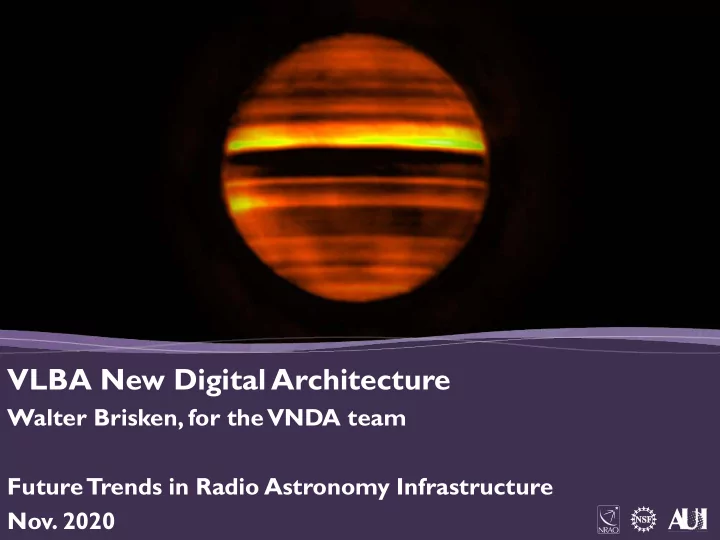
VLBA New Digital Architecture Walter Brisken, for the VNDA team - - PowerPoint PPT Presentation

vlba new digital architecture
SMART_READER_LITE
LIVE PREVIEW

VLBA New Digital Architecture Walter Brisken, for the VNDA team - - PowerPoint PPT Presentation

VLBA New Digital Architecture Walter Brisken, for the VNDA team Future Trends in Radio Astronomy Infrastructure Nov. 2020 Future Trends in Radio Astronomy Instrumentation 1 VLBA New Digital Architecture (VNDA) Project to replace the


slide-1
SLIDE 1

1

Future Trends in Radio Astronomy Instrumentation

VLBA New Digital Architecture

Walter Brisken, for the VNDA team Future Trends in Radio Astronomy Infrastructure

  • Nov. 2020
slide-2
SLIDE 2

2

Future Trends in Radio Astronomy Instrumentation

VLBA New Digital Architecture (VNDA)

  • Project to replace the aging ROACH DBEs

– Sample data – Channelize and quantize for VLBI processing – Time-tag and format – Demodulate “continuous cal” switched power

slide-3
SLIDE 3

3

Future Trends in Radio Astronomy Instrumentation

  • Backwards compatible with existing

VLBA capabilities

  • Provide gateway to higher bandwidths
  • Support for 2, 4, or 8 (maybe 12) bits per sample
  • Timing stability at sample level (no jumps)
  • Support for non-VLBI use
  • E.g., pulsars, spectroscopy, transient searches
  • Some use cases may require user-supplied HW or SW
  • Improve sustainability
  • Improved in RFI tolerance and avoidance
  • Improved compatibility with other VLBI systems
  • Reduced operations footprint
  • Increased maintainability

Requirements and design goals

slide-4
SLIDE 4

4

Future Trends in Radio Astronomy Instrumentation

  • Develop functional (superset) replacement of RDBEs

– Stay focused on core functionality – Provide interfaces for future expansion

  • Replacement system developed to following philosophies
  • Use commercial off-the-shelf (COTS) hardware where possible
  • Use standard interfaces and data formats where possible
  • Self diagnostic capabilities designed in from start
  • MTBF-informed design
  • Consider downstream obsolescence
  • Digitize as close to receivers as possible
  • Use multicast, to allow flexible re-use of signals

Engineering Approach

slide-5
SLIDE 5

5

Future Trends in Radio Astronomy Instrumentation

Project Phases

  • Phase 1: (Complete)
  • Risk reduction
  • Development of design concept
  • Conceptual design review
  • Phase 2: (Oct 2020 to Dec 2021*)
  • Preliminary design
  • One

VLBI baseband mode implemented

  • Zero baseline test
  • Preliminary design review

* timelines are approximate

slide-6
SLIDE 6

6

Future Trends in Radio Astronomy Instrumentation

VNDA-Oryx Project Phases

  • Phase 3: (Jan 2022 to Mar 2023*)
  • Final design
  • Deploy 2 units in field
  • Conduct fringe test
  • Final design review
  • Phase 4: (Apr 2023 to Jun 2024*)
  • Procure and assemble production hardware
  • Install at all sites
  • Commissioning / science verification
  • Offer new capability to users

* timelines are approximate

slide-7
SLIDE 7

7

Future Trends in Radio Astronomy Instrumentation

Major new components

  • Sampler modules, in receiver cabin
  • Creates 4 “digital IFs”, 1024 MHz bandwidth, in

VDIF format

  • 100 Gbps network switch
  • Fabric that connects all signal processing and recording

components

  • Channelizer module
  • Creates digital baseband channels
  • Requantizes to 2 (or other) bits per sample
  • Computes calibration metadata (switched power)
  • Timing module
  • Need repeatable 1 PPS tick and clock signals in receiver

cabin

slide-8
SLIDE 8

8

Future Trends in Radio Astronomy Instrumentation

VNDA Data path

slide-9
SLIDE 9

9

Future Trends in Radio Astronomy Instrumentation

VNDA prototype rack

  • 100 Gbps Switch

– Fiber sources 8500-32c – 32 ports

  • Sampler (Dell R740)

– 2x dual 40Gb NICs – PCI592 w/ sampler module

  • Channelizer (Dell R740)

– PCI592 module – Also GPU

  • Software dev system

– With Xilinx evaluation kit

slide-10
SLIDE 10

10

Future Trends in Radio Astronomy Instrumentation

Make use of commercial equipment

  • Commercial Off-The-Shelf (COTS) hardware, firmware and

software

  • Let industry pay for most of the NRE
  • Buy components with standard interfaces
  • Upgrade in the future with expectation of compatibility
  • Some specific commercial offerings follow

– VNDA not 100% tied to these solutions – Prototype is based on them

slide-11
SLIDE 11

11

Future Trends in Radio Astronomy Instrumentation

slide-12
SLIDE 12

12

Future Trends in Radio Astronomy Instrumentation

Xillybus

  • Commercial solution to FPGA   CPU communication
  • Modern Linux kernels have native support
  • Maps data streams on FPGA to file streams in Linux
  • Demonstrated on

VNDA hardware at nearly full PCIe3 x8 speed

– More than sufficient

  • Supported by a wide array of PCIe FPGA hardware
  • The company has been very supportive in initial development
slide-13
SLIDE 13

13

Future Trends in Radio Astronomy Instrumentation

slide-14
SLIDE 14

14

Future Trends in Radio Astronomy Instrumentation

Sampler module with standard FMC interface

slide-15
SLIDE 15

15

Future Trends in Radio Astronomy Instrumentation

Thanks to the VNDA team!

  • Matt Luce
  • Alan Erickson
  • Sylas Ashton
  • Ephraim Ford
  • Kristin Renda
  • Jon Cooper
  • Jonathan Dooley
slide-16
SLIDE 16

16

Future Trends in Radio Astronomy Instrumentation

science.nrao.edu public.nrao.edu ngvla.nrao.edu

The National Radio Astronomy Observatory is a facility of the National Science Foundation

  • perated under cooperative agreement by Associated Universities, Inc.