
SLIDE 1
Visualizing Quadratics
16-385 Computer Vision (Kris Kitani)
Carnegie Mellon University
Visualizing Quadratics 16-385 Computer Vision (Kris Kitani) - - PowerPoint PPT Presentation
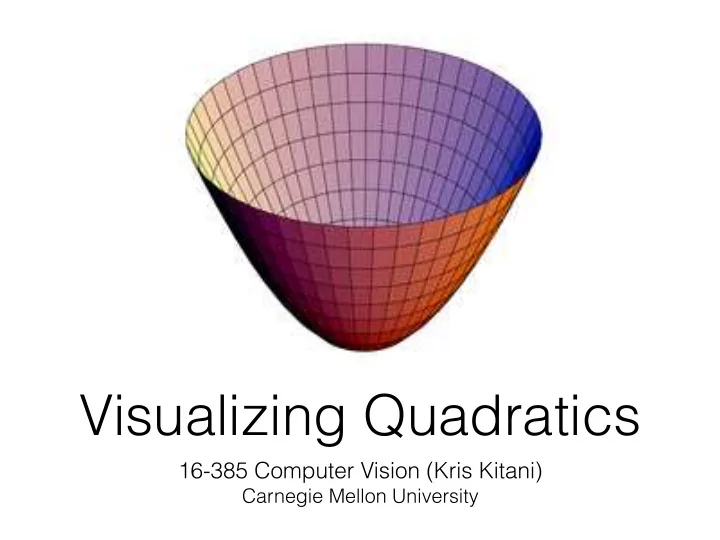
Visualizing Quadratics 16-385 Computer Vision (Kris Kitani) Carnegie Mellon University Equation of a circle 1 = x 2 + y 2 Equation of a bowl (paraboloid) f ( x, y ) = x 2 + y 2 If you slice the bowl at f ( x, y ) = 1 what do you get?
16-385 Computer Vision (Kris Kitani)
Carnegie Mellon University
f(x, y) = x2 + y2 1 = x2 + y2 Equation of a circle Equation of a ‘bowl’ (paraboloid) If you slice the bowl at f(x, y) = 1 what do you get?
f(x, y) = x2 + y2 1 = x2 + y2 Equation of a circle Equation of a ‘bowl’ (paraboloid) If you slice the bowl at f(x, y) = 1 what do you get?
can be written in matrix form like this…
0.5 1 1.5 2 2.5
0.5 1 1.5 2
f(x, y) = ⇥ x y ⇤ 1 1 x y
f(x, y) = ⇥ x y ⇤ 2 1 x y
coefficient on x?
and slice at 1
0.5 1 1.5 2 2.5
0.5 1 1.5 2
f(x, y) = ⇥ x y ⇤ 2 1 x y
coefficient on x?
and slice at 1
decrease width in x!
0.5 1 1.5 2 2.5
0.5 1 1.5 2
f(x, y) = ⇥ x y ⇤ 2 1 x y
coefficient on x?
and slice at 1
decrease width in x! What happens to the gradient in x? increases gradient in x ‘thins the bowl in x’
f(x, y) = ⇥ x y ⇤ 1 2 x y
coefficient on y?
and slice at 1
f(x, y) = ⇥ x y ⇤ 1 2 x y
coefficient on y?
and slice at 1
0.5 1 1.5 2 2.5
0.5 1 1.5 2
decrease width in y
f(x, y) = ⇥ x y ⇤ 1 2 x y
coefficient on y?
and slice at 1
0.5 1 1.5 2 2.5
0.5 1 1.5 2
decrease width in y What happens to the gradient in y?
f(x, y) = ⇥ x y ⇤ 1 2 x y
coefficient on y?
and slice at 1
0.5 1 1.5 2 2.5
0.5 1 1.5 2
decrease width in y What happens to the gradient in y? increases gradient in y ‘thins the bowl in y’
f(x, y) = x2 + y2 can be written in matrix form like this… f(x, y) = ⇥ x y ⇤ 1 1 x y
What are the eigenvectors? What are the eigenvalues?
f(x, y) = x2 + y2 can be written in matrix form like this… f(x, y) = ⇥ x y ⇤ 1 1 x y
1
1 1 1 1 1 1 >
eigenvalues along diagonal eigenvectors
Result of Singular Value Decomposition (SVD)
axis of the ‘ellipse slice’ gradient of the quadratic along the axis
T
! " # $ % & ! " # $ % & ! " # $ % & = ! " # $ % & = 1 1 1 1 1 1 1 1 A
Eigenvalues Eigenvectors Eigenvectors
Eigenvector Eigenvector
x y x y
*not the size of the axis
f(x, y) = ⇥ x y ⇤ 1 1 x y
f(x, y) = ⇥ x y ⇤ 1 4 x y
f(x, y) = ⇥ x y ⇤ 4 1 x y
T
! " # $ % & ! " # $ % & ! " # $ % & = ! " # $ % & = 1 1 1 4 1 1 1 4 A
Eigenvalues Eigenvectors Eigenvectors
Eigenvector Eigenvector
x y x y
*not the size of the axis (inverse relation)
T
! " # $ % & − − − ! " # $ % & ! " # $ % & − − − = ! " # $ % & = 50 . 87 . 87 . 50 . 4 1 50 . 87 . 87 . 50 . 75 . 1 30 . 1 30 . 1 25 . 3 A
Eigenvalues Eigenvectors Eigenvectors
Eigenvector Eigenvector
T
! " # $ % & − − − ! " # $ % & ! " # $ % & − − − = ! " # $ % & = 50 . 87 . 87 . 50 . 10 1 50 . 87 . 87 . 50 . 25 . 3 90 . 3 90 . 3 75 . 7 A
Eigenvalues Eigenvectors Eigenvectors
Eigenvector Eigenvector
(for Harris corners)
The surface E(u,v) is locally approximated by a quadratic form
We will need this to understand…
Since M is symmetric, we have
We can visualize M as an ellipse with axis lengths determined by the eigenvalues and orientation determined by R
direction of the slowest change (smaller gradient) direction of the fastest change (larger gradient)
(λmax)-1/2 (λmin)-1/2
Ellipse equation: ⇥ u v ⇤ M u v
‘isocontour’
but smaller axis
but larger axis