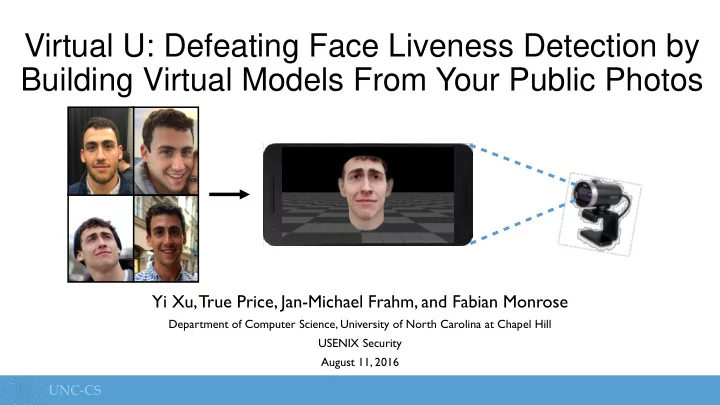
SLIDE 1 Virtual U: Defeating Face Liveness Detection by Building Virtual Models From Your Public Photos
Yi Xu, True Price, Jan-Michael Frahm, and Fabian Monrose
Department of Computer Science, University of North Carolina at Chapel Hill USENIX Security August 11, 2016
SLIDE 2 Face Authentication: Convenient Security
image source
SLIDE 3 Evolution of Adversarial Models
- Attack: Still-image Spoofing
SLIDE 4 Evolution of Adversarial Models
- Attack: Still-image Spoofing
- Defense: Liveness Detection
SLIDE 5 Evolution of Adversarial Models
- Attack: Still-image Spoofing
- Defense: Liveness Detection
- Attack:Video Spoofing
SLIDE 6 Evolution of Adversarial Models
- Attack: Still-image Spoofing
- Defense: Liveness Detection
- Attack:Video Spoofing
- Defense: Motion Consistency
SLIDE 7 Evolution of Adversarial Models
- Attack: Still-image Spoofing
- Defense: Liveness Detection
- Attack:Video Spoofing
- Defense: Motion Consistency
- Attack: 3D-Printed Masks
SLIDE 8
Virtual U: A New Attack
We introduce a new VR-based attack on face authentication systems solely using publicly available photos of the victim
SLIDE 9
Virtual U: A New Attack
Input Web Photos Image-based Texturing
❸
Gaze Correction
❹
Viewing with Virtual Reality System
❻
Landmark Extraction
❶
3D Model Reconstruction
❷
Expression Animation
❺
SLIDE 10
Leveraging Social Media
SLIDE 11
Landmark Extraction
SLIDE 12 3D Face Model
Expression Variation (e.g., frowning-to-smiling) Identity Variation (e.g., thin-to-heavyset)
SLIDE 13 3D Face Model
Expression Variation (e.g., frowning-to-smiling) Identity Variation (e.g., thin-to-heavyset)
𝑇 = 𝑇 + 𝐵𝑗𝑒𝛽𝑗𝑒 + 𝐵𝑓𝑦𝑞𝛽𝑓𝑦𝑞 𝑇 𝐵𝑗𝑒 𝐵𝑓𝑦𝑞
SLIDE 14 𝑇
3D Face Model
𝑇 = 𝑇 + 𝐵𝑗𝑒𝛽𝑗𝑒 + 𝐵𝑓𝑦𝑞𝛽𝑓𝑦𝑞
Reprojection
SLIDE 15
3D Face Model
𝑇 = 𝑇 + 𝐵𝑗𝑒𝛽𝑗𝑒 + 𝐵𝑓𝑦𝑞𝛽𝑓𝑦𝑞
Pose 𝛽𝑗𝑒 𝛽𝑓𝑦𝑞
SLIDE 16
3D Face Model
𝑇 = 𝑇 + 𝐵𝑗𝑒𝛽𝑗𝑒 + 𝐵𝑓𝑦𝑞𝛽𝑓𝑦𝑞
Pose 𝛽𝑗𝑒 𝛽𝑓𝑦𝑞
SLIDE 17
3D Face Model
𝑇 = 𝑇 + 𝐵𝑗𝑒𝛽𝑗𝑒 + 𝐵𝑓𝑦𝑞𝛽𝑓𝑦𝑞
Pose 𝛽𝑗𝑒 𝛽𝑓𝑦𝑞
SLIDE 18
3D Face Model
SLIDE 19
3D Face Model
SLIDE 20
3D Face Model
SLIDE 21
3D Face Model
Pose 𝛽𝑓𝑦𝑞 Pose 𝛽𝑓𝑦𝑞 Pose 𝛽𝑓𝑦𝑞 Pose 𝛽𝑓𝑦𝑞 𝛽𝑗𝑒
SLIDE 22
Multi-Image Modeling
Single image Multiple images
SLIDE 23
Texturing
Direct T exturing 2D Poisson Editing
SLIDE 24
Texturing
Direct T exturing 2D Poisson Editing 3D Poisson Editing
SLIDE 25 Gaze Correction
R G B G B R
SLIDE 26
Gaze Correction
SLIDE 27
Virtual U: A New Attack
Input Web Photos Image-based Texturing
❸
Gaze Correction
❹
Viewing with Virtual Reality System
❻
Landmark Extraction
❶
3D Model Reconstruction
❷
Expression Animation
❺
SLIDE 28
Expression Animation
Smiling Laughing Blinking Raising Eyebrows 𝑇 = 𝑇 + 𝐵𝑗𝑒𝛽𝑗𝑒 + 𝐵𝑓𝑦𝑞𝛽𝑓𝑦𝑞
SLIDE 29
VR Display
Authentication Device Printed Marker VR System
SLIDE 30
VR Display
SLIDE 31
Experiments
Motion-based liveness detection Interaction-based liveness detection Texture-based liveness detection BioID KeyLemon Mobius TrueKey 1U
* *
SLIDE 32 Experiments
- 20 participants
- Aged 24 to 44
- 14 males, 6 females
- Various ethnicities
- Two tests
- Indoor photo of the subject in the same environment as registration
- Publicly accessible photos
- Anywhere from 3 to 27 photos per person
- Low-, medium-, and high-quality
- Potentially strong changes in appearance over time
SLIDE 33 Experiments
BioID KeyLemon Mobius TrueKey 1U
Indoor Image (Single frontal image)
100% 100% 100% 100% 100%
Online
85% 1.6 80% 1.5 70% 1.3 55% 1.7 0%
SLIDE 34 Observations
- Medium- and high-resolution photos work best
- Photos from professional photographers (weddings, etc.)
- Only a small number of photos required
- One or two forward-facing photos
- One or two higher-resolution photos
- Group photos provide consistent frontal views
- Often lower resolution
SLIDE 35
Experiments
How does resolution affect reconstruction quality?
SLIDE 36
Experiments
How does rotation affect reconstruction quality?
SLIDE 37
Experiments
Combining high-res rotation with low-res front-facing? +
SLIDE 38 Experiments
against liveness detection
SLIDE 39 Experiments
against liveness detection
motion consistency
SLIDE 40 Experiments
- “Seeing Your Face is Not Enough: An Inertial Sensor-Based Liveness
Detection for Face Authentication” (Li et al., ACM CCS’15)
- Device motion measured by inertial sensor data
- Head pose estimated from input video
- Train a classifier to identify
real data (correlated signals) versus spoofed video data
SLIDE 41
Experiments
Training Data (Pos. Data vs. Neg. Data)
T est Result (Accept Rate)
Real Face Video Spoof
VR Spoof
Real vs. Video
98.0% 1.0% 99.5%
SLIDE 42
Experiments
Training Data (Pos. Data vs. Neg. Data)
T est Result (Accept Rate)
Real Face Video Spoof
VR Spoof
Real vs. Video
98.0% 1.0% 99.5%
Real vs. Video +VR
67.0% 0.0% 50.0%
SLIDE 43 Experiments
Training Data (Pos. Data vs. Neg. Data)
T est Result (Accept Rate)
Real Face Video Spoof
VR Spoof
Real vs. Video
98.0% 1.0% 99.5%
Real vs. Video +VR
67.0% 0.0% 50.0% Real vs. VR 67.0%
SLIDE 44 Mitigations
- Alternative/additional hardware
- Infrared imaging (e.g. Windows Hello)
- Random structured light projection
image source
SLIDE 45 Mitigations
- Alternative/additional hardware
- Infrared imaging (e.g. Windows Hello)
- Random structured light projection
- Improved defense against
low-resolution synthetic textures
Original Downsized to 50px
SLIDE 46 Conclusion
VR-based attack on face authentication systems solely using publicly available photos of the victim
- This attack bypasses existing defenses of liveness detection and
motion consistency
- At a minimum, face authentication software must improve against VR-
based attacks with low-resolution textures
- The increasing ubiquity of VR will continue to challenge computer-
vision-based authentication systems
SLIDE 47
Thank you!
Questions?
SLIDE 48
SLIDE 49 Overview
- Face Authentication
- Virtual U: A
VR-based attack
- Evaluation
- Mitigations
- Conclusion
SLIDE 50 Evolution of Adversarial Models
- Attack: Still-image Spoofing
- Defense: Liveness Detection
- Attack:Video Spoofing
- Defense: Motion Consistency
- Attack: 3D-Printed Masks
- Defense: Texture Detection
SLIDE 51 3D Face Model
Expression Variation (e.g., frowning-to-smiling) Identity Variation (e.g., thin-to-heavyset)
SLIDE 52 3D Face Model
Expression Variation (e.g., frowning-to-smiling) Identity Variation (e.g., thin-to-heavyset)
𝑇 = 𝑇 + 𝐵𝑗𝑒𝛽𝑗𝑒 + 𝐵𝑓𝑦𝑞𝛽𝑓𝑦𝑞 𝑇 𝐵𝑗𝑒 𝐵𝑓𝑦𝑞
SLIDE 53 𝑇
3D Face Model
𝑇 = 𝑇 + 𝐵𝑗𝑒𝛽𝑗𝑒 + 𝐵𝑓𝑦𝑞𝛽𝑓𝑦𝑞
Reprojection
min
𝑄,𝛽𝑗𝑒,𝛽𝑓𝑦𝑞 𝑗
𝑡𝑗 − 𝑄𝑇𝑗
2 + 𝛾𝑗𝑒 𝛽𝑗𝑒 2 + 𝛾𝑓𝑦𝑞 𝛽𝑓𝑦𝑞 2
Normalization Pose Summed over all landmarks
SLIDE 54
3D Face Model
SLIDE 55 Multi-Image Modeling
min
𝑄,𝛽𝑗𝑒,𝛽𝑓𝑦𝑞 𝑗
𝑡𝑗 − 𝑄𝑇𝑗
2 + 𝛾𝑗𝑒 𝛽𝑗𝑒 2 + 𝛾𝑓𝑦𝑞 𝛽𝑓𝑦𝑞 2
Single Image
min
𝑄,𝛽𝑗𝑒,𝛽𝑓𝑦𝑞 𝑛 𝑗
𝑡𝑛𝑗 − 𝑄
𝑛𝑇𝑛𝑗 2 + 𝛾𝑗𝑒 𝛽𝑗𝑒 2 + 𝛾𝑓𝑦𝑞 𝑛
𝛽𝑛
𝑓𝑦𝑞 2
Multiple Images
Sum over all images
SLIDE 56
Multi-Image Modeling
Corners of the eyes and mouth are stable landmarks Contour points are variable landmarks
SLIDE 57 Multi-Image Modeling
min
𝑄,𝛽𝑗𝑒,𝛽𝑓𝑦𝑞 𝑛 𝑗
𝑡𝑛𝑗 − 𝑄
𝑛𝑇𝑛𝑗 2 + 𝑜𝑝𝑠𝑛.
Multiple Images
min
𝑄,𝛽𝑗𝑒,𝛽𝑓𝑦𝑞 𝑛 𝑗
1 𝜏𝑗
𝑡 2 𝑡𝑛𝑗 − 𝑄 𝑛𝑇𝑛𝑗 2 + 𝑜𝑝𝑠𝑛.
Multiple Images with Landmark Weighting
Higher weighting for stable landmarks
SLIDE 58
SLIDE 59
SLIDE 60 Experiments
- 20 participants
- Aged 24 to 44
- 14 males, 6 females
- Various ethnicities
- Two tests
- Indoor photo of the subject in the same environment as registration
- Publicly accessible photos
- Anywhere from 3 to 27 photos per person
- Low-, medium-, and high-quality
- Potentially strong changes in appearance over time
SLIDE 61 Experiments
How does rotation affect reconstruction quality?
20 30 40 20 30 40
SLIDE 62
Experiments
Authentication Device VR System Google Cardboard