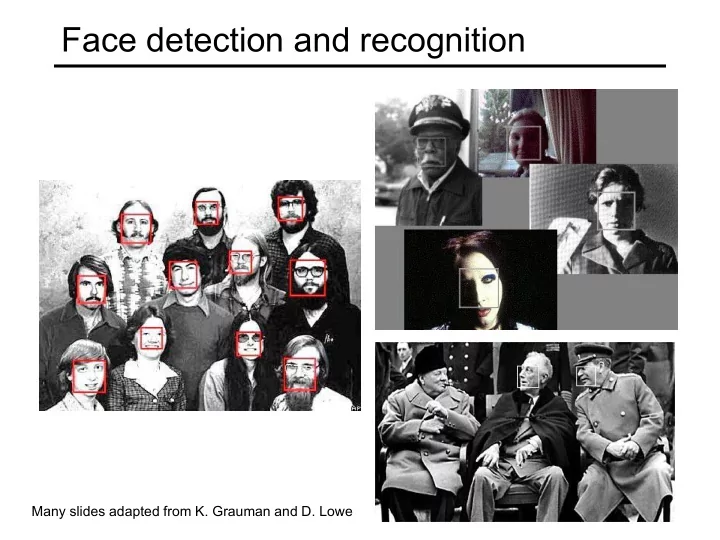
SLIDE 1 Face detection and recognition
Many slides adapted from K. Grauman and D. Lowe
SLIDE 2
Face detection and recognition
Detection Recognition
“Sally”
SLIDE 3
Consumer application: iPhoto 2009
http://www.apple.com/ilife/iphoto/
SLIDE 4
Consumer application: iPhoto 2009
Can be trained to recognize pets!
http://www.maclife.com/article/news/iphotos_faces_recognizes_cats
SLIDE 5
Consumer application: iPhoto 2009
Things iPhoto thinks are faces
SLIDE 6 Outline
- Face recognition
- Eigenfaces
- Face detection
- The Viola & Jones system
SLIDE 7 The space of all face images
- When viewed as vectors of pixel values, face
images are extremely high-dimensional
- 100x100 image = 10,000 dimensions
- However, relatively few 10,000-dimensional
vectors correspond to valid face images
- We want to effectively model the subspace of
face images
SLIDE 8 The space of all face images
- We want to construct a low-dimensional linear
subspace that best explains the variation in the set of face images
SLIDE 9 Principal Component Analysis
- Given: N data points x1, … ,xN in Rd
- We want to find a new set of features that are
linear combinations of original ones: u(xi) = uT(xi – µ) (µ: mean of data points)
- What unit vector u in Rd captures the most
variance of the data?
Forsyth & Ponce, Sec. 22.3.1, 22.3.2
SLIDE 10 Principal Component Analysis
- Direction that maximizes the variance of the projected data:
Projection of data point Covariance matrix of data
The direction that maximizes the variance is the eigenvector associated with the largest eigenvalue of Σ N N
SLIDE 11 Principal component analysis
- The direction that captures the maximum
covariance of the data is the eigenvector corresponding to the largest eigenvalue of the data covariance matrix
- Furthermore, the top k orthogonal directions
that capture the most variance of the data are the k eigenvectors corresponding to the k largest eigenvalues
SLIDE 12 Eigenfaces: Key idea
- Assume that most face images lie on
a low-dimensional subspace determined by the first k (k<d) directions of maximum variance
- Use PCA to determine the vectors or
“eigenfaces” u1,…uk that span that subspace
- Represent all face images in the dataset as
linear combinations of eigenfaces
- M. Turk and A. Pentland, Face Recognition using Eigenfaces, CVPR 1991
SLIDE 13
Eigenfaces example
Training images x1,…,xN
SLIDE 14
Eigenfaces example
Top eigenvectors: u1,…uk Mean: μ
SLIDE 15
Eigenfaces example
Principal component (eigenvector) uk μ + 3σkuk μ – 3σkuk
SLIDE 16 Eigenfaces example
- Face x in “face space” coordinates:
=
SLIDE 17 Eigenfaces example
- Face x in “face space” coordinates:
- Reconstruction:
= + µ + w1u1+w2u2+w3u3+w4u4+ …
=
^ x =
SLIDE 18
Reconstruction demo
SLIDE 19 Recognition with eigenfaces
Process labeled training images:
- Find mean µ and covariance matrix Σ
- Find k principal components (eigenvectors of Σ) u1,…uk
- Project each training image xi onto subspace spanned by
principal components: (wi1,…,wik) = (u1
T(xi – µ), … , uk T(xi – µ))
Given novel image x:
(w1,…,wk) = (u1
T(x – µ), … , uk T(x – µ))
- Optional: check reconstruction error x – x to determine
whether image is really a face
- Classify as closest training face in k-dimensional
subspace ^
- M. Turk and A. Pentland, Face Recognition using Eigenfaces, CVPR 1991
SLIDE 20
Recognition demo
SLIDE 21 Limitations
- Global appearance method: not robust to
misalignment, background variation
SLIDE 22 Limitations
- PCA assumes that the data has a Gaussian
distribution (mean µ, covariance matrix Σ)
The shape of this dataset is not well described by its principal components
SLIDE 23 Limitations
- The direction of maximum variance is not
always good for classification