SLIDE 1
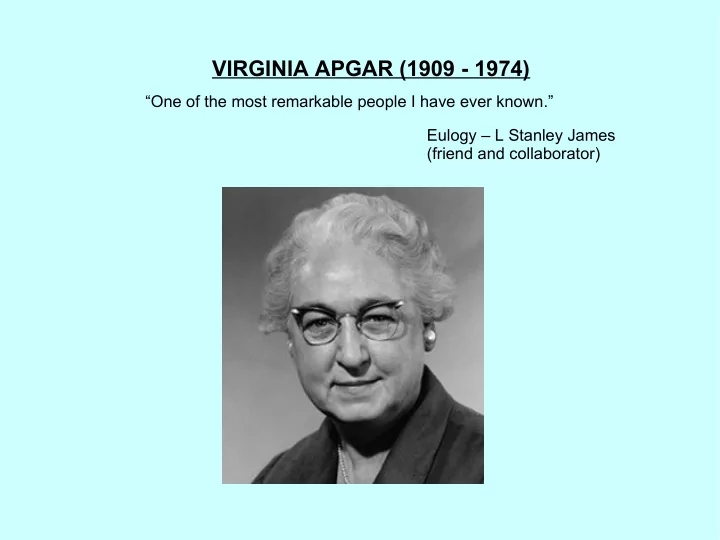
VIRGINIA APGAR (1909 - 1974)
“One of the most remarkable people I have ever known.” Eulogy – L Stanley James (friend and collaborator)
SLIDE 2
1909 Born in Westfield, New Jersey NY, the youngest of 3 children “In a family that never sat down” 1925 Graduated Westfield High School 1929 Graduated Mount Holyoak College, Mass. Zoology (maj), psychology & chemistry.
SLIDE 3
1929 Entered Columbia University (NY) College of Physicians and Surgeons doing her basic medical training. 1933 Followed by 2 yr Internship studying Surgery, one of only a few women in the country. 1936 Changed focus to Anaesthesia, one of the earliest medical doctors to do so. Took year out to train.
SLIDE 4 1937 Returned to Presbyterian Hospital, at Columbia set up and became Director of new Division of Anaesthesia. 1949 The Division became a department but the Chair was given to a male colleague. VA was appointed Professor of Anaesthesia at the College
- f P & S, the first woman to hold this rank.
She carried with her, at all times, for the rest of her life basic resuscitation equipment, when asked why, she said: “Nobody, but nobody is going to stop breathing on me”.
SLIDE 5
OBSTETRIC ANAESTHESIA
Inconsistent mortality rates Infants were not being examined Doctors/midwives to check baby
SLIDE 6
“What are we supposed to be looking for”
Young resident approached in canteen asked “What are we looking for? On paper napkin she quickly outlined the following:
SLIDE 7
SLIDE 8
The APGAR Score
All the red flags to be monitored 1 minute after birth, then 5 minutes later and changes noted.
Critical on 1 min requires medical attention – if improves at 5 mins is not a long term problem Remaining low at 10 – 30 mins may indicate longer term neurological damage. Score 7 & above NORMAL 4-6 FAIRLY LOW 3 & below CRITICAL Initial Score of 10 is uncommon
SLIDE 9
That was the birth of the APGAR SCORE which quickly spread world wide and still used today for all hospital and midwife lead home births. Triggered the use of clinical scoring systems now applied in many other areas of medicine: eg Glasgow Coma Scale – status of central nervous system. APACHE II attempts to predict the morbidity & mortality rates to IC patients.
SLIDE 10
THE CHANGE OF EMPHASIS 1958 Took a sabbatical at John Hopkins School of Public Health to do a Masters in Public Health. 1959 Was asked to join the National Foundation-March of Dimes to head new Division of Congenital Malformation
FDR
Where she advocated the mass vaccination against Rubella. Promoted Rh testing identifying Mothers at risk of antibody transmission to the foetus.
SLIDE 11
1967/8 Vice President & Director of Basic Medical research expanding her knowledge of medical genetics, while teaching at Cornell University School of Medicine. 1971/4 Vice President for Medical Affairs at FD and Clinical Professor of Paediatric Teratology at Cornell University School of Medicine. 1972 Wrote a book “Is My Baby All Right“ amongst 60 other scientif i c articles, travelled extensively lecturing. 1974 Died of degenerative liver disease
Final Years
SLIDE 12
Virginia Apgar Helped pave the way for women in medicine where she was often the first or one of a few. Spotting problems and setting out to solve them. Is remembered as a life long student, physician and friend.
“Every baby that is born in modern hospitals today is looked at through the eyes of Virginia Apgar”