Villa savoy, Le Corbusier House at Koganei, 1980 form from - - PowerPoint PPT Presentation

villa savoy le corbusier house at koganei 1980
SMART_READER_LITE
LIVE PREVIEW

Villa savoy, Le Corbusier House at Koganei, 1980 form from - - PowerPoint PPT Presentation

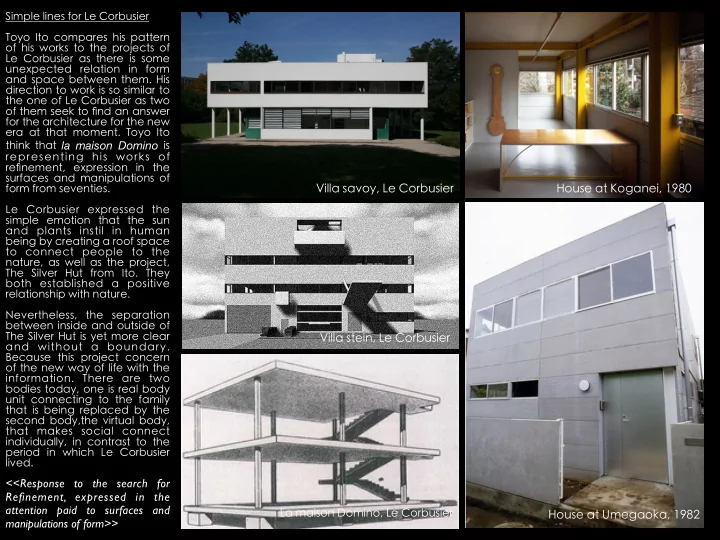
Simple lines for Le Corbusier Toyo Ito compares his pattern of his works to the projects of Le Corbusier as there is some unexpected relation in form and space between them. His direction to work is so similar to the one of Le Corbusier as


slide-1
SLIDE 1

House at Koganei, 1980 House at Umegaoka, 1982 <<Response to the search for Refinement, expressed in the attention paid to surfaces and manipulations of form>>

La maison Domino, Le Corbusier

Simple lines for Le Corbusier Toyo Ito compares his pattern

  • f his works to the projects of

Le Corbusier as there is some unexpected relation in form and space between them. His direction to work is so similar to the one of Le Corbusier as two

  • f them seek to find an answer

for the architecture for the new era at that moment. Toyo Ito think that la maison Domino is representing his works of refinement, expression in the surfaces and manipulations of form from seventies. Le Corbusier expressed the simple emotion that the sun and plants instil in human being by creating a roof space to connect people to the nature, as well as the project, The Silver Hut from Ito. They both established a positive relationship with nature. Nevertheless, the separation between inside and outside of The Silver Hut is yet more clear and without a boundary. Because this project concern

  • f the new way of life with the
  • information. There are two

bodies today, one is real body unit connecting to the family that is being replaced by the second body,the virtual body, that makes social connect individually, in contrast to the period in which Le Corbusier lived.

Villa stein, Le Corbusier Villa savoy, Le Corbusier

slide-2
SLIDE 2

The Silver Hut, 1984 The Silver Hut, 1984

Chandigarh, Le Corbusier, 1959

Simple lines for Le Corbusier With this contrast of the society t h a t ' s m a k e h i m s t o p comparing their works, until he has designed The Old People's Home whose the appearance

  • f the large flat roof is similar to

the project, Chandigarh of Le Corbusier. This project is created for the new life for the elderly to be contacted with the nature. They are old people with real b o d i e s s u i t e d t o l i v i n g together, but they are not the same time nomads with virtual bodies in their consciousness. This house is designed to be inhabited by a community of spirit not closely bound to the

  • place. He uses the materials in

abstract manner, and a not very defined space for the elderly to create themselves a preferred space in their minds. By these concept, he admits his latent process to the simple lines of Le Corbusier, in the sense that the real depth and breadth of existence have been eliminated. Anyway, some important different point today is that we could not create a community space that will be success and fascinating as the virtual one by just adding green area as the way of Le Corbusier.

Old People home, 1994 Old People home, 1994 <<What I wanted is to create a not very defined space that would have no centre other than the dreams of the residents>>

slide-3
SLIDE 3

T h e i m a g e

  • f

a r c h i t e c t u r e i n electronic age Architectural in the electron age is the figuration of a vortex of information Our virtual body is a part of the flow of e l e c t r o n i n t h e information world as we are created by the water and air flow. This c o n s e q u e n c e i s c h a n g i n g

  • u r

community and model

  • f communication in

the family. Q u e s t i o n i n t h e c o n t e m p o r a r y architecture is how to i n t e g r a t e t h e premature space to the world through the electronic network. Answer is electronic a n d b i o m o r p h i c space. <<Clad in mechanical suits called automobiles,people today have had their physical bodies expanded, Clad in media suits, propel have their brains expanded! >> Architectural in the electron age is an extended form of media suit If Architecture was previously a natural skin of people, the recent architecture is t h e n a s k i n

  • f

i n f o r m a t i o n a n d nature. Media suit is a hard and enclosed suit that p e o p l e p u t

  • n

individually but they a r e t w i r l i n g t h e w h i r l p o o l

  • f

information. Architectural in the e l e c t r o n a g e i s a convenience store of the media There will be no longer a distinction of level in e s t a b l i s h e d s t y l e medias, for example; books, paintings, and fi l m s , a s t h e y a r e t u r n i n g t o t h e electronic medias. With this change, the museum or library will be fused into one, <<mediathèque>>, c o m p a r e d a s a convenience store of the media, and a convenience strode of culture. A l l t h e s e n e w t y p o l o g i e s

  • f

architecture should be l o c a t e d n e a r t h e railway station to serve the public in their daily life. Architectural in the electron age change the concept of barrier T h e b a r r i e r s s u c h b e t w e e n p e o p l e - p e o p l e , s o c i e t y - society, etc. will be demolished by the world of information. For instance, using navigator system for g u i d i n g t o t h e d e s t i n a t i o n h a s changed the meaning

  • f the map as we are

connected to space by the media using the satellite. So the architecture will b e c h a n g e d accordingly to the new world of no- barrier concept. Architectural in the electron age is what designs time T h e p r o c e s s i n a r c h i t e c t u r a l d e s i g n i n g w i l l b e c h a n g e d simultaneously with the progression of the t e c h n o l o g y a n d media, as well as the equipment for helping to design. Thus there will be no end to our spatial experiences as the real and virtual spaces overlap in our experiences. We will be designing time as the same way as we design space.

slide-4
SLIDE 4

A body image beyond the modern : Is there residential architecture without criticism?

  • 1. Fissures in Contemporary society

Toyo Ito used his frustration and criticism over the state and society expressed in his early-10-years public works as he believed that it is impossible to conceive of a common language capable of bridging the gap between the systems of actual cities and societies. Unlike the other arts that can be installing in the library or museum, the architects have to expose this criticism to the environment. Even if the private project situated in enclosed boundary that the architects used to reflect their emotion, does not stop them from having social significance.

  • 2. The Misunderstanding of Criticism

So the question of how to turn the negative expression into the positive one has come through his thought. He found that the criticism issue is a part of the residential architecture without fissures and anger or frustration.

  • 3. A Flock of Reclusive Aesthetes

The negative attitude came from the period of the modernization. And it causes what Ito called "transparency syndrome" as we considered the aesthetics without realize the conflict with outside.

  • 4. A Home of the Purest Modernism, or the Tragedy of O'Gorman

The project, Diego Rivera and Frida Kahlo House, by Juan O'Gorman in mexico represent the concept of pure functionality, but differently from the modernism in the same period as this project integrates the real natural body which relate to the context of Mexico with the one of abstract art.

  • 5. A Body Image beyond the Modern

In the modern period, people seeks the body that embed by the mechanical experience using the materials of steel glass as if they were in the car or airplane. Now it's time to seek the body image of a new different kind of nature as a memory of the future, but respecting to the old natural body for achieving the positive language. The Diego Rivera and Frida Kahlo House, Juan O'Gorman, 1930s