VIF FILMS : REDUCING PREPLANT FUMIGANT DOSAGES WITH PRESERVED - - PDF document

vif films reducing preplant fumigant dosages with
SMART_READER_LITE
LIVE PREVIEW

VIF FILMS : REDUCING PREPLANT FUMIGANT DOSAGES WITH PRESERVED - - PDF document

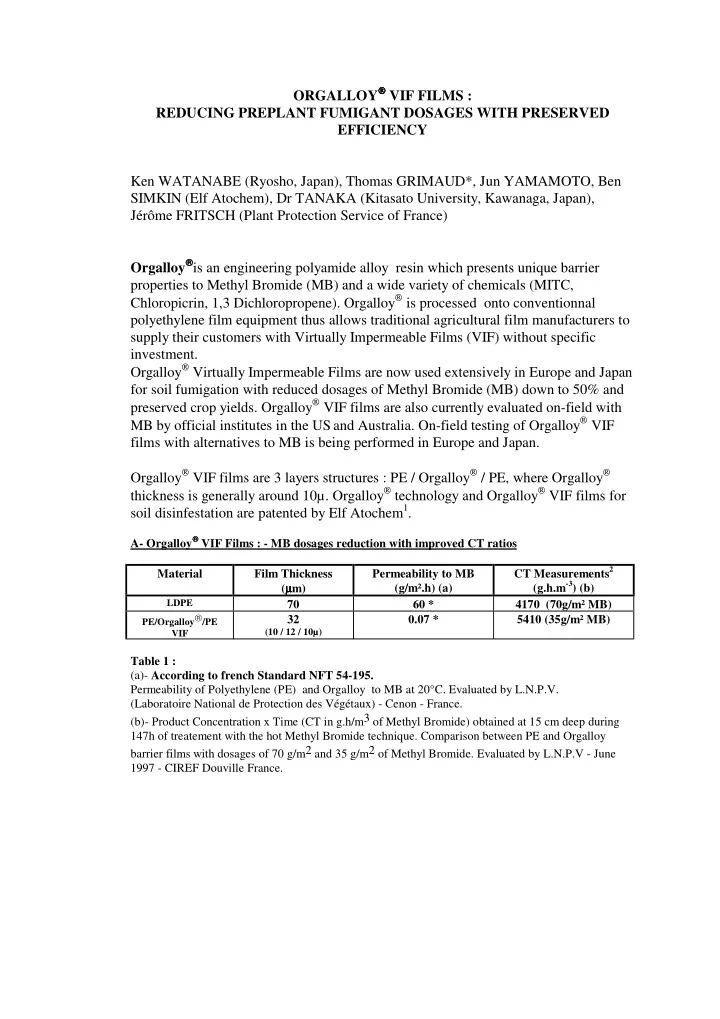
ORGALLOY VIF FILMS : REDUCING PREPLANT FUMIGANT DOSAGES WITH PRESERVED EFFICIENCY Ken WATANABE (Ryosho, Japan), Thomas GRIMAUD*, Jun YAMAMOTO, Ben SIMKIN (Elf Atochem), Dr TANAKA (Kitasato University, Kawanaga, Japan),


slide-1
SLIDE 1

ORGALLOY

   VIF FILMS :

REDUCING PREPLANT FUMIGANT DOSAGES WITH PRESERVED EFFICIENCY Ken WATANABE (Ryosho, Japan), Thomas GRIMAUD*, Jun YAMAMOTO, Ben SIMKIN (Elf Atochem), Dr TANAKA (Kitasato University, Kawanaga, Japan), Jérôme FRITSCH (Plant Protection Service of France) Orgalloy

  is an engineering polyamide alloy resin which presents unique barrier

properties to Methyl Bromide (MB) and a wide variety of chemicals (MITC, Chloropicrin, 1,3 Dichloropropene). Orgalloy is processed onto conventionnal polyethylene film equipment thus allows traditional agricultural film manufacturers to supply their customers with Virtually Impermeable Films (VIF) without specific investment. Orgalloy Virtually Impermeable Films are now used extensively in Europe and Japan for soil fumigation with reduced dosages of Methyl Bromide (MB) down to 50% and preserved crop yields. Orgalloy VIF films are also currently evaluated on-field with MB by official institutes in the US and Australia. On-field testing of Orgalloy VIF films with alternatives to MB is being performed in Europe and Japan. Orgalloy VIF films are 3 layers structures : PE / Orgalloy / PE, where Orgalloy thickness is generally around 10µ. Orgalloy technology and Orgalloy VIF films for soil disinfestation are patented by Elf Atochem1.

A- Orgalloy

   VIF Films : - MB dosages reduction with improved CT ratios

Material Film Thickness (µ µ µ µm) Permeability to MB (g/m².h) (a) CT Measurements2 (g.h.m-3) (b)

LDPE

70 60 * 4170 (70g/m² MB)

PE/Orgalloy/PE VIF

32

(10 / 12 / 10µ)

0.07 * 5410 (35g/m² MB) Table 1 : (a)- According to french Standard NFT 54-195. Permeability of Polyethylene (PE) and Orgalloy to MB at 20°C. Evaluated by L.N.P.V. (Laboratoire National de Protection des Végétaux) - Cenon - France. (b)- Product Concentration x Time (CT in g.h/m3 of Methyl Bromide) obtained at 15 cm deep during 147h of treatement with the hot Methyl Bromide technique. Comparison between PE and Orgalloy barrier films with dosages of 70 g/m2 and 35 g/m2 of Methyl Bromide. Evaluated by L.N.P.V - June 1997 - CIREF Douville France.

slide-2
SLIDE 2
  • Mellon production with reduced dosage of MB and preserved yields

Material Area % damaged fruits

  • Av. mellon

Weight (g) Ratio of Marketable fruits (%)

Untreated field

12m² 100

  • LDPE – MB 30kg/10a

24m² 8 1330 98

PE / Orgalloy / PE VIF MB 20kg/10a

24m² 5 1420 99 Table 2 : RYOSHO evaluation of mellon production at Miyazaki Prefectural Agricultural Center (Japan). Fumigation in August 98, Planting Sept. 10th / Evaluation Nov. 30th, 98 (Repeated 2 times). LDPE film : 75µ - PE / Orgalloy / PE film : 40µ Damage : infections, visual checking. B- Orgalloy

   VIF Films : Barrier to chemical alternatives (Chloropicrin, MITC, 1,3 D)

Material Film Thickness (µ µ µ µm) MeBr

  • Perm. (a)

Chloropicrin

  • Perm. (b)

MITC

  • Perm. (b)

1,3 Dichloropropene

  • Perm. (b)

LDPE

70 60 116 198 168

PE/ORGALLOY/PE VIF

32

(10 / 12 / 10µ)

0.07 0.138 1.4 0.15 Table 3 : (a)- According to NFT 54-195 and performed by LNPV. (b)- Permeability of polyethylene and 3 layers Orgalloy VIF films to MITC, Chloropicrin and 1,3 Dichloropropene evaluated by Dr TANAKA - Kitasato University – Kanagawa – Japan.

  • Herbicide Effect : Soil treatment with MITC, with and without Orgalloy VIF film

Film Film Thickness (µ µ µ µm) MITC/Water Dosage HERBICIDE EFFECT 4 days 13 days 39 days

LDPE

40 800L/10a 10 9 5

LDPE

40 120L/10a 10 9 4

PE/ORGALLOY/PE VIF

40 800L/10a 10 9 8

PE/ORGALLOY/PE VIF

40 120L/10a 10 9 8 Table 4 : Evaluation conducted by RYOSHO and Japan Association for Advancement of Phytoregulators, on 7 days (from May 28th, 99). Dosage : 40L Sodium Methyl dithio Carbamate + Water (800L = 40L + 760L Water, 120L = 40L + 120L) Herbicide Effect : Herb density evaluated on a 0 to 10 (no visible herbs) scale on :

  • Digitaria adscendens=crabgrass
  • Echinochloa curs-galli=barnyardegrass
  • Cyperus microiria Steud=chufa
  • Chenopodium album=common lambsquarters
slide-3
SLIDE 3
  • Portulaca oleracea=common purslane
  • Persicaria longiseta=posumbu knotweed

Conclusion : Orgalloy VIF films key points :

  • Barrier to MB and chemical alternatives
  • Fumigant dosage reduction with higher CT ratios
  • Preserved yields demonstrated for 50% reduction of MB dosage
  • Prevents from permeation and slow release of chemical in the near-by area during

the fumigation period (possible reduction of buffer-zones)

  • Cost reduction associated to fumigant dosage reduction can compensate VIF film

cost

  • Orgalloy processable onto conventional PE equipment

References : 1 – D.Basset, M.P. Bellinger, B.Echalier, EP N°95 11 698 2 – D.Roumilhac, B.Simkin, J.Fritsch, “Barrier film with Orgalloy”, MBAO Conf. 98