Vietnam, a champion for insect biodiversity: a win-win commitment - - PowerPoint PPT Presentation

vietnam a champion for insect biodiversity a win win
SMART_READER_LITE
LIVE PREVIEW

Vietnam, a champion for insect biodiversity: a win-win commitment - - PowerPoint PPT Presentation

Vietnam, a champion for insect biodiversity: a win-win commitment Science meets conservation Uptake workshop 10 years international cooperation Policy Brief VIETNAM CAMBODIA BELGIUM FRANCE ITALY Contributors Luca


slide-1
SLIDE 1

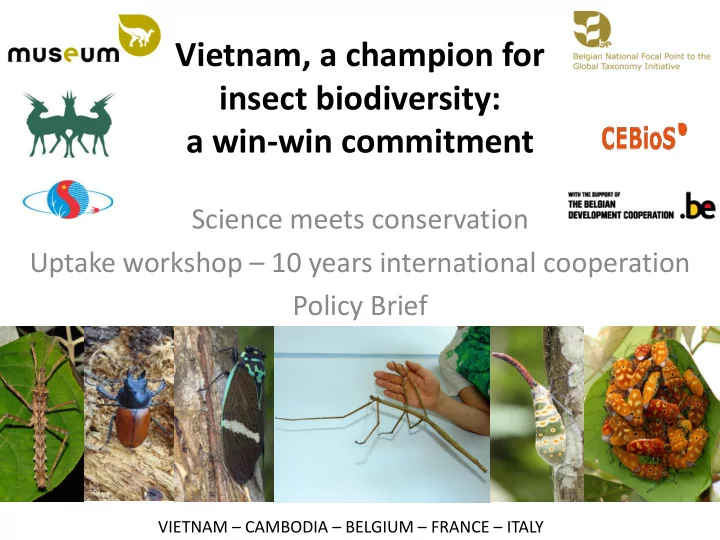
Vietnam, a champion for insect biodiversity: a win-win commitment

Science meets conservation Uptake workshop – 10 years international cooperation Policy Brief

VIETNAM – CAMBODIA – BELGIUM – FRANCE – ITALY
slide-2
SLIDE 2

Contributors

  • Luca Bartolozzi – Museum of Florence, Italy
  • Joachim Bresseel – Royal Belgian Institute of Natural Sciences, Brussels, Belgium
  • Thierry Bourgoin – Muséum national d’Histoire naturelle, Paris, France
  • Jérôme Constant – Royal Belgian Institute of Natural Sciences, Brussels, Belgium
  • Eric Guilbert – Muséum national d’Histoire naturelle, Paris, France
  • Luc Janssens de Bisthoven – Royal Belgian Institute of Natural Sciences, Brussels, Belgium
  • Sokchan Lorn – Royal Phnom Penh University, Cambodia
  • Hong Thai Pham – Vietnam National Museum of Nature, Hanoi
  • Adeline Soulier-Perkins – Muséum national d’Histoire naturelle, Paris, France
  • Marie-Lucie Susini-Ondafe – Royal Belgian Institute of Natural Sciences, Brussels, Belgium
  • Sokha Kheam – Royal Phnom Penh University, Cambodia
slide-3
SLIDE 3

GTI uptake meeting CEBioS-VNHN, Hanoi, Vietnam, 3-7th April 2017

  • Vietnam: 16th most biodiversity rich

country

  • Part of Indo-Burma hotspot designated

by Conservation International.

  • 14 terrestrial ecoregions
  • 110 key biodiversity areas

Vietnam Biodiversity

slide-4
SLIDE 4

GTI uptake meeting CEBioS-VNHN, Hanoi, Vietnam, 3-7th April 2017

Vietnam Biodiversity

Some general figures:

  • high level of endemism: 10% of Vietnam’s plants;

12 mammals, 7 birds, 48 reptiles, 33 amphibians, 80 freshwater fish…

  • 164 terrestrial Protected Areas (32 nat. Parks and

58 nature reserves), covering 7.5% of the country’s total land area, virtually address all of Vietnam's major ecosystems.

But what about insect diversity?

slide-5
SLIDE 5

Importance of insects diversity

  • Insects = half of known species
  • Probably 80% of species on Earth
  • About 20.000 species known from Vietnam

= 10% of estimated diversity

  • Very high level of endemism (species
  • ccurring only in Vietnam)

Vietnam = Hotspot also for insects!

slide-6
SLIDE 6

Case study: the Lacebugs of Vietnam

Each new location sampled = discovery of new species!

5 10 15 20 25 30 35 40 45 50 1906 1913 1920 1927 1934 1941 1948 1955 1962 1969 1976 1983 1990 1997 2004 2011 acc sp acc loc

Year Number of species/sites

slide-7
SLIDE 7

Case study: the Planthoppers of Vietnam

More taxonomic experts = more new species!

Matsumura 1914 Fennah 1978 Walker 1851 Emeljanov Gnezdilov Constant, Pham

slide-8
SLIDE 8

“We only love what we know and we only protect what we love.”

Konrad Lorenz

slide-9
SLIDE 9

Insect biodiversity in Vietnam even higher than expected

Numerous peculiar habitats = Lots of very local species (micro-endemism)

slide-10
SLIDE 10
  • Already very diverse but still very poorly

known: 255 species in Vietnam

More efforts = more species

Case study: planthopper diversity

China 677 Yunnan 164 Guangxi 66 Guangdong 71 Hainan 110 Vietnam 255 Laos 43 Thailand 76 Cambodia 53

slide-11
SLIDE 11

Rich but fragile: threats

  • Deforestation
  • Slash and burn agriculture
  • Mining
  • Poaching
  • Pollution
slide-12
SLIDE 12

Case study: stick insects

Sampled areas Three locations over a short distance:

  • Bidoup Nui Ba National Park
  • Phuoc Binh National Park
  • Nui Chua National Park
slide-13
SLIDE 13

Case study: stick insects

60 Km

Bidoup Nui Ba 23 species All new Phuoc Binh 13 species All new Nui Chua 19 species 18 new Single species present in two locations

Example of high rate of endemism in three protected areas of southern Central Vietnam.

Each location contains its own unique species

slide-14
SLIDE 14

Case study: stick insects

60 Km

Bidoup Nui Ba Phuoc Binh Nui Chua

Example of high rate of endemism in three protected areas of southern Central Vietnam Three species of Leaf insects (Bo La – Vietnam Red Book)

Important to create more protected areas

slide-15
SLIDE 15

Important to connect protected areas with corridors

Ngoc Son – Ngo Luong Area

  • Recently created (2006)
  • Connection between Pu Luong and Cuc

Phuong National Park (corridor)

  • Pu Luong: no data
  • Cuc Phuong: 33 species
  • Ngoc Son – Ngo Luong: 42 species

Case study: stick insects

slide-16
SLIDE 16

Lessons learnt and thoughts for the future

  • Science:
  • Improve collecting and taxonomic capacities
  • Explore and inventory peculiar habitats
  • Describe the new species
  • International collaboration
  • Complete hotspot status with insect diversity
  • Management tools: Taxonomic lists, online access, digitalization

for Vietnam and for each park

  • Conservation
  • Communication
  • Education
  • Public awareness
  • Develop the CBD Clearing House Mechanism (CHM)
  • Ecotourism
slide-17
SLIDE 17

Vietnam = Hotspot also for insects! Each new location sampled = discovery of new species! More taxonomic experts = more new species! More efforts = more species Important to create more protected areas Important to connect protected areas with corridors