Very Large Array Project The Expanded Observing with the Jansky - - PowerPoint PPT Presentation

very large array project
SMART_READER_LITE
LIVE PREVIEW

Very Large Array Project The Expanded Observing with the Jansky - - PowerPoint PPT Presentation

Very Large Array Project The Expanded Observing with the Jansky VLA Gustaaf van Moorsel Array Science Center National Radio Astronomy Observatory Atacama Large Millimeter/submillimeter Array Expanded Very Large Array Robert C. Byrd Green


slide-1
SLIDE 1

Atacama Large Millimeter/submillimeter Array Expanded Very Large Array Robert C. Byrd Green Bank Telescope Very Long Baseline Array

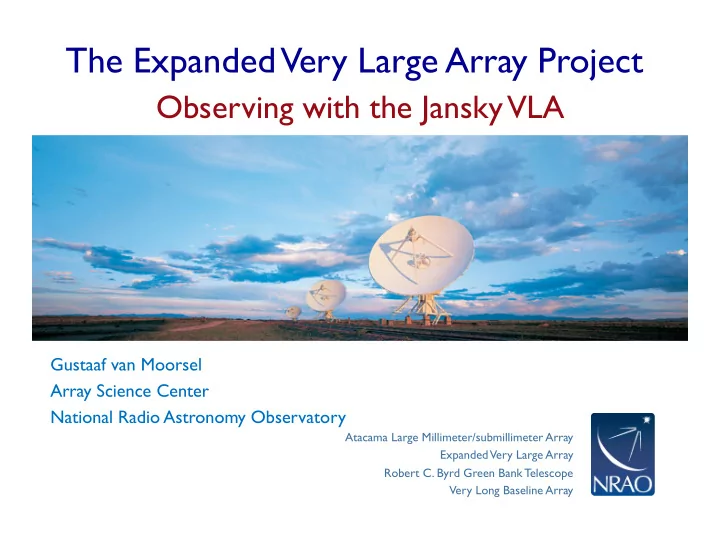
The Expanded Very Large Array Project

Observing with the Jansky VLA

Gustaaf van Moorsel Array Science Center National Radio Astronomy Observatory

slide-2
SLIDE 2

EVLA

EVLA Project Overview

  • The Expanded

Very Large Array is a major upgrade of the Very Large Array

  • The fundamental goal is to improve major observational

capabilities of the original VLA (sensitivity, bandwidth) by at least an order of magnitude

  • The project is on schedule to be completed at the end of

this year.

  • Key aspect: This is a leveraged project – building upon

existing infrastructure of the VLA

  • Renamed the Jansky

Very Large Array (Jansky VLA) during a rededication on 31 March, 2012

slide-3
SLIDE 3

EVLA

Key EVLA Project Goals

  • Full frequency coverage from 1 to 50 GHz.

– Provided by 8 frequency bands with cryogenic receivers.

  • Up to 8 GHz instantaneous bandwidth per polarization

– All digital design to maximize instrumental stability and repeatability.

  • New correlator with 8 GHz/polarization capability

– Designed, funded, and constructed by our Canadian partners, HIA/DRAO – Unprecedented flexibility in matching resources to attain science goals.

  • Noise-limited, full-field imaging in all Stokes parameters for most
  • bservational fields.
  • New software for telescope operations, correlator management,

and post-processing.

3

slide-4
SLIDE 4

EVLA

What is the JVLA?

  • 27x25m antennas reconfigurable on baselines 35m to 36km
  • located in Southern New Mexico at 2100m altitude
slide-5
SLIDE 5

EVLA

Spatial Resolution (unchanged!)

  • With reconfiguration of the antennas, the JVLA can vary its

spatial resolution by a factor of ~50.

  • Configuration sequence: D  C  B  A
  • Reconfiguration about every 4

months (modifications during commissioning).

  • Hybrid configurations (DnC, CnB,

BnA) extend for about 2 weeks in between regular configurations

5

slide-6
SLIDE 6

EVLA

Receivers

  • 8 wideband receivers
  • Switching receivers can be as fast as 20s

6

slide-7
SLIDE 7

EVLA

JVLA-VLA Capabilities Comparison

Parameter VLA JVLA Factor Current (OSRO)

Point Source Cont. Sensitivity (1σ,12hr.) 10 µJy 1 µJy 10 2 µJy Maximum BW in each polarization 0.1 GHz 8 GHz 80 2 GHz # of frequency channels at max. BW 16 16,384 1024 4096 Maximum number of freq. channels 512 4,194,304 8192 4096 Coarsest frequency resolution 50 MHz 2 MHz 25 2 MHz Finest frequency resolution 381 Hz 0.12 Hz 3180 0.12 kHz # of full-polarization spectral windows 2 64 32 16 (log) Frequency Coverage (1 – 50 GHz) 22% 100% 5 100%

The JVLA’s performance will be vastly better than the VLA’s:
slide-8
SLIDE 8

EVLA

EVLA Project Current Status (06/2012)

  • Installation of new wideband receivers now complete at:
  • 4 – 8 GHz (C-Band)
  • 18 – 27 GHz (K-Band)
  • 27 – 40 GHz (Ka-Band)
  • 40 – 50 GHz (Q-Band)
  • Installation of remaining four bands completed late-2012:
  • 1 – 2 GHz (L-Band) 22 now, completed end of 2012.
  • 2 – 4 GHz (S-Band) 24 now, completed Sept. 2012.
  • 8 – 12 GHz (X-Band) 20 now, completed end of 2012.
  • 12 – 18 GHz (Ku-Band) 21 now, completed end of 2012.
  • Low frequency (50-436 MHz) (not part of project)

8

slide-9
SLIDE 9

EVLA

EVLA Project Current Status (06/2012)

  • The last major construction component has been the

installation of the 3-bit , 4 Gsamp/sec samplers.

  • There are eight such samplers in each antenna. These

provide the full 8 GHz/polarization capability needed for the high frequency bands (above 4 GHz observing frequency).

  • Status:

– 17 antennas now fully outfitted. – 3 others with half the sampler complement. – Outfitting scheduled for completion in mid-August.

9

slide-10
SLIDE 10

EVLA

The ‘WIDAR’ Correlator

  • This extraordinarily flexible machine is now fully installed at

the VLA site, and is working magnificently.

  • We are far from deploying all of its capabilities, however. This

is a lengthy process, which is months to years away from completion.

  • Installation of WIDAR began January, 2010. It was turned on

for astronomy in early March, 2010. This was the only time during the whole project that the instrument did not observe

10

slide-11
SLIDE 11

EVLA

Enabling capabilities during construction and commissioning

  • Open Shared Risk Observing (OSRO)

– Restricted, but well tested capabilities – Scheduling block setup supported in OPT – Shared risk: we’ll do all in our power to make observations successful but we don’t guarantee re-observation in case of problems

  • Resident Shared Risk Observing (RSRO)

– Far fewer restrictions; observers encouraged to test uncharted waters – OPT unlikely to support scheduling block creation – Residency requirement to help us in commissioning

  • After full cycle of configurations (new D-configuration) we expand OSRO

capabilities based on success of commissioning effort – Huge leap every 16 months instead of piecemeal introduction

11

slide-12
SLIDE 12

EVLA

Next Proposal Deadline

August 1, 2012 (2013A)

12

http://science.nrao.edu/evla/

12

slide-13
SLIDE 13

EVLA

Observing Capabilities

Will be offered in three categories (note: OSRO is now gone):

  • 1. General capabilities (akin to what used to be OSRO)
  • Includes all well tested capabilities.
  • Data rate limit of 20 MB/sec.
  • 2. Shared Risk
  • For not well tested capabilities,
  • Can be set up and executed with the observing and scheduling

software.

  • SR observers will receive 1 hr of test time to validate their correlator

set-up and observing procedure.

  • 3. Resident Shared Risk
  • For capabilities that have not been tested, or known not to be robust.
  • Requires residency; 1 month visit per 20 hours of observing time.

13

slide-14
SLIDE 14

EVLA

General Capabilities 2013A (1)

  • 8-bit samplers

– 2 basebands, 1 GHz bandwidth each (same) – Up to 16 subband pairs per baseband (was: 8) – Independently tunable (anywhere in the baseband) – Independent bandwidths – Doppler setting per baseband – Baseline board stacking by factors of 2, to give up to 4096 channels per subband – Up to 16384 channels total.

14

slide-15
SLIDE 15

EVLA

General Capabilities 2013A (2)

  • 3-bit samplers

– 128 MHz subbands, contiguous in frequency within a baseband. – Up to 64x128 MHz subbands to cover available receiver bandwidth. – Full, dual, or single polarization to give spectral resolutions 2, 1, or 0.5 MHz (64, 128, or 256 channels per subband).

15

slide-16
SLIDE 16

EVLA

General Capabilities 2013A (3)

  • Phased

VLA output for VLBI – 8-bit samplers – 1 or 2 x 128 MHz subbands, independently phased – 256 channels per subband – No subarrays or baseline board stacking – No simultaneous access to unused correlator resources

16

slide-17
SLIDE 17

EVLA

General Capabilities 2013A (4)

  • Subarrays

– Up to 3 independent subarrays – 8-bit samplers, 128 MHz contiguous subbands only – Separate SBs for each subarray – Observer specifies which antennas go in each subarray – Some restrictions on number of antennas per subarray

17

slide-18
SLIDE 18

EVLA

Shared Risk Capabilities

  • One or two recirculation set-ups that have already been used

by RSRO participants

  • For 8-bit samplers

– Fast dump modes up to 60 MB/s, dump times >=50ms – More than 16 subband pairs per baseband

  • For 3-bit samplers

– Subarrays – Subband bandwidths narrower than 128 MHz

18

slide-19
SLIDE 19

EVLA

Resident Shared Risk (RSRO) Capabilities

  • OTF mosaics
  • Phased array for all but

VLBI

  • Real-time transient detection
  • Pulsars
  • Complicated subarrays
  • General recirculation set-ups

19

slide-20
SLIDE 20

EVLA

Examples of exploiting the general capabilities offered for 2013A:

  • 8 GHz wide observation in any of the high frequency bands. Gives

unprecedented continuum sensitivity and spectral index info – Uses the new 3-bit samplers. Not much versatility yet in tuning subbands but for pure sensitivity that is not needed

  • Simultaneous observation of a wide variety of lines within one band with

very high spectral resolution, e.g. by tuning each one of the 16 subband pairs (per baseband) on each of the lines – Uses the ‘traditional’ 8-bit samplers but exploits the newly introduced versatility in tuning subbands – Refinement 1: use some wide-bandwidth (128 MHz) subbands to form a continuum, and use remaining subbands (at much narrower bandwidth) to target lines – Refinement 2: use several subbands per line to increase # channels

20

slide-21
SLIDE 21

EVLA

Concluding Remarks

  • The EVLA project is near completion
  • Most key, and many new, capabilities are already available.
  • Increased capabilities will be added over the next few years.
  • Capabilities will continue to grow, as more capable correlator

and post-processing software is developed.

  • Many challenges remain before full throughput is obtained.
  • The JVLA will be, as the

VLA has been, a general-purpose,

  • pen-access, cm-wavelength telescope
  • Important dates:

– Call for proposals: ~ July 9, 2012. Will be final word on capabilities offered – Proposal deadline: August 1, 2012

21

slide-22
SLIDE 22

EVLA

Resources

  • Main EVLA observing page: https://science.nrao.edu/facilities/evla
  • EVLA Observational Status Summary: https://science.nrao.edu/facilities/

EVLA/docs/manuals/oss

  • Helpdesk: https://help.nrao.edu
  • NRAO science page: https://science.nrao.edu
  • NRAO eNews: https://science.nrao.edu/enews/5.4/

22