Vertex-coloring problem The Vertex coloring problem and bipartite - - PowerPoint PPT Presentation

vertex coloring problem the vertex coloring problem and
SMART_READER_LITE
LIVE PREVIEW

Vertex-coloring problem The Vertex coloring problem and bipartite - - PowerPoint PPT Presentation

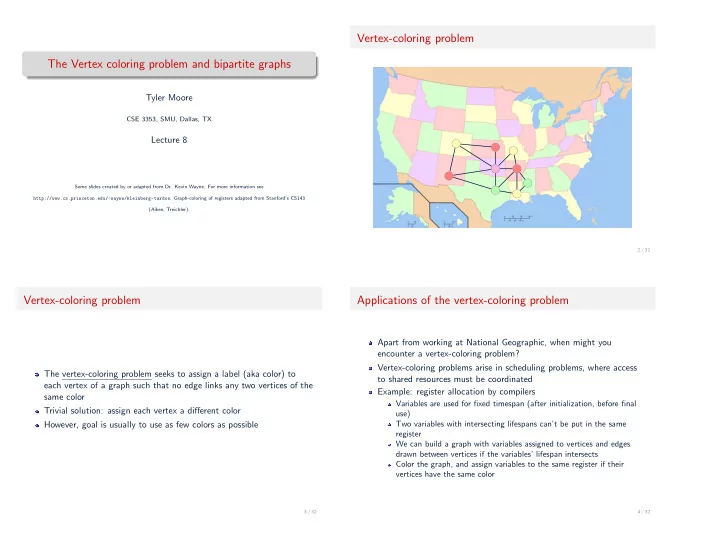
Vertex-coloring problem The Vertex coloring problem and bipartite graphs Tyler Moore CSE 3353, SMU, Dallas, TX Lecture 8 Some slides created by or adapted from Dr. Kevin Wayne. For more information see


slide-1
SLIDE 1

The Vertex coloring problem and bipartite graphs

Tyler Moore

CSE 3353, SMU, Dallas, TX

Lecture 8

Some slides created by or adapted from Dr. Kevin Wayne. For more information see http://www.cs.princeton.edu/~wayne/kleinberg-tardos. Graph-coloring of registers adapted from Stanford’s CS143 (Aiken, Treichler).

Vertex-coloring problem

2 / 32

Vertex-coloring problem

The vertex-coloring problem seeks to assign a label (aka color) to each vertex of a graph such that no edge links any two vertices of the same color Trivial solution: assign each vertex a different color However, goal is usually to use as few colors as possible

3 / 32

Applications of the vertex-coloring problem

Apart from working at National Geographic, when might you encounter a vertex-coloring problem? Vertex-coloring problems arise in scheduling problems, where access to shared resources must be coordinated Example: register allocation by compilers

Variables are used for fixed timespan (after initialization, before final use) Two variables with intersecting lifespans can’t be put in the same register We can build a graph with variables assigned to vertices and edges drawn between vertices if the variables’ lifespan intersects Color the graph, and assign variables to the same register if their vertices have the same color

4 / 32

slide-2
SLIDE 2

Vertex-coloring problem special case: two colors

A bipartite graph is an undirected graph whose vertices can be divided into disjoint sets U and V such that every edge connects a vertex in U to one in V . Bipartite graphs arise in matching problems: matching workers to jobs, matching kidney donors with recipients, finding heterosexual mates If we can color a graph’s vertices using just two colors, then we have a bipartite graph Problem: given a graph, find its two-coloring or report that a two-coloring is not possible U V

5 / 32

27

  • Many graph problems become:

Easier if the underlying graph is bipartite (matching). Tractable if the underlying graph is bipartite (independent set).

Before attempting to design an algorithm, we need to understand structure

  • f bipartite graphs.

v1 v2 v3 v6 v5 v4 v7 v2 v4 v5 v7 v1 v3 v6

  • 6 / 32

28

  • Lemma. If a graph is bipartite, it cannot contain an odd length cycle.
  • Pf. Not possible to 2-color the odd cycle, let alone .
  • 7 / 32

29

  • Lemma. Let be a connected graph, and let be the layers produced

by BFS starting at node . Exactly one of the following holds. (i) No edge of joins two nodes of the same layer, and is bipartite. (ii) An edge of joins two nodes of the same layer, and contains an

  • dd-length cycle (and hence is not bipartite).

L1 L2 L3

  • L1

L2 L3

8 / 32

slide-3
SLIDE 3

19

  • Property. Let be a BFS tree of , and let be an edge of .

Then, the level of and differ by at most 1.

L0 L1 L2 L3

9 / 32

30

  • Lemma. Let be a connected graph, and let be the layers produced

by BFS starting at node . Exactly one of the following holds. (i) No edge of joins two nodes of the same layer, and is bipartite. (ii) An edge of joins two nodes of the same layer, and contains an

  • dd-length cycle (and hence is not bipartite).
  • Pf. (i)

Suppose no edge joins two nodes in adjacent layers. By previous lemma, this implies all edges join nodes on same level. Bipartition: red = nodes on odd levels, blue = nodes on even levels.

L1 L2 L3

10 / 32

31

  • Lemma. Let be a connected graph, and let be the layers produced

by BFS starting at node . Exactly one of the following holds. (i) No edge of joins two nodes of the same layer, and is bipartite. (ii) An edge of joins two nodes of the same layer, and contains an

  • dd-length cycle (and hence is not bipartite).
  • Pf. (ii)

Suppose is an edge with , in same level . Let lowest common ancestor. Let be level containing . Consider cycle that takes edge from to ,

then path from to , then path from to .

Its length is , which is odd. ▪

z = lca(x, y) (x, y) path from y to z path from z to x

11 / 32

32

  • Corollary. A graph is bipartite iff it contain no odd length cycle.

5-cycle C

  • 12 / 32
slide-4
SLIDE 4

Two-coloring algorithm

1 Suppose there are two colors: blue and red. 2 Color the first vertex blue. 3 Do a breadth-first traversal. For each newly-discovered node, color it

the opposite of the parent (i.e., red if parent is blue)

4 If the child node has already been discovered, check if the colors are

the same as the parent. If so, then the graph isn’t bipartite.

5 If the traversal completes without any conflicting colors, then the

graph is bipartite.

13 / 32

Two-coloring algorithm example 1

Undirected Graph a b c d e f g Breadth-First Search Tree a b c d e f g

1 2 3 4 6 9 5 7

14 / 32

Two-coloring algorithm example 2

Undirected Graph a b c d e f g

CONFLICT

Breadth-First Search Tree a b c d e f g

1 2 3 4 6 9 5 7 8

15 / 32

Exercise: Check for bipartness

16 / 32

slide-5
SLIDE 5

Global ¡OpVmizaVon ¡

Consider ¡the ¡following ¡the ¡following ¡IL: ¡

Sean ¡Treichler ¡ CS143 ¡– ¡Summer ¡2014 ¡– ¡Lecture ¡13 ¡ 7 ¡

  • 17 / 32

Register ¡Interference ¡Graph ¡

Use ¡liveness ¡analysis ¡to ¡compute ¡a ¡register ¡ interference ¡graph ¡(RIG) ¡ Each ¡variable ¡is ¡a ¡node ¡in ¡the ¡RIG ¡ An ¡edge ¡exists ¡between ¡two ¡nodes ¡(variables) ¡if: ¡

at ¡ANY ¡point ¡in ¡program, ¡both ¡variables ¡are ¡live ¡

Directly ¡connected ¡nodes ¡are variables ¡that ¡ cannot ¡share ¡a ¡register ¡

Sean ¡Treichler ¡ CS143 ¡– ¡Summer ¡2014 ¡– ¡Lecture ¡13 ¡ 46 ¡ 18 / 32

RIG ¡Example ¡

Sean ¡Treichler ¡ CS143 ¡– ¡Summer ¡2014 ¡– ¡Lecture ¡13 ¡ 47 ¡

  • ;

{b, x, y} {b, w, x, z} {b, x} {b, w, z} {b, x, y}

  • {a, b, x, y}

19 / 32

Graph ¡Coloring ¡

A ¡coloring ¡of ¡a ¡graph ¡is ¡a ¡assignment ¡of ¡colors ¡to ¡ nodes: ¡

such ¡that ¡node ¡that ¡share ¡an ¡edge ¡have ¡different ¡ colors ¡

A ¡k-­‑coloring ¡is ¡a ¡coloring ¡that ¡uses ¡at ¡most ¡k ¡ different ¡colors ¡ A ¡k-­‑colorable ¡graph ¡is ¡a ¡graph ¡for ¡which ¡there ¡ exists ¡at ¡least ¡one ¡k-­‑coloring ¡

Sean ¡Treichler ¡ CS143 ¡– ¡Summer ¡2014 ¡– ¡Lecture ¡13 ¡ 48 ¡ 20 / 32

slide-6
SLIDE 6

Register ¡AllocaVon ¡via ¡Coloring ¡

A ¡k-­‑coloring ¡of ¡a ¡RIG ¡is ¡a ¡valid ¡register ¡ allocaVon ¡for ¡k ¡registers: ¡

Each ¡color ¡is ¡a ¡register ¡ Variables ¡with the ¡same ¡color ¡are ¡never ¡live ¡at ¡the ¡ same ¡Vme ¡

Graph ¡coloring ¡is ¡a ¡hard ¡problem ¡(NP-­‑hard) ¡

Have ¡to ¡use ¡heurisVcs ¡

Sean ¡Treichler ¡ CS143 ¡– ¡Summer ¡2014 ¡– ¡Lecture ¡13 ¡ 49 ¡ 21 / 32

Our ¡HeurisVc ¡

Start ¡with ¡full ¡RIG ¡ While ¡graph ¡is ¡not ¡empty: ¡

Select ¡a ¡node ¡with ¡minimum ¡number ¡of ¡edges ¡ Remove ¡node ¡from ¡graph, ¡place ¡on ¡stack ¡

While ¡stack ¡is ¡not ¡empty: ¡

Pop ¡node ¡from ¡stack, ¡put ¡back ¡in ¡graph ¡ Add ¡back ¡any ¡edges ¡to ¡other ¡nodes ¡in ¡graph ¡ Pick ¡a ¡color ¡for ¡the ¡node ¡that ¡doesn’t ¡match ¡any ¡neighbor ¡

Pick ¡a ¡new ¡color ¡if ¡necessary ¡

Sean ¡Treichler ¡ CS143 ¡– ¡Summer ¡2014 ¡– ¡Lecture ¡13 ¡ 50 ¡ 22 / 32

Example ¡Coloring ¡

Sean ¡Treichler ¡ CS143 ¡– ¡Summer ¡2014 ¡– ¡Lecture ¡13 ¡ 51 ¡

  • Graph: ¡

Stack: ¡

  • 23 / 32

Example ¡Coloring ¡

Sean ¡Treichler ¡ CS143 ¡– ¡Summer ¡2014 ¡– ¡Lecture ¡13 ¡ 57 ¡

Graph: ¡ Stack: ¡

  • 24 / 32
slide-7
SLIDE 7

Example ¡Coloring ¡

Sean ¡Treichler ¡ CS143 ¡– ¡Summer ¡2014 ¡– ¡Lecture ¡13 ¡ 58 ¡

Graph: ¡ Stack: ¡

  • 25 / 32
  • Example ¡Coloring ¡

Sean ¡Treichler ¡ CS143 ¡– ¡Summer ¡2014 ¡– ¡Lecture ¡13 ¡ 59 ¡

Graph: ¡ Stack: ¡

  • 26 / 32
  • Example ¡Coloring ¡

Sean ¡Treichler ¡ CS143 ¡– ¡Summer ¡2014 ¡– ¡Lecture ¡13 ¡ 60 ¡

Graph: ¡ Stack: ¡

  • 27 / 32
  • Example ¡Coloring ¡

Sean ¡Treichler ¡ CS143 ¡– ¡Summer ¡2014 ¡– ¡Lecture ¡13 ¡ 61 ¡

Graph: ¡ Stack: ¡

  • 28 / 32
slide-8
SLIDE 8
  • Example ¡Coloring ¡

Sean ¡Treichler ¡ CS143 ¡– ¡Summer ¡2014 ¡– ¡Lecture ¡13 ¡ 62 ¡

Graph: ¡ Stack: ¡

  • 29 / 32
  • Example ¡Coloring ¡

Sean ¡Treichler ¡ CS143 ¡– ¡Summer ¡2014 ¡– ¡Lecture ¡13 ¡ 63 ¡

Graph: ¡ Stack: ¡

  • 30 / 32
  • Example ¡Coloring ¡

Sean ¡Treichler ¡ CS143 ¡– ¡Summer ¡2014 ¡– ¡Lecture ¡13 ¡ 65 ¡

Graph: ¡ Code: ¡

  • 31 / 32
  • Example ¡Coloring ¡

Sean ¡Treichler ¡ CS143 ¡– ¡Summer ¡2014 ¡– ¡Lecture ¡13 ¡ 66 ¡

Graph: ¡ Code: ¡

  • 32 / 32