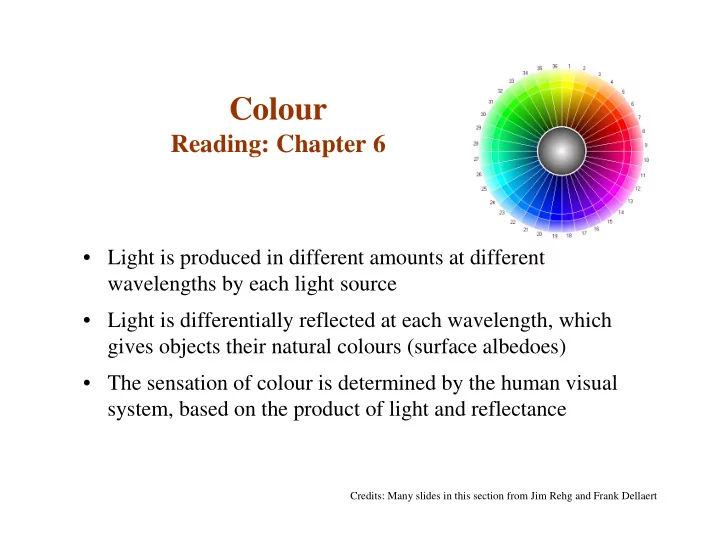
SLIDE 1 Colour
Reading: Chapter 6
- Light is produced in different amounts at different
wavelengths by each light source
- Light is differentially reflected at each wavelength, which
gives objects their natural colours (surface albedoes)
- The sensation of colour is determined by the human visual
system, based on the product of light and reflectance
Credits: Many slides in this section from Jim Rehg and Frank Dellaert
SLIDE 2 Measurements of relative spectral power
Parkkinen and P.
spectral power is plotted against wavelength in
about 400nm to 700nm. The colour names on the horizontal axis give the colour names used for monochromatic light of the corresponding wavelength.
Violet Indigo Blue Green Yellow Orange Red
Spectral power gives the amount of light emitted at each wavelength.
SLIDE 3 Black body radiators
- Construct a hot body with near-zero albedo (black body)
– Easiest way to do this is to build a hollow metal object with a tiny hole in it, and look at the hole.
- The spectral power distribution of light leaving this object is a function
- f temperature (degrees Kelvin)
– Surprisingly, the material does not make a difference!
- This leads to the notion of colour temperature --- the temperature of a
black body that would create that colour – Candle flame or sunset: about 2000K – Incandescent light bulbs: 3000K – Daylight (sun): 5500K – Blue sky (shadowed from sun): 15,000K
- Colour camera film is rated by colour temperature
SLIDE 4 Relative spectral power
illuminant models --- D65 models sunlight,and illuminant A models incandescent lamps. Relative spectral power is plotted against wavelength in nm.
Violet Indigo Blue Green Yellow Orange Red
SLIDE 5 Measurements of relative spectral power
- f four different artificial
illuminants, made by H.Sugiura. Relative spectral power is plotted against wavelength in
about 400nm to 700nm.
SLIDE 6 Spectral albedoes for several different flowers, with colour names attached. Notice that different colours typically have different spectral albedo, but that different spectral albedoes may result in the same perceived colour (compare the two whites). Spectral albedoes are typically quite smooth functions. Measurements by E.Koivisto.
Spectral reflectance (or spectral albedo) gives the proportion
- f light that is reflected at each wavelength
SLIDE 7 The appearance of colours
- Reflected light at each wavelength is the product of
illumination and surface reflectance
- Surface reflectance is typically modeled as having two
components: – Lambertian reflectance: equal in all directions (diffuse) – Specular reflectance: mirror reflectance (shiny spots)
SLIDE 8 When one views a coloured surface, the spectral radiance of the light reaching the eye depends on both the spectral radiance
- f the illuminant, and
- n the spectral albedo
- f the surface.
SLIDE 9
colour Names for Cartoon Spectra
SLIDE 10
Additive colour Mixing
SLIDE 11
Subtractive colour Mixing
SLIDE 12 Colour matching experiments - I
- Show a split field to subjects; one side shows the light
whose colour one wants to measure, the other a weighted mixture of primaries (fixed lights).
SLIDE 13
Colour Matching Process
SLIDE 14
Colour Matching Experiment 1
SLIDE 15
Colour Matching Experiment 1
SLIDE 16
Colour Matching Experiment 1
SLIDE 17
Colour Matching Experiment 2
SLIDE 18
Colour Matching Experiment 2
SLIDE 19
Colour Matching Experiment 2
SLIDE 20 Colour matching experiments - II
- Many colours can be represented as a positive weighted
sum of A, B, C
M=a A + b B + c C where the = sign should be read as “matches”
- This is additive matching.
- Gives a colour description system - two people who agree
- n A, B, C need only supply (a, b, c) to describe a
colour.
SLIDE 21 Subtractive matching
- Some colours can’t be matched like this:
instead, must write M+a A = b B+c C
- This is subtractive matching.
- Interpret this as (-a, b, c)
- Problem for building monitors: Choose R, G, B such that
positive linear combinations match a large set of colours
SLIDE 22 The principle of trichromacy
– Three primaries will work for most people if we allow subtractive matching
- Exceptional people can match with two or only one
primary (colour blindness)
- This could be caused by a variety of deficiencies.
– Most people make the same matches.
- There are some anomalous trichromats, who use
three primaries but make different combinations to match.
SLIDE 23
Human Photoreceptors
SLIDE 24 Human Cone Sensitivities
- Spectral sensitivity of L, M, S (red, green, blue) cones in human eye
SLIDE 25
SLIDE 26
Grassman’s Laws
SLIDE 27 Linear colour spaces
yields a linear colour space --- the coordinates
the weights of the primaries used to match it.
equivalent to choice of colour space.
- RGB: primaries are
- monochromatic. Energies
are 645.2nm, 526.3nm, 444.4nm.
imaginary, but have other convenient properties. Colour coordinates are (X,Y,Z), where X is the amount of the X primary, etc.
SLIDE 28
- monochromatic
- 645.2, 526.3, 444.4 nm.
- negative parts -> some
colours can be matched
RBG colour Matching
Figure courtesy of
SLIDE 29 CIE XYZ: colour matching functions are positive everywhere, but primaries are imaginary. Usually draw x, y, where x=X/(X+Y+Z) y=Y/(X+Y+Z) So overall brightness is ignored.
CIE XYZ colour Matching
Figure courtesy of
SLIDE 30 Geometry of colour (CIE)
- White is in the center, with
saturation increasing towards the boundary
- Mixing two coloured lights
creates colours on a straight line
- Mixing 3 colours creates colours
within a triangle
- Curved edge means there are no
3 actual lights that can create all colours that humans perceive!
SLIDE 31
RGB colour Space
The colours that can be displayed on a typical computer monitor (phosphor limitations keep the space quite small)
SLIDE 32
The black-body locus (the colours of heated black-bodies).
SLIDE 33 Uniform colour spaces
- McAdam ellipses (next slide) demonstrate that differences
in x,y are a poor guide to differences in colour – Each ellipse shows colours that are perceived to be the same
- Construct colour spaces so that differences in coordinates
are a good guide to differences in colour.
SLIDE 34 Figures courtesy of
- D. Forsyth
- 10 times actual size
Actual size
SLIDE 35 Non-linear colour spaces
- HSV: (Hue, Saturation, Value) are non-linear functions of
XYZ. – because hue relations are naturally expressed in a circle
- Munsell: describes surfaces, rather than lights - less
relevant for graphics. Surfaces must be viewed under fixed comparison light
SLIDE 36 Adaptation phenomena
- The response of your colour
system depends both on spatial contrast and what it has seen before (adaptation)
- This seems to be a result of
coding constraints -- receptors appear to have an operating point that varies slowly over time, and to signal some sort of
- ffset. One form of adaptation
involves changing this
- perating point.
- Common example: walk inside
from a bright day; everything looks dark for a bit, then takes its conventional brightness.
SLIDE 37
SLIDE 38
SLIDE 39
SLIDE 40
SLIDE 41 Viewing coloured objects
(Lambertian) plus specular model
– specularities on dielectric (non- metalic) objects take the colour of the light – specularities on metals have colour
- f the metal
- Diffuse component
– colour of reflected light depends on both illuminant and surface
SLIDE 42 Finding Specularities
- Assume we are dealing with dielectrics
– specularly reflected light is the same colour as the source
- Reflected light has two components
– diffuse – specular – and we see a weighted sum of these two
- Specularities produce a characteristic dogleg in the
histogram of receptor responses – in a patch of diffuse surface, we see a colour multiplied by different scaling constants (surface orientation) – in the specular patch, a new colour is added; a “dog- leg” results
SLIDE 43 R G B Illuminant color Diffuse component T S
Skewed-T in Histogram
A Physical Approach to colour Image Understanding – Klinker, Shafer, and Kanade. IJCV 1990 Figure courtesy of
SLIDE 44 R G B R G B Diffuse region Boundary of specularity
Figure courtesy of
Skewed-T in Histogram
SLIDE 45 Recent Application to Stereo
Sing Bing Kang
SLIDE 46 Recent Application to Stereo
!"
Figure courtesy of Sing Bing Kang
SLIDE 47 Human colour Constancy
- Colour constancy: determine hue and saturation under
different colours of lighting
- Lightness constancy: gray-level reflectance under
differing intensity of lighting
– colour a surface would have under white light – colour of reflected light (separate surface colour from measured colour) – colour of illuminant (limited)
SLIDE 48 Land’s Mondrian Experiments
- Squares of colour with the same colour radiance yield very
different colour perceptions
Photometer: 1.0, 0.3, 0.3 Photometer: 1.0, 0.3, 0.3 Audience: “Red” Audience: “Blue” White light Red light
SLIDE 49 Basic Model for Lightness Constancy
– Planar frontal scene – Lambertian reflectance – Linear camera response
- Modeling assumptions for scene
– Piecewise constant surface reflectance – Slowly-varying Illumination
) ( ) ( ) ( x p x I k x C
c
=
SLIDE 50 1-D Lightness “Retinex”
#$
Figure courtesy of
SLIDE 51 1-D Lightness “Retinex”
#%$
Figure courtesy of
SLIDE 52 colour Retinex
Images courtesy John McCann
SLIDE 53 Colour constancy
- Following methods have been used:
– Average reflectance across scene is known (often fails) – Brightest patch is white – Gamut (collection of all colours) falls within known range – Known reference colour (colour chart, skin colour…)
- Gamut method works quite well for correcting photographs
for human observers, but not well enough for recognition
- For object recognition, best approach is to use ratio of
colours on the same object (Funt and Finlayson, 1995)