Verifjcatjon of Sub-seasonal to Seasonal Predictjons Caio Coelho - - PowerPoint PPT Presentation

verifjcatjon of sub seasonal to seasonal predictjons
SMART_READER_LITE
LIVE PREVIEW

Verifjcatjon of Sub-seasonal to Seasonal Predictjons Caio Coelho - - PowerPoint PPT Presentation

Verifjcatjon of Sub-seasonal to Seasonal Predictjons Caio Coelho INPE/CPTEC, Brazil caio.coelho@cptec.inpe.br Acknowledgments: Arun Kumar, Alberto Arribas, Barbara Brown, Beth Ebert, David Stephenson, Debbie Hudson, Laura Ferranti, Matthew


slide-1
SLIDE 1

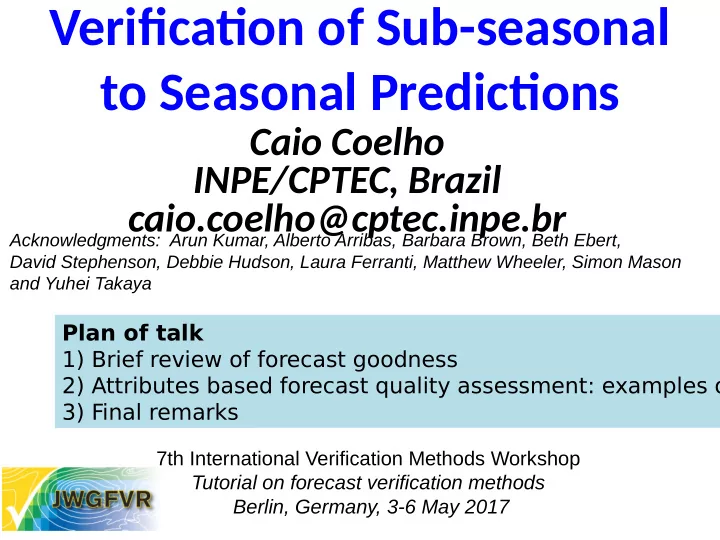
Verifjcatjon of Sub-seasonal to Seasonal Predictjons

Caio Coelho INPE/CPTEC, Brazil caio.coelho@cptec.inpe.br

Plan of talk 1) Brief review of forecast goodness 2) Attributes based forecast quality assessment: examples o 3) Final remarks

Acknowledgments: Arun Kumar, Alberto Arribas, Barbara Brown, Beth Ebert, David Stephenson, Debbie Hudson, Laura Ferranti, Matthew Wheeler, Simon Mason and Yuhei Takaya

7th International Verification Methods Workshop Tutorial on forecast verification methods Berlin, Germany, 3-6 May 2017

slide-2
SLIDE 2

What is a good forecast?

Good forecasts have:

  • QUALITY
  • VALUE/UTILITY
  • CONSISTENCY
  • A. H. Murphy 1993

“What is a good forecast ? An essay on the nature of goodness in weather forecasting” Weather and Forecasting, 8, 281-293.

Attributes of quality:

 Association  Accuracy  Discrimination  Reliability  Resolution

…  No single score can

be used to summarize a set of forecasts

slide-3
SLIDE 3

Some defjnitjons

  • Quality: Measure of correspondence between

forecasts and observatjons using mathematjcal relatjonship (deterministjc and probabilistjc scores)

  • Value: Measure of benefjt achieved (or loss

incurred) through the use of forecasts

  • Consistency: Correspondence between a forecast

and the forecasters belief. If consistent, the forecast must communicate what the forecaster thinks will happen, and correctly indicate the associated level

  • f uncertainty
slide-4
SLIDE 4

S2S forecast quality assessment

  • 1. Atuributes of deterministjc

forecasts (ensemble mean)

slide-5
SLIDE 5

Associatjon

  • Overall strength of the relatjonship between the

forecasts and observatjons

  • Linear associatjon is ofuen measured using the

product moment correlatjon coeffjcient

  

  

 

n i i n i i n i i i

y y r

1 2 1 2 1

) y

  • y

( ) x

  • x

( ) )( x

  • x

(

x: forecast y: observation n: number of (x,y) pairs

slide-6
SLIDE 6

r = 0.54 Forecasts with positive association

y x

Relationship between past forecast and past obs. anomalies

Forecast anomalies (mm) Observed anomalies (mm)

slide-7
SLIDE 7

r = 0.54 Forecasts with positive association

y

Observed anomalies (mm)

Slope=r*SD(y)/SD(x) Slope = 1 Slope < 1 Var(y)<Var(x)

x

Forecast anomalies (mm)

Relationship between past forecast and past obs. anomalies

slide-8
SLIDE 8

Accuracy

  • Average distance between forecasts and
  • bservatjons
  • Simplest measure is the Mean Error (Bias)

x: forecast y: observation n: number of (x,y) pairs

xi - yi ME

slide-9
SLIDE 9

Seasonal forecast example: 1-month lead precip. fcsts for DJF

slide-10
SLIDE 10

ACC (against GPCP v2 monthly) Day 1-30 mean I.C. : Dec.-Feb. 1981-2010 Bias (against GPCP v2 monthly) Day 1-30 mean I.C. : Dec.-Feb. 1981-2010

Monthly forecast example: 0-day lead precip. fcsts for next 30 days

Yuhei Takaya, JMA

slide-11
SLIDE 11

Mingyue Chen NCEP/NOAA

Monthly forecast example: 0, 5, 10 and 15-day lead fcsts for Feb

Precipitation 2m Temperature

slide-12
SLIDE 12

Debbie Hudson BOM, Australia

Two weeks forecast example: ½ month lead precip. fcsts

Correlation between forecast and observed precipitation anomalies Fortnight 2: Sep, Oct, Nov forecast start months. Hindcasts: 1980-2006

slide-13
SLIDE 13

S2S forecast quality assessment

  • 2. Atuributes of probabilistjc

forecasts (derived from ensemble members)

slide-14
SLIDE 14

Discriminatjon

  • Conditjoning of forecasts on observed outcomes
  • Addresses the questjon: Does the forecast difger

given difgerent observed outcomes? Or, can the forecasts distjnguish an event from a non-event?

  • If the forecast is the same regardless of the
  • utcome, the forecasts cannot discriminate an

event from a non-event

  • Forecasts with no discriminatjon ability are

useless because the forecasts are the same regardless of what happens

slide-15
SLIDE 15
  • The ROC curve is constructed by calculating the hit and f

for various probability thresholds

  • Area under ROC curve (A) is a measure of discrimination

successfully discriminating a warm (SST>0) from a cold (

slide-16
SLIDE 16
  • The ROC curve is constructed by calculating the hit and f

for various probability thresholds

  • Area under ROC curve (A) is a measure of discrimination

successfully discriminating a warm (SST>0) from a cold (

Shallow curve at top indicates forecasts with low probabilities are good. Good ability to indicate that a warm event will not occur. Steep curve at bottom indicates forecasts with high probabilities are good. Good ability to indicate that a warm event will occur.

slide-17
SLIDE 17

ROC Skill Score = 2 A - 1

Seasonal forecast example: 1-month lead precip. fcsts for DJF

slide-18
SLIDE 18

Relatjve Operatjng Characteristjcs T2m (upper tercile) Day 2-29 mean I.C. : Dec.-Feb. 1981- 2010 N.H., TROP, S.H.

Yuhei Takaya, JMA

Monthly forecast example: 1-day lead 2mT fcsts for day 2-29 mean

slide-19
SLIDE 19

One to two weeks forecast example: Northern extratropics

Monthly Forecast Persistence of day 5-11

ROC score: 2-metre temperature in the upper tercile

Day 12-18 (1 week ) Day 19-32 (2 weeks)

Monthly Forecast Persistence of day 5-18

Frederic Vitard and Laura Ferranti, ECMWF

slide-20
SLIDE 20

Debbie Hudson BOM, Australia

ROC area: Precipitation anomalies in the upper tercile Fortnight 2: Sep, Oct, Nov forecast start months. Hindcasts: 1980-2006

Two weeks forecast example: ½ month lead precip. fcsts

slide-21
SLIDE 21

Reliability and resolutjon

  • Reliability: correspondence between forecast

probabilities and observed relative frequency (e.g. an event must occur on 30% of the

  • ccasions that the 30% forecast probability

was issued)

  • Resolution: Conditioning of observed outcome
  • n the forecasts
  • Addresses the question: Does the frequency
  • f occurrence of an event difgers as the

forecast probability changes?

  • If the event occurs with the same relative

frequency regardless of the forecast, the forecasts are said to have no resolution

  • Forecasts with no resolution are useless

because the outcome is the same regardless

  • f what is forecast
slide-22
SLIDE 22

22

Reliability diagram

(pi) (oi )

  • Ni

Event: SST>0

slide-23
SLIDE 23

23

(pi) (oi )

  • Ni

.

Blue dot: Climatological forecast Perfectly reliable: Rel=0 Has no resolution: Res=0

Reliability diagram

Event: SST>0

slide-24
SLIDE 24

GLOSEA5 Hindcast Probabilistic skill MSLP in N. Atlantic in upper and lower tercile

Reliability ROC area

MacLachlan et al., QJRMS, 2015

Seasonal forecast example: 1-month lead MSLP fcsts for DJF

slide-25
SLIDE 25

Reliability Diagrams T2m (upper tercile) Day 2-29 mean I.C. : Dec.-Feb. 1981- 2010 N.H., TROP, S.H.

Monthly forecast example: 2-day lead 2mT fcsts for day 2-29 mean

Yuhei Takaya, JMA

slide-26
SLIDE 26

Debbie Hudson BOM, Australia

Precipitation anomalies in the upper tercile Fortnight 2: Sep, Oct, Nov forecast start months. Hindcasts: 1980-2006

Two weeks forecast example: ½ month lead precip. fcsts

slide-27
SLIDE 27

Seamless verifjcatjon

Seamless forecasts - consistent across space/tjme scales single modelling system or blended probabilistjc / ensemble

climate change local point regional global

Spatial scale forecast aggregation time

minutes hours days weeks months years decades NWP nowcasts decadal prediction seasonal prediction sub- seasonal prediction very short range

Ebert, E., L. Wilson, A. Weigel, M. Mittermaier, P. Nurmi,

  • P. Gill, M. Gober, S. Joslyn, B. Brown, T. Fowler, and A.

Watkins, 2013: Progress and challenges in forecast

  • verification. Meteorol. Appl., 20, 130–139.
slide-28
SLIDE 28

Final remarks

  • Clear need for attributes-based verification for a complete

forecast quality view

  • Need for use more than a single score for more detailed

forecast quality assessment

  • S2S verification is naturally leaning towards the seamless

consistency concept addressing the question of which scales and phenomena are predictable

  • As S2S covers various forecast ranges (days, weeks and

months) it naturally allows seamless verification developments

slide-29
SLIDE 29

Thank you all for your attention!