Venable SEC Update D E C E M B E R 2 0 0 3 Part I SEC Approves - - PDF document

venable sec update
SMART_READER_LITE
LIVE PREVIEW

Venable SEC Update D E C E M B E R 2 0 0 3 Part I SEC Approves - - PDF document

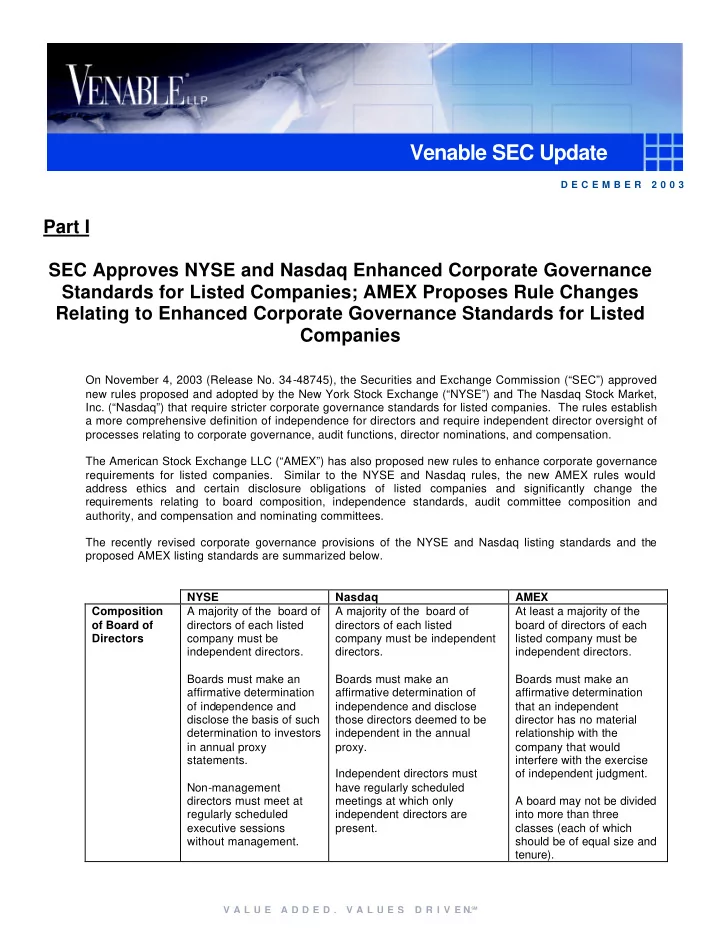
Venable SEC Update D E C E M B E R 2 0 0 3 Part I SEC Approves NYSE and Nasdaq Enhanced Corporate Governance Standards for Listed Companies; AMEX Proposes Rule Changes Relating to Enhanced Corporate Governance Standards for Listed Companies


slide-1
SLIDE 1

Venable SEC Update

D E C E M B E R 2 0 0 3 V A L U E A D D E D , V A L U E S D R I V E N.

SM

Part I SEC Approves NYSE and Nasdaq Enhanced Corporate Governance Standards for Listed Companies; AMEX Proposes Rule Changes Relating to Enhanced Corporate Governance Standards for Listed Companies

On November 4, 2003 (Release No. 34-48745), the Securities and Exchange Commission (“SEC”) approved new rules proposed and adopted by the New York Stock Exchange (“NYSE”) and The Nasdaq Stock Market,

  • Inc. (“Nasdaq”) that require stricter corporate governance standards for listed companies. The rules establish

a more comprehensive definition of independence for directors and require independent director oversight of processes relating to corporate governance, audit functions, director nominations, and compensation. The American Stock Exchange LLC (“AMEX”) has also proposed new rules to enhance corporate governance requirements for listed companies. Similar to the NYSE and Nasdaq rules, the new AMEX rules would address ethics and certain disclosure obligations of listed companies and significantly change the requirements relating to board composition, independence standards, audit committee composition and authority, and compensation and nominating committees. The recently revised corporate governance provisions of the NYSE and Nasdaq listing standards and the proposed AMEX listing standards are summarized below. NYSE Nasdaq AMEX Composition

  • f Board of

Directors A majority of the board of directors of each listed company must be independent directors. Boards must make an affirmative determination

  • f independence and

disclose the basis of such determination to investors in annual proxy statements. Non-management directors must meet at regularly scheduled executive sessions without management. A majority of the board of directors of each listed company must be independent directors. Boards must make an affirmative determination of independence and disclose those directors deemed to be independent in the annual proxy. Independent directors must have regularly scheduled meetings at which only independent directors are present. At least a majority of the board of directors of each listed company must be independent directors. Boards must make an affirmative determination that an independent director has no material relationship with the company that would interfere with the exercise

  • f independent judgment.

A board may not be divided into more than three classes (each of which should be of equal size and tenure).

slide-2
SLIDE 2

S E C U P D A T E D E C E M B E R 2 0 0 3 2 V A L U E A D D E D , V A L U E S D R I V E N.

SM

Definition

  • f

Independent Director The following individuals do not qualify as independent directors under the newly adopted NYSE rules:

  • An individual who is or

was an employee (or whose immediate family member is or was an executive

  • fficer) of the listed

company during the past three years.

  • An individual who

receives or received (or whose immediate family member receives or received) more than $100,000 per year in direct compensation from the listed company (except for certain permitted payments) during the past three years.

  • An individual who is or

was affiliated with or employed by (or whose immediate family member is or was affiliated with or employed by) a present or former internal or external auditor of the listed company during the past three years.

  • An individual who is or

was during the last three years employed (or whose family member is or was so employed) as an executive officer of another company where any of the listed company’s present executives serve on that company’s compensation committee.

  • An individual who is or

was an executive

  • fficer or an employee

The following individuals do not qualify as independent directors under the newly adopted Nasdaq rules:

  • An officer or employee of the

listed company or its subsidiaries, or any other individual having a relationship that would interfere with the exercise of independent judgment in carrying out the responsibilities of a director.

  • An individual who is, or at

any time during the past three years was, employed by the listed company or by any parent or subsidiary of the listed company

  • An individual who accepted
  • r has a family member who

accepted from the listed company (or any parent or subsidiary of the company) a payment in excess of $60,000 (except for certain permitted payments, including board compensation) in any single fiscal year during the past three years.

  • An individual who is a family

member of an individual who is or was employed as an executive officer by the listed company or by any parent or subsidiary of the company during the past three years.

  • An individual who is (or has

a family member who is) a partner, controlling shareholder or an executive

  • fficer in or of any
  • rganization to which the

company made, or from which the listed company received, payments for property or services in the current or any of the past three fiscal years that exceed the greater of 5% of the recipient’s gross revenues for that year or $200,000 (except for permitted payments). The following individuals would not qualify as independent directors under the most recently proposed AMEX rules:

  • Current officers and

employees of the listed company or its parent

  • r subsidiaries.
  • An individual who is or

was employed by the listed company or any parent or subsidiary of the company during the past three years.

  • An individual who

accepts (or whose immediate family member accepts) any payment from the listed company (or any parent or subsidiary of the company) in excess

  • f $60,000 during the

current or three previous fiscal years except for certain payments for investments, services

  • r benefits.
  • An individual who is (or

whose immediate family member is) a partner, controlling shareholder or executive officer of any

  • rganization to which
  • r from which the listed

company made or received payments that exceed the greater of 5% of the recipient’s gross revenues or $200,000 in any of the past three fiscal years.

  • An individual who is an

immediate family member of an individual who is or has been employed by the listed company (or any parent or subsidiary of the company) as an executive officer during any of the past three years.

slide-3
SLIDE 3

S E C U P D A T E D E C E M B E R 2 0 0 3 3 V A L U E A D D E D , V A L U E S D R I V E N.

SM

(or whose immediate family member is or was an executive

  • fficer) of a company

that makes payments to or receives payments from the listed company for property or services in an amount which, in any single fiscal year during the past three years, exceeds the greater of $1 million or 2% of such other company’s gross revenues.

  • An individual who is (or has

a family member who is) employed as an executive

  • fficer of another entity

where at any time during the past three years any of the executive officers of the listed company serve on the compensation committee of such other entity.

  • An individual who is or was

(or has a family member who is or was) a partner of the listed company’s outside auditor who worked on the listed company’s audit at any time during the last three years.

  • An individual who is (or

whose immediate family member is) an executive officer of another entity where at any time during the past three fiscal years any of the listed company’s executive

  • fficers serve on the

compensation committee.

  • An individual who is or

was (or whose immediate family member is or was) a partner or employee of the listed company’s

  • utside auditor, who

worked on the company’s audit during any of the past three years. Nomination of Directors Subject to limited exceptions, each listed company must have a nominating/corporate governance committee that is comprised entirely

  • f independent directors.

The committee must have a written charter that addresses the committee’s purpose and responsibilities and that provides for an annual performance evaluation

  • f the committee.

Subject to limited exceptions, director nominees must be selected or recommended for the board’s selection by a majority of the independent directors or by a nominating committee comprised solely of independent directors. One non-independent director who is not a current officer or employee, or family member of an officer or employee, of the listed company may be appointed to the nominating committee for a term of no more than two years under exceptional and limited

  • circumstances. Any such

appointment and the nature of the relationship must be disclosed in the company’s annual proxy statement. A listed company must certify that it has adopted a formal written charter or a board resolution addressing the director nominations process. Subject to limited exceptions, director nominees would have to be selected or recommended for the board’s selection by a majority of the independent directors or by a nominating committee comprised solely of independent directors. One non-independent director who is not a current

  • fficer or employee or

family member of an officer

  • r employee of the listed

company would be permitted to be appointed to the nominating committee for a term of no more than two years under exceptional and limited

  • circumstances. Any such

appointment and the nature

  • f the relationship would be

subject to disclosure in the company’s annual proxy statement. Each listed company would be required to adopt a formal written charter or board resolution addressing the director nominations process.

slide-4
SLIDE 4

S E C U P D A T E D E C E M B E R 2 0 0 3 4 V A L U E A D D E D , V A L U E S D R I V E N.

SM

Compensation

  • f Officers

East listed company must have a compensation committee composed entirely of independent directors. The committee must have a written charter that addresses the committee’s purposes and responsibilities and provides for an annual performance evaluation

  • f the committee.

Either as a committee or together with the other independent directors, the committee must determine and approve the CEO’s compensation and make recommendations to the board with respect to non-CEO compensation. The committee must produce a report on executive compensation to be included in the company’s annual proxy statement or annual report. The compensation of the CEO and all other executive officers

  • f a listed company must be

determined or recommended to the board for determination either by a majority of independent directors or by a compensation committee comprised solely of independent directors (subject to the limited exception below). The CEO may not be present during voting or deliberations

  • n the CEO’s compensation.

One non-independent director who is not a current officer or employee or family member of an officer or employee of the listed company may be appointed to the compensation committee for a term of no more than two years under exceptional and limited

  • circumstances. Any such

appointment and the nature of the relationship must be disclosed in the company’s annual proxy statement. The compensation of the CEO and all other officers

  • f a listed company would

be required to be determined or recommended to the board for determination either by a majority of independent directors or by a compensation committee comprised solely of independent directors (subject to the limited exception below). The CEO would not be permitted to be present during voting or deliberations on the CEO’s compensation. One non-independent director who is not a current

  • fficer or employee or

family member of an officer

  • r employee, would be

permitted to be appointed to the compensation committee for a term of no more than two years under exceptional and limited

  • circumstances. Any such

appointment and the nature

  • f the relationship would be

subject to disclosure in the company’s annual proxy statement. Audit Committee Composition and Charter Listed companies must comply with the standards relating to audit committee independence and responsibilities set forth in Rule 10A-3 of the Securities Exchange Act

  • f 1934 (“Rule 10A-3” of

the “Act”). Composition: Each listed company must have an audit committee with at least three members, all of whom must be independent directors. Each member must be financially literate. Listed companies must comply with the standards relating to audit committee independence, responsibilities and authority set forth in Rule 10A-3. Composition: Each listed company must have an audit committee composed

  • f at least three independent
  • directors. Nasdaq provides

certain limited cure periods for issuers who are unable to comply with the composition requirements because a member ceases to be independent or because of a vacancy. One member who is not Listed companies would be required to comply with the standards relating to audit committee independence and responsibilities set forth in Rule 10A-3, subject to limited opportunity to cure. A listed company would be required to notify AMEX promptly after an executive

  • fficer of the company

becomes aware of any material noncompliance by the company with the requirements of Rule 10A - 3.

slide-5
SLIDE 5

S E C U P D A T E D E C E M B E R 2 0 0 3 5 V A L U E A D D E D , V A L U E S D R I V E N.

SM

One member must have accounting or related financial management expertise. If a member simultaneously serves on the audit committees of more than three public companies, and the listed company does not limit the number of audit committees on which an audit committee member can serve, the board of the listed company must determine that such service does not impair the audit committee member’s ability to serve

  • n the listed company’s

audit committee and disclose such determination in the listed company’s annual proxy statement. Charter: The audit committee must have a charter that addresses: (1) the committee’s purpose, (2) an annual performance evaluation of the committee, and (3) the duties and responsibilities

  • f the committee.

independent and is not a current officer or employee or family member of such officer

  • r employee of the listed

company, but meets the criteria under Section 10A(m)(3) of the Act, may be appointed under special and limited circumstances for a term of no more than two years. Any such appointment and the nature of the relationship must be disclosed in the company’s annual proxy statement. Members must not have participated in the preparation

  • f the financial statements of

the company or any current subsidiary of the company at any time during the past three years and must be able to read and understand fundamental financial statements. One member must have financial sophistication. Charter: The audit committee must have a charter that specifies the committee’s purpose and sets forth the scope of the audit committee’s responsibilities and the means by which the committee carries out such responsibilities. Composition: Each listed company would be required to maintain an audit committee of at least three independent directors. One non-independent director who satisfies the requirements of Rule 10A-3 and is not a current officer

  • r employee or family

member of such officer or employee of the listed company would be permitted to be appointed to the audit committee for a term of no more than two years under exceptional and limited circumstances, but would not be permitted to chair the audit

  • committee. Any such

appointment and the nature

  • f the relationship would be

subject to disclosure in the company’s annual proxy statement. Audit committees would be required to hold meetings

  • n at least a quarterly

basis. Each member of the audit committee would have to be financially literate and at least one member would have to be financially sophisticated. Charter: The audit committee would be required to have a charter that specifies the scope of the committee’s responsibilities and how it carries out those responsibilities, the committee’s purpose and the authority and procedures specified in Rule 10A-3. Internal Audit Function Each listed company must have an internal audit function. N/A N/A

slide-6
SLIDE 6

S E C U P D A T E D E C E M B E R 2 0 0 3 6 V A L U E A D D E D , V A L U E S D R I V E N.

SM

Ethics, Corporate Governance Guidelines and Disclosure Listed companies must adopt and make publicly available a code of business conduct and ethics addressing conflicts of interest, corporate opportunities, confidentiality and fair dealing (among other things) and containing enforcement provisions applicable to all directors,

  • fficers and employees

and must publicly disclose any waiver of the code for directors and executive officers. Any waiver of the code for executive officer or directors may be made

  • nly by the board or a

board committee and must be promptly disclosed to shareholders. Listed companies must adopt and disclose corporate governance guidelines addressing director qualifications, responsibilities, compensation and education, as well as management succession and evaluation of the board (among other things), and must post such guidelines, along with the charters of their most important committees, on their websites. Listed companies must adopt and make publicly available a code of conduct that complies with the definition of “code of ethics” set out in Section 406(c)

  • f the Sarbanes-Oxley Act of

2002, contains enforcement provisions and is applicable to all directors, officers and employees. Any waivers of the code for directors or executive officers must be approved by the board and disclosed on a Form 8-K within five days. All listed companies would be required to adopt and make publicly available a code of conduct and ethics addressing accurate disclosure, ethical conduct, conflicts of interest, and compliance with laws (among other things) and containing enforcement provisions applicable to all directors, officers and employees, which also complies with the definition

  • f “code of ethics” set forth

in Item 406 of Regulation S- K. Any waivers of the code for directors or executive

  • fficers would be required

to be approved by the board and disclosed on a Form 8-K within five days. AMEX employees and floor members would be prohibited from serving on the board of directors of any listed company. The board of directors would be required to meet at least quarterly. The independent directors would be required to meet regularly, and at least annually, in executive session without non- independent directors and management. Listed companies would be urged to develop and implement continuing education for all directors and orientation for new directors. CEO Certification/ Other Notification Provisions The CEO of each listed company must certify to the NYSE each year that he or she is not aware of any violation by the company of the NYSE’s corporate governance An issuer must provide Nasdaq with prompt notification after an executive officer of the issuer becomes aware of any material noncompliance by the issuer with the qualitative listing requirements. Each listed company would be required to provide prompt notification to AMEX after an executive officer becomes aware of any material non-compliance by the listed company with

slide-7
SLIDE 7

S E C U P D A T E D E C E M B E R 2 0 0 3 7 V A L U E A D D E D , V A L U E S D R I V E N.

SM

listing standards. The CEO must promptly notify the NYSE of any material noncompliance with any such listing standard. applicable corporate governance requirements. Applicability The following types of issuers are exempt from certain provisions of the new NYSE rules:

  • Controlled

companies

  • Limited

partnerships

  • Companies in

bankruptcy

  • Closed-end and
  • pen-end

management investment companies

  • Closed-end and
  • pen-end funds
  • Business

development companies

  • Asset-backed

and other passive issuers

  • Companies listing

preferred or debt securities or derivatives or special purpose securities only

  • Foreign private

issuers The following types of issuers are exempt from certain provisions of the new Nasdaq rules:

  • Controlled companies
  • Foreign private issuers
  • Management

investment companies

  • Business development

companies

  • Cooperative entities
  • Asset-backed issuers

and other passive issuers The following types of issuers would be exempt from certain provisions of the AMEX rules:

  • Controlled

companies

  • Limited

partnerships

  • Companies in

bankruptcy

  • Closed-end and
  • pen-end

management companies

  • Foreign private

issuers

  • Issuers of preferred

and debt listings or derivatives or special purpose securities only

  • Small business

filers

  • Asset-backed

issuers and other passive business

  • rganizations
  • Issuers of

derivatives and special purpose securities

  • Business

development companies Going Concern Opinions N/A A listed company that receives an audit opinion that contains a going concern qualification must publicly disclose receipt of such a qualified opinion. A listed company that receives an audit opinion that contains a going concern qualification would be required to disclose publicly receipt of such a qualified opinion. Related Party Transactions N/A All related party transactions must be reviewed for potential conflict of interest situations on an ongoing basis and must be approved by the audit committee or another independent body of the board

  • f directors.

Related party transactions would be subject to appropriate mandatory review and oversight by the audit committee or a comparable body of the board.

slide-8
SLIDE 8

S E C U P D A T E D E C E M B E R 2 0 0 3 8 V A L U E A D D E D , V A L U E S D R I V E N.

SM

Implementa- tion Dates and Transition Periods Listed companies must comply with the majority

  • f the new listing

standards as of the earlier of (i) their first annual meeting after January 15, 2004 or (ii) October 31, 2004. Listed companies must comply with the majority of the new listing standards as of the earlier of (i) their first annual meeting after January 15, 2004

  • r (ii) October 31, 2004.

Listed companies would be required to comply with the majority of the new requirements by the earlier

  • f (i) their first annual

meeting after March 15, 2004 or (ii) October 31,

  • 2004. The audit committee

changes implementing Rule 10A-3 would be required to be complied with by the earlier of (i) the first annual meeting after January 15, 2004 or (ii) October 31, 2004. Enforcement The NYSE may issue a public reprimand letter to any listed company that violates a NYSE listing standard. N/A The AMEX may issue a Warning Letter to a listed company with respect to a minor violation of the corporate governance or shareholder protection requirements and may immediately suspend trading in any security and make application to the SEC to delist the security.

slide-9
SLIDE 9

S E C U P D A T E D E C E M B E R 2 0 0 3 1 V A L U E A D D E D , V A L U E S D R I V E N.

SM

Part II SEC Adopts Rules on Disclosure of Nominating Committee Functions and Communications Between Security Holders and Boards of Directors and Proposes Rules on Director Nominations by Security Holders

The SEC recently acted on two rules regarding the nomination and election of directors. The first rule, which the SEC adopted on November 19, 2003 (Release Nos. 33-8340; 34-48825; IC-26262) and is effective January 1, 2004, requires enhanced disclosure of nominating committee functions and communications between shareholders and boards of directors. The second rule, which the SEC proposed on October 14, 2003 (Release Nos. 34-48626; IC-26206) and is expected to become final in December 2003 or early 2004, provides significant, long-term shareholders with the opportunity, in certain situations, to include nominees for director in a company’s proxy materials. According to the SEC, the purposes of these rulemakings are to enhance transparency of the nominating process, enhance communications between shareholders and directors of public companies, and provide a mechanism for shareholders to have nominees included in company proxy materials where there is evidence of shareholder dissatisfaction with the company’s proxy process. Enhanced Disclosure. The rules the SEC adopted in November amend Items 7 and 22 of Schedule 14A under the proxy rules to require expanded disclosure in proxy statements regarding nominating committees and the ability of shareholders to communicate with boards of directors. Proxy statement disclosure regarding the nominating committee is expanded to include:

  • A statement as to whether the company has a standing nominating committee or a committee

performing similar functions and, if not, a statement of the basis for the board’s view that it is appropriate for the company not to have such a committee and identification of each director who participates in the consideration of director nominees;

  • The following information regarding the company’s director nomination process:
  • Whether or not the nominating committee has a charter and, if so, where

shareholders can find a copy of the charter (if the charter is not available on the company’s website, then the company must include a copy of the charter as an appendix to the company’s proxy statement at least once every three fiscal years);

  • Whether the members of the nominating committee are independent, as defined in

the listing standards applicable to the company;

  • Whether the nominating committee has a policy with regard to the consideration of

director candidates recommended by shareholders and a description of the material elements of that policy, including a statement as to whet her the committee will consider director candidates recommended by shareholders;

  • If the nominating committee does not have a policy with regard to the consideration
  • f director candidates recommended by shareholders, a statement of that fact and a

statement of the basis for the board’s view that it is appropriate for the company not to have such a policy;

  • If the nominating committee will consider candidates recommended by shareholders,

a description of the procedures to be followed by shareholders in submitting such recommendations;

slide-10
SLIDE 10

S E C U P D A T E D E C E M B E R 2 0 0 3 2 V A L U E A D D E D , V A L U E S D R I V E N.

SM

  • A description of any specific, minimum qualifications that the nominating committee

believes must be met by a nominating committee-recommended nominee for the board of directors, and a description of any specific qualities or skills that the nominating committee believes are necessary for one or more of the company’s directors to possess;

  • A description of the nominating committee’s process for identifying and evaluating

nominees for directorships, including nominees recommended by shareholders, and any differences in the manner in which the nominating committee evaluates nominees for director recommended by a shareholder;

  • With regard to each nominee approved by the nominating committee for inclusion on

the company’s proxy card (other than executive officers or directors standing for re- election), a statement as to which of the following categories of persons or entities recommended that nominee: shareholder, non-management director, chief executive

  • fficer, other executive officer, third-party search firm, or other, specified source;
  • If the company pays a fee to any third party or parties to identify or evaluate or assist

in identifying or evaluating potential nominees, disclosure of the function performed by each such third party; and

  • If the company’s nominating committee received, by a date not later than the 120th

calendar day before the date of the company’s proxy statement released to shareholders in connection with the previous year’s annual meeting, a recommended nominee from a shareholder that beneficially owned more than 5% of the company’s voting common stock for at least one year as of the date the recommendation was made, or from a group of shareholders that beneficially owned, in the aggregate, more than 5% of the company’s voting common stock, with each of the securities used to calculate that ownership held for at least one year as of the date the recommendation was made, identification of the candidate and the shareholder or shareholder group that recommended the candidate and disclosure as to whether the nominating committee chose to nominate the candidate, provided, however, that no such identification or disclosure is required without the written consent of both the shareholder or shareholder group and the candidate to be so identified. Proxy statement disclosure regarding the ability of shareholders to communicate with the board of directors is expanded to include:

  • A statement as to whether the company’s board of directors provides a process for

shareholders to send communications to the board of directors and, if not, a statement of the basis for the board’s view that it is appropriate for the company not to have a such a process;

  • If the company has a process for shareholders to send communications to the board of

directors:

  • a description of the manner in which shareholders can send communications to the

board and, if applicable, to specified individual directors; and

  • if all shareholder communications are not sent directly to board members, a

description of the company’s process for determining which communications will be relayed to board members.

  • A description of the company’s policy, if any, with regard to board members’ attendance at

annual meetings and a statement of the number of board members who attended the prior year’s annual meeting.

slide-11
SLIDE 11

S E C U P D A T E D E C E M B E R 2 0 0 3 3 V A L U E A D D E D , V A L U E S D R I V E N.

SM

Shareholder Nominees. Pursuant to the proposed rules regarding shareholder access to company proxy materials, companies would be required to include shareholder nominees in company proxy materials upon the occurrence of one or both of the following events:

  • At least one of the company’s nominees for the board of directors for whom the company solicited

proxies received “withhold” votes from more than 35% of the votes cast at an annual meeting of security holders held after January 1, 2004 at which directors were elected (provided, that this event may not occur in the case of a contested election to which Exchange Act Rule 14a-12(c) applies or an election to which the proposed security holder nomination procedure in Exchange Act Rule 14a-11 applies); or

  • A shareholder proposal submitted pursuant to Exchange Act Rule 14a-8 providing that the company

become subject to the shareholder nomination procedure in proposed Rule 14a-11:

  • was submitted for a vote of shareholders at an annual meeting of shareholders held

after January 1, 2004 by a shareholder or group of shareholders that held more than 1% of the company’s securities entitled to vote on the proposal for one year as of the date the proposal was submitted and that provided evidence of such holding to the company; and

  • such “direct access” proposal received more than 50% of the votes cast on that

proposal at that meeting. If the shareholder nomination procedure is triggered, then it will remain operative for any annual or special meetings held during:

  • The remainder of the calendar year in which the triggering event occurs;
  • The calendar year following the calendar year in which the triggering event occurs; and
  • The portion of the second calendar year following the calendar year in which the triggering

event occurs, up to and including the annual meeting held that year. Further, if the shareholder nomination process is triggered, the Company must disclose such fact in its Form 10-Q for the period in which the nomination triggering event occurred (or its Form 10-K if the nomination triggering event occurred during the fourth quarter of the fiscal year). To be eligible to submit a nomination in accordance with Rule 14a-11, a shareholder or group of shareholders would be required to:

  • Beneficially own, either individually or in the aggregate, more than 5% of the company’s

securities that are eligible to vote for the election of directors at the next annual meeting of shareholders, with each of such securities having been held continuously for at least two years as of the date of the nomination;

  • Intend to continue to own those securities through the date of that annual meeting;
  • Be eligible, as to the shareholder or each member of the shareholder group, to report beneficial
  • wnership on Schedule 13G, rather than Schedule 13D, in reliance on Exchange Act Rule 13d-

1(b) or (c); and

  • Have filed a Schedule 13G reporting its beneficial ownership as a passive or institutional

investor (or group) on such schedule before or on the date of the submission of the nomination to the company. In order to be eligible for inclusion in the company’s proxy materials, a nominee of a shareholder or shareholder group would have to meet the following conditions:

slide-12
SLIDE 12

S E C U P D A T E D E C E M B E R 2 0 0 3 4 V A L U E A D D E D , V A L U E S D R I V E N.

SM

  • The nominee’s candidacy or, if elected, board membership, must not violate controlling state

law, federal law, or the rules of a national securities exchange or national securities association (other than such rules that set forth requirements regarding the independence of directors);

  • The nominee cannot be the nominating shareholder, a member of the nominating

shareholder group, or a member of the immediate family of the nominating shareholder or any member of the nominating shareholder group;

  • Neither the nominee nor any immediate family member of the nominee shall have been an

employee of the nominating shareholder or of any member of the nominating shareholder group during the then-current calendar year or during the immediately preceding calendar year;

  • Neither the nominee nor any immediate family member of the nominee shall have, during the

year of the nomination or the immediately preceding calendar year, accepted directly or indirectly any consulting, advisory, or other compensatory fee from the nominating shareholder or from any member of the shareholder group or any affiliate of any such holder

  • r member;
  • The nominee shall not be an executive officer or director (or person fulfilling similar functions)
  • f the nominating shareholder or any member of the nominating shareholder group, or of an

affiliate of the nominating shareholder or any such member of the nominating shareholder group;

  • The nominee shall not control the nominating shareholder or any member of the nominating

shareholder group;

  • The nominee must satisfy the applicable standards of a national securities exchange or

national securities association regarding director independence, if any, except where a rule imposes a standard regarding independence that requires subjective determination by the board or a group or committee of the board; and

  • Neither the nominee nor the nominating shareholder (or any member of the nominating

shareholder group, if applicable) may have a direct or indirect agreement with the company regarding the nomination of the nominee. The number of shareholder nominees a company must include in its proxy materials for any meeting is limited to one nominee if the company’s board of directors has eight or fewer members, two nominees if the board has nine to nineteen members, and three nominees if board has 20 or more members. If more than one shareholder or shareholder group is eligible to nominate, then the nominee of the shareholder or shareholder group with the greatest beneficial ownership (as reported on Schedule 13G) at the time of delivery of the notice of intent to nominate shall be included in the proxy materials. If a shareholder or shareholder group wishes to include a nominee in the company’s proxy materials, then it must give notice to the company no later than 80 days prior to the date the company mails its proxy materials for the annual meeting (calculated as provided in Rule 14a-8) or such other date disclosed by the company in a Form 8-K. The notice would be required to include certain representations and information regarding right

  • f the shareholder or shareholder group to submit the nominee and compliance of the shareholder or

shareholder group and the nominee with the applicable procedures and requirements. A shareholder or shareholder group would be ineligible to use the shareholder nomination procedure under Rule 14a-11 if it does not provide timely notice. If the company determines that it is not obligated to include the nominee in its proxy materials, then it must give written notice to the nominating shareholder or shareholder group of its determination promptly, but in no case less than 30 calendar days before the date of the company’s proxy statement released to shareholders in connection with the previous year’s annual meeting. The notice must include a discussion of the specific

slide-13
SLIDE 13

S E C U P D A T E D E C E M B E R 2 0 0 3 5 V A L U E A D D E D , V A L U E S D R I V E N.

SM

requirement or requirements of Rule 14a-11 that the company’s board of directors has determined permit the company not to include that specific nominee and the specific basis for the belief of the board of directors that the company is permitted to not include that specific nominee. If the company determines that it must include the shareholder nominee, then it would be required to advise the nominating shareholder of this determination and state whether the company intends t

  • include in its proxy

statement disclosure opposing the shareholder nominee and/or supporting company nominees (other than a mere recommendation to vote in favor of or withhold votes from specified candidates). If the company intends to include such a statement, it must give the nominating shareholder or shareholder group the opportunity to submit a statement of not more than 500 words supporting the shareholder nominee(s). Solicitations by or on behalf of a nominating shareholder or shareholder group in support of a nominee placed

  • n the company’s proxy card in accordance with the proposed rule would not be subject to the proxy rules,

provided that the soliciting party does not, at any time during such solicitation, seek directly or indirectly, either

  • n its own or another’s behalf, the power to act as proxy for a shareholder and each written communication

includes the identity of the nominating shareholder or shareholder group and a description of his or her direct

  • r indirect interests, by security holdings or otherwise and a prominent legend advising shareholders to read

the company’s proxy statement when it becomes available. About Venable Venable is a strongly grounded law firm with a century-long history, energized by recent growth. Through

  • ffices in Maryland, Washington, DC and Virginia, we work with a diverse local, national and international
  • clientele. Our business is providing service and we recognize that our continued success depends on

delivering that service faster, more efficiently, and with high quality. Venable attributes its success to the success of its clients. We are committed to building relationships that transcend the usual role of legal advisor. Our practice areas are built not only on legal experience, but also on knowledge and understanding of each client’s industry. Our attorneys work as partners with clients, advising them on a number of levels. When clients face a challenge or opportunity, we immediately bring an experienced team from diverse specialties to coordinate advice. We seek not only to respond to our client’s current legal issues, but also to identify potential problems early. Our 420-plus attorneys comprise a team of skilled, experienced professionals. Our clients rely on our great breadth of experience and sound legal judgment for assistance in achieving solid and practical business

  • solutions. We represent businesses of all sizes – from emerging companies to large national and international

companies in industries that include financial, manufacturing, hospitality, health care, transportation, mass media information technology, as well as governmental entities, nonprofits and individuals. *******************************

For more information about the matters discussed in this SEC Update, please contact Beth Hughes at (703) 760-1649, Tuck Washburne at (410) 244-7744, Alan Yarbo at (410) 244-7622, Anita Finkelstein at (202) 344-4905, Ariel Vannier at (202) 344-4867, Melissa Warren at (410) 244-7695, Michael Conron at (410) 244-7424, Fred Spindel at (202) 344-4732 or Matthew Swartz at (703) 760-1660. SEC Update is published by the Corporate Finance and Securities Group of Venable LLP. It is not intended to provide legal advice or

  • pinion. Such advice may only be given when related to specific fact situations .