Legal Review An Association TRENDS Special Focus sponsored by VENABLE - - PDF document

legal review
SMART_READER_LITE
LIVE PREVIEW

Legal Review An Association TRENDS Special Focus sponsored by VENABLE - - PDF document

2012 Annual Legal Review An Association TRENDS Special Focus sponsored by VENABLE LLP Venable is pleased Association legal concerns ran the to sponsor again the gamut in 2011, from the new Association TRENDS Annual area of Internet concerns,


slide-1
SLIDE 1

TOP 8

ASSOCIATION

LEGAL ISSUES OF THE PAST YEAR

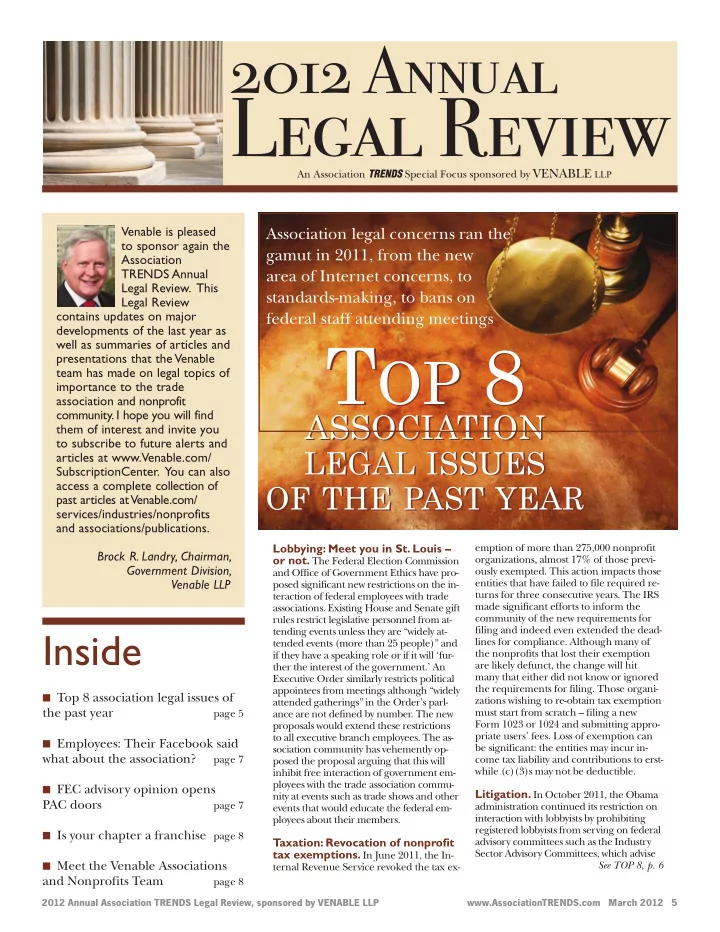
Association legal concerns ran the gamut in 2011, from the new area of Internet concerns, to standards-making, to bans on federal staff attending meetings

TOP 8

ASSOCIATION

LEGAL ISSUES OF THE PAST YEAR

Venable is pleased to sponsor again the Association TRENDS Annual Legal Review. This Legal Review contains updates on major developments of the last year as well as summaries of articles and presentations that the Venable team has made on legal topics of importance to the trade association and nonprofit

  • community. I hope you will find

them of interest and invite you to subscribe to future alerts and articles at www.Venable.com/

  • SubscriptionCenter. You can also

access a complete collection of past articles at Venable.com/ services/industries/nonprofits and associations/publications. Brock R. Landry, Chairman, Government Division, Venable LLP

2012 Annual Association TRENDS Legal Review, sponsored by VENABLE LLP www.AssociationTRENDS.com March 2012 5

2012 Annual

Legal Review

An Association TRENDS Special Focus sponsored by VENABLE LLP

Lobbying: Meet you in St. Louis –

  • r not. The Federal Election Commission

and Office of Government Ethics have pro- posed significant new restrictions on the in- teraction of federal employees with trade

  • associations. Existing House and Senate gift

rules restrict legislative personnel from at- tending events unless they are “widely at- tended events (more than 25 people)” and if they have a speaking role or if it will ‘fur- ther the interest of the government.’ An Executive Order similarly restricts political appointees from meetings although “widely attended gatherings” in the Order’s parl- ance are not defined by number. The new proposals would extend these restrictions to all executive branch employees. The as- sociation community has vehemently op- posed the proposal arguing that this will inhibit free interaction of government em- ployees with the trade association commu- nity at events such as trade shows and other events that would educate the federal em- ployees about their members.

Taxation: Revocation of nonprofit tax exemptions. In June 2011, the In-

ternal Revenue Service revoked the tax ex- emption of more than 275,000 nonprofit

  • rganizations, almost 17% of those previ-
  • usly exempted. This action impacts those

entities that have failed to file required re- turns for three consecutive years. The IRS made significant efforts to inform the community of the new requirements for filing and indeed even extended the dead- lines for compliance. Although many of the nonprofits that lost their exemption are likely defunct, the change will hit many that either did not know or ignored the requirements for filing. Those organi- zations wishing to re-obtain tax exemption must start from scratch – filing a new Form 1023 or 1024 and submitting appro- priate users’ fees. Loss of exemption can be significant: the entities may incur in- come tax liability and contributions to erst- while (c)(3)s may not be deductible.

  • Litigation. In October 2011, the Obama

administration continued its restriction on interaction with lobbyists by prohibiting registered lobbyists from serving on federal advisory committees such as the Industry Sector Advisory Committees, which advise See TOP 8, p. 6

Inside

■ Top 8 association legal issues of

the past year

page 5 ■ Employees: Their Facebook said

what about the association?

page 7 ■ FEC advisory opinion opens

PAC doors

page 7 ■ Is your chapter a franchise page 8 ■ Meet the Venable Associations

and Nonprofits Team

page 8

slide-2
SLIDE 2

TOP 8, from p. 5 the U.S. trade representative and the Com- merce Department on international trade

  • matters. Six lobbyists for various trade associ-

ation groups have sued the administration claiming that the new policy denies their constitutional right of freedom of speech and the equal protection guarantees. The complaint also alleges that the policy would have the effect of encouraging people to avoid registration. The government has filed a motion to dismiss, arguing among other grounds that the plaintiffs have no standing since all advisory committee members serve at the pleasure of the president.

New corporation rules in D.C.

On Jan. 1, 2012 the new D.C. Non-Profit Corporation Act went into effect. This law is considerably more detailed than the pre- vious statute, but overall the act generally provides flexibility to alter the statutory “de- fault rules” through specific, different pro- visions adopted in a corporation’s articles

  • r bylaws. The act also recognizes and ac-

commodates 21st century forms of commu- nication in doing business such as Internet

  • r other electronic meeting technology

and notice. There are a number of signifi- cant areas of change: The act codifies the common law fiduciary duties of care and loyalty imposed upon directors and officers and specifies the nature of conflict situa- tions that must be disclosed. Indemnifica- tion requirements are detailed. It streamlines the process and requirements for incorporation. Recordkeeping provi- sions are expanded significantly, requiring permanent retention of the minutes of meetings of boards and members. A variety

  • f other records must be maintained at the

corporation’s principal office and are sub- ject to inspection by directors and mem-

  • bers. These changes will require review and

revision of existing corporate documents of D.C. corporations.

Litigation heats up on standards-

  • making. In a case that has now stretched

for over five years, an insulation manufac- turer alleges that the American Society of Heating, Refrigerating and Air Condition- ing Engineers improperly developed stan- dards for metal building insulation systems that restrained trade, foreclosed competi- tion, and facilitated price increases. The plaintiffs originally sought injunctive relief to prohibit circulation or publication of a standard that had been in effect for nearly 10 years. The crux of the complaint is that the standards-making process was unfair and manipulated by ASHRAE and other unnamed persons. It is alleged that the re- sulting standards disadvantaged its product in the market (although did not bar it). The plaintiff also originally claimed viola- tions of the Lanham Act, continued to as- sert a common law claim of unfair competition against the association. No

  • ther defendants have been named in the
  • suit. Trial is set for later in the year.

This case will be watched for further guid- ance as to the claims that can withstand scrutiny related to associations’ standards- making activities.

Internet: dot whatever. The furor

  • ver generic Top Level Domain Names

raged through 2011 and continues this

  • year. After years of consideration, in June

2011, ICANN – the entity charged with ad- ministration of the top-level domain names – announced the process by which applicants could seek new web address suf-

  • fixes. In addition to the familiar few, such

as .org, .com, .edu, .net, ICANN will open the floodgates to any new designations that it approves. Applications will be accepted until later in March. The process, however, is expensive. Application fees are $185,000 and this is just the start of establishing and maintaining a registry program for the do- main name. Proponents of the change note that some countries are likely to start their own systems if the new proposals are

  • thwarted. Widespread opposition has gath-
  • ered. The Association of National Advertis-

ers has established a coalition with more than 160 members, including ASAE, Na- tional Association of Manufacturers and the U.S. Chamber. The coalition is con- cerned about the confusion, cost and po- tential cyber-squatting that could ensue. Various legislators also have weighed in. It all spells a controversy for the rest of 2012.

Membership/accreditation

  • restriction. Association members who

determine or unduly influence another member’s accreditation status can be dicey. In K&S Associates v. American Association

  • f Physicists in Medicine, the court found

that the plaintiff stated an unreasonable re- straint of trade claim against the association for improperly withholding an economi- cally critical accreditation. The factual alle- gations were important in denying a motion to dismiss. The chairpersons of the committee charged with evaluating the ap- plication recommended acceptance of K&S, but another ad hoc group was con- vened that included the applicant’s two di- rect competitors. The complaint alleges that the accreditation was denied largely because of the improper involvement of the competitors. The case is set for trial later this year.

Taxation: IRS announces its focus for enforcement. The 2012 Work Plan

published by the IRS Exempt Organiza- tions Division highlighted significant areas of scrutiny that the association com- munity will face. The substantial changes to the Form 990 were promulgated for the express purpose of providing infor- mation to better evaluate tax compliance

  • f nonprofits. Data for tax years 2008 and

after are being evaluated to construct “risk models to identify the likelihood of noncompliance.” For example, questions

  • n the form regarding corporate gover-

nance are being used to identify potential

  • noncompliance. Political activity is an-
  • ther area of emphasis. The IRS will also

look to outside sources as well as returns to identify potential noncompliance with political activity and lobbying tax issues. Unrelated business income tax is always a hot topic with the IRS – in 2012 the EO will analyze associations that report signif- icant gross receipts from unrelated activi- ties, but declare no tax due. 6 March 2012 www.AssociationTRENDS.com 2012 Annual Association TRENDS Legal Review, sponsored by VENABLE LLP

TOP 8

ASSOCIATION

LEGAL ISSUES OF THE PAST YEAR

TOP 8

ASSOCIATION

LEGAL ISSUES OF THE PAST YEAR

slide-3
SLIDE 3

2012 Annual Association TRENDS Legal Review, sponsored by VENABLE LLP www.AssociationTRENDS.com March 2012 7

B

ECAUSE NONPROFITS ARE TYPICALLY NOT

unionized, they often overlook the fact that the National Labor Relations Act can apply to them and limit their right to discipline or ter- minate employees for social media activity. A report by the NLRB’s acting general coun- sel issued last August and a subsequent ruling of an NLRB administrative law judge provide very helpful guidance for nonprofits on what policies and punishment for postings might be prob-

  • lematic. For example, the NLRB report dis-

cusses the following findings in particular cases:

■ Employees were unlawfully discharged for

responding to the Facebook posting of a co- worker discussing working conditions, even though the employee who initiated the cyber conversation considered her coworkers’ com- ments to be cyberbullying and harassment.

■ An employee was discharged lawfully

after posting profane com- ments on Facebook criti- cal of store management because the employee’s postings were merely an expression of individual gripes, as opposed to pro- tected concerted activity. In this case, at least two coworkers responded to the posting; however, their messages reflected that the posting was individual and not group activity.

■ A policy prohibiting

employees from making disparaging comments when discussing the em- ployer or its supervisors was unlawful because the policy did not make clear that it did not prohibit protected concerted activity.

■ The discharge of a recovery specialist in a

residential facility for homeless individuals who posted demeaning comments concerning her employer’s clientele was lawful because there was no evidence of protected concerted activ- ity: the comments did not mention any terms

  • r conditions of employment, the posting was

not discussed with any coworkers, and the com- ments were not for the purpose of inducing group activity or an outgrowth of collective concerns of the employee or her coworkers. ON SEPT. 2, 2011, AN NLRB ADMINISTRATIVE LAW judge issued the first adjudicated decision in- volving social media-based discipline. In the case, Hispanics United of Buffalo Inc., a non- profit that renders social services to economi- cally disadvantaged clients in Buffalo, N.Y., was found to have committed unfair labor practices when it discharged several employees for Face- book postings – made on their own computers

  • utside of working hours – that expressed criti-

cism of their working conditions and of a per- son who worked for the nonprofit. The employees were terminated based on the con- tention that the postings constituted cyberbully-

FEC advisory

  • pinion opens

PAC doors

T

HE FEC HAS ISSUED AN ADVISORY
  • pinion (AO) to the Utah

Bankers Association that provides new opportunities for associations to solicit contributions from the general public to candidates. The AO will allow the Utah Bankers PAC to establish a project that will identify candidates who support the banking industry. One advisory council will identify those candidates and a second will determine which candidates will receive support from the project. The councils will be staffed by association employees and also by volunteers from member banks. The project will then create a website and emails that will encourage people to contribute to the candidates. The council members may forward the emails to their personal contacts, and ask that they be forwarded along to others. It is important to note that the emails and websites are not used to collect contributions for the

  • candidates. Rather, they encourage

people to contribute directly to the candidates involved (by directing people to the candidate’s websites). In addition, this activity will not be coordinated with the candidates. The costs involved for creating content (including staff time), paying Internet vendors, etc. will be paid by the PAC. In addition, the PAC will pay its affiliated associations (those in other states) $50 annually to cover the costs associated with staff from those associations forwarding emails. The association itself will pay any administrative costs, such as accounting, legal, and phone costs. This AO makes clear that associations may use their PACs to solicit contributions to candidates from those outside of the association’s restricted class. This frees up PAC resources, helps to elect candidates whom the association supports, and likely will help the association raise more money for its PAC since it can rely

  • n contributions from those outside
  • f the restricted class to contribute

to candidates. Read the full article by Ron Jacobs at www.Venable.com. ing and harassment in violation of the non- profit’s policies. The ALJ found the comments protected and rejected the contention that the employees were bullying the other worker or that they harassed her in violation of the non- profit’s policies. Consequently, the ALJ con- cluded that the employees had not engaged in conduct that converted their concerted activity from protected to unprotected status. THE NLRB’S RECENT REPORT AND THE HISPANICS United of Buffalo decision provide helpful guidance to nonprofits not wishing to become potential NLRB cases, including the following:

■ Communications that are not concerted

are generally not protected. However, the cases highlight that a finding of concerted activity might turn on evidence not readily available to the employer, so caution is warranted.

■ Communications that are concerted (i.e.,

that are not merely an individual gripe) on matters of mutual concern to employees are likely to be found to be protected by the NLRA.

■ Communications that are protected do

not become unprotected simply because the comments are communicated via the Internet and/or because they might be read by non- employees as well.

■ Communications that are protected do

not become unprotected just because they con- tain some critical (about the employer) or oth- erwise objectionable language.

■ An association policy that, reasonably in-

terpreted, would tend to “chill” employees in the exercise of their rights under the NLRA is likely to be found unlawful by the NLRB if it is challenged. Given this new focus on social media, non- profits should: 1) review their relevant employ- ment policies to ensure that they are not

  • verbroad and do not constitute potential un-

fair labor practices; and 2) proceed cautiously when determining whether to discipline an em- ployee because of his or her comments in post- ings on Facebook, Twitter or other social media. Read the full article by Ron Taylor and Jeff T enen- baum at www.Venable.com.

Employees: Their Facebook page said what about the association?

slide-4
SLIDE 4

8 March 2012 www.AssociationTRENDS.com 2012 Annual Association TRENDS Legal Review, sponsored by VENABLE LLP

Associations and Nonprofits Team

Venable LLP, an AmLaw 100 law firm, has nearly 600 attorneys in offices across the country practicing in all areas of corporate and business law, complex litigation, intellectual property and regulatory and government

  • affairs. Its Nonprofit Group represents more than 600 trade associations,

membership societies, charities and other nonprofits. Our team of nearly 20 lawyers focuses on the unique needs of nonprofit organizations and draws, as necessary, on the knowledge of skilled attorneys throughout the firm in areas such as litigation, government relations and lobbying, employment, tax, international trade advertising, environmental, busi- ness transactions, privacy, intellectual property and many others. Harry I. Atlas 410-528-2848 hiatlas@Venable.com Walter R. Calvert 410-244-7726 wrcalvert@Venable.com Audra J. Heagney 202.344.4281 ajheagney@Venable.com Lisa M. Hix 202-344-4793 lmhix@Venable.com Matthew T . Journy 202-344-4589 mtjourny@Venable.com Alexandra Megaris 212-370-6210 amegaris@Venable.com Jonathan L. Pompan 202-344-4383 jlpompan@Venable.com Janice M. Ryan 202-344-4093 jryan@Venable.com Davis V.R. Sherman 410-244-7810 dvsherman@Venable.com Yosef Ziffer 410-244-7550 yziffer@Venable.com Brock R. Landry 202-344-4877 brlandry@ Venable.com Jeffrey S. T enenbaum 202-344-8138 jstenenbaum@ Venable.com Robert L. Waldman 410-244-7499 rlwaldman@ Venable.com William N. Hall 202-344-4631 wnhall@ Venable.com George E. Constantine 202-344-4790 geconstantine@ Venable.com Ronald M. Jacobs 202-344-8215 rmjacobs@ Venable.com Thora A. Johnson 410-244-7747 tajohnson@ Venable.com Maurice Baskin 202-344-4823 mnbaskin@ Venable.com Visit www.Venable.com/Nonprofits/Publications to view the complete list

  • f

Venable publications and presentations for nonprofits and associations.

Is your chapter a franchise?

A

RECENT SEVENTH CIRCUIT APPEALS COURT DECISION HELD THAT THE NA-

tional Girl Scouts organization violated a Wisconsin franchise law when it attempted to take away territory from a local “chapter” as a part

  • f the national’s reorganization of affiliates. In Girl Scouts of Manitou

the Manitou council sought to enjoin the national organization from transfering all of its territory in Wisconsin, arguing that it was a “dealer” under Wisconsin law and that such action would violate the Wisconsin Fair Dealership Law. While the transfer of all of the Manitou council’s ter- ritory would not have served to dissolve the Manitou council as an entity, it would have prevented it from representing itself as a Girl Scouts or- ganization and from otherwise using Girl Scouts trademarks, which the court characterized as a “constructive termination.” In 2004, the national Girl Scouts organization decided to cut back dras- tically the number of local councils and expand the surviving councils’

  • boundaries. Each council is party to a charter agreement. According to

the court’s decision, the agreement with the Manitou council did not permit the national organization to change its territory at the time the national organization attempted to take away the council’s territory, though the council had agreed to be subject to a rule that allowed the na- tional organization to have the final say over “all matters concerning ju- risdictional lines.” THE WISCONSIN FAIR DEALERSHIP LAW FORBIDS A FRANCHISOR FROM TER- minating, canceling, failing to renew or substantially changing “the competitive circumstances of a dealership agreement without good cause.” A “dealer” is defined as a “grantee of a dealership,” and the ap- plicable “dealership” definition is an agreement that grants “the right to sell or distribute goods or services, or use a trade name, trademark, service mark, logotype, advertising or other commercial symbol, in which there is a community of interest in the business of offering, selling or distributing goods or services.” Girl Scout cookies played a big part in the decision! The national organization raised several unsuccessful arguments. First, it claimed a First Amendment right of free expression would be violated if it wasn’t allowed to reorganize. Second, it argued that the Wisconsin law does not apply to nonprofit entities due to an absence of commercial

  • activities. The court gave that short shrift, stating that, “[f]rom a com-

mercial standpoint, the Girl Scouts are not readily distinguishable from a Dunkin’ Donuts.” Ultimately, the court held that although the national

  • rganization’s board of directors had the authority in its chartering

agreement with the Manitou council to make final decisions “in all mat- ters concerning jurisdictional lines,” when attempting “to use that au- thority to terminate the franchise altogether,” the national organization violated the Wisconsin Fair Dealership Law. WHILE THE FACTS INVOLVED IN THIS CASE ARE SOMEWHAT UNIQUE – GIVEN how significant and recognizable the Girl Scouts’ cookie sales and

  • ther activities are – the decision of the court was a broad one that

could be construed as applying to more traditional nonprofits that might have less visible commercial activities. The contractual rela- tionship between the Girl Scouts and its councils (which the court viewed as akin to that of “franchisor to franchisee”) appears to be very similar to relationships that associations and other nonprofit organi- zations have with their state and local chapters, and other affiliates. As a result, this decision could pave the way for state dealership and fran- chise laws to be imposed on nonprofit organizations’ relationships with their chapters and affiliates. About 20 states have dealership or franchise laws that could now come into play for nonprofit organiza- tions across the country. Consequently, nonprofit organizations with chapters should review their organizational structure, charter agreements and related docu- mentation, as well as state dealership and franchise laws, to determine whether changes to these documents may be necessary or prudent. Read the full article by George Constantine at www.Venable.com.