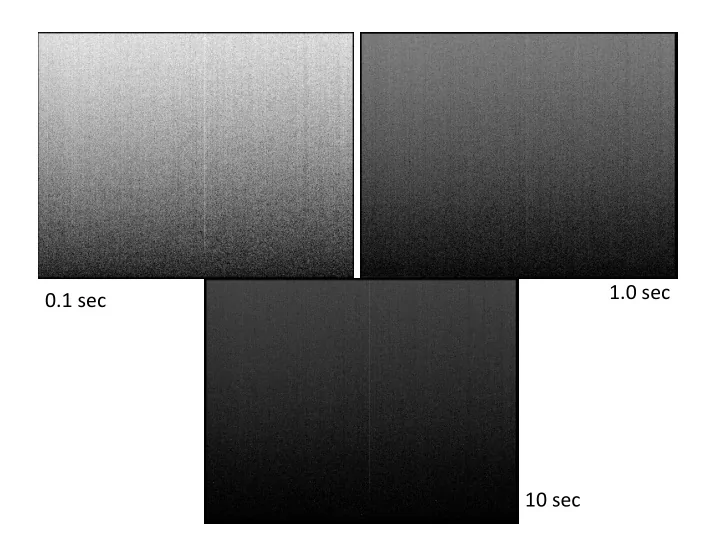
1.0 sec 0.1 sec 10 sec 1.0 sec 0.1 sec Min:500 - - PowerPoint PPT Presentation

1 0 sec 0 1 sec 10 sec 1 0 sec 0 1 sec min 500
SMART_READER_LITE
LIVE PREVIEW

1.0 sec 0.1 sec 10 sec 1.0 sec 0.1 sec Min:500 - - PowerPoint PPT Presentation

1.0 sec 0.1 sec 10 sec 1.0 sec 0.1 sec Min:500 10 sec Max:700 1.0 sec 0.1 sec Min:500 10 sec Max:700 1.0 sec 0.1 sec


slide-1
SLIDE 1

0.1 ¡sec ¡ 1.0 ¡sec ¡ 10 ¡sec ¡

slide-2
SLIDE 2

0.1 ¡sec ¡ 1.0 ¡sec ¡ 10 ¡sec ¡ Min:500 ¡ Max:700 ¡

slide-3
SLIDE 3

0.1 ¡sec ¡ 1.0 ¡sec ¡ 10 ¡sec ¡ Min:500 ¡ Max:700 ¡

slide-4
SLIDE 4
slide-5
SLIDE 5

0.1 ¡sec ¡ 1.0 ¡sec ¡ 10 ¡sec ¡ Min:555 ¡ Max:686 ¡

slide-6
SLIDE 6

Uncooled: ¡increase ¡of ¡100 ¡DN ¡ Cooled: ¡increase ¡of ¡<3 ¡DN ¡

slide-7
SLIDE 7

The ¡human ¡eye ¡is ¡a ¡crude ¡ reflectance ¡spectrometer ¡

slide-8
SLIDE 8

* Additives Primary colors are GRB (light is emitted: TV, movies, flames, lasers, LEDs,) Yellow means both green and red rays are present * Subtractive Primary colors are YMC (light is absorbed: Printer, paints, flowers…) Yellow means blue is absorbed from the white light source.

Primary ¡Colors ¡

slide-9
SLIDE 9

Are ¡primary ¡colors ¡a ¡fundamental ¡ realizaHon ¡of ¡the ¡Universe? ¡Or ¡is ¡it ¡a ¡ human ¡construct? ¡

slide-10
SLIDE 10

Is ¡there ¡more ¡than ¡one ¡way ¡something ¡ can ¡appear ¡yellow? ¡

slide-11
SLIDE 11

http://www.cudo.jp/e/images/eye1.gif http://www.colorcube.com/articles/basics/1sscurve.gif http://www.amastro2.org/at/ot/othcs.gif

slide-12
SLIDE 12

Visible ¡NIR ¡Sensor ¡ Types ¡

  • Imaging ¡spectrometers ¡

– Filter ¡wheel ¡w/ ¡narrow ¡ band ¡passes ¡

  • Images ¡the ¡whole ¡seen ¡
  • nce ¡for ¡each ¡wavelength ¡
  • MulHband ¡10-­‑20 ¡

wavelengths ¡

– DiffracHon ¡graHng ¡and ¡a ¡ slit ¡in ¡foreopHcs ¡ ¡

  • All ¡wavelengths ¡take ¡

simultaneously ¡

  • Images ¡are ¡hyperspectral ¡

i.e., ¡hundreds ¡of ¡bands ¡

  • Pushbroom ¡sensor ¡
  • Whiskbroom ¡sensor ¡

– Point ¡spectrometer ¡

  • Prisim ¡or ¡diffracHon ¡graHng ¡

Pushbroom ¡imaging ¡spectrometer: ¡detector ¡ uses ¡moHon ¡of ¡spacecra[ ¡to ¡image ¡in ¡2D ¡

Filter ¡wheel ¡imaging ¡spectrometer: ¡Image ¡ for ¡each ¡filter, ¡images ¡must ¡overlap ¡ Whiskbroom ¡imaging ¡spectrometer: ¡ detector ¡uses ¡moHon ¡of ¡spacecra[ ¡and ¡ sideways ¡scanning ¡mirror ¡to ¡image ¡in ¡2D ¡

slide-13
SLIDE 13

Life ¡of ¡a ¡photon ¡

  • Photons ¡enter ¡a ¡medium ¡they ¡are: ¡ ¡

– Some ¡reflected ¡from ¡surfaces ¡(n) ¡ – Some ¡pass ¡through ¡(n) ¡ – Some ¡are ¡absorbed ¡(k) ¡

  • Photons ¡that ¡are ¡reflected ¡or ¡refracted ¡through ¡a ¡

medium ¡are ¡sca`ered ¡

  • AbsorpHon ¡happens ¡by ¡variety ¡of ¡processes ¡ ¡

– D-­‑orbital ¡transiHons ¡ – Wavelength ¡dependence ¡allow ¡us ¡to ¡derive ¡informaHon ¡ about ¡the ¡chemistry ¡of ¡a ¡mineral ¡

  • Photons ¡that ¡originate ¡from ¡a ¡material ¡are ¡emi`ed. ¡
slide-14
SLIDE 14

Life ¡of ¡a ¡Photon ¡

slide-15
SLIDE 15

Index of Ref. or Extinction Coeff. Reflectance n: index of refraction is a measure of the speed of light in a substance K: extinction coefficient, related to absorption coefficient (k) by k = 4 pi K/

n and k control scattering and absorption properties of materials; these are often referred to as the ‘optical constants’ (though they are not constant!)

slide-16
SLIDE 16

High ¡index ¡of ¡refracHon ¡– ¡n ¡> ¡2.5 ¡ Low ¡index ¡of ¡refracHon ¡– ¡n ¡ Close ¡to ¡1 ¡

slide-17
SLIDE 17
slide-18
SLIDE 18

Absorbing ¡parHcles ¡dominate ¡

y f

Adding small amounts of a highly absorbing material can have dramatic effects on reflectance spectra, including suppression of strong absorption bands.