Vehicular Carriers: Present in large numbers When Data Meet the Road - - PowerPoint PPT Presentation

vehicular carriers
SMART_READER_LITE
LIVE PREVIEW

Vehicular Carriers: Present in large numbers When Data Meet the Road - - PowerPoint PPT Presentation

Why Study Vehicules? Vehicular Carriers: Present in large numbers When Data Meet the Road 1 Already surpassed 1 billion mark (2010) Expected to double in the next two decades Mobile by nature, obviously Promthe Spathis , UPMC


slide-1
SLIDE 1

Vehicular Carriers: When Data Meet the Road1

Prométhée Spathis, UPMC Marcelo Dias de Amorim, Raul A. Gorcitz, Yesid Jarma, Serge Fdida, UPMC Ryuji Wakikawa,Toyota ITC John Whitbeck, Vania Conan, Thales

1 Vehicular Carriers for Big Data Transfers, in Proc. of IEEE VNC2012, Nov 2012, Seoul Korea

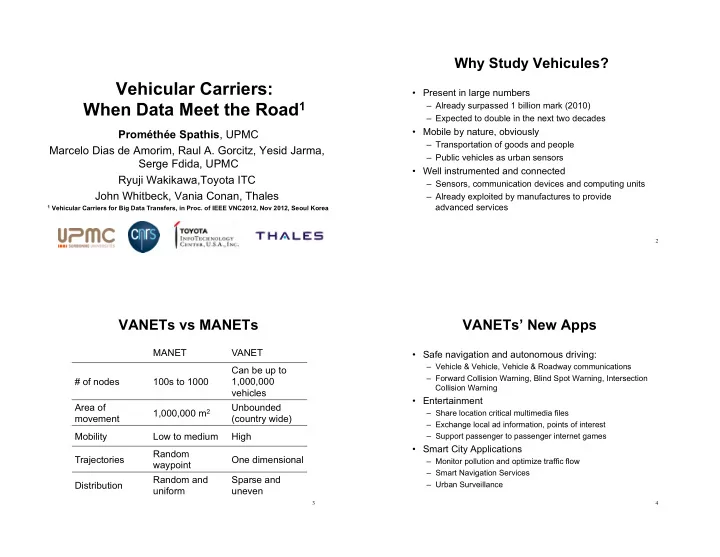
Why Study Vehicules?

  • Present in large numbers

– Already surpassed 1 billion mark (2010) – Expected to double in the next two decades

  • Mobile by nature, obviously

– Transportation of goods and people – Public vehicles as urban sensors

  • Well instrumented and connected

– Sensors, communication devices and computing units – Already exploited by manufactures to provide advanced services

2

VANETs vs MANETs

3

MANET VANET # of nodes 100s to 1000 Can be up to 1,000,000 vehicles Area of movement 1,000,000 m2 Unbounded (country wide) Mobility Low to medium High Trajectories Random waypoint One dimensional Distribution Random and uniform Sparse and uneven

VANETs’ New Apps

  • Safe navigation and autonomous driving:

– Vehicle & Vehicle, Vehicle & Roadway communications – Forward Collision Warning, Blind Spot Warning, Intersection Collision Warning

  • Entertainment

– Share location critical multimedia files – Exchange local ad information, points of interest – Support passenger to passenger internet games

  • Smart City Applications

– Monitor pollution and optimize traffic flow – Smart Navigation Services – Urban Surveillance

4

slide-2
SLIDE 2

Research in VANETs

  • MAC & Physical Layer

– DSRC – IEEE 802.11p

  • Data Dissemination

– More later

  • Mobility Models & Simulators

– Traffic Simulators – Real Traces

  • Security & Privacy

– False Data – DOS Attacks – Privacy

5

The World of Big Data

6

Data Management

  • Large companies, organizations, universities,

and governmental agencies

  • Technical flexibility and cost-effective

scalability

  • Balance workloads, fast data retrieval, data

replication, resources consolidation

  • Cloud computing, multimedia transfers, data

migration, disaster recovery, online backups, file/email archiving

7 8

Vehicles as Data Carriers

Vehicular-based opportunistic bulk delay-tolerant data transfers using offloading technique

slide-3
SLIDE 3

9

Autonomy Predictable itinerary Room for storage capacity

Mobile Modular Data Centers

10

Dataset

  • Annual Average Daily Traffic

(AADT)

  • Provided by the French

Ministry of Ecology, Energy, and Sustainable Development

  • Used for transportation

planning and engineering

  • Measured from 2010 to 2011
  • Multiple point of

measurements per highways

11 12

slide-4
SLIDE 4

Vehicle Density

τ = D × K sf × ((k × K) − k2) × S × P + d ¯ s·

Computing Transfer Latency

13

Transfer Latency Total Data Penetration Ratio Storage Capacity Distance Avg Speed

Highway Capacity vs Vehicle Density

14

40 80 120 160 10 20 30 40 50 60 70 Latency (hours) Vehicle density (Vehicles/Km) Measured value (5.96 Vehicles/Km) 250GB 1TB

1 Pbytes data – Class A vehicles – 3-lane rural highway

Intercity scenario: Tours – Orléans

15 Vehicle Flow = 706 Veh/H Penetration Rate = 20% Highway Length = 118 Km Average Speed = 100 Km/H

5 10 15 20 25 30 400000 700000 1e+06 Latency (hours) Total data (GB) 250GB 1TB 60 80 100 120 140 160 180 200 220 240 260 280 400000 700000 1e+06 System throughput (Gbps) Total data (GB) 250GB 1TB

Transfer latency for delivering up to 1 PB of data between Orleans and Tours using vehicle carriers. ! System throughput for delivering up to 1 PB of data using the delay constraints obtained in Figure 1. ! 16

Average Transfers Delay

Lille Paris Le Mans Angers Dijon Lyon Valence Avignon Tours τ = A = 32, 935 9.2 h 46,290 6.4 h τ = A = 6.6 h 52,390 τ = A = 12.2 h 21,408 τ = A = 8.2 h 33,922 τ = A = 10.5 h 31,753 τ = A = 6.4 h 53,196 τ = A = 4.7 h 64,535 τ = A = 4.7 h 67,813 τ = A = Orleans

Α "Annual Average Daily Traffic τ Average Transfer Latency

slide-5
SLIDE 5

Impact of Speed and Distance

17 3 6 9 60 70 80 90 100 110 120 130 Latency (hours) Average vehicle speed (Km/h) 21.6% 19.1% 16.3% 15.6% 14.2% 13.1% 12.1% 11.2% 1TB Speed influence proportion 3 6 9 12 50 100 150 200 250 300 350 400 Latency (hours) Distance on highway (Km) 6.5% 11.3% 17.4% 22% 26% 29.7% 33% 36.1% 1TB Distance influence proportion

Cost Comparison

18

Cost comparison between a full electrical recharge cost and a package delivery system.! Cost comparison between Internet with dedicated links and Vehicular Carriers.

600 800 1000 1200 1400 1600 1800 2000 400000 700000 1e+06 Cost (in Euros) Total data (GB) Energy cost UPS cost 10000 20000 30000 40000 50000 60000 400000 700000 1e+06 Cost (in Euros) Total data (GB) Internet (1TB) Internet (250GB) Energy (1TB) Energy (250GB)

Conclusion

  • Offloading delay tolerant data to vehicles

could ease the burden on the legacy Internet infrastructure

  • Vehicular Carriers can be higly efficient in

terms of transfer latency when large amounts

  • f data are considered
  • Incentive based motivational actions can

increase the penetration ratio of the system

19

Open Issues

  • Routing
  • Delay sensitiveness
  • Context
  • Resilience/robustness
  • Reliability
  • Security
  • Incentives
  • Business model

20