
SLIDE 1
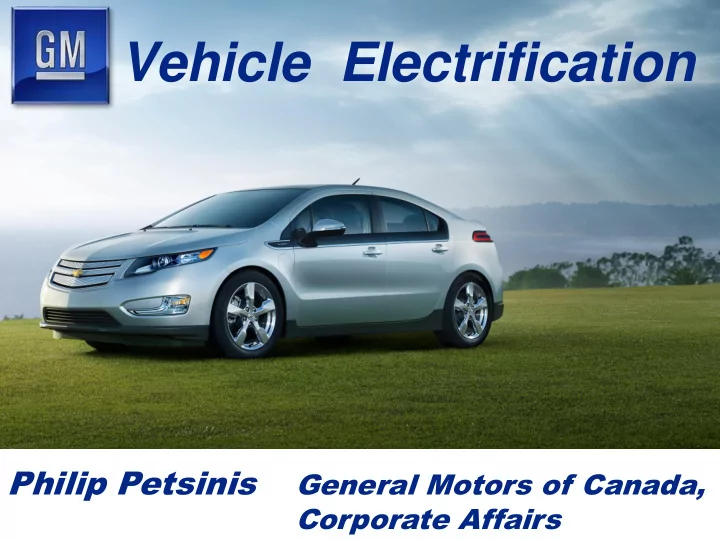
Vehicle Electrification Philip Petsinis General Motors of Canada, - - PowerPoint PPT Presentation
Vehicle Electrification Philip Petsinis General Motors of Canada, Corporate Affairs Current Situation Market Challenges U.S. housing crisis Credit / Liquidity crisis U.S. New Vehicle Market Collapse Volatility of fuel prices
U.S. housing crisis Credit / Liquidity crisis U.S. New Vehicle Market Collapse Volatility of fuel prices Global cost competition Dramatic FE Regulations Changes
Increasing Electrification
Engine Generator Lithium-Ion Battery Electric Drive Unit Charge Port
applications differ greatly from consumer electronics
storage Capacity
and cooling
288 Cells
70% of the Cost
Module Pack
Based on U.S. Department of Transportation 2003 Omnibus Household Survey
commute 40miles/64km
50 100 150 200 250 300
Volt Toyota Prius Chevrolet Cobalt Chevrolet Malibu
Fuel Lifecycle CO2 Emissions (g/km) Vehicle Model
Leading Hybrid
Volt emits 1/8th or 12% of the fuel lifecycle GHG emissions of most fuel efficient Hybrid Volt emits 6% of the fuel lifecycle GHG emissions of a comparable fuel efficient gasoline vehicle
(2¢ on-peak)
– Plugs into standard household outlet – Full charge in about 8 hours – No additional equipment or installation – Charge cord comes standard with the vehicle
– Full charge in about 3 hours – Increased convenience and enables more
– Will require a one-time investment to upgrade garage with dedicated 240V circuit
120V Cordset 240V Charge Station
Volt charging options move customers away from peak charging, result in a “stagger” that prevents a new evening peak, and includes manual programmable features that anticipate the more automatic "smart grid" features to come.
0.00% 10.00% 20.00% 30.00% 40.00% 50.00% 60.00% 70.00% 80.00% 90.00% 100.00% Sunday 04:00 Sunday 08:00 Sunday 12:00 Sunday 16:00 Sunday 20:00 Monday 00:00 Monday 04:00 Monday 08:00 Monday 12:00 Monday 16:00 Monday 20:00 Tuesday 00:00 Tuesday 04:00 Tuesday 08:00 Tuesday 12:00 Tuesday 16:00 Tuesday 20:00 Wednesday 00:00 Wednesday 04:00 Wednesday 08:00 Wednesday 12:00 Wednesday 16:00 Wednesday 20:00 Thursday 00:00 Thursday 04:00 Thursday 08:00 Thursday 12:00 Thursday 16:00 Thursday 20:00 Friday 00:00 Friday 04:00 Friday 08:00 Friday 12:00 Friday 16:00 Friday 20:00 Saturday 00:00 Saturday 04:00 Saturday 08:00 Saturday 12:00 Saturday 16:00 Saturday 20:00 Sunday 00:00
Fleet Distribution during week
Home Residence Work School & Church Commercial Other Driving
Source of Data - 2001 National Household Travel Survey ; GM Data Analysis (Tate/Savagian) - SAE paper 2009-01-1311
– High Visibility – Commercial/Retail – Public Education and Outreach
– Corporate, Municipal Parking Lots
– Satisfying consumer-driven home installation process – Permits, electricians, inspections, meters, rates
Public
Residential Workplace
Public
Includes more than 50 Utilities… many the industry’s thought- leaders in electric transportation and grid interaction
Sacramento Municipal UD San Diego Gas & Electric PacifiCorp Tri-State G&T Hydro-Québec Arkansas Electric Coop Dairyland Power Consumers Energy Hoosier Southern Company EnWin NYPA Central Hudson G&E PSEG Exelon CPS Energy BC Hydro Southern California Edison Hawaiian Electric Co. Great Plains Energy FirstEnergy Constellation Energy Progress Energy Northeast Utilities NY ISO PJM Seattle City Light Salt River Project Austin Energy Great River Energy DTE ConEd EUROPE Iberdrola, S.A. Hydro One Pepco Holdings, Inc. Tennessee Valley Authority Portland General Electric Snohomish County PUD No. 1 Nebraska Public Power Dist. We Energies AEP Duke Energy Ameren Services Hetch Hetchy Water and Power Rochester G&E LIPA Pacific Gas & Electric Golden Valley Electric Assn. Manitoba Hydro CenterPoint Energy Lincoln Electric Dominion Resources United Illuminating Avista Corp. Madison G&E Arizona Public Service
Municipalities
commissions
Desired Enablers
Government fleet purchases Building codes and home charging enablers Green charging
Vehicle purchase incentives Low off-peak charging rates
Infrastructure/Incentives/Educational Outreach
Charging installation incentives
(home, work, public)
HOV lane access Free charging Free parking
Required Stakeholders