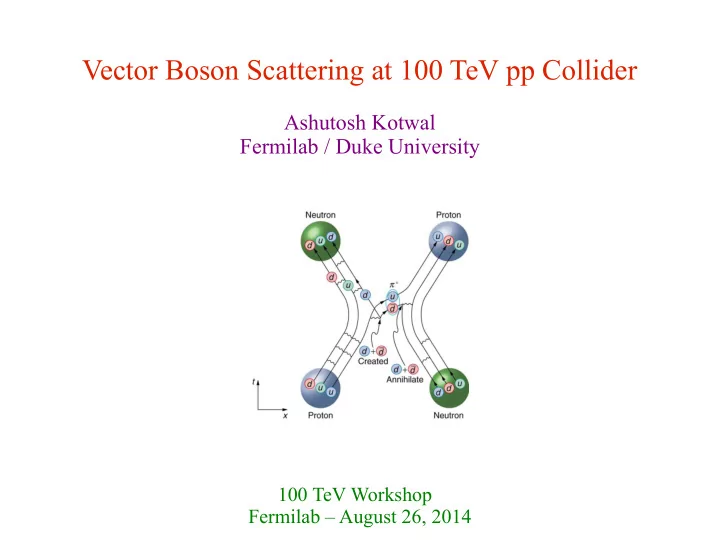
SLIDE 1
Vector Boson Scattering at 100 TeV pp Collider
Ashutosh Kotwal Fermilab / Duke University
100 TeV Workshop Fermilab – August 26, 2014
SLIDE 2
What do we gain from measurements of gauge couplings, trilinear (TGC) & quartic (QGC), in light of other precision electroweak data? Do theories exist where we expect to naturally have SM-like precision measurements, but large deviations in the TGCs & QGCs? Questions from Snowmass 2013 Workshop
SLIDE 3
What do we gain from measurements of gauge couplings, trilinear (TGC) & quartic (QGC), in light of other precision electroweak data? Answer: A lot Do theories exist where we expect to naturally have SM-like precision measurements, but large deviations in the TGCs & QGCs? Questions from Snowmass 2013 Workshop
SLIDE 4
What do we gain from measurements of gauge couplings, trilinear (TGC) & quartic (QGC), in light of other precision electroweak data? Answer: A lot Do theories exist where we expect to naturally have SM-like precision measurements, but large deviations in the TGCs & QGCs? Answer: yes Questions from Snowmass 2013 Workshop
SLIDE 5 Spontaneous Symmetry Breaking of Gauge Symmetry
- The Higgs potential in the SM is a parameterization that respects certain
rules of QFT
- Phase transition → vacuum state possesses non-trivial quantum numbers
- Dynamical origin of this phase transition is not known
- Broadly speaking, underlying dynamics may be
– Weakly coupled (e.g. Supersymmetry) – Strongly coupled
SLIDE 6 A Toy Model for BSM extension
- Consider a term coupling the Higgs to a singlet scaler S: f
- Via S exchange, can mediate scattering process:
- For energies << mS , induces effective field theory operators:
– Dimension-4: (f / mS)2 – Dimension-6: Oφd = (f 2/ mS
4)
– This is one of the operators predicted in strongly-interacting
light Higgs models
- Alternate mechanism to SUSY for ensuring light Higgs boson
– alters VBS compared to SM
S S
[□ - mS
2]-1 ~ mS
2]
SLIDE 7 A Toy Model for BSM extension
- Consider a term coupling the Higgs to a singlet scaler S: f
- Via S exchange, can mediate scattering process:
- For energies << mS , induces effective field theory operators:
– Dimension-4: (f / mS)2 – Dimension-6: Oφd = (f 2/ mS
4)
– Observing a deviation in gauge and Higgs couplings consistent
with this model would immediately point to model parameter values for f and mS
S S
SLIDE 8 Examples from Strongly Interacting Light Higgs models
(see Low et al, JHEP 1004:126 (2010), Giudice et al, JHEP06, 045 (2007) and references therein)
Effective Field Theory Operators provide a general parameterization
- f new physics at a high mass scale
Especially useful to parameterize new strong dynamics
Pure gauge Coupling modifications
SLIDE 9 Examples from Strongly Interacting Light Higgs models
Effective Field Theory Operators provide a general parameterization
- f new physics at a high mass scale
Especially useful to parameterize new strong dynamics
Gauge & Higgs couplings Coupling modifications
(see Low et al, JHEP 1004:126 (2010), Giudice et al, JHEP06, 045 (2007) and references therein)
SLIDE 10 Examples from Strongly Interacting Light Higgs models
Effective Field Theory Operators provide a general parameterization
- f new physics at a high mass scale
Especially useful to parameterize new strong dynamics
Higgs couplings { Coupling modifications
(see Low et al, JHEP 1004:126 (2010), Giudice et al, JHEP06, 045 (2007) and references therein)
SLIDE 11 Combined Fit to Higgs and Anomalous Gauge Couplings
- Illustrates the complementary of approaches to new physics via deviations of
Higgs-to-gauge and gauge-gauge couplings
– Combined fit provides significantly tighter constraints
Corbett et al.,
arXiv:1304.1151
∝ OW ∝ (OW + OB )
SLIDE 12 Another Toy Model – for Dimension-8 Operators
- Consider the analogy with light-by-light scattering via electron loop
- Euler-Heisenberg effective lagrangian at low energies
–
SLIDE 13 Another Toy Model – for Dimension 8 Operators
- Consider the analogy with light-by-light scattering via electron loop
- Euler-Heisenberg effective lagrangian at low energies
– – Second term can be re-written in terms of
Operator coefficients contain information on mass and coupling of new dynamical degrees of freedom
SLIDE 14 Another Analogy – Primakoff Production of π0
- Primakoff production by photon interacting with strong nuclear EM field
– Therefore following operators can describe scalar resonance
production in VBS
Operator coefficients contain information on mass and coupling of new scalar resonance
SLIDE 15 Vector Boson Scattering
- This is a key process accessible for the first time at LHC
Vector Boson Scattering is intimately connected with EWSB Provides a unique method of exploring the possibility of strong dynamics
SLIDE 16 Effective Field Theory Operators at Dimension-8
- All dimension-6 and dimension-8 operators involving SM boson fields
have been catalogued
- Examples of dimension-8 operators
- Dimension-8 operators only affect vector boson scattering and triboson
production
– These processes open up a new and unique window on new
dynamics in the EWSB sector
SLIDE 17 Effective Field Theory Operators
- All dimension-6 and dimension-8 operators have been catalogued
- VBS processes have the potential for
– measuring new physics parameterized by higher-dimension operators – Differentiating between different operators using
- Direct measurement of energy-dependence
- different channels
– Dimension-8 operators tested:
SLIDE 18 VBS Studies using Forward Tagged Jets
Threshold of interest for dim-6
- perator coefficient < v-2 ~ 16 TeV-2
ZZ → leptons WZ → leptons
dim-8 operator coefficient implies sensitivity to strong dynamics at TeV-scale
(ATL-PHYS-PUB-2013-006, ATLAS White Paper arXiv:1307.7292)
pT
j > 50 GeV
mjj > 1 TeV
SLIDE 19
Complementarity of VBS and Triboson production
Anomalous Zγγ production at high mass also very sensitive to “T” operators => Comparison of VBS and triboson production is another powerful capability for characterizing the new physics
SLIDE 20
VBS and Tribosons at 100 TeV pp Collider
SLIDE 21
Conclusions
VBS and triboson production is dramatically more sensitive to new physics at higher beam energy Dimension-8 operators are probed much more strongly than Dimension-6 operators (due to stronger growth of amplitude with energy) For dimension-8 operator coefficients of order ~ 1: HL-LHC probes energy scale Λ ~ 1.6 TeV VLHC (100 TeV) probes Λ ~ 6 TeV (with 3ab-1) High energy pp colliders probe dimension-8 operators much more sensitively than lepton colliders
SLIDE 22 Complication with EFT Approach
EFT approach valid and results easy to interpret when mVV << Λ S a f e t
s e a t l e p t
c
l i d e r s Hadron colliders can probe mVV ~ Λ O b s e r v a t i
r e s
a n c e s m
e l i k e l y t h a n E F T d e s c r i p t i
? To preserve generality offered by EFT operators, intermediate solution may be to preserve unitarity by imposing ad-hoc prescription:
- eg. K-matrix unitarization (adds no parameters)
Agreement and implementation of some unitarization scheme would facilitate studies immensely
technical problem for K-matrix method in MADGRAPH
SLIDE 23 What do we gain from measurements of gauge couplings, trilinear (TGC) & quartic (QGC), in light of other precision electroweak data? Answer: A lot, because heavy gauge bosons and Higgs boson are inextricably linked. Gauge couplings contain complementary and independent information to other electroweak measurements
Do theories exist where we expect to naturally have SM-like precision measurements, but large deviations in the TGCs & QGCs?
Answer: yes, individual models eg. Littlest Higgs etc. predict specific values for coefficients of specific higher-dimension operators. Observing a certain pattern of deviations in electroweak precision
- bservables, Higgs and gauge boson processes can pick out certain
models and associated mass scales.
SLIDE 24 THANK YOU
- Thanks to the Snowmass Energy Frontier Electroweak working group members
Electroweak Report posted at:
http://snowmass2013.org/tiki-index.php?page=Precision+Study+of+Electroweak+Interactions and arXiv:1310.6708
SLIDE 25
Backup
SLIDE 26
Program of VBS and Triboson Measurements
Conclusions: 1) factor of 2-3 improvement in sensitivity with HL-LHC upgrade 2) single-channel sensitivities pushed into the TeV-scale if new dynamics is strongly-coupled to Higgs and vector bosons 3) a powerful method of probing models of strongly-interacting light Higgs 4) model-independent tests of BSM dynamics
SLIDE 27
Example Test of Unitarization by Higgs
Conclusion: We are not really testing unitarization by SM Higgs until operator < 16 TeV-2
SLIDE 28
Example Test of Unitarization by Higgs
Conclusion: We are not really testing unitarization by SM Higgs until operator < 16 TeV-2 Single-channel tests of unitarization achievable with HL-LHC
SLIDE 29 LHC and ILC Comparison for Anomalous Trilinear Gauge Couplings
- equivalent to dimension-6 operator coefficients
Generally, ILC probes dimension-6 operators, through diboson production, much better than LHC
SLIDE 30 Hadron vs Lepton Colliders
- ILC1000 vs LHC sensitivity to higher-dimension operators in VBS and multi-boson
production:
– ILC more sensitive to dimension-6 operators through diboson production
(clean environment, sensitivity through interference with SM)
– LHC more sensitive (by 1-2 orders of magnitude) to dimension-8 operators
compared to ILC1000, as probed by VBS and triboson production
SLIDE 31
VBS Study using same-sign WW → leptons
Stronger SM interference for “S0” operator → different kinematic dependence