Variables & References Variables with primitive types: - - PowerPoint PPT Presentation

variables references variables with primitive types
SMART_READER_LITE
LIVE PREVIEW

Variables & References Variables with primitive types: - - PowerPoint PPT Presentation

Variables & References Variables with primitive types: Primitive types Lower case names int, float, double, boolean, Declare variables: <type name> <variableName>; Memory will be allocated to


slide-1
SLIDE 1

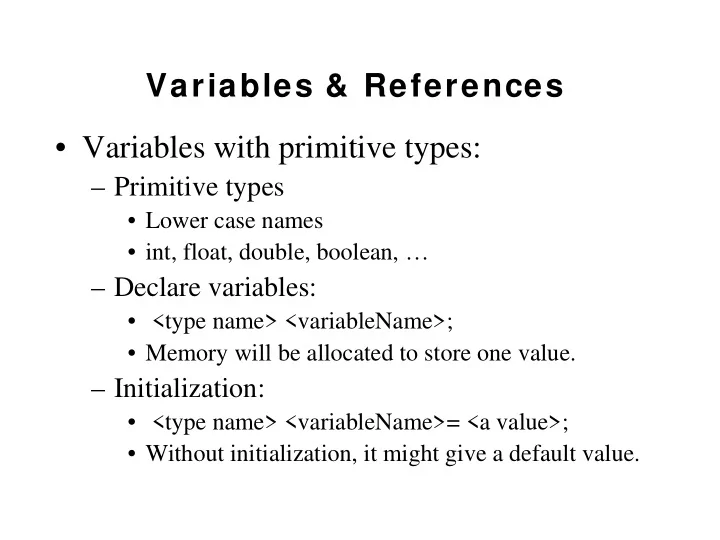
Variables & References

  • Variables with primitive types:

– Primitive types

  • Lower case names
  • int, float, double, boolean, …

– Declare variables:

  • <type name> <variableName>;
  • Memory will be allocated to store one value.

– Initialization:

  • <type name> <variableName>= <a value>;
  • Without initialization, it might give a default value.
slide-2
SLIDE 2

references

  • Variable of non-primitive type

– Syntax of Delarations:

  • <ClassName> <variableName>;
  • ClassName should be in capital
  • Class must be created.

– Declaration

  • It gives reference
  • It allocates memory for one reference;
  • It will give the initial value null
  • No object (of the class) is created
slide-3
SLIDE 3

Exam ples

  • ClassName:

class Rational { int numerator; int denominator; }

  • Declaration

Rational r;

r null

slide-4
SLIDE 4

Object Creation

  • Syntax

– Example Rational r ; r = new Rational();

r Heap numerator denominator

slide-5
SLIDE 5

Object Creation

  • properties

– Use new to create – Access through reference – All objects created on heap

  • Assignment

– No new object is created – Assign only the reference. – Example Rational r = new Rational(); Rational s; s = r; // s refers to same object

slide-6
SLIDE 6

initialization

  • Use init

– Example Rational r = new Rational(); r.init(0,1); – Remember:

  • Line one declares and use default to create an object.
  • Declare w/o object cannot be used to initialize with

init.

slide-7
SLIDE 7

initialization

  • Use the class constructors: example

class Rational { // characteristics int numerator; int denominator; // a constructor Rational (int n) { numerator = n; denominator=1;} } // class end ……….. Rational r = new Rational(5);

slide-8
SLIDE 8

Array as a reference

  • Array variables are references

– Assign one array-variable to another array variable is copying reference – Example: int[] arrA = new int { 5, 7}; // picture in green int[] arrB; // picture in light blue arrB = arrA; // picture in arrow arrA EEFE arrB null 5 1 7

slide-9
SLIDE 9

Arrays of References

  • Array of class type are arrays of references

int[] arrR = new Rational[3]; // picture in green arrR[0]= new Rational(4); // picture in light blue arrR[1]= new Rational(7); // picture in light blue arrR[2]= new Rational(2); // picture in light blue arrR 7 1 1 2 2 1 4 1

slide-10
SLIDE 10

Passing param eters

  • Passing a reference variable to a method

(routine) is passing the reference, not the

  • bject.
slide-11
SLIDE 11

Reference and m em ory

  • Reference is the address of the allocated memory.
  • Memory can only be accessed via reference.
  • Memory will NOT be accessible if we don’t have

its reference.

  • Assign a new reference to a variable does not

destroy the object of the old reference.

  • Memory of unusable objects are reclaimed by the

Java VM.

– Unusable when there are NO references to it – Java VM claims it by its own schedule – Reclaim it by activating garbage collection

slide-12
SLIDE 12

Garbage Collection

  • Algorithm:

– Go through the stack based references – Then via reference from stack trace through the heap and mark the used memory. – After the stack is check completely, go back to heap to collect the unmarked memory. Memory will NOT be accessible if we don’t have its reference.

  • We can invoke garbage collector

protected void finalized() { flush(); flush();}