Variable scope All <?php ?> blocks in the file share the same - - PowerPoint PPT Presentation

variable scope
SMART_READER_LITE
LIVE PREVIEW

Variable scope All <?php ?> blocks in the file share the same - - PowerPoint PPT Presentation

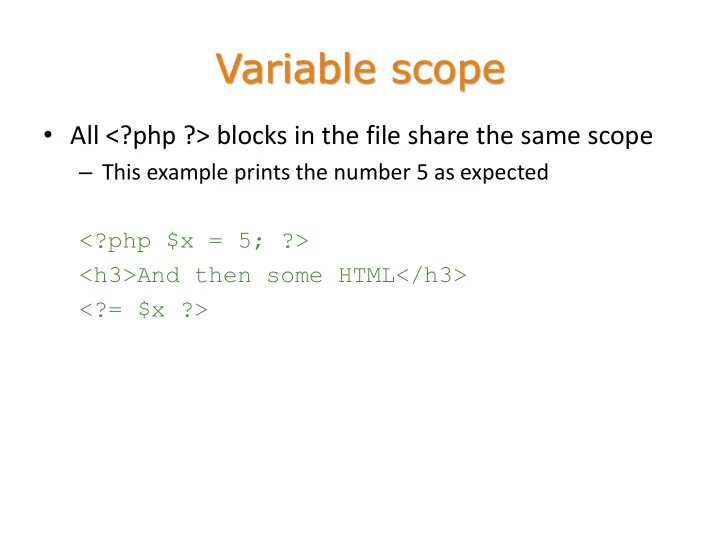
Variable scope All <?php ?> blocks in the file share the same scope This example prints the number 5 as expected <?php $x = 5; ?> <h3>And then some HTML</h3> <?= $x ?> Defining functions PHP functions

slide-1
SLIDE 1

Variable scope

  • All <?php ?> blocks in the file share the same scope

– This example prints the number 5 as expected <?php $x = 5; ?> <h3>And then some HTML</h3> <?= $x ?>

slide-2
SLIDE 2

Defining functions

  • PHP functions follow c-style syntax

– But with no explicit types

function pythagorean( $s1, $s2 ) { return sqrt( $s1*$s1 + $s2*$s2 ); }

– No explicit parameter or return types – No return statement implies a return of NULL

slide-3
SLIDE 3

Calling functions

  • PHP function calls follow c-style syntax

$s3 = pythagorean( $s1, $s2 );

– Number of parameters must match – Types are not enforced (obviously)

  • Functions have global scope

– Can be called from anywhere – Should be defined at the top-level of the file – Do not have to be defined before they are called

slide-4
SLIDE 4

Default parameter values

  • Function parameters may be given default values

function makecoffee($type = "cappuccino") { return "Making a cup of $type.\n"; } echo makecoffee(); # Making a cup of cappuchino. echo makecoffee(null); # Making a cup of . echo makecoffee("espresso"); # Making a cup of espresso.

– Only rightmost parameters can be default

slide-5
SLIDE 5

Pass by reference

  • PHP defaults to pass-by-value
  • Pass by reference is supported

function add_some_extra( &$string ) { $string .= 'and something extra.'; } $str = 'This is a string, '; add_some_extra( $str ); echo $str; # This is a string, and something extra.

– But really only makes sense when using classes

slide-6
SLIDE 6

Global variables

  • Variables are assumed to exist in the scope they are

used

– There’s no declaration to say otherwise

function example() { print $a; # will always print NULL }

  • To access a global variable, it must be declared as

such

$a = 15; function example() { global $a; print $a; # will print 15 }

slide-7
SLIDE 7

Includes

  • The include and require functions insert the contents
  • f the specified file at that point

– Which are then interpreted right there

include( “login.php” ); require( “header.php” );

  • Using include/require encourages modularity

– Put common functions in included files – Put header/footer/sidebar code in included files

  • Commonly, use include_once/require_once to avoid

the same file being included twice

– Like the include guard problem in C++

slide-8
SLIDE 8

Client-side redirects

  • Asks the client to request a replacement page
  • Send an HTTP header via PHP

– PHP: header("Location: http://google.com");

  • Or directly in HTML

– <meta http-equiv="refresh“ content="0;url=http://google.com/">