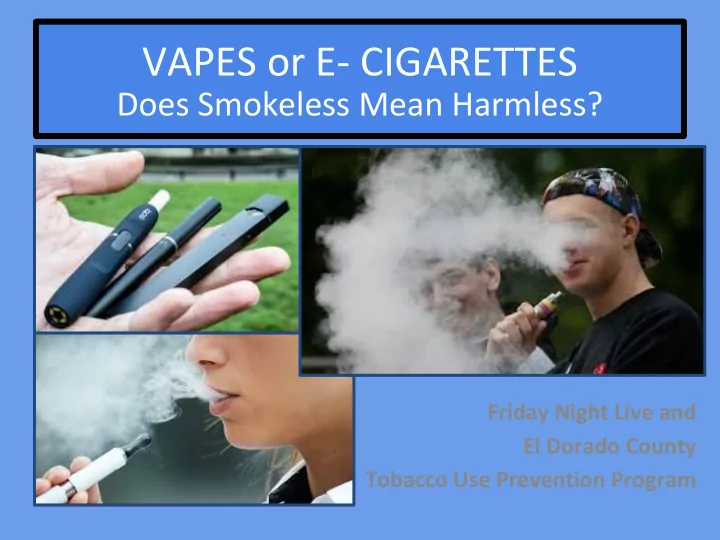
VAPES or E- CIGARETTES Does Smokeless Mean Harmless? Friday Night - - PowerPoint PPT Presentation

vapes or e cigarettes
SMART_READER_LITE
LIVE PREVIEW

VAPES or E- CIGARETTES Does Smokeless Mean Harmless? Friday Night - - PowerPoint PPT Presentation

VAPES or E- CIGARETTES Does Smokeless Mean Harmless? Friday Night Live and El Dorado County Tobacco Use Prevention Program What Are Vapes Electronic Nicotine Delivery Systems (ENDS), Electronic smoking Devices, Digital Vapor Cigarette,


slide-1
SLIDE 1

Friday Night Live and El Dorado County Tobacco Use Prevention Program

VAPES or E- CIGARETTES

Does Smokeless Mean Harmless?

slide-2
SLIDE 2

What Are Vapes

  • Electronic Nicotine Delivery

Systems (ENDS), Electronic smoking Devices, Digital Vapor Cigarette, VAPES, etc.

  • Solution contains 3 main

ingredients: ➢ Propylene Glycol or Vegetable Glycerin (Humectant) ➢ Nicotine ➢ Flavor (fruit, candy, tobacco, coffee, bacon, mix & match)

slide-3
SLIDE 3

Common Electronic Cigarettes

slide-4
SLIDE 4

Devices Vary in Voltage

High-voltage use releases enough formaldehyde-containing compounds to increase a person's lifetime risk of cancer 5 to 15 times higher than the risk caused by long-term smoking.

slide-5
SLIDE 5

E-Liquid/E-Solids

slide-6
SLIDE 6

While e-cigarettes pollute the air less than traditional cigarettes, contrary to popular belief, e-cigarettes don’t emit a harmless water vapor, but a concoction of chemicals toxic to human cells in the form of aerosol.

“It’s not easy to Quit Smoking, but we’ve made it easy to Start Vaping”

slide-7
SLIDE 7

A Growing Trend

  • In the United States, youth are more likely than adults to use

e-cigarettes.

  • In 2016, more than 2 million U.S. middle and high school students used

e-cigarettes in the past 30 days, including 4.3% of middle school students and 11.3% of high school students.

  • In 2013-2014, 81% of current youth e-cigarette users cited the availability
  • f appealing flavors as the primary reason for use.
  • To evaluate e-cig use, the CDC and the US Food and Drug Administration

poured through surveys filled out by 17,000 middle and high school students across the US in 2015. About 38 percent of high school students and 13 percent of middle school students reported that they’ve tried e-cigarettes. That could be an underestimate....

slide-8
SLIDE 8
  • Students have regularly hidden vaping devices in the toilet

seat covers and soap dispensers of the bathrooms as a means of passing off the device to others.

Access & Availability

slide-9
SLIDE 9

Long Term Health Effects

E-cigarettes are still fairly new, and scientists are still learning about their long-term health effects. Here is what we know now:

  • Most e-cigarettes contain nicotine, which has known health effects

■ Nicotine is highly addictive. ■ Nicotine is toxic to developing fetuses. ■ Nicotine can harm adolescent brain development, which continues into the early to mid-20s. ■ Nicotine is a health danger for pregnant women and their developing babies.

slide-10
SLIDE 10

Long Term Health Effects

Besides nicotine, e-cigarette aerosol can contain substances that harm the body. ■ This includes cancer-causing chemicals and tiny particles that reach deep into your lungs. ■ In recent days, more than one student in our county has had an anaphylactic reaction to vaping substances requiring the use of an EpiPen.

slide-11
SLIDE 11

Toxic Ingredients

Formaldehyde Diethylene Nickel Chromium Cadmium Lead Hydrogen cyanide *Pentanedione Fine/Ultrafine Particles Volatile Organic Compounds Tobacco Specific Nitrosamines (TSNAs) Heavy metals Silicate Particles Acetaldehyde Acrolein Benzene Isoprene Ammonia *Diacetyl Nicotine Touline

*Items in Yellow: On CA prop 65 list of carcinogens and reproductive toxins

slide-12
SLIDE 12
  • High school students who never smoked, but reported using

e-cigarettes, were about 3 times more likely to start using combustible tobacco after 1 year.

  • Nearly 44% of youth who use either e-cigarettes or

conventional cigarettes have dual use.

Potential Gateway to Cigarettes

slide-13
SLIDE 13

Are You Being Targeted?

slide-14
SLIDE 14

Nicotine and the Brain

slide-15
SLIDE 15
  • Consumers do not have reliable information
  • n product quality

➢ Poor quality control (no manufacturing standards) ➢ Technical flaws (leaking cartridges) ➢ Variable nicotine delivery (inconsistent dose)

  • Also:

➢ Unsubstantiated health claims ➢ Erroneous nicotine content labeling

Lack of Standardization

slide-16
SLIDE 16
  • Smoke was detected coming out of a South Tahoe High student's

backpack and found it to be a faulty battery on a vape pen and contents of the backpack caught on fire South Tahoe Now.com February 9, 2016

Explosions

  • Electronic cigarette

blamed for Nev. high school gym explosion Reno Gazette-Journal, January13, 2015

slide-17
SLIDE 17
  • According to the CDC there has been a sharp rise in calls to poison centers involving

e-cigarette liquids containing nicotine. The calls increased from 1 call per month in September 2010 to 215 calls per month in February 2014

  • Alarmingly, over ½ of e-cigarette poisonings reported were in children under 5 years old.

42% of other cases were among people under 20.

  • E-liquid bottles do not have childproof caps

A 30ml bottle of e-liquid which contains 24mg of nicotine per ml has 720 mg of nicotine in 1 bottle. A lethal dose of nicotine for an adult is 50-60mgs

www.tobaccofree.com

Poisonings

slide-18
SLIDE 18

Talking To Your Teen

BEFORE THE TALK Know the facts

  • Get credible information about e-cigarettes and young people at www.E-cigarettes.SurgeonGeneral.gov

Be patient and ready to listen

  • Avoid criticism and encourage an open dialogue.
  • Remember, your goal is to have a conversation,not to deliver a lecture.
  • It’s OK for your conversation to take place over time, in bits and pieces.

START THE CONVERSATION Find the right moment. A more natural discussion will increase the likelihood that your teen will listen. Rather than saying “we need to talk,” you might ask your teen what he or she thinks about a situation you witness together, such as: » Seeing someone use an e-cigarette in person or in a video. » Passing an e-cigarette shop when you are walking or driving. » Seeing an e-cigarette advertisement in a store or magazine or on the internet. Ask for support. Not sure where to begin? Ask your healthcare provider to talk to your teen about the risks of e-cigarettes.

  • You might also suggest that your teen talk with other trusted adults, such as relatives, teachers, faith

leaders, coaches, or counselors whom you know are aware of the risks of e-cigarettes. These supportive adults can help reinforce your message as a parent.

slide-19
SLIDE 19

Talking To Your Teen

ANSWER THEIR QUESTIONS

Here are some questions and comments you might get from your teen about e-cigarettes and some ideas about how you can answer them. Why don’t you want me to use e-cigarettes?

  • Science shows that e-cigarettes contain ingredients that are addictive and could harm different parts of

your body.

  • Right now, your brain is still developing, which means you are more vulnerable to addiction. Many

e-cigarettes contain nicotine, and using nicotine can change your brain to make you crave more nicotine. It can also affect your memory and concentration. I don’t want that for you!

  • E-cigarettes contain chemicals that are harmful. When people use e-cigarettes, they breathe in tiny

particles that can harm their lungs.

  • The cloud that people exhale from e-cigarettes can expose you to chemicals that are not safe to breathe.

What’s the big deal about nicotine?

  • Your brain is still developing until about age 25. The Surgeon General reported that nicotine is addictive

and can harm your brain development.

  • Using nicotine at your age may make it harder for you to concentrate, learn, or control your impulses.
slide-20
SLIDE 20

Dual Use / THC (Marijuana)

slide-21
SLIDE 21

Now Let’s Talk...

slide-22
SLIDE 22

Resources

California Smokers’ Helpline 1-800-NO-BUTTS Center for Tobacco Cessation http://www.centerforcessation.org Stanford University http://tobacco.stanford.edu/tobacco Tobacco Related Disease Research Program (TRDRP) http://www.trdrp.org California Department of Public Health http://www.cdph.ca.gov

slide-23
SLIDE 23

Challenge Success

slide-24
SLIDE 24

A Quick Survey

Please share your thoughts by going to: https://tinyurl.com/Vapeorhs

Thank you!