Valerie Miller Mechanical Option Advisor: Dr. Freihaut NASA Langley - - PDF document

valerie miller mechanical option advisor dr freihaut nasa
SMART_READER_LITE
LIVE PREVIEW

Valerie Miller Mechanical Option Advisor: Dr. Freihaut NASA Langley - - PDF document

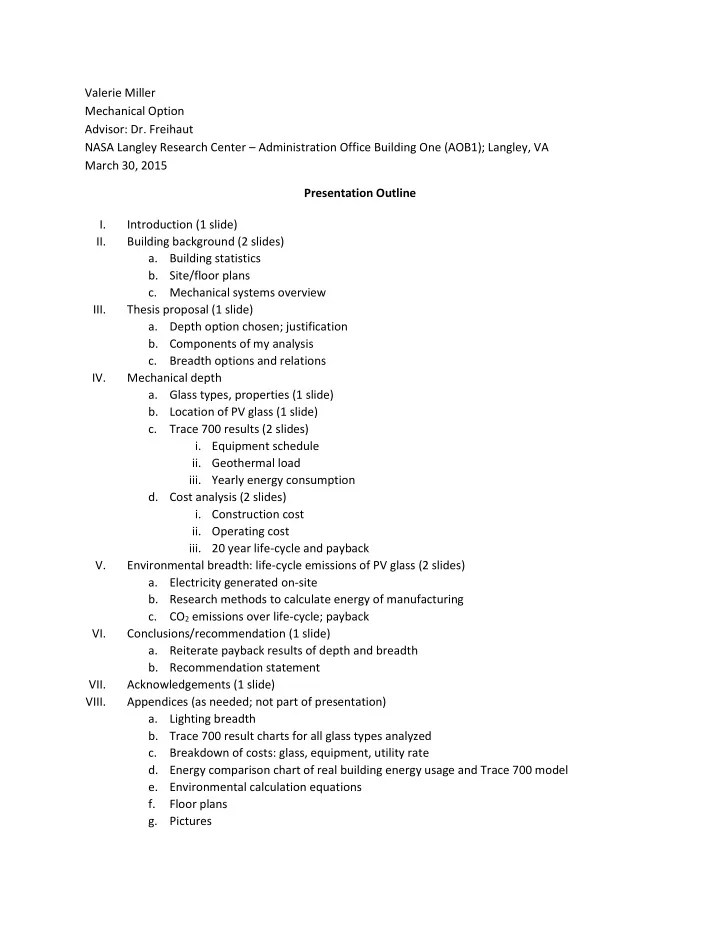
Valerie Miller Mechanical Option Advisor: Dr. Freihaut NASA Langley Research Center Administration Office Building One (AOB1); Langley, VA March 30, 2015 Presentation Outline I. Introduction (1 slide) II. Building background (2 slides) a.


slide-1
SLIDE 1

Valerie Miller Mechanical Option Advisor: Dr. Freihaut NASA Langley Research Center – Administration Office Building One (AOB1); Langley, VA March 30, 2015 Presentation Outline I. Introduction (1 slide) II. Building background (2 slides)

  • a. Building statistics
  • b. Site/floor plans
  • c. Mechanical systems overview

III. Thesis proposal (1 slide)

  • a. Depth option chosen; justification
  • b. Components of my analysis
  • c. Breadth options and relations

IV. Mechanical depth

  • a. Glass types, properties (1 slide)
  • b. Location of PV glass (1 slide)
  • c. Trace 700 results (2 slides)
  • i. Equipment schedule
  • ii. Geothermal load
  • iii. Yearly energy consumption
  • d. Cost analysis (2 slides)
  • i. Construction cost
  • ii. Operating cost
  • iii. 20 year life-cycle and payback

V. Environmental breadth: life-cycle emissions of PV glass (2 slides)

  • a. Electricity generated on-site
  • b. Research methods to calculate energy of manufacturing
  • c. CO2 emissions over life-cycle; payback

VI. Conclusions/recommendation (1 slide)

  • a. Reiterate payback results of depth and breadth
  • b. Recommendation statement

VII. Acknowledgements (1 slide) VIII. Appendices (as needed; not part of presentation)

  • a. Lighting breadth
  • b. Trace 700 result charts for all glass types analyzed
  • c. Breakdown of costs: glass, equipment, utility rate
  • d. Energy comparison chart of real building energy usage and Trace 700 model
  • e. Environmental calculation equations
  • f. Floor plans
  • g. Pictures
slide-2
SLIDE 2

NASA LANGLEY RESEARCH CENTER ADMINISTRATION OFFICE BUILDING ONE (AOB1)

Valerie Miller, BAE Mechanical Option Advisor: Dr. Freihaut

LANGLEY, VA

slide-3
SLIDE 3

TABLE OF CONTENTS

Introduction Building background Thesis proposal Mechanical depth Environmental breadth Recommendation Acknowledgement

NASA AOB1 – Valerie Miller

  • Owner: NASA & U.S.

General Services Administration

  • Location: Langley, VA
  • 79,000 ft2

Geothermal Transfer Field

Office Core Conference

  • 3 stories + penthouse
  • LEED Platinum rating
  • Cost: $26 million
  • Ribbon cutting: June 17, 2011
slide-4
SLIDE 4

TABLE OF CONTENTS

Introduction Building background Thesis proposal Mechanical depth Environmental breadth Recommendation Acknowledgement

NASA AOB1 – Valerie Miller

Office Core Conference

AHU-1, 2, 3 UFAD floors 1, 2, 3 AHU-4 Conference 105A, B Penthouse: AHU-5: Conference 205 and 305 DOAS unit: AHU-1, 2, 3, 5 Geothermal Side Plant Side Building Side

slide-5
SLIDE 5

TABLE OF CONTENTS

Introduction Building background Thesis proposal Mechanical depth Environmental breadth Recommendation Acknowledgement

NASA AOB1 – Valerie Miller

BREADTH TOPIC:

LIFE-CYCLE EMISSIONS OF PV GLASS

Onyx Solar: Low-E Photovoltaic Transparent Glass

  • Manufactured in Spain
  • Thin film amorphous silicon (a-Si)
  • Etched for desired Visible Light Transmittance (VLT)
  • 3,575 ft2 total glass area, 2,500 ft2 PV area
  • Peak power: 2.972 W/ft2 = 7,440 W
  • 1,450 kWh/year generated
  • $111.65/year saved

Research Method 1

  • E. Alsema, 1998

Research Method 2

Environmental Science and Technology, 2013

Area method

  • 11.15 kWh/ft2
  • 39,861 kWh

Power output method

  • 4.5 kWh/W
  • 33,480 kWh
slide-6
SLIDE 6

TABLE OF CONTENTS

Introduction Building background Thesis proposal Mechanical depth Environmental breadth Recommendation Acknowledgement

NASA AOB1 – Valerie Miller

Onyx Solar: Low-E Photovoltaic Transparent Glass

Site CO2 emission factor:

1.64 lb/kWh

Spain CO2 emission factor:

0.756 lb/kWh

Research method 1 Research method 2

kWh/year generated on-site by glass:

1,451

Pounds of CO2/year saved from on-site generation:

2,380

Total power (kWh) required for manufacturing:

39,861 33,480

Pounds CO2 emitted in manufacturing:

30,131 25,308

CO2 payback (years):

12.7 10.6

BREADTH TOPIC:

LIFE-CYCLE EMISSIONS OF PV GLASS