
SLIDE 1
MINING USER CONFERENCE, 04TH MAY 2017
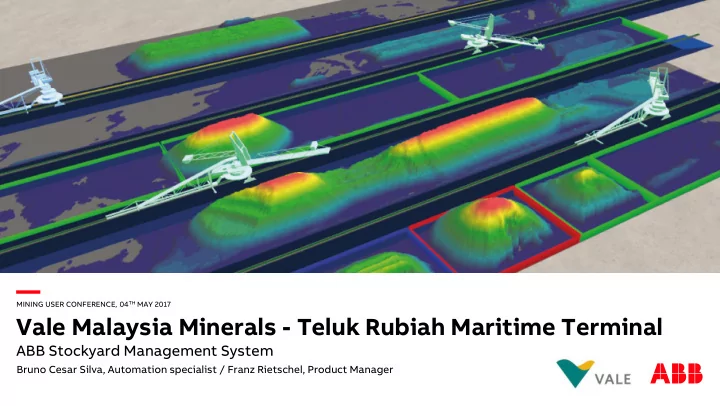
Vale Malaysia Minerals - Teluk Rubiah Maritime Terminal
ABB Stockyard Management System
Bruno Cesar Silva, Automation specialist / Franz Rietschel, Product Manager
Vale Malaysia Minerals - Teluk Rubiah Maritime Terminal ABB - - PowerPoint PPT Presentation
MINING USER CONFERENCE, 04 TH MAY 2017 Vale Malaysia Minerals - Teluk Rubiah Maritime Terminal ABB Stockyard Management System Bruno Cesar Silva, Automation specialist / Franz Rietschel, Product Manager Vale Global Presence Headquartered in
MINING USER CONFERENCE, 04TH MAY 2017
ABB Stockyard Management System
Bruno Cesar Silva, Automation specialist / Franz Rietschel, Product Manager
Headquartered in Rio de Janeiro, we have operations, research laboratories, projects and offices on five continents.
Vale – Global Presence
#1 in the world #2 in the world
Iron ore Logistics Nickel Coal Copper Fertilizers Vale has a diversified business portfolio
Vale is the world’s largest producer of iron ore and pellets, essential raw materials for the manufacture of steel. Our mines are concentrated in Brazil, where we also operate pelletizing plants. We are investing in technology to extend the lifespan of our iron ore mines, processing low-grade ores, expanding our production capacity and contributing to environmental preservation. In Pará, the S11D project brings together the lessons Vale has learned from mining in the Amazon. The project, which will enable Vale to maintain its global leadership in the supply of iron ore, will use 93% less water, consume 77% less fuel and emit 50% less greenhouse gases than a comparable operation based on conventional methods.
Iron Ore Distribution Center
May 8, 2017
Slide 6
IMPORT BERTH EXPORT BERTH
Main Access Trestle
STOCKYARDS
Iron Ore Distribution Center
May 8, 2017
Slide 7
IMPORT BERTH Import Wharf: 750 m Depth: 25 m 3 Ship Unloaders Nominal capacity: 3,500 ton/h each EXPORT BERTH Export Wharf: 560 m Depth: 22 m 1 Ship Loader Nominal capacity: 8,000 ton/h STOCKYARDS Storage capacity 3.2 Mton (5 yards) 1 Stacker Nominal Capacity: 10,500 ton/h 1 Reclaimer Nominal Capacity: 8,000 ton/h 3 Stacker-reclaimers Nominal Capacity: 8,000 ton/h
Malaysia Distribution Centre provides for a throughput of 60 million tons per annum through two berths:
Iron Ore Distribution Center
May 8, 2017
Slide 8
Operational Flexibility & high level productivity
Laboratory
Sampling Tower
EXPORT BERTH
Malaysia Distribution Center facilities provides
35 days
BRAZIL MALAYSIA DC
10 days
Flexibility in quality and low carbon footprint
Recent project highlight: Iron Ore Distribution Terminal for Vale in Malaysia
May 8, 2017
Slide 11
Material Tracking – Tracking from the source to the discharge point – Monitors the material flow by masses/volumes on belt conveyors Quality Management – real time stockpile tracking by tonnage and quality – Stockpile Monitoring / Mass Balance PLC Programming for Material Handling Equipment with Minerals Library – 1 Stacker – 1 Reclaimer – 3 Stacker/Reclaimer – Belt conveyor system – Substation automation Central Control Room integration VFD Drives Commissioning MES Interface to global planning system (PIMS/ GPV) Evaluate Jobs according to available space, material quality and quantity Delegate commands to machines & conveyors Execute material handling by fully automated yard machines
Stockyard Management System Controller & Drives commissioning Fully automated machine operation
Stockyard management system features
May 8, 2017
Slide 12
Tracking based on process data – Monitoring of masses/volumes on belt conveyors – Tracking of materials to the discharge point Supplies real time stockpile tracking by tonnage and grade – Dynamic display of belt load with color differentiation according material type – Stockpile Monitoring Monitoring of the material flow
cuboid model – based on machine position, boom belt speed and tonnage
the reality by 3D-laserscanner data
Calculated pile model with scanner update
System Architecture for fully automated operation
May 8, 2017
Slide 14
– Every material movement is a job – Production Planing creates job in PIMS and exchange via web service to SYMS – In addition Operators can also enter jobs manual in SYMS – Delegation
quality and quantity requirements – Delegate job information to substation and machine controller – Automation control receives information from machine controller and performs fully automated machine operation – Moved material & Qualities will be tracked – Actual performance will be reported to PIMS/GPV
Job oriented handling philosophy
PIMS / GPV Stockyard Management System Material Tracking Quality Management 3D / 2D Pile Monitoring Job Management Central Control System 800xA HMI Visualization Conveyor sequences Anti Collision System Field Level integration Job Delegation GPS Laser Scanner Safety appl. OPC Server Fully automated Yard Machines Conveyor belt system Substations & Auxiliaries
1 1 2 2 3 3 4 4 5 1 5
Features
May 8, 2017
Slide 15
– Overview of the stockyard – slice view functionality – Coordinates blending
– Reach the quality goals with the best possible accuracy
Blending process Verification of actual material quality
Stockpile Monitoring
May 8, 2017
Slide 16
– Overview of the stockyard – Visualize stocks of the material
– Displays empty spaces – Simplifies the accumulation of inventories – Provides data for reporting enables process simplification
3D-Pile Model for Pile Monitoring
3D-view 2D-view
Features
May 8, 2017
Slide 17
– All features enable reliable quality management – No material contamination – Create exact out coming material – Mass balance for inventory management – Data for reporting
Quality management
Features of iSAM Technology
May 8, 2017
Slide 18
– Fully automated stacking assures the execution of appropriate stacking method (Coneshell, Windrow, ..) – Stacking exact into the specified stockpile profile – Flat shaped piles for maximum performance – No overrun of the pile area – Reduced dust by adjustment of the boom close to the top of the pile
Fully automated stacking & reclaiming
Features of iSAM Technology
May 8, 2017
Slide 19
– Fully automated reclaiming based on stockpile shape and volume model – Operation supported by 3D laser scanner for shape detection and RTK-GPS receivers for exact positioning – Reclaiming also in worse environmental conditions due to continuously updated stockpile shape model – Smooth continuous operation reduces wear and tear
Fully automated stacking & reclaiming
Flow rate trend charts
May 8, 2017
Slide 20
Manual operation Automatic operation
Lessons learned:
Benefits for the site:
What we have learned and gained
May 8, 2017
Slide 21