USING CLIMATE CHANGE VULNERABILITY Shannon Still 1 , Kay Havens 2 , - - PowerPoint PPT Presentation

using climate change vulnerability
SMART_READER_LITE
LIVE PREVIEW

USING CLIMATE CHANGE VULNERABILITY Shannon Still 1 , Kay Havens 2 , - - PowerPoint PPT Presentation

USING CLIMATE CHANGE VULNERABILITY Shannon Still 1 , Kay Havens 2 , Pati Vitt 2 1 UC Davis Arboretum & Public Garden ASSESSMENTS FOR RARE PLANT CONSERVATION IN 2 Chicago Botanic Garden THE WESTERN UNITED STATES Overview of research funded


slide-1
SLIDE 1

Shannon Still1, Kay Havens2, Pati Vitt2

1UC Davis Arboretum & Public Garden 2Chicago Botanic Garden
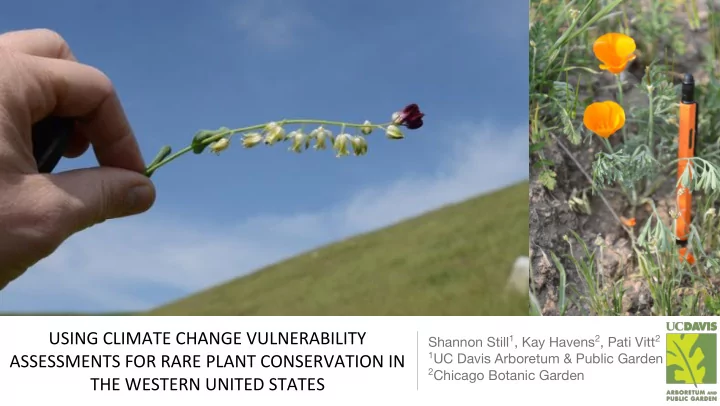
USING CLIMATE CHANGE VULNERABILITY ASSESSMENTS FOR RARE PLANT CONSERVATION IN THE WESTERN UNITED STATES

slide-2
SLIDE 2

Overview of research

  • funded by Bureau of Land Management Plant

Conservation Program – ~570 rare plants across 51 familes

  • ex. Penstemon albomarginatus
  • Provide assessment for climate change effects
  • n rare taxa
  • Compare to other assessments
  • Goal to provide data for rare plant management

and seed collection strategies in part

slide-3
SLIDE 3

Taxa included in the dataset: Listed taxa

Listing

  • No. species

% Listed Endangered 57 10.1 Listed Threatened 38 6.7 not listed 476 83.3

slide-4
SLIDE 4

Taxa included in the dataset: Global Ranks

Global Rank (rounded)

  • No. species

% Ranks included Designation G1 134 23.7 G1, G1?, G1Q, G1?Q, G1G2, G1G2Q, G1G2T1, G1G2T1T2, G1G3, G1QT1Q, G1T1, G2G3T1, G2G3T1T2, G2T1, G3?T1Q, G3G4T1T3, G3T1, G3T1T2Q, G4?T1, G4G5T1, G4G5T1T2, G4T1, G5T1, G5T1Q Critically Imperiled G2 413 73.1 G2, G2?, G2Q, G2?Q, G2G3, G2G3Q, G2G3T2T3, G2T2, G3?T2, G3G4T2, G3T2, G4?T2, G4?T2Q, G4G5T2, G4T2, G5T2, G5T2?Q, G5T2Q, G5T2T3, G5T2T3Q Imperiled G3 17 3.0 G3, G3? Vulnerable G4 0.0 Apparently Secure G5 0.0 Secure GNA 1 0.2 GNA N/A

slide-5
SLIDE 5

Taxa included in the dataset: species/state

State/nation

  • No. species

Example taxa Arizona 41

Carex specuicola [Navajo sedge] Echinocereus triglochidiatus var. arizonicus [Arizona Hedgehog Cactus]

California 314

Penstemon albomarginatus [white-edged beardtongue] Prunus eremophila [desert plum]

Colorado 12

Sclerocactus mesa-verdae [Mesa Verde cactus] Astragalus osterhoutii [Osterhout milkvetch]

Idaho 23

Astragalus mulfordiae [Mulford’s milkvetch] Rubus bartonianus [Bartonberry]

Montana 11

Lomatium attenuatum [Taper-tip desert parsley] Shoshonea pulvinata [Shoshonea]

Nevada 79

Enceliopsis argophylla [silverleaf sunray] Selaginella utahensis [Utah spikemoss]

New Mexico 21

Oenothera organensis [Organ evening primrose] Asclepias welshii [Welsh’s milkweed]

Oregon 64

Trifolium owyhhense [Owyhee clover] Senecio ertterae [Ertter’s senecio]

Utah 98

Pediocactus sileri [Siler’s pincushion] Cryptantha jonesiana [Jones’ cateye]

Washington 23

Allium constrictum [Constricted Douglas’ onion] Howellia aquatilis [Howellia]

Wyoming 27

Penstemon acaulis var. acaulis [stemless beardtongue] Phlox pungens [Beaver Rim phlox]

Navajo Nation 22

Carex specuicola [Navajo sedge] Cryptantha atwoodii [Atwwod’s catseye]

slide-6
SLIDE 6

Taxa included in the dataset: species/state

ESA Status Rounded Global Rank State/nation

  • No. taxa

Total listed Total not listed G1 G2 G3 GNA California 314 53 261 77 229 8 Utah 98 11 85 23 70 3 Nevada 79 6 73 9 68 2 Oregon 64 13 51 15 46 3 Arizona 41 8 31 9 27 2 1 Wyoming 27 27 1 24 2 Idaho 23 3 20 3 19 1 Washington 23 4 19 3 19 1 Navajo Nation 22 6 16 7 13 2 New Mexico 21 7 14 4 16 1 Colorado 12 7 5 6 5 1 Montana 11 1 10 7 4

slide-7
SLIDE 7

Model parameters

  • MaxEnt
  • area is a convex hull of the occurrences

buffered by 50 km or the entire west

  • testing on 25% of occurrences
  • projected to same extent as modeled
  • up to 10,000 background points
  • 10 model replicates for each species
  • present, 2020s, 2050s, 2080s
  • WorldClim, IPCC 4
  • 13 Global Circulation Model and

emission scenario combinations for each future prediction

slide-8
SLIDE 8

What I will discuss

  • change of suitable habitat area
  • change in suitable habitat range
  • change of in situ habitat
  • create SDM Score for vulnerability

using species distribution models

slide-9
SLIDE 9

Change in suitable habitat area

slide-10
SLIDE 10

Change in Suitable Habitat Area

Current (1000 sq. km) Future (1000 sq. km) Overlap (500 sq. km) Change in Suitable Habitat Area = 0% Overlap = 50%

slide-11
SLIDE 11

Current (1000 sq. km) Future (500 sq. km) Overlap (250 sq. km) Change in Suitable Habitat Area =

  • 50%

Overlap = 25%

Change in Suitable Habitat Area

slide-12
SLIDE 12

Predicting change in suitable habitat area

slide-13
SLIDE 13

Predicting change in suitable habitat area How can you use this?

✓ Predict suitable areas for the future

  • prioritize species for conservation
  • which taxa more imperiled
  • prioritize areas for conservation
  • which areas more imperiled

✓ Identify leading and trailing edges of suitable habitat

  • collect germplasm for those areas on trailing edge
slide-14
SLIDE 14

Predicting change in suitable habitat area

areas classified (thresholded) as suitable/not suitable

slide-15
SLIDE 15

Change of in situ habitat (areas where species presently located)

slide-16
SLIDE 16

Current Future Change in Suitable Habitat Area =

  • 20%

Overlap = 50% Suitability Score = -0.350

* * * * * * * * * * *

  • 1.000

+0.00

  • 0.250
  • 0.200
  • 0.300

Suitability Score (in situ change)

slide-17
SLIDE 17

Quantify change for known occurrences (in situ)

  • Compare suitability between present and future for all occurrences
  • for each location…is suitability changing?
slide-18
SLIDE 18

Model variation

slide-19
SLIDE 19

suitability 28 increase (0 all gain) 67 decrease (24 all loss)

Federally listed: 95 taxa

2080s

slide-20
SLIDE 20

Conservation planning: focus on species using in situ score

slide-21
SLIDE 21

Change of habitat where presently located How can you use this?

✓ Identify species most at risk ✓ Identify populations most at risk

  • collect germplasm from imperiled populations
slide-22
SLIDE 22

Using the results: Conservation planning & prioritization

slide-23
SLIDE 23

Suitable habitat range Overlap of Suitable Habitat Area Suitability Score n (%) Contracting (n=308) < 50% decreasing 277 (49.0%) increasing 0 (0%) > 50% decreasing 22 (3.9%) increasing 3 (0.5%) Expanding (n=263) < 50% decreasing 72 (12.7%) increasing 4 (0.7%) > 50% decreasing 44 (7.8%) increasing 143 (25.3%)

Conservation planning: focus on overall patterns

slide-24
SLIDE 24

2020s 2050s 2080s count % count % count %

Change in range size increasing 277 48.5 267 46.7 263 46.1 decreasing 294 51.5 304 53.3 308 53.9 Range overlap > 50% 286 50.1 237 41.5 218 38.2 < 50% 285 49.9 334 58.5 353 61.8 Suitability score increasing 176 30.8 163 28.5 149 26.1 decreasing 395 69.2 408 71.5 422 73.9 SDM Score highest risk 0.75-1.00 254 44.5 moderate risk 0.50-0.75 114 20.0 lower risk 0.25-0.50 149 26.1 presumed not at risk 0.00–0.25 54 9.5

Overall results

slide-25
SLIDE 25

SDM Score (risk categories)

2080s count % highest risk 0.75-1.00 254 45.0 moderate risk 0.50-0.75 114 20.2 lower risk 0.25-0.50 143 25.3 presumed not at risk 0.00–0.25 54 9.6

slide-26
SLIDE 26

SDM Score (risk categories)

slide-27
SLIDE 27

Conservation planning: focus on species using SDM Score (overall patterns)

slide-28
SLIDE 28

2080s Top 10 lowest risk Top 10 highest risk Astragalus lentiformis Sphaeralcea janeae Dudleya brevifolia Lomatium bradshawii Monardella frutescens Penstemon barrettiae Townsendia aprica Tracyina rostrata Eriophyllum mohavense Sullivantia oregana Lyonothamnus floribundus subsp. aspleniifolius Plagiobothrys hirtus Stylocline citroleum Agrostis howellii Eremalche kernensis Mentzelia leucophylla Monardella crispa Erigeron decumbens var. decumbens Callitropsis pygmaea Eriogonum viscidulum

Lowest and highest risk taxa (by SDM Score)

slide-29
SLIDE 29

Global Ranks

  • Do Global

Ranks indicate future vulnerability?

slide-30
SLIDE 30

Prioritization

  • Which

species for conservation focus? high priority; most at risk low priority; least at risk

slide-31
SLIDE 31

USFS provisional seed zones

Conservation planning: sourcing & reintroductions

slide-32
SLIDE 32

Overall results

  • Seeing loss of suitable

habitat for ~75% of rare taxa and 75% for federally listed species

  • Contraction for half of

species

  • Range overlap less than

50% for half of species

  • Fairly consistent with CCVI

but there are notable exceptions

slide-33
SLIDE 33

Issues

  • SDMs do not account for plasticity of plants
  • May have not included factors important to the distribution (such as soils)
  • Rare plants more difficult to model due to lower number of

populations/occurrences

  • Doesn’t mean models are bad but we are unable to effectively test them
  • Vegetation models and common plants have more locations and may

develop a better climatic envelope

  • Absence data can help increase the quality of models and may allow for
  • ther modeling algorithms (such as Random Forests)
slide-34
SLIDE 34

Thank you!

  • BLM Plant Conservation Program and Peggy Olwell
  • Chicago Botanic Garden, including Kay Havens amd Pati

Vitt

  • UC Davis Arboretum & Public Garden, including Kathleen

Socolofsky, and Mary Burke

  • NatureServe
  • Robert Hijmens, Pat McIntyre, Brian Anacker and other

informal advisors that answered many of my questions

  • Other collaborators on publication and portions of the

project

slide-35
SLIDE 35

The preceding presentation was delivered at the This and additional presentations available at http://nativeseed.info

2017 National Native Seed Conference

Washington, D.C. February 13-16, 2017