
SLIDE 1
CXC
The Chandra Source Catalog
User Interface
Nina Bonaventura
Science Data Systems
User Interface Nina Bonaventura Science Data Systems CXC The - - PowerPoint PPT Presentation
The Chandra Source Catalog User Interface Nina Bonaventura Science Data Systems CXC The Chandra Source Catalog: User Interface http://cxc.harvard.edu/csc/columns/ The Chandra Source Catalog (CSC) is presented to the user in two table views:
CXC
Nina Bonaventura
Science Data Systems
CXC
The Chandra Source Catalog (CSC) is presented to the user in two table views: the Master Chandra Source Table and the Table of Individual Source Observations Master source properties represent the best estimates of the properties of a source, based on data derived from all
been detected.
In the Table of Individual Source Observations, source properties are recorded on a per-
for a source, one for each individual observation in which it has been detected.
http://cxc.harvard.edu/csc/columns/
CXC
Individual source observations are linked to a corresponding single, merged master
not contribute to the reported master source properties.
For more on the organization of the catalog, see: http://cxc.harvard.edu/csc/organization.html
CXC
Master Source Properties
Observation Identification Source Flags Pointing Information Source Extent and Errors Timing Information (Obi and Source) Source Fluxes Instrument Information (Obi and Source) Source Significance Processing Information Spectral Properties Observing Cycle Source Variability Source Identification The CSC Column Descriptions pages describe how each source property is determined.
http://cxc.harvard.edu/csc/columns/index.html#coldesc
CXC
The bird's-eye view of the CSC, with master source properties, individual source properties, and file-based data products connected by the catalog processing steps.
http://cxc.harvard.edu/csc/proc/
CXC
CXC
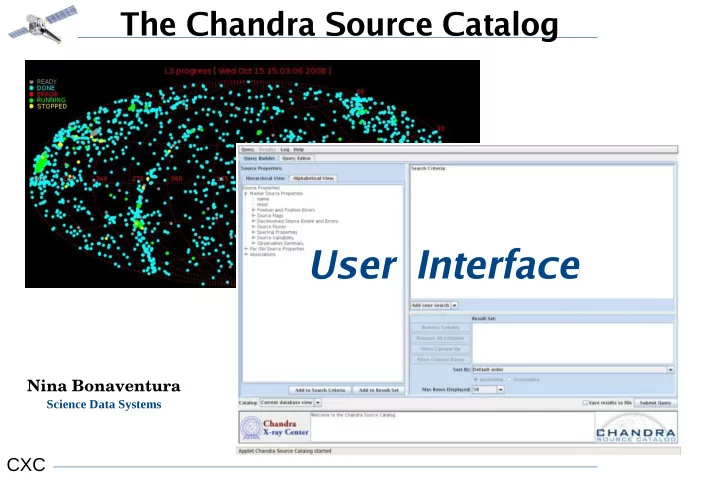
CSCview provides direct access to the contents of the catalog via user- specified queries.
CXC
Master Source Properties Per Obi Source and Observation Properties
CXC
Here, we establish a search on all Chandra
'o.targname LIKE SN 1993%' translates to
“find all sources in observations with a target name beginning with 'SN 1993', followed by any set of characters .”
CXC
We have the options to save the query and query results to individual text files before submitting the query.
CXC
After the query is submitted, the query results interface appears, displaying a table of query results in which each row represents a source, and each column a selected property characterizing the source.
CXC
We have the option to download data products to a tar or batch file.
CXC
See the full list of Level 3 data products at http://cxc.harvard.edu/csc/data_products/
CXC
As an alternative to submitting web-style queries in the Query Builder of CSCview, users may enter SQL-like query expressions in the Query Editor of CSCview. For example,
'SELECT m.name, m.ra, m.dec, o.obsid, m.photflux_aper_b FROM cscat WHERE o.targname LIKE “SN 1993%”' translates to “return the master source catalog name, equatorial coordinates and broad band photon flux, and the per obi ObsID associated with all sources found in observations with a target name beginning with 'SN 1993' .”
CXC
unix% curl --form query='SELECT TOP 10 m.name, m.ra, m.dec, o.obsid,
1993%”''http://cda/cscview/getProperties' unix% wget -O out.file 'http://cda.cfa.harvard.edu/cscview/getPropertiesquery=SELECT
TOP 10 m.name, m.ra, m.dec, o.obsid, o.ra_targ, o.dec_targ, m.photflux_aper_b FROM cscat WHERE o.targname LIKE “SN 1993%”''http://cda/cscview/getProperties'
CXC