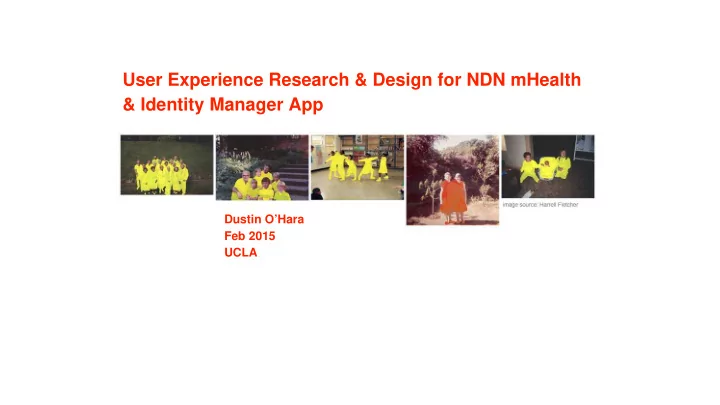
SLIDE 1
User Experience Research & Design for NDN mHealth & Identity Manager App
Dustin O’Hara Feb 2015 UCLA
SLIDE 2
SLIDE 3
SLIDE 4
SLIDE 5
SLIDE 6
SLIDE 7
SLIDE 8
SLIDE 9
SLIDE 10
SLIDE 11
SLIDE 12
“People want privacy, but they don’t want to practice privacy…” - Jean-François Blanchette
SLIDE 13 Out of the 2.92 billion internet users, roughly 42% of them are on facebook
according to Google
SLIDE 14
SLIDE 15
SLIDE 16
SLIDE 17
SLIDE 18
Articulating one’s place within the network is often foundational to social practices involving trust.
SLIDE 19
SLIDE 20
SLIDE 21
The ID Manager is about the management of context & trust (which then informs who gets access to public keys) Trust & context are first established by situating and understanding one-another’s place within the network, which is mirrored by the nature of the exchange.
SLIDE 22 ID Manager UX Ontology
- numerous self defined identities
- users
- apps
- data types
SLIDE 23
Identities: enable to the user to quickly cluster their tasks, into self described categories or identitieis, (i.e. home & utilities, family, work, social, media, etc) that are each defined by the particular networking of users, apps, and data types.
SLIDE 24
Data Types: allow the user to quickly understand what data, or public keys, the various apps and users have access to. Rather that managing specific public keys, the user authorized clusters of public keys, for present and future exchanges.
SLIDE 25
Users: are understood as other individuals or groups that the user is actively, or potentially, exchanging data with. When authorizing a connection with a user, or reviewing existing connections, users are understood by their “mutual apps,” their “mutual users,” and the “data types” associated with their mutual apps.
SLIDE 26
Apps: function as form of trusted context for a given exchange, and are understood by their necessary “data types” and "mutual users.” Apps are identify and associate with a wider range of institutions and groups.
SLIDE 27
SLIDE 28
SLIDE 29
SLIDE 30
SLIDE 31
SLIDE 32