
SLIDE 1
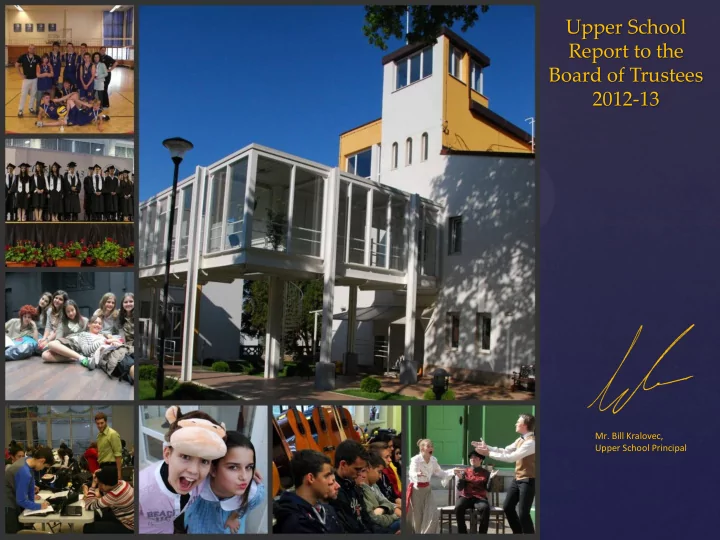
Upper School Report to the Board of Trustees 2012-13
- Mr. Bill Kralovec,
Upper School Principal
Upper School Report to the Board of Trustees 2012-13 Mr. Bill - - PowerPoint PPT Presentation
Upper School Report to the Board of Trustees 2012-13 Mr. Bill Kralovec, Upper School Principal IB Diploma Statistics Class of 2012 IB Diploma Programme for Beginners The DP originally designed to provide a reliable and consistent
Upper School Report to the Board of Trustees 2012-13
Upper School Principal
The DP originally designed to provide a reliable and consistent qualification for international students returning “home” to study at university.
Two-year program (Grades 11 and 12) for the six subject areas. The academic level is equivalent to a first- year, first-semester, university course. There are over 2,000 IBDP schools, 1/3 are from the our region (Africa, Europe, Middle East)
In May of senior year, the students sit an exam in each of the subject areas. Also included in their score for the subject are internal assessments, which are assignments they did during the two years. Also points are rewarded for an independent research project, and TOK course.
To earn the Diploma, students must score at least 24 points out of 45 points possible. Interesting Statistics
55% of the students taking the exam were female versus 45% male; difference of 12,000 students.
50% of the candidates taking the exams were full diploma. (ISB average higher 80%)
Top two nationalities sitting the exam in 2012 were USA (63,972) and Canada (9,609) and there were 92 Serbians.
There were 2,064 schools world wide taking the IB examinations with 121,195 candidates total.
17 secondary students earned DELF certification in 2012-2013. Three students earned a B Level proficiency, which is the intermediate
level of the CEFR (Common European Framework of Reference). One of those students had the highest score in Belgrade!
One student earned certification for Serbian as a Foreign Language, a
first in school history.
Next year (2013-2014) a testing arrangement will be set up with
Cervantes Center for Spanish students to earn certification.
In a smaller school, it is important to have outside
assessments to measure our students externally.
We have a high participation rate in the IB Diploma
Programme with significantly higher pass rates and bilingual diplomas than world average.
ISB won 7 of the 12 sports events in 2012-2013; ISB won trophies (first,
second, or third) in all 12 events; ISB made it to 10 of the 12 finals (8 teams in CEESA “Blue Division”)
In the previous three years, ISB has won 20 of the 32 CEESA sports events. 89.7% of US Students participated in an ASA, up 12% from last year. 57% of those students participated in at least 2 activities. ISB wins HS Knowledge Bowl for second consecutive year, and won 25%
The MAP assessment was given for the second time this year – previously we used the
International School Assessment.
The assessment was given to students in grades 3-10 in the areas of reading, language
use and mathematics
Scores reported in RIT units (Rasch UnIT) – an equal interval scale that ranges from
100-280. RIT scores are independent of grade level (however students typically begin at the 180/200 level and end high school by the 260 level)
More than 3,500 school systems worldwide use the assessment. The norm group is
comprised of 2.3 million students in the United States (international norm are currently being developed as more international students take this test)
This year, international norms were established (fall norms have been published, and
spring norms are yet to be published). We will now have the ability to compare results to the performance of thousands of students around the world.
180 190 200 210 220 230 240 Gr.3 Gr.4 Gr.5 Gr.6 Gr.7 Gr.8 Gr.9 Gr.10 Grade Score Norm Group
Organized in 7 content areas:
Number Sense – understanding of number (representing, comparing,
Estimation and Computation – solve problems involving whole
numbers, fractions, decimals…
Algebra – patterns, algebraic expressions, coordinate graphing, solving
equations and inequalities
Geometry – Understanding of geometric concepts, scale, 2 and 3-
dimensional objects
Measurement – surface area, volume, rate, conversion… Statistics and Probability – graphing, interpretation of data… Problem Solving, Reasoning & Proofs – Developing strategies to solve
problems, verifying results, explaining strategies
100 110 120 130 140 150 160 170 180 190 200 210 220 230 240 250 Fall 2012 Spring 2013 184 195 178 191 ISB Gr. 2 Norm Group
100 110 120 130 140 150 160 170 180 190 200 210 220 230 240 250 Fall 2012 Spring 2012 194 210 192 203 ISB Gr. 3 Norm Group
100 110 120 130 140 150 160 170 180 190 200 210 220 230 240 250 Fall 2012 Spring 2013 213 226 204 213 ISB Gr. 4 Norm Group
100 110 120 130 140 150 160 170 180 190 200 210 220 230 240 250 Fall 2012 Spring 2013 223 233 213 221 ISB Gr. 5 Norm Group
100 110 120 130 140 150 160 170 180 190 200 210 220 230 240 250 Fall 2012 Spring 2013 225 231 220 226 ISB Gr. 6 Norm Group
100 110 120 130 140 150 160 170 180 190 200 210 220 230 240 250 Fall 2012 Spring 2013 232 237 226 231 ISB Gr. 7 Norm Group
100 110 120 130 140 150 160 170 180 190 200 210 220 230 240 250 Fall 2012 Spring 2013 240 247 230 235 ISB Gr. 8 Norm Group
100 110 120 130 140 150 160 170 180 190 200 210 220 230 240 250 Fall 2012 Spring 2013 240 246 234 236 ISB Gr. 9 Norm Group
100 110 120 130 140 150 160 170 180 190 200 210 220 230 240 250 Fall 2012 Spring 2013 247 246 234 237 ISB Gr. 10 Norm Group
197 205 207 223 217 224 225 231 50 100 150 200 250 Fall 2009 (Gr.3) Spring 2010 (Gr.3) Fall 2010 (Gr.4) Spring 2011 (Gr.4) Fall 2011 (Gr.5) Spring 2012 (Gr.5) Fall 2012 (Gr.6) Spring 2013 (Gr.6) ISB Gr.6 Norm Group
Organized in 5 content areas:
Word Recognition & Vocabulary – Vocabulary and ability to use clues to
decipher word meaning
Reading Comprehension – Literal – Recall of facts, sequence and details
from written material
Reading Comprehension – Inferential – Ability to make predications,
analyze cause/effect relationships, synthesize information
Reading Comprehension – Evaluative – Understand fact & opinion, can
compare works, detect bias
Literary Response and Analysis – ability to respond to stories based on
characters, themes, plot, & setting
100 110 120 130 140 150 160 170 180 190 200 210 220 230 240 250 Fall 2012 Spring 2013 187 196 176 190 ISB Gr. 2 Norm Group
100 110 120 130 140 150 160 170 180 190 200 210 220 230 240 250 Fall 2012 Spring 2013 192 203 190 199 ISB Gr. 3 Norm Group
100 110 120 130 140 150 160 170 180 190 200 210 220 230 240 250 Fall 2012 Spring 2013 208 216 200 207 ISB Gr. 4 Norm Group
100 110 120 130 140 150 160 170 180 190 200 210 220 230 240 250 Fall 2012 Spring 2013 218 222 207 212 ISB Gr. 5 Norm Group
100 110 120 130 140 150 160 170 180 190 200 210 220 230 240 250 Fall 2012 Spring 2013 217 219 212 216 ISB Gr. 6 Norm Group
100 110 120 130 140 150 160 170 180 190 200 210 220 230 240 250 Fall 2012 Spring 2013 221 222 216 220 ISB Gr. 7 Norm Group
100 110 120 130 140 150 160 170 180 190 200 210 220 230 240 250 Fall 2012 Spring 2013 227 231 219 222 ISB Gr. 8 Norm Group
100 110 120 130 140 150 160 170 180 190 200 210 220 230 240 250 Fall 2012 Spring 2013 228 231 221 223 ISB Gr. 9 Norm Group
100 110 120 130 140 150 160 170 180 190 200 210 220 230 240 250 Fall 2012 Spring 2013 238 237 223 224 ISB Gr. 10 Norm Group
192 198 201 203 206 216 217 219 175 180 185 190 195 200 205 210 215 220 225 Fall 2009 (Gr.3) Spring 2010 (Gr.3) Fall 2010 (Gr.4) Spring 2011 (Gr.4) Fall 2011 (Gr.5) Spring 2012 (Gr.5) Fall 2012 (Gr.6) Spring 2013 (Gr.6) ISB Gr.6 Norm Group
25 50 75 100
79.4 59 74 88 90 % meeting Standard (All)
25 50 75 100
77 83 72 96 97 % meeting Standard (All)
Organized in 5 content areas:
Composing / Writing Process – Skills to write, draft, revise, edit and
proofread
Composition Structure – Sentences and paragraphs, understanding of
compositional forms
Grammar and Usage – Sentence patters, verb tenses, subject/verb
agreement…
Punctuation – Appropriate use of punctuation Capitalization – Beginning capitalization, proper nouns,…
100 110 120 130 140 150 160 170 180 190 200 210 220 230 240 250 Fall 2012 Spring 2013 183 198 175 190 ISB Gr.2 Norm Group
100 110 120 130 140 150 160 170 180 190 200 210 220 230 240 250 Fall 2012 Spring 2013 195 205 191 200 ISB Gr.3 Norm Group
100 110 120 130 140 150 160 170 180 190 200 210 220 230 240 250 Fall 2012 Spring 2013 207 214 201 207 ISB Gr.4 Norm Group
100 110 120 130 140 150 160 170 180 190 200 210 220 230 240 250 Fall 2012 Spring 2013 217 222 208 213 ISB Gr.5 Norm Group
100 110 120 130 140 150 160 170 180 190 200 210 220 230 240 250 Fall 2012 Spring 2013 214 218 213 216 ISB Gr.6 Norm Group
100 110 120 130 140 150 160 170 180 190 200 210 220 230 240 250 Fall 2012 Spring 2013 218 222 216 219 ISB Gr.7 Norm Group
100 110 120 130 140 150 160 170 180 190 200 210 220 230 240 250 Fall 2012 Spring 2013 225 228 219 221 ISB Gr.8 Norm Group
100 110 120 130 140 150 160 170 180 190 200 210 220 230 240 250 Fall 2012 Spring 2013 224 228 221 222 ISB Gr.9 Norm Group
100 110 120 130 140 150 160 170 180 190 200 210 220 230 240 250 Fall 2012 Spring 2013 230 231 222 223 ISB Gr.10 Norm Group
194 203 198 209 209 215 214 218 175 180 185 190 195 200 205 210 215 220 Fall 2009 (Gr.3) Spring 2010 (Gr.3) Fall 2010 (Gr.4) Spring 2011 (Gr.4) Fall 2011 (Gr.5) Spring 2012 (Gr.5) Fall 2012 (Gr.6) Spring 2013 (Gr.6) ISB Gr.6 Norm Group
Language Use – ISB Lower School and US school students perform above or equall to the norm group. Strengths - in the area of capitalization and punctuation use. Areas to Monitor – Composition structure and Grammar Usage – MS and US trends in general Mathematics – ISB Lower School and US students consistently outperform the norm group. Strengths – in the area of number sense, geometry & measurement Areas to Monitor – Computation and Problem Solving Reading – ISB Lower School students and US students perform similarly to the norm group and more often, above Strengths – in the area of comprehension (especially interpretive and literary response/analysis) Areas to Monitor – Word recognition, parts of speech, and vocabulary This year’s big ideas :
Goals for 2013/14:- An increased focus school-wide on Language Use and Reading
185 190 195 200 205 210 215 Mathematics Reading Language Usage
ISB International Students CEESA
185 190 195 200 205 210 215 220 225 230 Mathematics Reading Language Usage
ISB International Students CEESA
195 200 205 210 215 220 225 230 235 Mathematics Reading Language Usage
ISB International Students CEESA
205 210 215 220 225 230 235 Mathematics Reading Language Usage
ISB International Students CEESA
210 215 220 225 230 235 240 Mathematics Reading Language Usage
ISB International Students CEESA
210 215 220 225 230 235 240 245 250 Mathematics Reading Language Usage
ISB International Students CEESA
210 215 220 225 230 235 240 245 250 Mathematics Reading Language Usage
ISB International Students CEESA
205 210 215 220 225 230 235 240 245 250 255 Mathematics Reading Language Usage
ISB International Students CEESA
n/a
182 students enrolled 50 students participate in our pull-out EAL support program 8 students receive pull-out learning support services 33 nationalities represented in the Lower School
The Role of Mathematics in the PYP Inquiry Based teaching in the PYP PYP teacher exchange CIS teacher conference-Nice CEESA teacher conference On-line learning platforms
4 Principal Coffees in the LS MAP presentation – With US 11 PYP Parent Workshops for Parents Healthy Life Night – With US Technology at ISB – With US 42 field trips by LS students this year
A total number of participants was 165 which represents 92 % of total student population at the Lower School- Number of classes offered per week - 25
Winter ASA 2013
A total number of participants was 151 which represents 84% of total student population at the Lower School- Number of offered classes per week- 21
Spring ASA 2013
A total number of participants is 160 which is 89% of total student population at the Lower School- Number of offered classes per week- 29
Nemanja Topovic- Introduction to computers , Introduction to sports and
Magazine Design
Elena Sentevska- Drama and Math Made Easy Jeff Zollner– Chess club(1-5),Survival skills and Eco club Rebecca Brink – Musicals Ivana Jovanovic- Comic club and Board games Nadia Kralovec and Melissa Arias- Girls on the move
Susan Hart: HS Girls Basketball/MS Girls volleyball Jeff Zollner: HS Girls Basketball Nemanja Topovic: MS Boys soccer/MS Girls Basketball/MS Boys Volleyball Marija Dimitrov: HS Girls Soccer/HS Girls Volleyball