Upland Woodland Restoration Plantlife recovery and natural - - PowerPoint PPT Presentation

upland
SMART_READER_LITE
LIVE PREVIEW

Upland Woodland Restoration Plantlife recovery and natural - - PowerPoint PPT Presentation

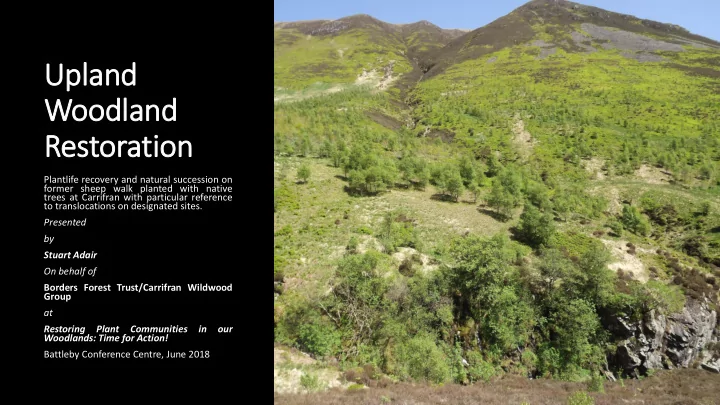
Upland Woodland Restoration Plantlife recovery and natural succession on former sheep walk planted with native trees at Carrifran with particular reference to translocations on designated sites. Presented by Stuart Adair On behalf of


slide-1
SLIDE 1

Upland Woodland Restoration

Plantlife recovery and natural succession on former sheep walk planted with native trees at Carrifran with particular reference to translocations on designated sites. Presented by Stuart Adair On behalf of Borders Forest Trust/Carrifran Wildwood Group at Restoring Plant Communities in

  • ur

Woodlands: Time for Action! Battleby Conference Centre, June 2018

slide-2
SLIDE 2

Brief history of Carrifran Wildwood

  • ?-2000: Centuries of open sheep walk with occasional

hill cattle and feral goats.

  • 1949: (1956, 1972, 1974, 1981) Notified as part of Moffat Hills

Site of Special Scientific Interest (SSSI). Notified for upland and vascular plant assemblages and geological features.

  • 1st January 2000: Purchased by Borders Forest Trust/Carrifran

Wildwood Group.

  • 2000-2007: Removal of all domestic stock (sheep, cattle, feral

goats); planting of circa 600,000 native trees and shrubs in the lower part of the valley (<450m a.s.l) funded through FCS Woodland Grant Scheme.

  • 2000-2001: Alison & Ben Averis conduct base-line habitat of

Carrifran and the neighbouring Black Hope.

  • 2005: Designated as part of Moffat Hills Special Area of

Conservation (SAC). Qualifying interests: Eight (8) alpine/montane Annex 1 Habitats.

  • 2005-present: Smaller areas of montane scrub (e.g. juniper,

downy willow etc) established on parts of the higher ground (i.e. Firthhope Corrie; Rispie Lairs).

  • 2007-present: Volunteer ‘enrichment planting’ adding species
  • nly partially funded or not funded at all by FCS woodland grant

scheme (e.g. hazel, hawthorn, willow, roses, honeysuckle, ivy).

  • 2008: SNH refuse permission to establish Dwarf Birch (Betula

nana) in tree-line woodland at Carrifran.

  • 2012: SNH refuse permission to translocate a list of circa 50

associated (not trees or shrubs) plant species and advise that we must carry out a translocation application for each species individually.

  • 2013: Stuart Adair carries out ‘re-survey’ of the entire Glen
  • 2018: Official application to SNH to translocate Bearberry

(Arctostaphylos uva-ursi) to Carrifran (and other locations in the Moffat/Tweedsmuir Hills). Currently awaiting outcome.
slide-3
SLIDE 3

Carrifran: Then and Now Left, 1999 (P. Ashmole); Right, 2017 (J. Barton)

slide-4
SLIDE 4

Remnant Woodland at Carrifran (l-r Ashy Dean; Hazel Linn; Holly Gill)

slide-5
SLIDE 5

Remnant woodland as refugia for woodland flo lora

  • Although the three extant woodland fragments were

very small, linear and confined to inaccessible places along the burn, they provided vital refugia for myriad woodland and shade tolerant plants, lichens and fungi. Including trees, shrubs, herbs and lower plants, each fragment supported an average of 70-80 recognizable woodland/shade plant species.

  • In terms of plant life recovery through natural

succession, such refugia (along with other inaccessible and shady places on crags, cliffs etc) are vital sources for future plant succession.

  • These refugia can also make an ideal source of plant

material for plant translocations into the wider landscape.

  • Pictured right, Barren Strawberry (Potentilla sterilis) in

Ashy Dean.

slide-6
SLIDE 6

Pla lanted Nativ ive Woodla land & N Natural Succession

  • Removal of domestic stock, deer control and

the establishment of native woodland will stimulate natural succession within the extant flora.

  • The picture opposite shows circa 13 years of

planted tree growth on what had formerly been typical Nardus dominated, tree-less, sheep

  • walk. The bright yellow-green colour is

succeeding Vaccinium myrtillus. The latter has all but replaced the Nardus and Calluna vulgaris is expanding downslope and the community is clearly succeeding to recognizable W17 Upland

  • ak-birch woodland.
slide-7
SLIDE 7

Pla lant/v /vegetatio ion su successio ion sin since th the removal l of domestic ic stock and the pla lantin ing

  • f

f nativ ive tr trees: : Th The St Story ry So So Far

  • Timeline: 2000-present in rough chronological order:
  • Bent-fescue (NVC U4) and Nardus swards (U5) thicken-up and become rank;
  • Bracken stands (NVC U20) thicken up and gain stature;
  • Dwarf-shrubs (esp. blaeberry and to a lesser extent, ling-heather) begin to succeed from

suppressed populations within the Nardus swards especially, eventually replacing the latter near completely within 10-15 years (NVC U5 succeeding to H18 and H12 and ultimately [with planted native trees] becoming recognizable, bryophyte-rich, W17 upland oak-birch woodland);

  • As early plantings mature and shade increases, bracken thins and bryophytes become prominent in

the flora. Flora clearly starting to resemble NVC W11 oak-birch woodland. On more neutral and base-rich profiles, recognizable ash-elm W9 flora starts to develop under the increasing shade of planted ash, wych elm, hazel, hawthorn etc. In wetter and flushed situations, tall-herb plant communities begin to form under and around planted (W7) alder, bird cherry and willows;

  • Typical woodland plants (e.g. wood sorrel, common dog-violet, wood anemone, pignut, Dryopteris

ferns, lemon scented-fern etc) become more prominent;

  • On the higher, especially north facing ground (e.g. Rispie Lairs), great wood-rush (Luzula sylvatica)

succeeds from Nardus swards, replacing the latter near completely within 5-15 years;

  • Natural regeneration from planted trees becomes increasingly frequent, especially hazel, bird

cherry and alder; Planted aspen starts suckering (note: some natural regeneration of ash and rowan especially from extant remnant woodland fragments also occurs but is largely confined to the margins of the burn adjacent the extant woodland fragments);

  • Pictured right, spreading extant Honeysuckle (Lonicera periclymenum) in Hazel Linn.
slide-8
SLIDE 8

Pla lant/v /vegetatio ion su successio ion sin since th the removal l of f domestic ic stock and th the pla lantin ing

  • f native trees: The Story So Far (cont’d)
  • Blanket bog recovery. Sphagna increasing and notable plant species such as Bog Blaeberry

(Vaccinium uliginosum) increasing its coverage enormously. Note: some blanket bog restoration ‘re- wetting’ has taken place at Rotten Bottom and Little Firthhope; Myrica gale established on some of the lower lying mires;

  • Tall-herb ‘ledge’ (NVC U17 Luzula-Geum community) vegetation including alpines (e.g. Mountain

Sorrel, Roseroot) move down hill and out of their inaccessible refuges onto the lower ground and are becoming very prominent along almost the entire course of the Carrifran Burn, especially on formerly largely bare gravel/shingle bars. This is perhaps the most ‘exciting’ change in the flora since the change of management in 2000;

  • April 2016: First formal record of Bluebell/Wild Hyacinth (Hyacinthoides non-scripta) at Carrifran.

This iconic woodland species was not recorded at Carrifran before this date, despite the area being

  • ne of the most heavily botanized areas in the south of Scotland. Bluebells are spreading fairly

consistently since this first record and in some places, the flora is taking on the familiar look of ‘bluebell oakwood’ (NVC W11). In terms of the associated woodland flora this is, perhaps, the most interesting, intriguing and most positive development yet;

  • Planted montane willow scrub in Firthhope Corrie, beginning to resemble recognizable natural (NVC

W20) Salix-Luzula flora with associated tall-herb vegetation (e.g. Luzula sylvatica, Geum rivale, Rhodiola rosea, Deschampsia cespitosa, Alchemilla glabra etc). Planted juniper scrub (W19) is slower to resemble semi-natural formations but can be seen on the steeper slopes of Firthhope Rig;

slide-9
SLIDE 9

Look out for surprises: The march ch of f the blu luebells

  • Bluebell

(Hyacinthoides non- scripta) was not recorded at Carrifran while managed as sheep walk.

  • First

formal record in 2016 (pictured, right, in Ashy Dean).

  • Is now spreading fairly rapidly and

is forming recognizable (NVC W11) ‘bluebell oak wood’ on the better brown earths.

slide-10
SLIDE 10

What’s happening on the ground?

Leaf litter, woody debris, hazelnut, bryophytes, fungi, moss covered (introduced) dead wood (birch). The forest floor in the more mature plantings is taking on the familiar characteristics of semi-natural woodland. Moder humus is forming and soil fauna such as worms are increasing (much to the pleasure of the badgers!).

slide-11
SLIDE 11

Tree-line woodland/montane scrub

  • L-r: Downy Willow (Salix lapponum), prostrate

Juniper (Juniperus communis), Mountain Sorrel (Oxyria digyna) coming out into the

  • pen, location of forming (NVC W20) Salix-

Luzula scrub in Firthhope Corrie immediately below White Coomb at c. 700m a.s.l. The establishment of montane scrub did not start until 2006 and the progress, as one would expect at these altitudes, has been slow. But recognizable montane scrub communities are now in evidence. This is especially true of W20 scrub which has been joined by alpines and tall-herbs so typical of natural formations. Juniper scrub has been slower to take on natural characteristics but species such as Oxalis acetosella, Calluna vulgaris, Vaccinium vitis-idea, Empetrum nigrum, Deschampsia flexuosa and Oxyria digyna are joining the Juniper.

slide-12
SLIDE 12

The descent of the alpines and ‘ledge’ communities

  • Clockwise: (NVC U17) Luzula-Geum tall-herb

‘ledge’ vegetation with Mossy Saxifrage (Saxifraga hypnoides), Ladies Mantle (Alchemilla glabra) and Knapweed (Centaurea nigra). Sea campion (Silene uniflora); Roseroot (Rhodiola rosea); Mountain Sorrel (Oxyria digyna) along the course of the Carrifran Burn. This species- rich tall-herb vegetation has expanded enormously since the removal of stock. Once confined to inaccessible cliffs, ledges, crags etc on the higher ground, now abundant on the lower ground, coming down as low as 190m a.s.l. This type of vegetation is one of the key qualifying interests for the Moffat Hills SSSI/SAC.

slide-13
SLIDE 13

Translocation of associated plant species

  • Honeysuckle (Lonicera periclymenum), Ivy (hedera helix)

(both pictured, opposite) Roses (Rosa canina, R. spinosissima) and Bog Myrtle (Myrica gale) have been established at Carrifran through planting (with the consent of SNH). An application to translocate Bearberry (Arctostaphylos uva-ursi)

  • nto the higher ground is currently under consideration by

SNH.

  • Ideally, we would like to translocate many other associated

plant species, especially ferns and typical woodland herbs. We

  • riginally presented SNH with a list of c. 50 associated plant

species that we wished to establish along with the native trees and shrubs but unfortunately this was refused as SNH wanted us to provide a translocation application for each species individually. Although understandable - such rules apply to designated sites for sound reasons - this has been very frustrating for us as to do so would require a huge amount of time and effort from what is largely a volunteer

  • peration.

Some, what may be termed, incidental translocations, may have occurred through the importing (with permission) of deadwood (especially bryophytes, lichens and fungi).

slide-14
SLIDE 14

Planted W11 oak- birch woodland ripe for translocations

  • The stand pictured opposite is an

excellent example

  • f

where translocation of associated plant species (especially Dryopteris ferns and bluebell) would compliment the planted woodland. Species such as these are present and are spreading but progress is slow. Translocating such species would aid and accelerate natural recruitment. One could easily imagine establishing thousands of such species in much the same way trees are planted.

  • What

is needed is not the abandonment

  • f

important established translocation protocols but discretion from local SNH

  • fficers – having accepted the

establishment of woodland on a designated site, is it really so much

  • f a leap to allow major scale

translocation of associated plant species within this woodland?

slide-15
SLIDE 15

The Future: Reviving the Wild Heart of Southern Scotland

  • Since the purchase of Carrifran in 2000, BFT

have purchased two other sites in the central Southern Uplands, Talla & Gameshope (pictured left with remnant woodland) and Corehead & The Devil’s Beef Tub (pictured above with planted native woodland). BFT now owns a total of 31km2 situated in the central Southern Uplands, mostly within the Talla-Hart Fells Wild Land

  • Area. The ultimate aim is ‘Reviving the Wild

Heart of Southern Scotland’.

slide-16
SLIDE 16

On behalf of Borders Forest Trust & The Wildwood Group – Thank You for your time.

  • Reports available on request:
  • (Adair, 2001) Carrifran: Woodland Fragments. Unpublished

report to BFT.

  • (Adair, 2005) Carrifran: Firthhope Corrie/Hanging Valley:

Montane Scrub Restoration Unpublished report to SNH.

  • (Adair, 2016) Carrifran - Ecological Restoration in the Southern

Uplands (Scottish Forestry VOL 70 NO 1, 2016).

  • (Adair, 2017) Reviving the Wild Heart of southern Scotland (RFS

56 Autumn-Winter 2017, pp 28-29).

  • (Savory, 2016) Colonisation by woodland birds at Carrifran

Wildwood: the story so far (Scottish Birds 36:2, pp 135-149).

  • (Taylor, Smyth, 2014) Carrifran Peatland Restoration: A scoping

study of restoration needs and potential methods. Crichton Carbon Centre report to BFT.

  • (Adair, Alexander, Ashmole, 2008) Request to SNH from BFT for

permission to include Dwarf Birch Betula nana ssp. nana in the tree-line woodland planting at Carrifran, Dumfriesshire. Unpublished request to SNH.

  • (Adair, Alexander, Ashmole, Mathews, 2012) Request to SNH

from BFT for permission to carry out translocations of selected plant species at Carrifran, Dumfriesshire. Unpublished request to SNH.