Update on Bariatrics and she has remained morbidly obese Past - - PDF document

update on bariatrics
SMART_READER_LITE
LIVE PREVIEW

Update on Bariatrics and she has remained morbidly obese Past - - PDF document

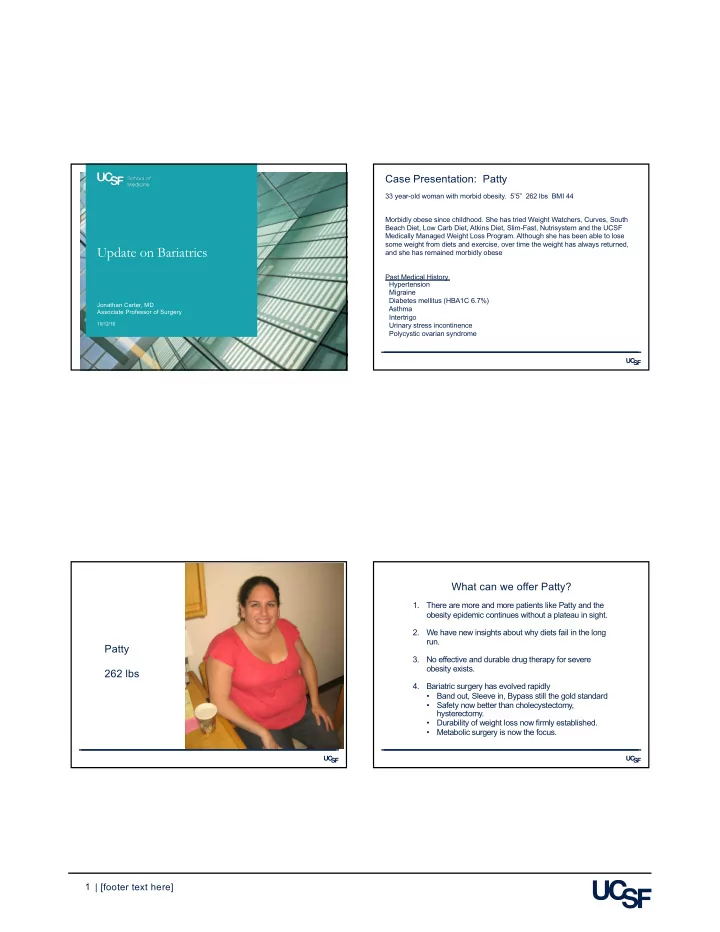
Case Presentation: Patty 33 year-old woman with morbid obesity. 55 262 lbs BMI 44 Morbidly obese since childhood. She has tried Weight Watchers, Curves, South Beach Diet, Low Carb Diet, Atkins Diet, Slim-Fast, Nutrisystem and the UCSF


slide-1
SLIDE 1

1 | [footer text here]

10/12/18

Jonathan Carter, MD Associate Professor of Surgery

Update on Bariatrics

33 year-old woman with morbid obesity. 5’5” 262 lbs BMI 44 Morbidly obese since childhood. She has tried Weight Watchers, Curves, South Beach Diet, Low Carb Diet, Atkins Diet, Slim-Fast, Nutrisystem and the UCSF Medically Managed Weight Loss Program. Although she has been able to lose some weight from diets and exercise, over time the weight has always returned, and she has remained morbidly obese Past Medical History Hypertension Migraine Diabetes mellitus (HBA1C 6.7%) Asthma Intertrigo Urinary stress incontinence Polycystic ovarian syndrome

Case Presentation: Patty Patty 262 lbs

1. There are more and more patients like Patty and the

  • besity epidemic continues without a plateau in sight.

2. We have new insights about why diets fail in the long run. 3. No effective and durable drug therapy for severe

  • besity exists.

4. Bariatric surgery has evolved rapidly

  • Band out, Sleeve in, Bypass still the gold standard
  • Safety now better than cholecystectomy,

hysterectomy.

  • Durability of weight loss now firmly established.
  • Metabolic surgery is now the focus.

What can we offer Patty?

slide-2
SLIDE 2

2 | [footer text here]

1. There are more and more patients like Patty and the

  • besity epidemic continues without a plateau in sight.

2. We have new insights about why diets fail in the long run. 3. Drug therapy has a modest effect on weight. 4. Bariatric surgery has evolved rapidly

  • Band out, Sleeve in, Bypass still the gold standard
  • Safety now better than cholecystectomy,

hysterectomy.

  • Durability of weight loss now firmly established.
  • Metabolic surgery is now the focus.

What can we offer Patty?

1990

https://stateofobesity.org/adult-obesity/

1995 2000

slide-3
SLIDE 3

3 | [footer text here]

2003 2004 2005 2006

slide-4
SLIDE 4

4 | [footer text here]

2007 2008 2009 2010

slide-5
SLIDE 5

5 | [footer text here]

2011 2012 2013 2014

slide-6
SLIDE 6

6 | [footer text here]

2015 2016

Why is obesity unhealthy?

Mechanick et al. SOARD 2008 CARDIOVASCULAR Hypertension Congestive Heart Failure Cor pulmonale Varicose veins Pulmonary embolism Coronary artery disease ENDOCRINE Metabolic syndrome Type 2 diabetes Dyslipidemia Polycystic ovary syndrome Amenorrhea, infertility, menstrual disorders MUSCULOSKELETAL Gout Osteoarthritis Lower back pain Carpal tunnel syndrome SKIN dermatoliposclerosis lymphedema cellulitis intertrigo hidradenitis suppurativa RESPIRATORY

  • bstructive sleep apnea

Pickwickian syndrome asthma GASTROINTESTINAL GERD Fatty liver disease / NASH Hernia Colon cancer GENITOURINARY Urinary stress incontinence Obesity-related glomerulonephropathy Hypogonadism Breast and uterine cancer Pregnancy complications NEUROLOGIC Stroke Idiopathic intracranial hypertension Meralgia paresthetica Dementia PSYCHOLOGIC Depression Low self-esteem Body image disturbance Social stigmatization

Obesity reduces life expectancy

Years of lost life expectancy in women

25 26 27 28 29 30 31 32 33 34 35 36 37 38 39 40 41 42 43 44 45

BODY MASS INDEX

10 8 6 4

slide-7
SLIDE 7

7 | [footer text here]

1. There are more and more patients like Patty and the

  • besity epidemic continues without a plateau in sight.

2. We have new insights about why diets fail in the long run. 3. Drug therapy has a modest effect on weight. 4. Bariatric surgery has evolved rapidly

  • Band out, Sleeve in, Bypass still the gold standard
  • Safety now better than cholecystectomy,

hysterectomy.

  • Durability of weight loss now firmly established.
  • Metabolic surgery is now the focus.

What can we offer Patty?

Randomly assigned 811 patients to 4 groups: low fat, low protein high fat, high protein low fat, high protein high fat, low protein Intensive group/individual instructional sessions Intensive follow-up to 2 years

slide-8
SLIDE 8

8 | [footer text here]

30 weeks: VLCD exercise 14 participants of “The Biggest Loser” competition Participants were studied

  • 1. prior to participation in the show
  • 2. at the end of the 30 week competition
  • 3. 6 years later

Indirect calorimetry to measure resting metabolic rate Fast for 12 hours Breathe into Outcome variables Methodology Measured resting metabolic rate (RMR)

  • Indirect calorimetry
  • Fast for 12 hours, then lay supine
  • Breath into metabolic cart for 15 min
  • Measure O2 intake and CO2 emission
  • Calculate Resting Metabolic Rate (RMR)

Body composition Predicted RMR

  • By dual-energy x-ray absorptiometry
  • Measures Fat Mass (FM) and Fat-Free Mass (FFM)

Total energy expenditure

  • Clearance of 18O H2O and 2H H2O over 2 weeks
  • CO2 generation calculated, used to calculate TEE
slide-9
SLIDE 9

9 | [footer text here]

Metabolic Adaptation

= RMR (measured) – RMR (predicted) = the difference between what you are actually burning versus what you should be burning based upon your body composition, age, and sex. Reflects the body’s ability to slow metabolic rate in order to preserve fat mass In lay terms, is the body’s “starvation mode”

What happened at 6 years?

Body weight change in kilograms Fat-free mass change in kilograms Fat mass change in kilograms

slide-10
SLIDE 10

10 | [footer text here]

What happened at 6 years?

The metabolic rate slowed by 500 kcal/day, 6 years after the diet!

Metabolic adaptation foils long-term attempts at dieting Obesity is not a disease of gluttons and sloths. The body acts to preserve the fat mass set point. Diet and exercise do not change the set point.

1. There are more and more patients like Patty and the

  • besity epidemic continues without a plateau in sight.

2. We have new insights about why diets fail in the long run. 3. Drug therapy has a modest effect on weight. 4. Bariatric surgery has evolved rapidly

  • Band out, Sleeve in, Bypass still the gold standard
  • Safety now better than chole or
  • The weight stays off for most – rigorous durability
  • Metabolic surgery more and more accepted

What can we offer Patty?

Phentermine

The Good... The Bad... The Ugly...

About 5% loss in total body weight beyond placebo FDA approved (schedule IV controlled) Side effects: dry mouth insomnia dizzyness hypertension tachycardia abuse potential About 50% drop out of therapy from side effects. Only indicated for SHORT TERM use Mechanism: stimulant similar to amphetamine Phen-Fen still fresh in everyone’s mind (induced severe pulmonary HTN and/or cardiac valve disease)

slide-11
SLIDE 11

11 | [footer text here]

Orlistat (Xenical)

The Good... The Bad... The Ugly...

Over one year, good for about 4-8 pounds over placebo FDA approved for LONG term use Reduces DM, HTN Side effects:

  • ily spotting

staining with flatus fecal urgency steatorrhea Decreases LDL cholesterol Requires daily vitamin ADEK dosing Mechanism: pancreatic lipase inhibitor in the GI tract 3x risk of acute kidney injury FDA label: risk of severe liver injury

Rimonabant

The Good... The Bad... The Ugly...

Mechanism: antagonist of cannibinoid receptor CB1 About 5% weight loss beyond placebo May also help with smoking cessation Side effects: nausea depression diarrhea NOT FDA approved Europe approved, then later withdrew because of suicides (2x risk of psychiatric disorder and 10% depression, 1% suicidal ideation

Qsymia

The Good... The Bad... The Ugly...

Mechanism: phentermine: stimulant topiramate: anticonvulsant About 10% weight loss beyond placebo FDA approved in 2012 Lowers BP. Benefit in sleep apnea. Side effects: dry mouth tingling fingers constipation BIRTH DEFECTS Initially declined by FDA over concerns about suicidal thoughts, palpitations, memory lapses, and cleft lip/palatte Requires monthly urine pregnancy tests!

Lorcaserin (Belviq)

The Good... The Bad... The Ugly...

Mechanism: selective serotonergic agonist 5HT2c About 4-8 pounds additional weight loss at 12 weeks beyond placebo FDA approved in 2012 – Schedule IV Not a lot of side effects! Side effects: hallucinations Initially declined by FDA over concerns about safety. FDA reversed decision in

  • 2012. DEA lists as Schedule IV

narcotic. Heart valve damage? Need to wait for post marketing studies....

slide-12
SLIDE 12

12 | [footer text here]

Bupropion/naltrexone

(Contrave)

The Good... The Bad... The Ugly...

Mechanism: Bupropion: norepinephrine reuptake inhibitor and nicotinic acetylcholine

  • agonist. Activated POMC neurons

in hypothalamus = satiety Naltrexone: opioid antagonist, potentiating effect on the POMC

About 12 pounds of weight loss on average. Less than half of patients achieved 5% weight loss at one year. Side effects cause ¼ to discontinue Some concern about long term cardiovascular effects Costs $100-250 per month!

Black box warning: may affect mood and increase risk of suicide

Patty 262 lbs

We performed an intervention……

Patty Day of intervention

slide-13
SLIDE 13

13 | [footer text here] 2 months after 208 lbs 4 months after 180 lbs 6 months after 161 lbs 8 months after 149 lbs

slide-14
SLIDE 14

14 | [footer text here] 10 months after 146 lbs 12 months after 143 lbs 18 months after 142 lbs 2 years after 138 lbs …first half-marathon!

slide-15
SLIDE 15

15 | [footer text here]

2 year check-up: Weight: 138 pounds BMI 21.6 Hypertension: resolved. Off all meds. Diabetes: complete resolution. HBA1C 5.6% PCOS: just stopped OCPs, trying to get pregnant Migraines: none in last year Asthma: resolved Stress incontinence: resolved

What was the intervention?

Gastric bypass

Cummings, NEJM 2002 GHRELIN

slide-16
SLIDE 16

16 | [footer text here]

The only durable way to change the set point is bariatric surgery

1. There are more and more patients like Patty and the

  • besity epidemic continues without a plateau in sight.

2. We have new insights about why diets fail in the long run. 3. Drug therapy has a modest effect on weight. 4. Bariatric surgery has evolved rapidly

  • Band out, Sleeve in, Bypass still the gold standard
  • Safety now better than cholecystectomy,

hysterectomy.

  • Durability of weight loss now firmly established.
  • Metabolic surgery is now the focus.

What can we offer Patty?

  • bese

controls bypass number of patients

Bariatric surgery has a durable effect on weight

JAMA Surgery, 2017 bypass band

slide-17
SLIDE 17

17 | [footer text here]

418 409 379 387 NEJM 2017

Surgical options to treat obesity.

Gastric Bypass Sleeve gastrectomy LapBand

NEJM 2007

Gastric Bypass Sleeve gastrectomy LapBand

Surgical options to treat obesity.

NEJM 2007

Safety: Early Complications

slide-18
SLIDE 18

18 | [footer text here]

JAMA 2018 Sleeve (n=101) Bypass (n=104) bypass sleeve

Safety: Late Complications

slide-19
SLIDE 19

19 | [footer text here]

Bypass Sleeve

leak (1-2%) treatment: reoperation or drainage procedure with feeding tube placement staple line leak (0.5-%) treatment: reoperation, stent placement, feeding tube placement, drain placement, or some combination thereof stricture of gastrojejunostomy (2-3%) treatment: dilation during endoscopy sleeve stricture (1-4%) treatment: reoperation, conversion to gastric bypass marginal ulceration (3-5%) treatment: antacids, surgery in rare cases gallstone disease (2% with prevention) prevention: ursodiol for 6 months treatment: remove gallbladder gallstone disease (2% with prevention) prevention: ursodiol for 6 months treatment: remove gallbladder gastroesophageal reflux (20-50%) treatment: acid blocking medications. (conversion to gastric bypass in extreme cases) internal hernias / obstruction (1-5%) treatment: surgery in most cases dumping syndrome (0-10%) treatment: limit simple sugars, high protein diet, complex carbs, high fiber, smaller more frequent meals dumping syndrome (0-10%) treatment: limit simple sugars, high protein diet, complex carbs, high fiber, smaller more frequent meals

LATE REOPERATION (5%) LATE REOPERATION (3% - 10%)

Nutritional Deficiencies after Gastric Bypass Surgery

Nutrient

Risk of deficiency Diagnosis Treatment

Protein

<5% Hypoalbuminemia Dietary diary <60g Prophy: dietary training >60g Rx: Protein shakes

Calcium / vitamin D

0.9% hypocalcemia 30% secondary HPTH Serum calcium Serum PTH Vitamin D level Prophy: Ca 500mg + vit D 200IU TID Rx: vit D 100,000 IU IM weekly until 25-OHD levels normalize

Essential fatty acids

Rare Dry scaly skin, hair loss Triene:tetraene ratio >0.2 Prophy: soy protein Rx: soy protein, safflower oil

Vits ADEK

Rare A - Night blindness E - Eczematous rash K - Coagulopathy D - Osteomalacia Rx: ADEK tablet daily vitamin A 4,000 IU vitamin D 400 IU vitamin E 150 IU vitamin K 0.15mg (also contains folate, thiamine, B vits)

Iron

Up to 50% of women without supplements Anemia Prophy: FeSO4 325mg daily + vit C Rx: mild: FeSO4 TID severe: Iron dextran IV

Vitamin B12

Up to 33% if only taking multivitamin Anemia Neuropathy Prophy: vit B12 500ug SL daily Rx: 1000uG IM monthly until normal

Folate

Rare if taking MVI Hyperhomocysteinemia Anemia Neural tube defects of preg Prophy: MVI Rx: folate acid supplementation

Thiamine (vit B1)

Rare, unless severe nausea and vomiting Wernicke-Korsakoff Peripheral neuropathy Beriberi <erythrocyte transketolase activity Prophy: MVI Rx: thiamine 100mg/day IV

courtesy of ASMBS

Metabolic benefits

  • f

bariatric surgery

courtesy of ASMBS

Metabolic benefits

  • f

bariatric surgery

slide-20
SLIDE 20

20 | [footer text here]

impaired fasting glucose diet controlled diabetics

  • ral agent

diabetics insulin dependent diabetics

HbA1C (%)

8.2% before bypass 5.5% after bypass

6.0 5.0 7.6 8.3 8.7 5.5 6.0 5.2

  • ral agent

diabetics insulin dependent diabetics

% using medication

All 13% All 64% 23% 21% 65% 27%

all diabetics

13% 6%

Bariatric surgery and comorbidity resolution

courtesy of ASMBS

RYGB dropped percentage of dyslipidemic patients from 95% to 28% Number taking medication dropped to 15%

  • 7%
  • 22%

40%

  • 27%

Total cholesterol LDL cholesterol HDL cholesterol Triglycerides Percent change from baseline preoperative value

Change in lipid profile 2 years after gastric bypass

slide-21
SLIDE 21

21 | [footer text here]

surgery

  • bese controls

Lancet July, 2009 Bariatric surgery reduces risk of: colon cancer endometrial cancer breast cancer prostate cancer

  • varian cancer

CANCER INCIDENCE

Prospective, controlled trial 2010 patients underwent bariatric surgery 2037 matched patients underwent conventional Rx Mean 11 years of follow-up 99% of patients were followed

Decrease mortality was from decrease in incidence of myocardial infarction and cancer