Up from the Rubble: Restoring Faith in Capitalism and Democracy - - PowerPoint PPT Presentation

up from the rubble restoring faith in capitalism and
SMART_READER_LITE
LIVE PREVIEW

Up from the Rubble: Restoring Faith in Capitalism and Democracy - - PowerPoint PPT Presentation

Up from the Rubble: Restoring Faith in Capitalism and Democracy after WWII An Online Professional Development Seminar Sheryl Kroen Associate Professor of History, University of Florida National Humanities Center Fellow We will begin promptly


slide-1
SLIDE 1

We will begin promptly on the hour. The silence you hear is normal. If you do not hear anything when the images change, e-mail Caryn Koplik ckoplik@nationalhumanitiescenter.org for assistance.
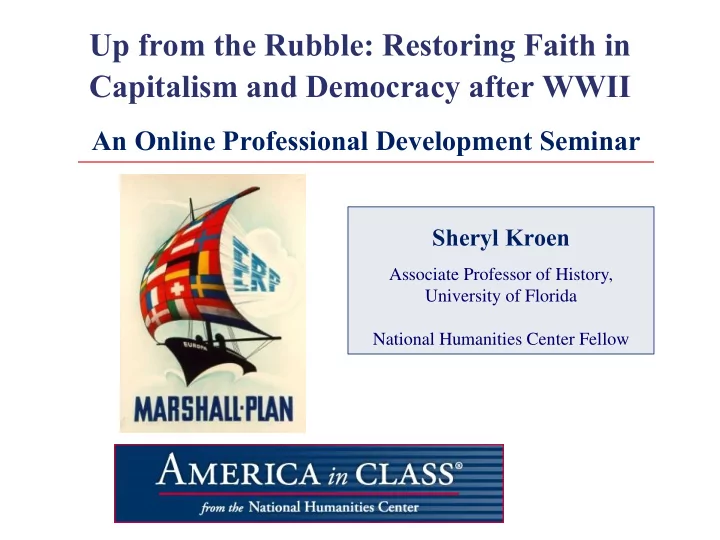
Up from the Rubble: Restoring Faith in Capitalism and Democracy after WWII

An Online Professional Development Seminar

Sheryl Kroen

Associate Professor of History, University of Florida National Humanities Center Fellow

slide-2
SLIDE 2

americainclass.org 2

Sheryl Kroen

Associate Professor of History, University of Florida National Humanities Center Fellow Politics and Theater: The Crisis of Legitimacy in Restoration France, 1815-1830 University of California Press, 2000 Her current project – The Recovery: the Reinvention of Europe and the West after WWII

slide-3
SLIDE 3

americainclass.org 3

Up from the Rubble: Restoring Faith in Capitalism and Democracy after WWII

From the Freedom Train to the Europe Train, via the Recovery Introduction: Planning the Freedom Train The Recovery in Europe: Germany (Berlin Fair, 1950) Europe, the Atlantic, the West (Europe Train) Conclusion: Lessons from the Rubble

slide-4
SLIDE 4

americainclass.org 4

Freedom Train: Planning

On May 22, 1947, leaders of some 66 industries, civic associations fraternities, religious organizations, youth movements, war veterans, racial units, and national councils met at the White House. There they organized the American Heritage Foundation.... The meeting was called by Attorney General Tom Clark and was sponsored by the Department of Justice. One of the chief objectives was ... the inauguration of the Freedom Train. The Freedom Train was designed to bring to the people the knowledge, understanding and appreciation of our system of government.

From RG200 198 AHF NAR: National Archives in College Park, Maryland

slide-5
SLIDE 5

americainclass.org 5

The Freedom Train: Re-dedicating Americans

This is a proposal for an educational campaign on a national and local level which dramatizes the American way of life through the traveling exhibition

  • f an impressive collection of original, American historic documents and

the contrasting documents of Nazi totalitarianism. It is proposed that this exhibition tour the nation in a special train of railroad cars reconstructed and designed for this purpose, making scheduled stops in all of the 48 states.

slide-6
SLIDE 6

americainclass.org 6

The Freedom Train: The Campaign

A mere springboard to the national and local educational campaign…” in any given community a thousand people view the exhibition, then hundreds of thousands will be reached with the message through newspapers, publications, radio, motion pictures, and all other media for dissemination information. In addition it is /p2 proposed to activate all kinds of fraternal, civic and veterans’ organizations as participants in this program. In other words, the success of the campaign in any given community will not be measured by the number of individuals who visit the train. It will be determined by the intensity of the coverage of the media suggested above and the activity of the organizations.

slide-7
SLIDE 7

americainclass.org 7

Edward L. Bernays The “Father of modern public relations” Books: Speak up for Democracy: What you Can Do—a Practical Plan of Action for Every American Citizen (1941) Public Relations (1952) Crystallizing Public Opinion (1961) Your Future in Public Relations (1961)

The Freedom Train: The Campaign

slide-8
SLIDE 8

americainclass.org 8

The Freedom Train: Defining the Problem

This book in not intended to sell Democracy to you. We can assume that you, its readers believe in it already, that you are reading this in order to learn how to make your beliefs a positive force how to persuade others, how to marshal public opinion-- how to speak up for Democracy effectively. The men and women of the country can be made to understand what Democracy means to them, what Washington and Lincoln stood for, what the Declaration of Independence and the Constitution do for them, the part that civil rights play in their

  • lives. They must also know what totalitarianism does to the people. [FASCISM THE

GREAT THREAT] Who shall lead this campaign? leaders of society + opinion molders How shall they do it? Chapter 7, Speak up for Democracy, “Planned Events, the Backbone of your Campaign”.

Edward Bernays, Speak up for Democracy, 1941

slide-9
SLIDE 9

americainclass.org 9

The Freedom Train: Defining the Cure

“Natural Leaders” to be activated Media coverage

slide-10
SLIDE 10

americainclass.org 10

The Freedom Train Press Kit

This is a plan to help raise the level of active citizenship in our country. To accomplish this purpose, it seeks:

  • 1. To develop a greater awareness of the

advantages we enjoy as Americans, emphasizing the relationship of our hard-won personal freedoms to our development as the strongest nation of free people in history.

  • 2. To persuade all Americans that only by

active personal participation in the affairs of the community, state and nation can we safeguard and preserve

  • ur liberties and continue to demonstrate

to ourselves and to the world that the way of free men is best.

slide-11
SLIDE 11

americainclass.org 11

From the Freedom Train to The Recovery

Fact: Theodore Repplier first worked as an advertising copy writer. “By contrast, for the past 10 years of my life have produced nothing for the magazine except ... headaches. [Everyone in publishing] dread the sight of me, for they know I will be asking for some more free space for the Red Cross, the Community Chest, or US Savings Bonds.….”

Theodore Repplier, “America’s Leadership Role and Magazines’ Responsibility”, 1951

slide-12
SLIDE 12

americainclass.org 12

From the Freedom Train to The Recovery

What is American capitalism?’ In my opinion, if Italy, France, or any of Western Europe slide back into the arms of Moscow—and don’t think that they are solidly anchored in

  • ur camp—the chief cause will be our failure to communicate the answer to this question.

Now why in the name of heaven haven’t we long since convinced the European that the choice isn’t just between communism and Old World Capitalism—that there is a third society—call it incentivism—which can really deliver the things that communism falsely promises? … We have failed to export this knowledge because it is not yet mass knowledge here… This is what we have been trying to do on the Advertising Council. For 2 years we have been carrying on a campaign on the American Economic System, with productivity as our main theme. A couple of million people have written in for a booklet called “The Miracle of America.” It is what we have been trying to do in cooperation with the American Heritage Foundation, first with the Freedom Train… and soon with the 175th anniversary of the Declaration of Independence.. We attacked the problem at a roundtable last month with Paul Hoffman.

Theodore Repplier, “America’s Leadership Role and Magazines’ Responsibility”, 1951

slide-13
SLIDE 13

americainclass.org 13

The Freedom Train: Defining the Solution

So I shall close by suggesting that you become the social and political philosophers of the 1950s; that you help search out and define the American proposition—Fortune has already made a good start—that you explain it to Americans until their pride in what they have created becomes a quiet fervor. If you do this, we shall launch a new wave of hope throughout the entire free world.

Theodore Repplier, to the Advertising Council, 1951

slide-14
SLIDE 14

americainclass.org 14

The Recovery: Marshall’s Speech

Our policy is directed not against any country

  • r doctrine but against hunger, poverty,

desperation, and chaos. Its purpose should be the revival of a working economy in the world so as to permit the emergence of political and social conditions in which free institutions can exist. Such assistance, I am convinced, must not be on a piecemeal basis as various crises develop. Any assistance that this Government may render in the future should provide a cure rather than a mere palliative.

Commencement Address, Harvard University, 1947

George C. Marshall, Secretary of State

slide-15
SLIDE 15

americainclass.org 15

The Recovery: Marshall’s Speech

Defining the Situation: [1] I need not tell you that the world situation is very serious. That must be apparent to all intelligent people. I think one difficulty is that the problem is one

  • f such enormous complexity that the very mass of facts presented to the public

by press and radio make it exceedingly difficult for the man in the street to reach a clear appraisement of the situation. Furthermore, the people of this country are distant from the troubled areas of the earth and it is hard for them to comprehend the plight and consequent reactions of the long-suffering peoples, and the effect of those reactions on their governments in connection with our efforts to promote peace in the world.

slide-16
SLIDE 16

americainclass.org 16

The Recovery: Marshall’s Speech

Reading the Rubble: [2] In considering the requirements for the rehabilitation of Europe, the physical loss of life, the visible destruction of cities, factories, mines, and railroads was correctly estimated, but it has become obvious during recent months that this visible destruction was probably less serious than the dislocation of the entire fabric of European economy. For the past ten years conditions have been highly abnormal. The feverish preparation for war and the more feverish maintenance of the war effort engulfed all aspects of national

  • economies. Machinery has fallen into disrepair or is entirely obsolete. Under the arbitrary

and destructive Nazi rule, virtually every possible enterprise was geared into the German war machine. Longstanding commercial ties, private institutions, banks, insurance companies, and shipping companies disappeared, through loss of capital, absorption through nationalization, or by simple destruction. In many countries, confidence in the local currency has been severely shaken. The breakdown of the business structure of Europe during the war was complete. Recovery has been seriously retarded by the fact that two years after the close of hostilities a peace settlement with Germany and Austria has not been agreed upon. But even given a more prompt solution of these difficult problems, the rehabilitation of the economic structure of Europe quite evidently will require a much longer time and greater effort than had been foreseen.

slide-17
SLIDE 17

americainclass.org 17

The Recovery: Marshall’s Speech

Defining the Deepest Problem: [3] There is a phase of this matter which is both interesting and serious. The farmer has always produced the foodstuffs to exchange with the city dweller for the other necessities

  • f life. This division of labor is the basis of modern civilization. At the present time it

is threatened with breakdown. The town and city industries are not producing adequate goods to exchange with the food-producing farmer. Raw materials and fuel are in short

  • supply. Machinery is lacking or worn out. The farmer or the peasant cannot find the

goods for sale which he desires to purchase. So the sale of his farm produce for money which he cannot use seems to him an unprofitable transaction. He, therefore, has withdrawn many fields from crop cultivation and is using them for grazing. He feeds more grain to stock and finds for himself and his family an ample supply of food, however short he may be on clothing and the other ordinary gadgets of civilization. Meanwhile people in the cities are short of food and fuel [and in some places approaching the starvation level—oral addition]. So the governments are forced to use their foreign money and credits to procure these necessities abroad. This process exhausts funds which are urgently needed for reconstruction. Thus a very serious situation is rapidly developing which bodes no good for the world. The modern system of the division of labor upon which the exchange of products is based is in danger of breaking down.

slide-18
SLIDE 18

americainclass.org 18

The Recovery

John Locke Two Treatises on Government, 1690 Adam Smith Wealth of Nations, 1776

slide-19
SLIDE 19

americainclass.org 19

Consequences of the Marshall Speech

1) Economic Recovery Act passed (April 1948), Economic Recovery Program (dubbed "The Marshall Plan") put into effect (via bilateral treaties with 18 participating Western European nations) 2) The OEEC (Organization for European Economic Cooperation) is established 3) 5% of every dollar spent on a campaign and The Recovery is underway.... All over Western Europe

slide-20
SLIDE 20

americainclass.org 20

The Recovery: Ground Zero, Berlin

“The Air of Freedom” The ERP message, broadcast from Berlin, for all the world to see: 1950 The Recovery is underway!!!! “Getting ready for the fair”: the ERP campaign all over W. Germany before 1950 Tradition of the World Fair from the Crystal Palace of 1851, via Paris 1889, 1900, 1938 HOW CAN BERLIN BE A WINDOW ON THE WEST in 1950??

slide-21
SLIDE 21

americainclass.org 21

The Recovery: Ground Zero, Berlin

Where is Germany at the Fair?

  • 1 of 18 flags flying overhead
  • 1 of 18 figures sprouting out of the map
  • NO PAVILION OF ITS OWN
  • Deep inside the red, white, and blue-stamped Marshall House
  • Parts V and VI: Germany exists, once the recovery is

underway!

slide-22
SLIDE 22

americainclass.org 22

The Recovery: Ground Zero, Berlin

Germany’s Pavilion: The Marshall House

slide-23
SLIDE 23

americainclass.org 23

The Recovery: Ground Zero, Berlin

Why is Germany Ground Zero for the Recovery?

  • II. Europe, 1945-1947

Vernichtung (Destruction, annihilation, extermination) spread across Europe Image illustrating “Ghostly hints of war” Image: Herr X, in uniform marching. (this man appears later in exhibit) … and left its traces Image and explanations showing Europe in the rubble: crippled transportation networks, dwellings, factories in ruins, black market, need, exhausted men, children in misery. Herr K in front of the rubble that was once his home.

slide-24
SLIDE 24

americainclass.org 24

The Recovery: Ground Zero, Berlin

America Helps! 12,5 billion dollars of goods through 1948 IMAGE: Herr X receives a CARE package

This is a Palliative, not a cure!

Exports are lacking (more numbers) Dollars are lacking (Herr X looking for loose change) Shortages, hunger, unemployment Herr X in front of unemployment bureau

slide-25
SLIDE 25

americainclass.org 25

The Recovery: Ground Zero, Berlin

Question: Will Herr X March Again? Answer: NO!!

slide-26
SLIDE 26

americainclass.org 26

The Recovery: Ground Zero, Berlin

Question: Why not? Answer: Mr. Marshall had an idea Europeans agreed, goods began to arrive OEEC organized and The recovery is underway!!!!!!!

slide-27
SLIDE 27

americainclass.org 27

The Recovery: Ground Zero, Berlin

The Recovery as an Event

  • Marshall, and his speech (founding moment)
  • European leaders, photos of key meetings
  • Chronology of Events: “calendar” of Recovery
  • LAW of 3 April 1948 (in the foundation of the building!!!!):

“rites” of the Recovery

slide-28
SLIDE 28

americainclass.org 28

The Recovery: Ground Zero, Berlin

ERP Deliveries Arrive

slide-29
SLIDE 29

americainclass.org 29

The Recovery: Ground Zero, Berlin

Before…. ..and After

slide-30
SLIDE 30

Rites of the Recovery

slide-31
SLIDE 31

americainclass.org 31

The Recovery: Ground Zero, Berlin

Germany and Berlin in the Recovery Section V: The numbers, the facts Before/After Section VI: BERLIN ON DISPLAY AT THE FAIR Herr X: in a new suit, enjoying the fair!

slide-32
SLIDE 32

americainclass.org 32

The Recovery: Ground Zero, Berlin

The Story of Herr X

  • My historical problem: how do they imagine the average

German?

  • Documentary problems in the archives
  • How I went about this: looking for Herr X’s story,

wherever I could In “Air of Freedom” In “Gateway to Germany”

slide-33
SLIDE 33

americainclass.org 33

The Recovery: Ground Zero, Berlin

The Air of Freedom What is Herr X doing? (He’s not marching!)

  • He IS “stampeding” the prefabricated model

house

  • He IS voluntarily enjoying a labor rally
  • He IS sending balloons to his neighbors in the

East

  • He IS working, working, working: getting ready

for the fair, making products for which Germany is famous on 5 continents.

Discussion Question

  • What did you see and hear in “Air of Freedom”
slide-34
SLIDE 34

americainclass.org 34

The Recovery: Ground Zero, Berlin

Gateway to Germany

  • Why is the rubble a hopeful thing?
  • Herr X before the rubble that was his home
  • Robinson Crusoe?
  • Lockean/Smithean liberal everyman?
slide-35
SLIDE 35

americainclass.org 35

The Recovery: Ground Zero, Berlin

The division of labor is the basis of modern civilization. At the present time it is threatened with breakdown. Marshall speech, 1947 For a time it seemed as though this country’s will to live had been broken, her culture and historical countenance blotted out…. But despite all this, the German people did not give up. One of their strongest traits, an almost fanatic reverence for toil, is probably what saved them. They had lost everything— except the property rights to the rubble which had once comprised their homes and shops. Gateway to Germany Brochure

slide-36
SLIDE 36

americainclass.org 36

The Recovery: Ground Zero, Berlin

He who comes to Germany today will see a nation whose people seem only to live for the sake of working. Everywhere he goes he will find resurrected cities which, only six years ago, were a monotonous pattern of soot and charred rafters.

Gateway to Germany, page 10

In every part of Western Germany the traveler will find a building program running day and night in high gear-a program which can only be compared in magnitude with the foregoing destruction.

Gateway to Germany, page 11

slide-37
SLIDE 37

americainclass.org 37

The Recovery: Ground Zero, Berlin

West: not marching, relying upon its rich “heritage of civilization” East: marching, “The Soviet Union has set up a communist regime in the area it

  • ccupies, liquidating entirely the previous

social order. Property owners have been relieved of their deeds, and with the already property-less, subjected to a totalitarian machine.”

Gateway to Germany, page 17

slide-38
SLIDE 38

americainclass.org 38

The Recovery: Ground Zero, Berlin

The 146 Articles of the constitution… correspond structurally to those of the constitutions of other freedom-loving nations. An exception is Article Nr. 24, which provides for the eventual surrender of the Republic’s sovereignty to an international union… a European family of nations, of which Germany would be an integral part.

Gateway to Germany, page 19

slide-39
SLIDE 39

americainclass.org 39

The Recovery: Ground Zero, Berlin

Germany and its Exports: Rites of the Recovery

  • Germans work
  • Produce goods for which Germany is rightly famous the world over
  • Germany and Germans = its exports
  • How to “rebrand” Berlin? And therefore Germany? A real question

for Roy Bernard, Inc.

slide-40
SLIDE 40

americainclass.org 40

The Recovery: Ground Zero, Berlin

Rebranding Berlin, 1951

slide-41
SLIDE 41

americainclass.org 41

The Europe Train: Laying the Tracks

Europe Train, Laying the Tracks, 1951 Paris

slide-42
SLIDE 42

americainclass.org 42

The Europe Train: ERP Victory Lap!

The Europe Train, 1951

slide-43
SLIDE 43

americainclass.org 43

The Europe Train: “Media Event”

The Europe Train, Paris, 1951

slide-44
SLIDE 44

americainclass.org 44

The Europe Train: ERP Victory Lap

Reading the Exhibit: Europe, Europe, Europe (3 cars)

  • 3 years of cooperation, 3 years of progress
  • Echoes of Marshall House exhibit: narrative of events, way of seeing

the rubble, before/after

  • OEEC: Solid structures, a permanent Europe
  • Heavy handed states, with “experts” planning, planning, planning
  • A new social contract?
slide-45
SLIDE 45

americainclass.org 45

The Europe Train: Europe

slide-46
SLIDE 46

americainclass.org 46

The Europe Train: local adaptations

slide-47
SLIDE 47

americainclass.org 47

The Europe Train: Europe

slide-48
SLIDE 48

americainclass.org 48

The Europe Train: The Atlantic

slide-49
SLIDE 49

americainclass.org 49

The Atlantic: Car 4 Large animated map of North Atlantic region with OEEC countries + USA and Canada The CIRCULATION behind it all “Two continents linked in economy” A flashing light beam indicates two-way movement on shipping and aircraft lines, cable and radio connections. In the center is a projector screen on which appear pictures and texts devoted to principal items of trade, as well as statistics on vital commodities produced by the 20 countries.

The Europe Train: Two Continents, One Civilization

slide-50
SLIDE 50

americainclass.org 50

Lessons from the Rubble

slide-51
SLIDE 51

americainclass.org 51

Lessons from the Rubble

The Europa Zug, Made in Germany first stop: Munich April 21, 1951

slide-52
SLIDE 52

americainclass.org 52

Lessons from the Rubble: Conclusion

  • Up from the rubble: Restoring Faith in Capitalism and

Democracy after WWII

  • The Recovery: a Foundational Moment
  • A Liberal Foundational Moment (1789, 1688, 1776)
  • Not an economic miracle, an ideological miracle
  • Enacted In Europe, Ground Zero, Berlin
  • The Civilizing Potential of Doux Commerce (gentle

commerce)

  • The “Social and Political philosophers” of the 1950s!
slide-53
SLIDE 53

americainclass.org 53

Ideas for Teaching

  • “On Our Way,” speech at opening, 1949
  • On Our Way storyboard for traveling exhibit.
  • On Our Way "press book" sent out for advance preparations as the

exhibit traveled around the UK.

  • Robinson Charley script, a film shown at On Our Way.
  • “Robinson Charley: The Ideological Underpinnings of Atlantic

History,” Chapter 3 in Biography and the Black Atlantic, 2013

slide-54
SLIDE 54

americainclass.org 54

Ideas for Teaching

Spectacles of Power

  • Great Exhibitions: 1851, 1889. 1900 (Rogers, Atlantic Crossings)
  • Chicago, 1893; NY 1964
  • Chicago Fair of 1950: ERP nations required to attend; press reports
  • n, pamphlets produced by each nation
  • Epcot?
slide-55
SLIDE 55

americainclass.org 55

Final slide Thank you