Unsung Heroes An Introduction to the often-ignored world of by - - PowerPoint PPT Presentation

unsung heroes
SMART_READER_LITE
LIVE PREVIEW

Unsung Heroes An Introduction to the often-ignored world of by - - PowerPoint PPT Presentation

Unsung Heroes An Introduction to the often-ignored world of by Amber Masso Program Director American Childhood Cancer Organization What is Childhood Cancer? What? Childhood Cancer is the leading cause of death in children under 18 and is


slide-1
SLIDE 1

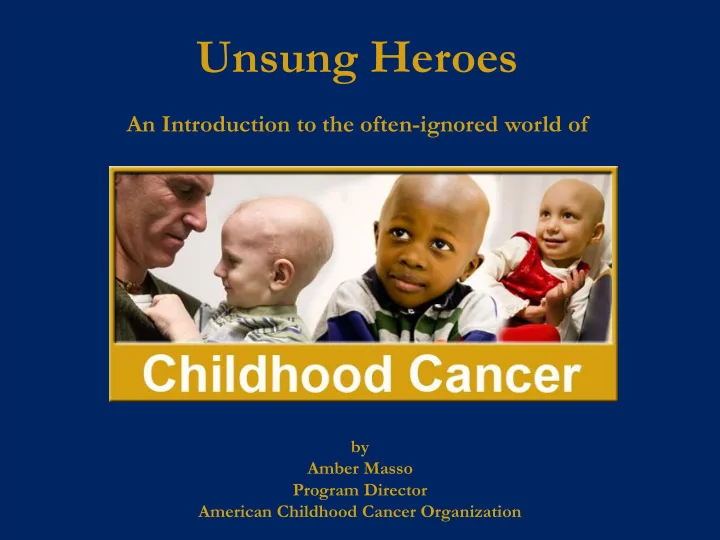
by Amber Masso Program Director American Childhood Cancer Organization

Unsung Heroes

An Introduction to the often-ignored world of
slide-2
SLIDE 2

What?

What is Childhood Cancer?

  • Childhood Cancer is the leading cause of death in

children under 18 and is actually a collection of diseases.

  • Children are diagnosed with many different forms
  • f cancer. There are 12 major types of cancer that

can affect the bones, muscle, blood, liver, kidney, brain, or even the eyes.

  • Common adult cancers

(lung, breast, colon, etc.) rarely occur in children

  • r adolescents.
slide-3
SLIDE 3

What?

What is Childhood Cancer?

  • Among the 12 major types, Leukemias (cancer in the

blood) and brain tumors account for more than half

  • f all cases.
  • The median age at diagnosis is six years old.
  • Some forms of pediatric cancer have a 5 year

survival rate of more than 90%, while others have a 5 year survival rate of less than 2%.

slide-4
SLIDE 4

What?

What is Childhood Cancer?

  • Every day in America, 46 children are diagnosed

with cancer.

  • Each year in the U.S. approx. 12,400 children

between the ages of birth and 19 years of age are diagnosed with cancer.

  • There is no known cause of

childhood cancer, and it occurs regularly and randomly across all ethnic groups. Some children are even born with cancer.

slide-5
SLIDE 5

What?

Effects of Childhood Cancer

  • Many adult cancer patients endure no more than a

year of treatment.

  • On the other hand, the average length of

treatment for children, from initial diagnosis to cure

  • r remission, is three years.
  • If the child experiences

a relapse, the treatment time could possibly be extended over many years with a potentially lowered prognosis.

slide-6
SLIDE 6

What?

The Need for Progress

  • Childhood cancers tend to be more aggressive than

adult cancers, so this late diagnosis can significantly affect the 5-year survival probability of the child.

  • In 80% of cases, a child‟s cancer diagnosis is delayed

until the disease is very advanced and has spread to

  • ther parts of the body. As a stark comparison, this
  • nly occurs in 20% of adult cancer cases.
slide-7
SLIDE 7

What?

The Need for Progress

  • Today‟s pediatric cancer patients are still being

treated with drugs that were developed in the 1950‟s, 1960‟s and 1970‟s.

  • Why? Because childhood

cancer is rare, often called an „orphan disease.‟ Therefore, drug development for this group of patients is not considered „cost effective.‟

slide-8
SLIDE 8

What?

The Need for Progress

  • Some forms of pediatric cancer have seen an

increase in survival over the past few decades but

  • ne in four children will still die.
  • If formerly incurable

types of cancer are being treated successfully with “old drugs,” imagine what progress could be made with new drugs!

slide-9
SLIDE 9

What?

The Need for Progress

  • In the past 20 years, the FDA has only approved

ONE new drug exclusively for pediatric patients.

  • In the past 20 years, the prevalence of pediatric

cancer has risen by 29%.

slide-10
SLIDE 10

What?

The Battle After Treatment

  • Out of every 4 children diagnosed, one will not

survive past 5 years and three will have life-long complications due to aggressive treatments for their

  • cancer. When treatment stops, an entirely different

battle begins…

slide-11
SLIDE 11

What?

The Battle After Treatment

  • Because children‟s bodies are still developing, toxic

therapies damage more than just the cancer cells. Young cancer survivors live the remainder of their lives with the side-effects of their initial treatments. A few of these side effects are:

  • Delayed/ Disrupted cognitive development
  • Stunted Growth
  • Damaged speech and/or hearing
  • Infertility and Endocrine Dysfunction
  • Learning Disabilities
  • Physical Handicaps due to nerve damage or

amputation

slide-12
SLIDE 12

What?

The Battle After Treatment

  • As many as 2/3rds of survivors have at least one

chronic health effect.

  • 25% of survivors have severe or life-threatening

effects.

  • 10% will develop a secondary cancer.
  • Follow-up care is CRUCIAL. However, only 20% of

children receive follow-up care. This is in stark contrast to the 90% adults who receive follow-up care.

slide-13
SLIDE 13

What?

Effects of Childhood Cancer

  • Chemo and radiation make children feel sick and
  • weak. They also make hair fall out. This can be very

scary and makes children with cancer feel different from their peers. Often, these children are also coping with major trust issues, since the world no longer feels safe.

They often feel that their parents and other adults can no longer protect them, since each new adult is usually associated with a painful procedure.

slide-14
SLIDE 14

What?

Effects of Childhood Cancer

  • Because cancer usually strikes children at a young

age, their families are often very young as well. There may also be other small children at home to look after.

  • Sometimes, one or both parents must stop working

in order to care for the sick child.

The child’s entire family is affected.

slide-15
SLIDE 15

What?

Effects of Childhood Cancer

  • Siblings are often put to the wayside. Some may be

constantly shuttled around and may have problems maintaining a normal schedule. They are worried, resentful, and feel abandoned.

  • These children may develop behavioral problems,

anxiety, or depression.

  • They may also begin to

have trouble in school.

  • Counseling specifically for

siblings is often necessary.

slide-16
SLIDE 16

What?

Effects of Childhood Cancer

  • Children with cancer can best be helped by doctors

who have specialized in treating pediatric cancer patients.

  • These specialized treatment centers are spread

across the country, so families must travel to get the best treatment for their children.

  • This puts a financial,

emotional, and social strain

  • n the parents.
slide-17
SLIDE 17

What?

Effects of Childhood Cancer

  • Parents can spend over 40 hours per week caring for

their sick child.

  • Studies have even shown that mothers of a child with

cancer may exhibit symptoms similar to those of Post Traumatic Stress Disorder.

  • The effects on parents are almost always long term. If

the child dies, parents deal with difficult and long-lasting

  • grief. If the child lives, parents may still have to care for

a child who has mild, moderate or severe physical or emotional late effects. They may spend the rest of their lives helping their child deal with those issues.

slide-18
SLIDE 18

What Can You Do?

  • Help scientists search for a cure by donating or

fundraising to support childhood cancer research.

  • Contact your state representatives and insist that

childhood cancers be added to your state‟s cancer plan legislation.

  • Volunteer for a childhood

cancer organization.

  • Start a support group or
  • utreach organization.
slide-19
SLIDE 19

What?

You can also help your community become more cancer- aware and more supportive of local families and children who are fighting this devastating disease.

slide-20
SLIDE 20

Please visit www.acco.org To find out how you can help us continue to provide free materials and services to children and families.

slide-21
SLIDE 21

Thank you for viewing this slideshow.

We hope you are motivated to help this most-worthy cause.

… because kids can’t fight cancer alone!

slide-22
SLIDE 22

References

  • 1. Peter C. Adamson, Hellen Gelband, Joseph V. Simone, and Susan L. Weiner, Editors.

“Making Better Drugs for Children with Cancer.” Accessed 3/1/2011. http://www.nap.edu/catalog/11259.html .

  • 2. Maria Hewitt, Joseph V. Simone, and Susan L. Weiner, Editors. Childhood Cancer

Survivorship: Improving Care and Quality of Life. Washington, D.C.: The National Academies Press, 2003.

  • 3. Wendy Landier, Editor. “Long Term Follow-Up Resource Guide.” Accessed 3/1/2011.

www.survivorshipguidelines.org.

  • 4. Angela B. Mariotto, Eric J. Feuer, Mark Hachey, Lynn Ries, Julia H. Rowland, Steve Scoppa,

and K. Robin Yabroff. “Long-Term Survivors of Childhood Cancers in the United States.” Accessed 3/1/2011. http://www.keepandshare.com/doc/2125542/long- term-survivors-of-childhood-cancers-in-the-united-states-pdf-august-3-2010-6-55-am- 176?da=y.

  • 5. American Childhood Cancer Organization. “Childhood Cancer Statistics.” Accessed

3/1/2011. http://www.acco.org/Information/AboutChildhoodCancer/ChildhoodCancerStatistics.aspx.

  • 6. American Childhood Cancer Organization. “Education Issues.” Accessed 3/1/2011.

http://www.acco.org/Information/TreatmentandSurvivorship/EducationalIssues.aspx