
SLIDE 1
Nov 2019
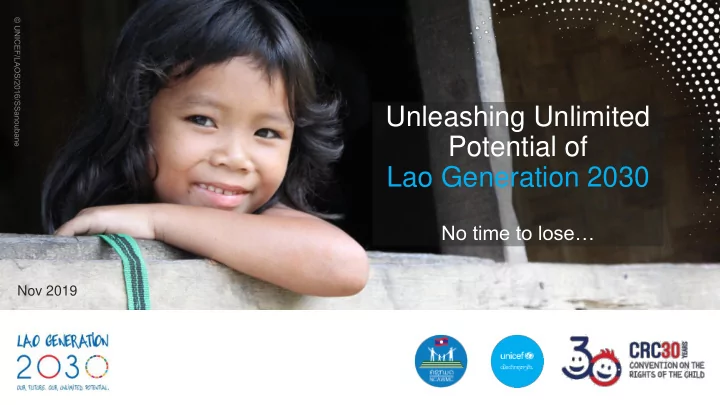
Unleashing Unlimited Potential of Lao Generation 2030 No time to - - PowerPoint PPT Presentation
Unleashing Unlimited Potential of Lao Generation 2030 No time to lose Nov 2019 20 November 2019 will mark the 30th anniversary of the adoption of the Convention on the Rights of the Child (CRC30), one of the worlds most -ratified
Nov 2019
This is sample text. This space is provided to introduce your new chapter / section / topic. Try and not exceed beyond 2-3 sentences.
special event on the CRC during the UN General Assembly week in New York and pledged to uphold their commitment to realizing child rights.
Assembly on World Children’s Day (WCD).
focusing on education at the General Assembly. This is a great opportunity to raise Lao children’s voices at global level.
improve the situation of children in their respective countries.
This is sample text. This space is provided to introduce your new chapter / section / topic. Try and not exceed beyond 2-3 sentences.
Source: IMF, 2019
Source: World Bank Human Capital Index 2018. Notes: Selected economies only.
Brain circuits stabilize with age, making them increasingly more difficult to alter Good nutrition and rich experiences affect brain development Brain architecture is built in a “bottom up” sequence: higher capacities are more difficult to develop if lower capacities have not emerged appropriately
Protective factors Good nutrition Responsive & nurturing parenting Safe and stimulating environmeant Health care (prenatal, maternity, new born, infant) Adequate family income Biological risks
Chronic under-nutrition Iron and iodine deficiency IUGR HIV infection
Psycho-social risks
Poor caregiver-child interaction Maternal depression Institutional rearing Exposure to violence Poor learning environment
Source: The Lancet, 2016
below the age of 25, and approximately 40% is below the age of 18.
and empowerment, young people can make the most of their talents and potential and contribute to the peace and prosperity of their communities.
to complete primary and secondary.
the needs of most disadvantaged
Secondary-age education
to opportunities to develop skills.
education to work – internships
Skills for learning, employability and decent work
rights and make life choices.
engagement and to voice
Empowerment, with a focus on girls
3 strategies to maximize impact
Distribution of Multidimensional Deprivation for Children 0-17 Years Old and Distribution by Area of Residence
88.3 70.6 50.4 30.6 15.5 6.1 1.4 97.5 89.9 74.8 50.2 27.9 12.1 2.9 92.4 76.6 56.2 34.8 17.8 6.9 1.6 74.4 47.5 25.4 11.4 4.4 1.4 0.3 10 20 30 40 50 60 70 80 90 100
Headcount Deprivation Rate (H) (%)
National Rural without road Rural with road Urban
By 2024 Lao PDR has the ambition to graduate to the status of middle-income country.
the life-cycle:
school age and adolescence will improve the lives of children and adolescents NOW.
the FUTURE, benefiting the Lao PDR through enormous dividends to future growth.
contribute to its successful advancement toward a Higher-Middle Income Country.
(i) Strengthening national systems to provide quality services for reproductive, maternal, newborn, child and adolescent health, nutrition specific and sensitive interventions, quality education and life skills, clean water, hygiene and safe environment, and protection from abuse, violence, and exploitation, with focus on most vulnerable and hard to reach. Paying special attention to strengthening the child protection system to protect children, and to create developmental
(ii) Demand Generation and Changing Behaviors and Practices, for example through improving parenting for young children to provide best start in life; and ending child marriage. (iii) Strengthening Policies and Expanding Partnerships, including translating the policy objectives for Lao Generation 2030 into the 9th NSEDP.
Forum Joint Statement.
Lao Gen2030)
solutions, C4D/BCC interventions and provincial investment plans).
line).