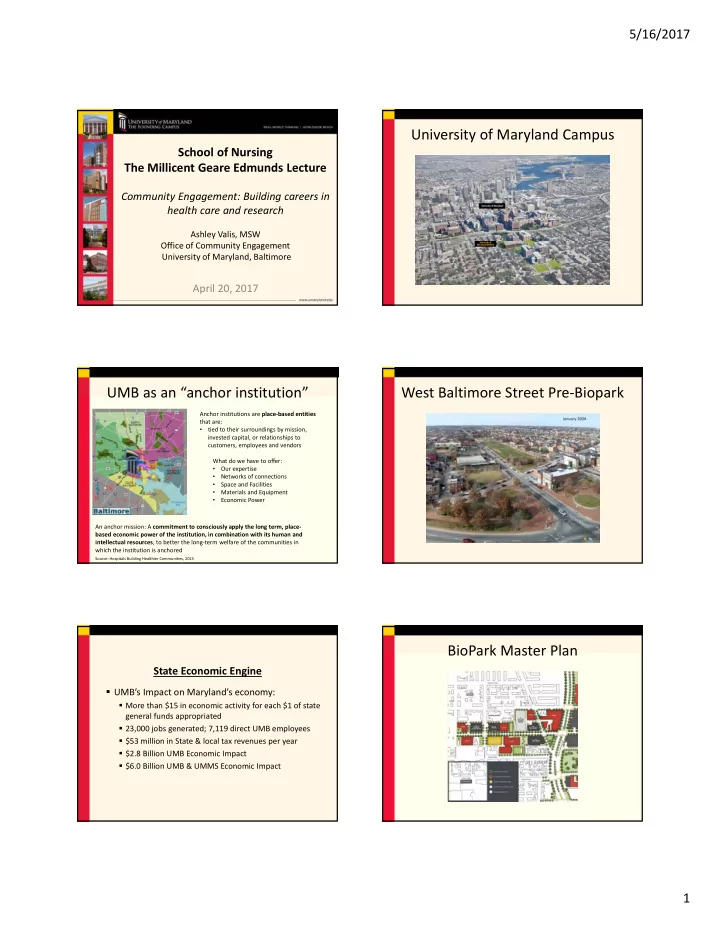
University of Maryland Campus School of Nursing The Millicent Geare - - PDF document

university of maryland campus
SMART_READER_LITE
LIVE PREVIEW

University of Maryland Campus School of Nursing The Millicent Geare - - PDF document

5/16/2017 University of Maryland Campus School of Nursing The Millicent Geare Edmunds Lecture Community Engagement: Building careers in health care and research Ashley Valis, MSW Office of Community Engagement University of Maryland, Baltimore April


slide-1
SLIDE 1

5/16/2017 1

School of Nursing The Millicent Geare Edmunds Lecture

Community Engagement: Building careers in health care and research

Ashley Valis, MSW Office of Community Engagement University of Maryland, Baltimore

April 20, 2017

UMB as an “anchor institution”

Anchor institutions are place‐based entities that are:

  • tied to their surroundings by mission,

invested capital, or relationships to customers, employees and vendors What do we have to offer:

  • Our expertise
  • Networks of connections
  • Space and Facilities
  • Materials and Equipment
  • Economic Power

An anchor mission: A commitment to consciously apply the long term, place‐ based economic power of the institution, in combination with its human and intellectual resources, to better the long‐term welfare of the communities in which the institution is anchored

Source: Hospitals Building Healthier Communities, 2013

State Economic Engine

  • UMB’s Impact on Maryland’s economy:
  • More than $15 in economic activity for each $1 of state

general funds appropriated

  • 23,000 jobs generated; 7,119 direct UMB employees
  • $53 million in State & local tax revenues per year
  • $2.8 Billion UMB Economic Impact
  • $6.0 Billion UMB & UMMS Economic Impact

University of Maryland Campus West Baltimore Street Pre‐Biopark BioPark Master Plan

slide-2
SLIDE 2

5/16/2017 2

Maryland Proton Treatment Center

Community Perspective on Anchor Institutions ‐ Shortfalls

  • Inconsistency of effort
  • Institutional fragmentation
  • Failure to foster community
  • wnership of projects or

data

  • Lack of strategic focus
  • Our Partners: Why aren’t

you at the table?

About the Community

  • Neighborhoods immediately west of UMB are

among Baltimore’s poorest performing community statistical areas in health, social and economic outcomes.

  • In 2011, communities immediately west of UMB

had the third highest rate of neighborhood business loss. The median household income was less than $20,000 per year, and almost 10%

  • f small businesses closed or left the area.

Community Engagement Focus Area

What Communities Seek from Anchor Partners

  • Leveraging Of Resources
  • Transparency/Communication
  • Community Presence In Decision‐

making

  • Centralized Community

Partnership Office

  • Job Training And Job Creation

The Anchor Dashboard, 2013

slide-3
SLIDE 3

5/16/2017 3 Building relationships‐ UMB Community Engagement Center

  • Community Engagement

Center‐ Organic Market, Exercise classes, Diabetes Prevention

  • Free Legal Clinic
  • PATIENTS Program; JACQUES

Initiative

  • The CEC is the “front door”

for community to UMB, over 7,000 visits since we opened in October of 2015

14

Support neighborhood businesses

  • Merchant Access Program‐ Local Food

Connection: Achieve Year 1 spending of $30,000 in catering at Southwest Baltimore businesses from Bon Secours and UMB, as measured by each institution’s procurement

  • ffice.

–Status: UMB spent $62,000 and buyers across the city spent $112,278.37

K –12 Educational Partnerships

  • CURE Scholars and

P‐Tech program

  • Youthworks
  • Community School

programs

  • Supporting

principals to connect to UMB resources

Workforce/Local Hiring

  • Existing Partnerships

with workforce

  • rganizations in SW

Baltimore: BTI, MOED Satellite Office, SWP Workforce committee

  • Workforce

Wednesdays at the CEC; partnership with UMB HR; 5 hired in 6 months; 36 at UMMC

Engaging Community

  • Financially supporting the

Southwest Partnership (collaboration of anchor institutions and neighborhood associations)

  • Community Advisory Board

for the Center

  • Hiring Community

members to work on campus

  • Building long standing,

trusting relationships with residents around our campus

  • BioPark Community TIF
slide-4
SLIDE 4

5/16/2017 4 SON Involvement

  • Simulation Lab‐ K‐12

school tours

  • Community/Public

Health students at the CEC and involved at James McHenry

  • Supporting principals

to connect to SON resources/experts

How we will continue to build community:

  • Connect to better health care
  • Spend quality time listening
  • Let the community lead the way
  • Use our well‐connected network

to bring resources into the neighborhood that RESIDENTS say they need

  • Be honest about limitations, but

deliver what you say you think you can

Thank You

  • Thoughts, questions, suggestions welcome 