University Endowment Lands Integrated Stormwater Management Plan - - PowerPoint PPT Presentation

university endowment lands
SMART_READER_LITE
LIVE PREVIEW

University Endowment Lands Integrated Stormwater Management Plan - - PowerPoint PPT Presentation

University Endowment Lands Integrated Stormwater Management Plan Stage 3 & 4 Reports May 15, 2017 2 2 2 Agenda 1. Work completed to date 2. Stage 3 Report Summary 3. Stage 4 Report Summary 4. Discussion Work completed to date 4 4


slide-1
SLIDE 1

University Endowment Lands

May 15, 2017
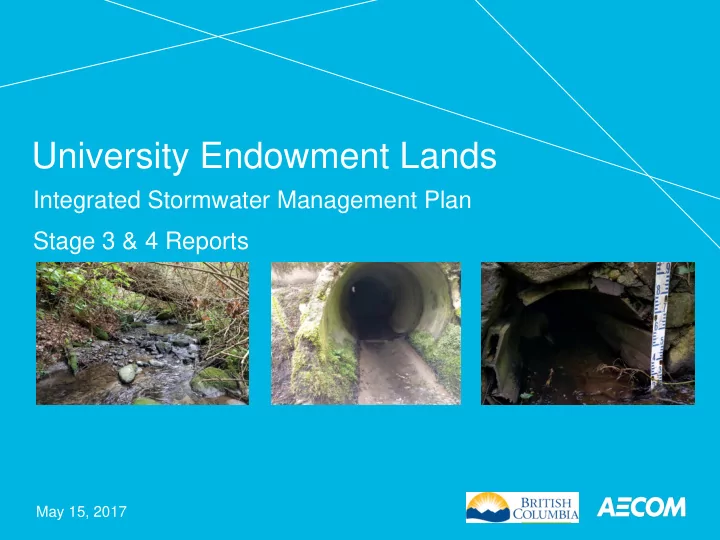
Integrated Stormwater Management Plan Stage 3 & 4 Reports

slide-2
SLIDE 2

2 2 2

Agenda

  • 1. Work completed to date
  • 2. Stage 3 Report Summary
  • 3. Stage 4 Report Summary
  • 4. Discussion
slide-3
SLIDE 3

Work completed to date

slide-4
SLIDE 4

4 4 4

UEL ISMP Approach

Stage Question Answered Description of tasks Relevant ISMP Sections 1 What do we have? Review background information and summarize existing conditions

  • Study Area
  • Regulatory Context
  • Land Use
  • Hydrology
  • Stormwater System
  • Hydrogeology and Soils
  • Environment
  • Hydraulic Modelling

and Assessment 2 What do we want? Establish the vision for future development

  • Vision and Goals

3 How do we put this into action? Development of an implementation plan, funding and enforcement strategies

  • Implementation Plan

4 How do we stay on target? Development of a monitoring and assessment program

  • Adaptive Management

Plan

slide-5
SLIDE 5

5 5 5

Stormwater Management Vision and Goals “A stormwater management plan that protects the natural and built environment through enhancement of natural watercourses, and provides opportunities for collaboration and engagement with community and residents on stormwater issues”

slide-6
SLIDE 6

6 6 6

Stormwater Management Vision and Goals

Goal 1: The UEL community is engaged in stormwater management Goal 2: Healthy streams and a natural environment are a part of the UEL Goal 3: Stormwater infrastructure provides an adequate level of service, while protecting life and property Goal 4: The UEL provides guidelines and a regulatory framework for stormwater management Goal 5: Stormwater management at UEL adapts to change

slide-7
SLIDE 7

7 7 7

Comments from Stage 2 Report?

slide-8
SLIDE 8

Stage 3

Development of an Implementation Plan

slide-9
SLIDE 9

9 9 9

UEL ISMP Stage 3 Development of an Implementation Plan

10 Action Items were identified and are proposed for implementation to help the UEL meet the goals and the vision established in Stage 2

slide-10
SLIDE 10

10 10

Action Item #1: Promote stormwater management awareness and engagement opportunities

  • Promote Spanish Bank

Streamkeepers

  • Retain all stormwater

reports and study results

  • n record
slide-11
SLIDE 11

11 11

Action Item #2: Continue to implement UEL’s combined sewer separation strategy

  • Currently in implementation

phase of separating existing combined sewers in Area B

  • Sewer separation helps reduce

combined sewer overflows, sewage backups, and negative impact on baseflows in the Acadia Creek

  • Opportunity to implement BMPs,

such as rain gardens, to manage stormwater efficiently

slide-12
SLIDE 12

12 12 12

Action Item #3: Manage the quantity of road runoff

slide-13
SLIDE 13

13 13 13

Action Item #3: Manage the quantity of road runoff

  • Reduce impact of increased

impervious areas

  • Decrease stream erosion
  • Groundwater recharge
  • Increased stream baseflows
  • Rain gardens provide a

plausible solution

slide-14
SLIDE 14

14 14 14

Action Item #4: Upgrade stormwater treatment at the UEL Works Yard

slide-15
SLIDE 15

15 15 15

Action Item #4: Upgrade stormwater treatment at the UEL Works Yard

slide-16
SLIDE 16

16 16 16

Action Item #5: Identify stormwater infrastructure that are poorly located for maintenance. Develop plans for management or replacement. (i.e. the 300mm diameter storm sewer in Pacific Spirit Park east of Acadia Road)

slide-17
SLIDE 17

17 17 17

Action Item #6: Continue to upgrade system capacity and renew aging infrastructure in a proactive manner through the capital planning process

Project Reference Number Description 2015-02 Construction of stormwater/sanitary sewer separation on Wesbrook Cres, north of Chancellor Blvd. 2016-02 Construction of storm sewer replacement on Wesbrook Cres. South of Chancellor Blvd. 2016-01 Construction of new storm sewer on Alison Rd between Campus Rd. and College Highroad, and on Western Parkway between College Highroad and University Blvd. 2017-02 Design and construction of storm sewer replacements on lane north of College Highroad 2018-01 Construction of sanitary/stormwater separation on Acadia Rd. north of Chancellor Blvd. 2018-02 Design and construction (reline) of storm sewer on Drummond Dr. and College Highroad 2021-01 Construction of Water, Sewer and Road replacement on Newton Wynd between Acadia Rd. and Kingston Rd. TBC-02 Construction of storm sewer replacement on lane north of Wycliffe Rd.

slide-18
SLIDE 18

18 18 18

Action Item #7: Develop mitigation measures to address slope stability in Area B

slide-19
SLIDE 19

19 19 19

Action Item #8: Integrate stormwater asset maintenance with work order management using a GIS-centric system

slide-20
SLIDE 20

20 20 20

Action Item #9: Develop Erosion and Sediment Control requirements

slide-21
SLIDE 21

21 21 21

Action Item #10: Control runoff from private properties

  • Review and formalize

stormwater discharge limits for developments

  • Provide options for

developers for limiting stormwater runoff

slide-22
SLIDE 22

22 22 22

Summary of Stage 3 Action Items

1. Promote stormwater management awareness and engagement opportunities 2. Continue to implement UEL’s combined sewer separation strategy 3. Manage the quantity of road runoff 4. Treat stormwater runoff from the UEL Works Yard 5. Decommission, where possible, pipes that are poorly located for maintenance and replacement (i.e. the 300mm diameter storm sewer in Pacific Spirit Park east of Acadia Road) 6. Continue to upgrade system capacity and renew aging infrastructure in a proactive manner through the capital planning process 7. Establish areas of no infiltration at the UEL so as not to threaten slope stability 8. Integrate stormwater asset maintenance with work order management using a GIS-centric system 9. Develop Erosion and Sediment Control requirements

  • 10. Control runoff from private properties
slide-23
SLIDE 23

Stage 4

Adaptive Management Plan

slide-24
SLIDE 24

24 24 24

Metro Vancouver’s Monitoring and Adaptive Management Framework Recommended Monitoring Programs

Piped System

Water Quality

Lower Gradient System

Water Quality Flow (Natural Channels Only)

Higher Gradient System

Water Quality Flow Benthic Invertebrates

slide-25
SLIDE 25

25 25 25

Monitoring Watershed Health

slide-26
SLIDE 26

26 26 26

Adaptive Management Assessment of Watershed Health Monitoring Results

  • Water Quality Results
  • Flow Monitoring Results
  • Benthic Invertebrate Sampling Results
slide-27
SLIDE 27

27 27 27

Adaptive Management Assessment of Watershed Health Monitoring Results

Good Level Satisfactory Level Need Attention Level General Parameter Dissolved Oxygen (mg/L) ≥ 11 6.5 to < 11 < 6.5 pH 6.5 to 9.0 6.0 to < 6.5 or > 9.0 to 9.5 < 6 or > 9.5 Water Temperature (° C) Low flow summer < 16 16 to 18 >18 Wet Weather 7 to 12 5 to <7 or >12 to 14 < 5 or > 14 Conductivity (µS/cm) < 50 50 to 200 > 200 Turbidity (NTU) ≤ 5 > 5 to 25 > 25 Nutrients Nitrate as Nitrogen (mg/L) ≤ 2 2 to 5 > 5 Microbial Parameters E.coli (freshwater) (CFU/100ml) Geomean ≤ 77 Geomean between 78 - 385 Geomean > 385 Fecal coliform (CFU/100ml) Geomean ≤ 200 Geomean between 2201 - 1,000 Geomean > 1,000 Metals (Total Metals) (µg/L) Iron < 800 800 to 5,000 > 5,000 Cadmium < 0.06 0.06 to 0.34 > 0.34 Copper < 3 3 to 11 > 11 Lead < 5 5 to 30 > 30 Zinc < 6 6 to 40 > 40

For Example, Water Quality Assessment Criteria (MAMF, 2014)

slide-28
SLIDE 28

28 28 28

Adaptive Management Practices

  • Source Control Measures
  • Absorbent Landscaping
  • Rain Gardens
  • Pervious Pavement, and etc.
  • Education and Public Outreach
  • Cross Connection Control
  • Runoff Detention, Retention, and

Treatment Facilities

  • Riparian Habitat Restoration
  • Mitigation of Construction Impacts
slide-29
SLIDE 29

29 29 29

Stage 4 Report In Summary

  • 1. Monitor watershed health at strategic locations
  • 2. Evaluate results of monitoring according to available

criteria

  • 3. Adapt to changes in watershed health through

implementation of Adaptive Management Practices

slide-30
SLIDE 30

Thank You!

Discussion and Questions

May 15, 2017