
SLIDE 1
United States of America Food & Beverage Market Study June - - PowerPoint PPT Presentation
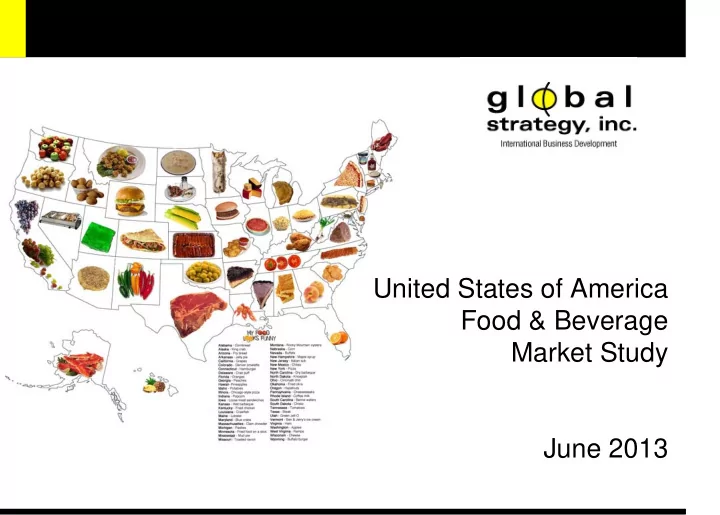
United States of America Food & Beverage Market Study June 2013 1. Introduction This research was carried out by Global Strategy, Inc. (www.consultgsi.com), a U.S. business development and market research consulting firm on behalf of OSEC
2
This research was carried out by Global Strategy, Inc. (www.consultgsi.com), a U.S. business development and market research consulting firm on behalf of OSEC Business Network, from March to May 2013. Research Objective The main objective of the study is to provide Swiss food & beverage exporters a solid understanding of historical, current and future trends of the U.S. food & beverage market, focusing on the following topics: Regulatory environment
Geography United States of America Period of analysis 2009 – 2012 Target categories
3
4
5
6
Bakery 21% Dairy 16% Frozen 10% Confectionar y 10% Sweet & Savory 10% Others 33%
Sales: $331.9 Billion
7
Meat 28% Dairy 15% Frozen 9% Confectionary 9% Sweet & Savory 9% Others 30%
Sales: $12 Billion
8
Fruit and Vegetables 38% Prepared Foods 21% Dairy 15% Beverages 13% Bread and Grains 11% Meat, Fish & Poultry 2%
Sales: $29.2 Billion
9
Supermarket & Grocery, 65.0% Wholesale Clubs, 17.0% Specialty, 1.5% Mass Merchandise, 1.7% C Stores, 2.8% Home Delivery, 3.5% Farmers, 1.0% Others, 7.5%
10
Sales: $497 Billion
$407.2 $426.8 $435.8 $435.3 $449.2 $476.7 $496.6 $516.8 $539.8 $200.9 $211.4 $212.1 $210.4 $217.4 $234.7 $244.1 $253.9 $266.6 $186.4 $194.8 $203.2 $204.3 $210.5 $220.0 $229.9 $239.6 $249.2 $19.9 $20.6 $20.5 $20.6 $21.3 $21.9 $22.6 $23.3 $24.0 $0.0 $100.0 $200.0 $300.0 $400.0 $500.0 $600.0 2006 2007 2008 2009 2010 2011 2012 2013 2014 Total restaurant and drinking places Full-service restaurants Limited-service eating places Drinking places
11
12
Canned Foods 3.6% Frozen Foods 1.5% Organic Foods 9.7% Dairy 3.6%
2 4 6 8 10 12
13
Top food and beverage imports to the United States include beverages, with 17 percent share, fish (12 percent), fruit (10 percent), coffee, tea and spices (8 percent) and vegetables (7 percent).
Beverages 17% Fish 12% Fruit 10% Coffee, Tea, Spices 8% Vegetables 7% Others 46%
% Share
14
Canada was the United States’ largest import source, with 18 percent share, followed by EU (17 percent), Mexico (15 percent), China (5 percent), Brazil (4 percent) and Thailand (4 percent).
Canada 18% EU 17% Mexico 15% China 5% Brazil 4% Thailand 4% Rest of World 37%
% Share
15
U.S. imports of agricultural products from Switzerland totaled $807 million in
roasted and instant coffee, ($86 million), cheese ($63 million), and essential oils ($15 million).
Snack Foods 12% Coffee 11% Cheese 8% Essential Oils 2% Others 67%
% Share
16
17
18
19
20
21
22
23
SALES AND SALES GROWTH
The 212,000 traditional food stores in the U.S. sold $571 billion of retail food and nonfood products in 2011. Grocery stores, including supermarkets, accounted for the largest share of food store sales (91.0 percent), followed by convenience stores without gasoline (5.5 percent). Specialized food stores, including meat and seafood markets, produce markets, retail bakeries, and candy and nut stores, accounted for the remaining 3.4 percent of the total.
24
INDUSTRY STRUCTURE
Sales by the 20 largest food retailers totaled $418.0 billion in 2011. The long term trend shows an increasing concentration of sales among the largest grocery retailers.
25
TRENDS AND DEVELOPMENTS
Nontraditional stores' share of food‐at‐home sales increased from 13.7 percent in 2000 to 21.5 percent in 2011 (traditional food stores and non‐store food sales—such as mail order, home delivery, and direct sales by farms, processors, and wholesalers—account for the remaining shares).
26
THE INTERNET AND CONSUMER EMPOWERMENT: SOCIAL MEDIA
from the Web 2.0 era has had a dramatic impact on the current commercial environment. Businesses can no longer simply publish content they wish potential customers to see; the social media landscape has instigated a power shift from the business towards the consumer.
27
Consumer Trends: Online Grocery Shopping
As the popularity of online shopping grows, consumers are beginning to explore new digital shopping categories, including groceries. A variety of reasons were cited as plusses to shopping the virtual supermarket aisles, including the following:
items in the store
your virtual "cart" throughout the week
buy junk food
28
OVERVIEW
billion food retail market in the United States, there is little room for other food retailers to get a foot in the door. Specialty food stores cannot compete with large supermarkets on price, but they can capture a share of food retail based on quality, expertise and uniqueness.
traditionally high per unit sold, relative to the thin earnings of their supermarket counterparts. In 2013, this sector is projected to have revenue
29
continue to experience strong growth.
representing a compound annual growth rate (CAGR) of 9.4% between 2007 and 2011.
30
REGULATIONS AND LABELING
As consumer interest continues to gather momentum, many U.S. producers, manufacturers, distributors, and retailers are specializing in growing, processing, and marketing an ever‐widening array of organic agricultural and food products.
percent or more organic content. For multi‐ingredient products such as bread or soup, if the label claims that it is made with specified organic ingredients, those specific ingredients have been certified organic.
31
dairy product exports during the past five years, benefiting the US Dairy product industry’s revenue. In 2012, higher consumer spending was expected to boost revenue 1.0% to an estimated $89.3 billion.
percent), yogurt, cream cheese and cottage cheese (12 percent), spreadable fats (8 percent), cream (5 percent) and chilled desserts (1 percent).
32
PRODUCTS AND MARKETS
product segment at 38.4% of revenue in 2012. The segment includes cheddar, Swiss, mozzarella, Monterey jack, blue and cream cheeses.
consumption of fast foods and ethnic foods, which
varieties, increasing food sophistication and more convenient packaging are driving cheese sales.
reached 11.3 pounds per capita and cheddar reached 10.4 pounds per capita in 2010. The two cheeses are the most popular single‐cheese varieties, with cheddar cheese accounting for more than 75.0% of all American‐type cheese production.
33
INDUSTRY OVERVIEW
projected to grow to $8.6 billion in 2015, a 21% increase driven by the increasing popularity of energy drinks and growing demand for fortified dairy products such as probiotic yogurts.
whole grain and oat content leading the way with heart health claims. Following that were soy products. Together, these 3 categories represent 85% of the U.S. functional food category.
34
Soft Drinks, Dairy and Energy Foods
drinks and dairy products constitute 60 percent of the market among
in popularity as consumers seek alternatives to carbonated beverages.
categorized by benefit.
expected to be an $8 billion market by 2013. Other areas of growth are expected to be products for weight management, mood enhancement, and those that promote healthy, beautiful skin.
35
Industry Characteristics
Food and beverage manufacturing plants transform raw agricultural materials into products for intermediate or final consumption by applying labor, machinery, energy, and scientific knowledge. Some products may serve as inputs for further processing (such as syrup for manufacturing soda). In 2011, these plants accounted for 14.7 percent of the value of shipments from all U.S. manufacturing plants.
Components of processed food value of shipments, 2011
36
MARKET SIZE AND VALUE
The US savory snacks market has been growing at a strong rate in recent
period, with annual rate dropping below 4%. The US savory snacks market had total revenues of $26.4 billion in 2011, representing a compound annual growth rate (CAGR) of 6.3% between 2007 and 2011.
37
MARKET SHARE
The Snack Food Production industry is moderately concentrated, with the top four players estimated to account for 61.4% of the market in 2012. This percentage represents an increase from 58.8% in 2007, mainly because larger players have engaged in acquisitions to expand their product mix and market reach.
Figure 24: U.S. Savory Snack Market Shares: % share, by value, 2012
38
nonalcoholic beverages. Major companies include Britvic (UK), Coca‐Cola (US), Cott (Canada), Dr Pepper Snapple Group (US), Nestlé (Switzerland), PepsiCo (US), and Red Bull (Austria).
1,500 companies with combined annual revenue of about $55 billion. Low growth is forecast for the next two years. Sodas account for about 60 percent of the market.
internationally has been growing dramatically in recent decades. As a result, U.S. farm milk production has grown to about 190 billion pounds per year.
39
Soda and Bottle Water Production
3,000 companies. Major beverage companies include Coca‐Cola, PepsiCo and the Dr Pepper Snapple Group. The industry includes manufacturers and distributors of soft drinks and bottled water.
based on revenue. It was forecast to generate a profit of $2 billion in 2012. The industry’s annual growth was 1.8% from 2005 to 2010, and it is expected to maintain this growth rate between 2010 and 2015.
40
PRODUCT SEGMENTS AND MAJOR MARKET BRANDS
Products broadly referred to as soft drinks but can be further divided into six main segments based on industry revenue:
41
U.S. retailer food brands, i.e. private label brands, are on track to achieve market penetration of between 25% and 30% in the next decade, up from their current market share of under 20%. Retailer Brands Are Powerful Competitors
sales of national branded packaged food manufacturers which have grown just 2%.
from consumer packaged goods companies (CPGs) to food retailers, as well as the growing trust and loyalty consumers have to today's innovative and high quality retailer brands.
supermarkets, retail brands now compete successfully and often win against national brands, earning consumer trust in terms of pricing, quality, image and value.
42
43
BEVERAGES Currently, some of the strongest private label beverage categories are bottled water, powdered beverage concentrates and 100 percent juice. Bottled water and 100 percent juice are commodity-based categories, so the price of the product becomes more
According to SymphonyIRI Group, Chicago, in the 52 weeks ending July 10, 2011 in supermarkets, drug stores, mass merchandisers, club stores, gas and convenience stores, excluding Walmart, U.S. dollar sales for national branded bottled water products totaled $4.9 billion, while private label bottled water dollar sales totaled nearly $1.3 billion. Using the same qualifications, national branded bottled juices totaled $3.8 billion, while private label totaled $666.6 million. In the soft drinks category, national brands have worked to build brand equity, keeping many consumers from even considering private label soft drinks. With regard to carbonated soft drinks, most analysts believe that Coke and Pepsi have done a very good job over the years of establishing their brands and what people expect from it, and private label’s not as strong in carbonates. But that doesn’t mean private label beverages can’t adapt. Although many retailers are competing with national brands, some are
Howl, which is a citrus-flavored beverage with a taste of cherry. Some of the strong private label brands are the upper-tier store brands where retailers are offering a quality product for a good price, Haffner says. He notes that private label products are getting more competitive in the ready-to-drink tea segment. The RTD tea segment] has grown substantially, so it’s becoming a much larger segment that is able to attract the attention of private label. For the 52 weeks ending July 10, 2011 national brands of canned and bottled tea totaled nearly $1.3 billion while private label brands
club stores, gas and convenience stores, excluding Walmart.
44
The Foodservice Industry is generally categorized based on type of eating establishment, such as full service restaurant, limited service restaurant, fast casual restaurant (also referred to as quick service restaurant or QSR) and snack and beverage restaurant.
49% 46% 4%
2011 Market Share
Full-service Restaurants Limited-service Restaurants Drinking Places
45
INDUSTRY INNOVATION
There are many ways to classify the degree of newness of a
1.creative products 2.innovative products 3.new packaging of existing products 4.reformulation of existing products 5.new forms of existing products 6.repositioned existing products 7.line extensions The challenge for product development is to develop a product which is acceptable to the target consumer.
46
According to the first annual U.S. Food & Beverage Industry Study by WeiserMazars LLP, a leading accounting, tax and advisory services firm, food companies look to new customers for the majority of increased product sales in 2013. The top four trends to impact the industry in 2013 were reported as healthy/nutritious, organic, ethnic/international, and private label foods.
0% 5% 10% 15% 20% 25% 30% 35% 40% 45% 50% Healthy/nutritious foods Organic foods Ethnic/International Private label Locally produced None/Unknown Percent of Participants
47
48
49
FOOD DISTRIBUTION CHANNELS
The food system encompasses many activities, from harvest to processing, retailing, and consuming. The main middlemen in the distribution channel are as follows. Food distributors purchase products from a manufacturer or from another distributor and sell and distribute the products to retailers, foodservice companies, and other distributors. Food brokers act as food manufacturers’ representatives and facilitate sales between manufacturers and retailers. They do not take ownership
Food wholesale distributors are very similar to distributors, but they do not perform as many services, such as stocking and managing retail shelves. Foodservice distributors and brokers are similar to retail brokers and distributors, except that they focus on servicing foodservice customers.
50
ROUTE TO MARKET CONSIDERATIONS
Step 1. Test the waters Many new food manufacturers introduce their product at small, local retail markets. This is a great way to test the waters. Starting locally gives you an opportunity to tweak your product, packaging, and promotions. Step 2. Hire a broker While some new food manufacturers have the skills to sell successfully, most do not. A broker can help you with this job. Securing a broker takes time, money, and effort. For a broker, the costs and energy required to launch a new product are great. On average, brokers will take a 3 to 5 percent commission. Step 3. Find a distributor Distributors purchase, inventory, transport, and sell products to retail accounts that the manufacturer has set up. They also assist in gaining new retail accounts. Distributors act as logistics experts for food distribution. Markups can range from 10 to 35 percent of the wholesale price, depending on the product, category, distributor, and retail customer. Step 4. Secure retail accounts Choosing the right retail accounts is crucial. All retailers are different and have different
in your product category. New food businesses usually find it best to start small for financial and logistical reasons.
51
COMPANY ASSESSMENT CHECKLIST International sales experience? English language capabilities? Streamlined customer service? English website and online ordering capability? Strong domestic sales? Sufficient capacity to target international sales? Working capital to focus on international sales? Competitive products & defined target market? Working capital to grow the brand? COMPETITIVE, CUSTOMER AND MARKET LANDSCAPE ASSESSMENT
52
BRANDING
Developing a brand for a specialty food product is perhaps the most important aspect of product development, as it becomes the public face of both the manufacturer and the product itself. When developing a brand for specialty food products, it is important to note a few key questions, including:
53
PRICING The following chart describes the channels and margins for companies when importing to the U.S.
54
improved channel management.
such as creating an optimized supply chain while implementing effective risk management practices.
consumer trends, proposed government regulations, new companies, and new product and service offerings ‐ challenges organizations to remain competitive.
55