SLIDE 1
High Throughput Sequence Manipulation and Annotation
Martin Morgan Fred Hutchinson Cancer Research Center 19-21 January, 2011, edited 31 December, 2010
Contents
1 Introduction 1 2 Data input and exploration 2 2.1 Sequences . . . . . . . . . . . . . . . . . . . . . . . . . . . . . . . 2 2.2 Gapped alignments . . . . . . . . . . . . . . . . . . . . . . . . . . 3 3 Annotation: transcripts 4 4 Counting and measuring 6 5 Differential representation 7 6 Annotation: biological function 10 A Appendix: counting overlaps 12
1 Introduction
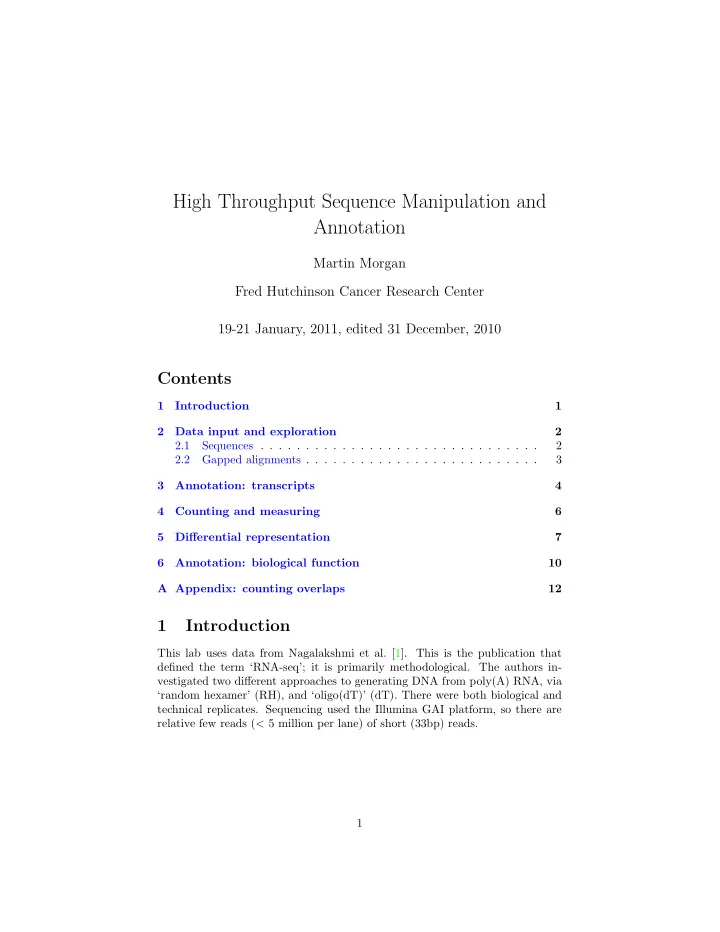
This lab uses data from Nagalakshmi et al. [1]. This is the publication that defined the term ‘RNA-seq’; it is primarily methodological. The authors in- vestigated two different approaches to generating DNA from poly(A) RNA, via ‘random hexamer’ (RH), and ‘oligo(dT)’ (dT). There were both biological and technical replicates. Sequencing used the Illumina GAI platform, so there are relative few reads (< 5 million per lane) of short (33bp) reads. 1
SLIDE 2
2 Data input and exploration
2.1 Sequences
Attach the ShortRead and IWB2011 packages, and locate the file path to the sample data set of the IWB2011 package. > library(ShortRead) > library(IWB2011) > fastqFile <- system.file("extdata", "SRR002051.reads1-50k.fastq", + package="IWB2011") Hint: if fastqFile is "", then the system.file argument is incorrect. Input the fastq sequences, and explore the resulting object. > fq <- readFastq(fastqFile) > fq class: ShortReadQ length: 50000 reads; width: 33 cycles > head(sread(fq)) A DNAStringSet instance of length 6 width seq [1] 33 AAAGAACATTAAAGCTATATTATAAGCAAAGAT [2] 33 AAGTTATGAAATTGTAATTCCAATATCGTAAGC [3] 33 AATTTCTTACCATATTAGACAAGGCACTATCTT [4] 33 AGATTTCTAATATGGTTAAGAAGCGAACTTTTT [5] 33 AAAGCAGCAGCACGTAGTTCTTCATCCTTCTTC [6] 33 AAGAATTATTAGTCTTTTCTTCTTATTTTTTCA > head(quality(fq)) class: FastqQuality quality: A BStringSet instance of length 6 width seq [1] 33 IIIIIIIIIIIIIIIIIIIIIIIII'II@I$)- [2] 33 IIIIIIIIIIIIIIIIIIIIIIIIIIIIIII07 [3] 33 IIIIIIIIIIIIIIIIIIIIIIIIIIIIIII&I [4] 33 IIIIIIIIIIIIIIIIIII?IIIIII<IIIIII [5] 33 IIIIIIIIIIIIIIIIIIIIIIIFIIIIII%.I [6] 33 IIIIIIIIIIIIIIIIIIIIIIIIIIIIIIII4 As a simple illustration of tasks that can be performed, use the alphabetByCy-
cle, t (matrix transposition), and matplot (‘matrix plot’) functions to visualize
how nucleotide use changes with cycle. 2
SLIDE 3 > abc <- alphabetByCycle(sread(fq)) > matplot(t(abc[1:4,]), type="l", xlab="Cycle", ylab="Count", lwd=2)
5 10 15 20 25 30 6000 8000 10000 14000 18000 Cycle Count
As a second illustration, coerce quality scores to a matrix using as. Then use
apply and mean to summarize the mean base quality per read. Create a subset
- f ‘high quality’ reads with mean quality greater than 20, using the [ operator
and a (vectorized) logical test. > m <- as(quality(fq), "matrix") > baseQualPerRead <- apply(m, 1, mean) > fq[baseQualPerRead > 20] class: ShortReadQ length: 35304 reads; width: 33 cycles
2.2 Gapped alignments
Attach the GenomicRanges package, determine the path to the sample BAM file, and read in the alignments using the readGappedAlignments function. Use
head to view the first half dozen records.
> library(GenomicRanges) > bamFile <- system.file("extdata", "SRR002051.chrI-V.bam", + package="IWB2011") 3
SLIDE 4 > galn <- readGappedAlignments(bamFile) > head(galn) GappedAlignments of length 6 rname strand cigar qwidth start end width ngap [1] chrI
33 11 43 33 [2] chrI + 33M 33 1062 1094 33 [3] chrI
33 1114 1146 33 [4] chrI + 33M 33 1366 1398 33 [5] chrI + 33M 33 4336 4368 33 [6] chrI + 33M 33 4581 4613 33 Be sure to verify that the file path has been specified correctly! Use the cigar accessor to obtain the CIGAR code of each read. Use the
table, sort and tail functions to summarize the most commonly occurring
CIGARs. > tail(sort(table(cigar(galn)))) 5M1I27M 26M1I6M 3M1I29M 4M1I28M 27M1I5M 33M 179 197 210 222 322 446075
3 Annotation: transcripts
Sequence-based annotations are generally more complicated than the simple gene-level annotations from microarray data. The following script downloads and saves a UCSC genome browser track describing annotated genes in yeast > readScript("create-txdb.R") [1] pkgroot <- "/home/mtmorgan/IWB2011" [2] txdbFile <- file.path(pkgroot, "inst", "extdata", "sacCer2_sgdGene.sqlite") [3] [4] library(GenomicFeatures) [5] txdb <- makeTranscriptDbFromUCSC(genome="sacCer2", tablename="sgdGene") [6] saveFeatures(txdb, txdbFile) Load this file into your current session, and find out more information about it with the following commands: > library(GenomicFeatures) > txdbFile <- system.file("extdata", "sacCer2_sgdGene.sqlite", + package="IWB2011") > txdb <- loadFeatures(txdbFile) > txdb 4
SLIDE 5 TranscriptDb object: | Db type: TranscriptDb | Data source: UCSC | Genome: sacCer2 | UCSC Table: sgdGene | Type of Gene ID: ID of canonical transcript in cluster | Full dataset: yes | transcript_nrow: 6717 | exon_nrow: 7083 | cds_nrow: 7061 | Db created by: GenomicFeatures package from Bioconductor | Creation time: 2010-12-06 13:16:42 -0800 (Mon, 06 Dec 2010) | GenomicFeatures version at creation time: 1.2.2 | RSQLite version at creation time: 0.9-2 | DBSCHEMAVERSION: 1.0 Query the txdb object for transcripts using the transcripts function and
columns="gene_id" argument. Summarize the number of transcripts associated
with each gene symbol by: (a) extracting the gene_id column using values and column selectin; and (b) using table twice, first to count the number of times each gene identifier occurs, and then the number of times any gene identifier
- ccurs once, twice, . . . .
> tscript <- transcripts(txdb, columns="gene_id") > head(tscript) GRanges with 6 ranges and 1 elementMetadata value seqnames ranges strand | gene_id <Rle> <IRanges> <Rle> | <CompressedCharacterList> [1] 2micron [ 252, 1523] + | R0010W [2] 2micron [3271, 3816] + | R0030W [3] 2micron [1887, 3008]
R0020C [4] 2micron [5308, 6198]
R0040C [5] chrI [ 335, 649] + | YAL069W [6] chrI [ 538, 792] + | YAL069W seqlengths chrIV chrXV chrVII chrXII ... chrVI chrI chrM 2micron 1531919 1091289 1090947 1078175 ... 270148 230208 85779 6318 > geneIds <- as(values(tscript)$gene_id, "character") > table(table(geneIds)) 1 2 3 4 6 6394 149 5 1 1 > ## following line changes how 'gene_id' is stored, internally > values(tscript)$gene_id <- geneIds 5
SLIDE 6 For simplicity in subsequent analyses, select the subset of genes with exactly
- ne transcript. Do this using table, (names), and logical subsetting to identify
candidate genes, and %in% to select the corresponding rows of tscript. Confirm that the resulting subset is consistent with the tabulation performed in the previous exercise. > x <- table(geneIds) > ugeneIds <- names(x)[x==1] > idx <- values(tscript)$gene_id %in% ugeneIds > tscript1 <- tscript[idx] > length(tscript1) [1] 6394
4 Counting and measuring
The goal is to count the number of times a read ‘hits’ a transcript. We need to make decisions about what constitutes a ‘hit’, and what to do with reads that hit more than one transcript. We define a hit as any overlap between the aligned read and a transcript, and we discard reads that align to more than one
- transcript. The RNAseq protocol used in this experiment does not distinguish
between strands, so in preparation for further analysis we indicate that the strand of the transcript is unimportant > strand(tscript1) <- "*" Use the IRanges package and countOverlaps function to count the number
- f times each read aligns to a transcript.
Subset the reads to include only those that align to exactly one transcript. Use countOverlaps again, but with arguments reversed, to count the number of times each transcript overlaps a read. > library(IRanges) > hits <- countOverlaps(galn, tscript1) > table(hits) hits 1 2 3 164635 265107 19780 2 > galn1 <- galn[hits==1] > counts <- countOverlaps(tscript1, galn1) Explore the counts object to ensure that the results are reasonable. For instance, non-zero counts should only involve chromosomes I-V (because the subset of reads we are using are from these chromosomes). Visualize the non- zero counts as a histogram; use the asinh (inverse hyperbolic sine) function for a log-like transformation of the data. 6
SLIDE 7 > table(seqnames(tscript1[counts!=0])) chrIV chrII chrV chrIII chrI 775 411 292 157 102 > hist(asinh(counts[counts!=0]))
Histogram of asinh(counts[counts != 0])
asinh(counts[counts != 0]) Frequency 2 4 6 8 10 100 200 300 400 500 600
5 Differential representation
This section is optional; greater detail on differential expression will be provided tomorrow. Code presented in the appendix was used to create an object summarizing the entire data set. Load the data set into R. The object is a kind of data.frame, designed for large data. A feature is that the columns can be annotated with additional information. Access this information with the elementMetadata func-
- tion. Coerce tscriptCounts to a standard data.frame and summarize the asinh-
transformed counts across samples using splom function from the lattice package. Use the pch argument to set the plot character to “.”. Can you identify, ‘by eye’, the technical and biological replicates within each protocol? > data("tscriptCounts") > head(tscriptCounts) 7
SLIDE 8 DataFrame with 6 rows and 6 columns SRR002062 SRR002051 SRR002064 SRR002058 SRR002059 SRR002061 <integer> <integer> <integer> <integer> <integer> <integer> R0010W 397 655 1190 518 785 1219 R0030W 146 291 470 167 273 429 R0020C 264 458 658 415 476 742 R0040C 209 374 677 354 443 692 YAL066W 1 3 1 YAL064W-B 1 1 6 2 2 6 > elementMetadata(tscriptCounts) DataFrame with 6 rows and 3 columns Protocol Replicate SRR <character> <character> <character> SRR002062 dT Biological SRR002062 SRR002051 dT Original SRR002051 SRR002064 dT Technical SRR002064 SRR002058 RH Biological SRR002058 SRR002059 RH Original SRR002059 SRR002061 RH Technical SRR002061 > df <- as(tscriptCounts, "data.frame") > print(splom(asinh(df), pch="."))
Scatter Plot Matrix SRR002062
6 8 10 6 8 10 2 4 0 2 4
SRR002051
6 8 10 6 8 10 2 4 0 2 4
SRR002064
6 8 10 6 8 10 2 4 0 2 4
SRR002058
6 8 10 6 8 10 2 4 0 2 4
SRR002059
6 8 10 6 8 10 2 4 0 2 4
SRR002061
6 8 10 6 8 10 2 4 0 2 4
8
SLIDE 9
Create a subset of the data that includes only biological replicates. Do this by creating an index variable based on the ‘Replicate’ column of the element-
Metadata of tscriptCounts, and using logical subsetting. Remove any gene for
which no transcripts were found by using rowSums to sum over the number of reads per row, and creating a logical index variable that is TRUE only when the row contains some reads. Use this to subset tscriptCounts1. > idx <- elementMetadata(tscriptCounts)$Replicate > tscriptCounts1 <- tscriptCounts[,idx != "Technical"] > ridx <- rowSums(as(tscriptCounts1, "data.frame")) != 0 > tscriptCounts1 <- tscriptCounts1[ridx,] We use the edgeR package to assess differential representation. This pack- age requires counts (created by coercing tscriptCounts1 to a data.frame) and a variable to indicate groups to compare (from the ‘Protocol’ column of the el-
ementMetadata), presented to the DGEList function. edgeR implements methods
for normalizing library representations (with the calcNormFactors function), esti- mating dispersion parameters of the negative binomial model (estimateCommonDisp), performing exact tests of statistical significance (exactTest), and presenting a ‘top table’ of differentially represented tags (topTags). There are important sta- tistical decisions at each step of the analysis; evaluate the following command as a ‘fast track’ through this work flow. > library(edgeR) > df <- as(tscriptCounts1, "data.frame") > grps <- elementMetadata(tscriptCounts1)$Protocol > dge <- DGEList(df, group=grps) > dge <- calcNormFactors(dge) > dge <- estimateCommonDisp(dge) > etest <- exactTest(dge) Comparison of groups: dT - RH > ttags <- topTags(etest, n=10, adjust.method="BH") Explore these results. For instance, use hist to visualize the distribution of (unadjusted) P values available in the etest object. > hist(etest$table$p.value, 21) 9
SLIDE 10 Histogram of etest$table$p.value
etest$table$p.value Frequency 0.0 0.2 0.4 0.6 0.8 1.0 200 400 600 800 1000
6 Annotation: biological function
We can find out about the biological features identified as differentially repre-
- sented. For instance, use rownames to extract the most differentially represented
transcripts in ttags. Use these to query tscript for the genomic locations of these transcripts. > geneIds <- rownames(ttags$table) > idx <- values(tscript)$gene_id %in% geneIds > (topScripts <- tscript[idx]) GRanges with 10 ranges and 1 elementMetadata value seqnames ranges strand | gene_id <Rle> <IRanges> <Rle> | <character> [1] chrXI [258717, 258866]
YKL096C-B [2] chrXII [452439, 452624] + | YLR154W-A [3] chrXII [454393, 454557] + | YLR154W-B [4] chrXII [454697, 455071] + | YLR154W-C [5] chrXII [455434, 455637] + | YLR154W-E [6] chrXII [455884, 456024] + | YLR154W-F [7] chrXII [490407, 490595] + | YLR162W-A [8] chrXII [462523, 462672]
YLR154C-G 10
SLIDE 11 [9] chrXII [468828, 468959]
YLR154C-H [10] chrXII [485712, 485843]
YLR159C-A seqlengths chrIV chrXV chrVII chrXII ... chrVI chrI chrM 2micron 1531919 1091289 1090947 1078175 ... 270148 230208 85779 6318 The BSgenome.* packages provide DNA sequences of model organisms. At- tach the BSgenome.Scerevisiae.UCSC.sacCer2 package and display a summary
- f its content using the organism part of the package name. Use getSeq to re-
trieve the sequences corresponding to these regions, using the as.character=FALSE argument to return the results in a DNAStringSet object. Use the alphabetFre-
quency function with the baseOnly=TRUE argument from Biostrings to summary
nucleotide use. What is the GC content of the top transcripts? > library(BSgenome.Scerevisiae.UCSC.sacCer2) > Scerevisiae Yeast genome | | organism: Saccharomyces cerevisiae (Yeast) | provider: UCSC | provider version: sacCer2 | release date: June 2008 | release name: SGD June 2008 sequence | | sequences (see '?seqnames'): | chrI chrII chrIII chrIV chrV chrVI chrVII | chrVIII chrIX chrX chrXI chrXII chrXIII chrXIV | chrXV chrXVI chrM 2micron | | (use the '$' or '[[' operator to access a given sequence) > (topSeqs <- getSeq(Scerevisiae, topScripts, as.character=FALSE)) A DNAStringSet instance of length 10 width seq [1] 150 ATGAAGTTATTTATTCTTGATTATGAGA...TTCAATTTTTTCGTTGTTTTTTTTTTAG [2] 186 ATGGTTTGTATTCACACTGAAAATCAAA...CCCGGATCAGCCCCGAATGGGACCTTGA [3] 165 ATGCTCTTACTCAAATCCATCCGAAGAC...TCCGTGTTTCAAGACGGGCGGCATATAA [4] 375 ATGCGAGATTCCCCTACCCACAAGGAGC...CACCGAAGGTACCAGATTTCAAATTTGA [5] 204 ATGCCCCCTGGAATACCAAGGGGCGCAA...TTTTGACAAAAATTTAATGAATAGATAA [6] 141 ATGCTCTTGCCAAAACAAAAAAATCCAT...CCAAGTTTGTCCAAATTCTCCGCTCTGA [7] 189 ATGGTTTGTATTCACACTGAAAATCAAA...CATAAACTGTATTATGAACAGAAGGTAG [8] 150 ATGTGGAGACGTCGGCGCGAGCCCTGGG...GCTCCGGTGCGCTTGTGACGGCCCGTGA [9] 132 ATGTATTCGTGCGCGAAAAAAAAAACAA...TCGGACGGGAAACGGTGCTTTCTGGTAG [10] 132 ATGTATTCGTGCGCGAAAAAAAAAACAA...TCGGACGGGAAACGGTGCTTTCTGGTAG 11
SLIDE 12 > (abc <- alphabetFrequency(topSeqs, baseOnly=TRUE)) A C G T other [1,] 55 10 29 56 [2,] 44 54 36 52 [3,] 40 47 34 44 [4,] 102 114 58 101 [5,] 63 37 38 66 [6,] 43 34 16 48 [7,] 50 41 35 63 [8,] 25 36 49 40 [9,] 36 33 31 32 [10,] 36 33 31 32 > rowSums(abc[,c("G", "C")]) / rowSums(abc) [1] 0.2600000 0.4838710 0.4909091 0.4586667 0.3676471 0.3546099 [7] 0.4021164 0.5666667 0.4848485 0.4848485 The org.* packages represent a snapshot of organism-centric annotation in- formation collated before each Bioconductor release. Attach the Saccharomyces cerivisiea annotation package created from SGD annotations. Use mget to look up the GENENAME corresponding to gene ids of differentially represented tran- scripts; only a couple of these transcripts have names, use Filter and Negate to select those with names > library(org.Sc.sgd.db) > (namedIds <- Filter(Negate(is.na), mget(geneIds, org.Sc.sgdGENENAME))) $`YLR154W-C` [1] "TAR1" $`YLR162W-A` [1] "RRT15" There are many other annotation resources available in Bioconductor. Ex- plore, on your own, the biomaRt and rtracklayer packages.
References
[1] U. Nagalakshmi, Z. Wang, K. Waern, C. Shou, D. Raha, M. Gerstein, and
- M. Snyder. The transcriptional landscape of the yeast genome defined by
RNA sequencing. Science, 320:1344–1349, Jun 2008.
A Appendix: counting overlaps
This script counts reads overlapping transcripts across six samples. 12
SLIDE 13 > readScript("create-tscriptCounts.R") [1] library(GenomicFeatures) [2] library(multicore) [3] [4] pkgroot <- "/home/mtmorgan/IWB2011" [5] datasrc <- file.path(pkgroot, "NagalakshmiEtAl", "aln") [6] txdbFile <- file.path(pkgroot, "inst", "extdata", "sacCer2_sgdGene.sqlite") [7] countsFile <- file.path(pkgroot, "data", "tscriptCounts.rda") [8] [9] ## transcript coordinates of gene symbols with exactly one transcript [10] txdb <- loadFeatures(txdbFile) [11] tscript <- transcripts(txdb, column="gene_id") [12] geneIds <- as(values(tscript)[["gene_id"]], "character") [13] values(tscript)[["gene_id"]] <- geneIds [14] x <- table(geneIds) [15] ugeneIds <- names(x)[x==1] [16] tscript1 <- tscript[geneIds %in% ugeneIds] [17] strand(tscript1) <- "*" # protocol doesn't distinguish strand [18] [19] ## reads and counts [20] fls <- list.files(datasrc, pattern="fastq.sorted.bam$", full=TRUE) [21] counts <- mclapply(fls, function(fl, ts) { [22] print(fl) [23] ga <- readGappedAlignments(fl) [24] hits <- countOverlaps(ga, ts) [25] countOverlaps(ts, ga[hits==1]) [26] }, tscript1) [27] tscriptCounts <- as(counts, "DataFrame") [28] dimnames(tscriptCounts) <- [29] list(as(values(tscript1)[["gene_id"]], "character"), [30] sub(".fastq.*", "", basename(fls))) [31] [32] ## sample annotations [33] df <- DataFrame(Protocol=rep(c("RH", "dT"), each=3), [34] Replicate=rep(c("Biological", "Original", "Technical"), 2), [35] SRR=c("SRR002058", "SRR002059", "SRR002061", [36] "SRR002062", "SRR002051", "SRR002064")) [37] elementMetadata(tscriptCounts) <- [38] df[match(colnames(tscriptCounts), df$SRR),] [39] o <- with(elementMetadata(tscriptCounts), [40]
- rder(Protocol, Replicate))
[41] tscriptCounts <- tscriptCounts[ridx,o] [42] [43] save(tscriptCounts, file=countsFile) 13