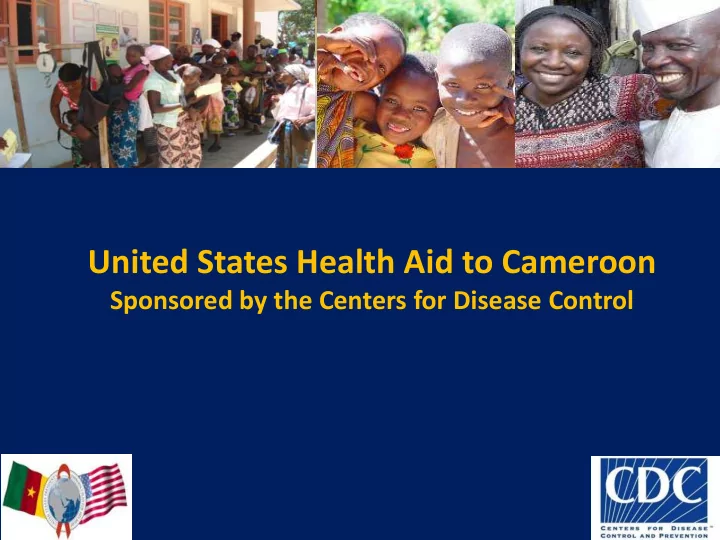
United States Health Aid to Cameroon Sponsored by the Centers for - - PowerPoint PPT Presentation

united states health aid to cameroon
SMART_READER_LITE
LIVE PREVIEW

United States Health Aid to Cameroon Sponsored by the Centers for - - PowerPoint PPT Presentation

United States Health Aid to Cameroon Sponsored by the Centers for Disease Control Milestones in CDC Aid to Cameroon Two CDC First round of operational centers: PEPFAR Funds Mutengene & HIV research Lab HIV Lab set up in obligated to


slide-1
SLIDE 1

United States Health Aid to Cameroon

Sponsored by the Centers for Disease Control

slide-2
SLIDE 2

Milestones in CDC Aid to Cameroon

PEPFAR: U.S. President’s Emergency Plan for AIDS Relief PMTCT: Prevention of Mother-to-Child-Transmission

1998 2000

HIV Lab set up in Mutengene

2004 2007 2008 2010 2011 2012

Two CDC

  • perational centers:

Mutengene & Yaoundé

2013

HIV research Lab at CRESAR First round of PEPFAR Funds

  • bligated to

Cameroon

($8.5m) ($8m) ($ 1 m)

($17m est.)

($4m)

slide-3
SLIDE 3

Four pillars of PEPFAR assistance to Cameroon

  • 1. Prevention of Mother to Child HIV Transmission (PMTCT)
  • Provision of PMTCT services at hundreds of hospitals
  • Development of national guidelines, policies and curriculum for health workers
  • Community mobilization
  • 2. Health System Strengthening
  • Laboratory: improving quality; early infant diagnosis
  • Capacity Building; Training; Lab Accreditation
  • Supply Chain Management
  • Monitoring and Evaluation and collection of Strategic Information through surveys
  • 3. Blood Transfusion
  • Setting up a national blood transfusion committee and blood transfusion unit
  • Scaling up voluntary blood donation programs
  • Screening blood before transfusion
  • 4. Most At Risk Population

Men who have sex with men (MSM); Commercial sex workers (CSW); young women

slide-4
SLIDE 4

Why address these four pillars?

  • 2. Blood safety:
  • In 2010:

– Available blood supply reached only 20% of the amount needed

  • Maternal deaths are mainly due to

bleeding

  • 3. Health System Strengthening:
  • Weak institutions require improvements in:

– Laboratories – Data systems – Trained health care workers

1. PMTCT

  • Cameroon is first out of 22 countries

globally in the rate of HIV transmission from mother to child

  • Cameroon has the highest HIV prevalence

for pregnant women in West and Central Africa (7.3%)*

  • Only 40% pregnant women were tested

for HIV in 2010 (16th of 22 countries)

  • 2. Most At Risk Population:
  • Cameroon has the highest HIV prevalence

in Africa (CSWs- 36%, MSM)

*RAPPORT NATIONAL DE SUIVI DE LA DECLARATION POLITIQUE SUR LE VIH/SIDA CAMEROUN (2012)

slide-5
SLIDE 5

CDC Cameroon’s Vision, Mission & Goals

Vision

Contribute to a healthier Cameroon

Mission

Reduce the burden of HIV/AIDS and other communicable diseases in Cameroon; improve maternal and child health conditions; build local capacity & partnerships to implement comprehensive and evidence-based public health practices

Goal 4 Use resources efficiently

  • 1. Fund what works:

“smart investment”

  • 2. Partnership &

collaboration

  • 3. Monitor budget

consistently Goal 2 Monitor programs efficiently

  • 1. Activity

management

  • 2. Site monitoring
  • 2. HQ visit & response
  • 3. Data collection for

partner monitoring Goal 1 Develop local capacity to ensure country ownership

  • 1. Technical

assistance on policies and training

  • 2. Support CDC

Programs that respond to public health threats Goal 3 Evaluate programs to assess impact

  • 1. Conduct studies

and surveys

  • 2. Use results for

program improvement

slide-6
SLIDE 6

CDC’s PEPFAR Partners

Partners

Cameroon Baptist Health Board National AIDS Control Committee Global Health System Solutions Department of Family Health, Cameroonian Ministry of Health WHO & UNICEF African Field Epidemiology Network & African Society for Laboratory Medicine CDC Lab

slide-7
SLIDE 7

PMTCT activities undertaken by the Cameroon Baptist Health Board

  • Support health care workers

to provide quality maternal, child and PMTCT services

  • Enter clinical data daily &

summarize monthly

  • Support for drug supplies

and services for populations at greatest risk

  • With District & Regional

Health Officers

  • Analyze data for program

improvement

  • PMTCT: HIV testing,

counseling, antiretroviral drugs

  • Early infant Diagnosis
  • Logistics & drug

forecasting

  • Data Collection
  • Enables women to attend

clinic

  • And involves:
  • Peer Health educators

(170)

  • Men as Partners program
  • Journalist trained to air

radio messages (21)

  • Religious leaders, NGOs
  • Bikers for health
  • Partnership with Peace

Corps Volunteers

Community Outreach Training of Health Care Workers Clinical Service Provision Mentoring & Program Monitoring

slide-8
SLIDE 8

PMTCT Achievements

CDC-funded activities in one year (2011-2012) resulted in significant changes in:

  • # of women with HIV TC increased from 59,000 to

73,000;

  • # of HIV-positive pregnant women provided with

antiretroviral drugs increased from 4,400 to 5,250;

  • # of patients reached at new PMTCT sites

increased from 446 to 525.

slide-9
SLIDE 9

Summary: How does CDC aid to Cameroon work?

  • Site monitoring visits allow

us to:

  • Monitor data provided by

partner organizations

  • Assure quality of data
  • Provide service delivery

quality assurance

  • Research studies and

surveillance activities:

  • Provide findings used in

program strategy

  • Assist in country

management & support assessment

  • Ensure fiscal oversight

through:

  • Monthly activity

management visits

  • Routine financial reporting

& review

  • Regular tracking of funds
  • Country Management &

Support Assessment

  • HHS IG Audits
  • CDC Staff :
  • Strategizes with partners
  • n how best to implement

activities, using evidence based approach

  • Collaborates with other

U.S. funded programs

  • Provides technical support

to GRC on developing guidelines and policies

Program Strategy Fiscal Oversight Program Monitoring Program Evaluation