Unit4Day4-Crawford Monday, November 18, 2013 3:15 PM Vanden - - PDF document

unit4day4 crawford
SMART_READER_LITE
LIVE PREVIEW

Unit4Day4-Crawford Monday, November 18, 2013 3:15 PM Vanden - - PDF document

Unit4Day4-Crawford Monday, November 18, 2013 3:15 PM Vanden Bout/LaBrake/Crawford CH301 Why does that happen backwards? The 2 nd Law of Thermodynamics Entropy UNIT 4 Day 4 CH301 Vanden Bout/LaBrake Fall 2013 Important Information LM31


slide-1
SLIDE 1

CH301 Vanden Bout/LaBrake Fall 2013

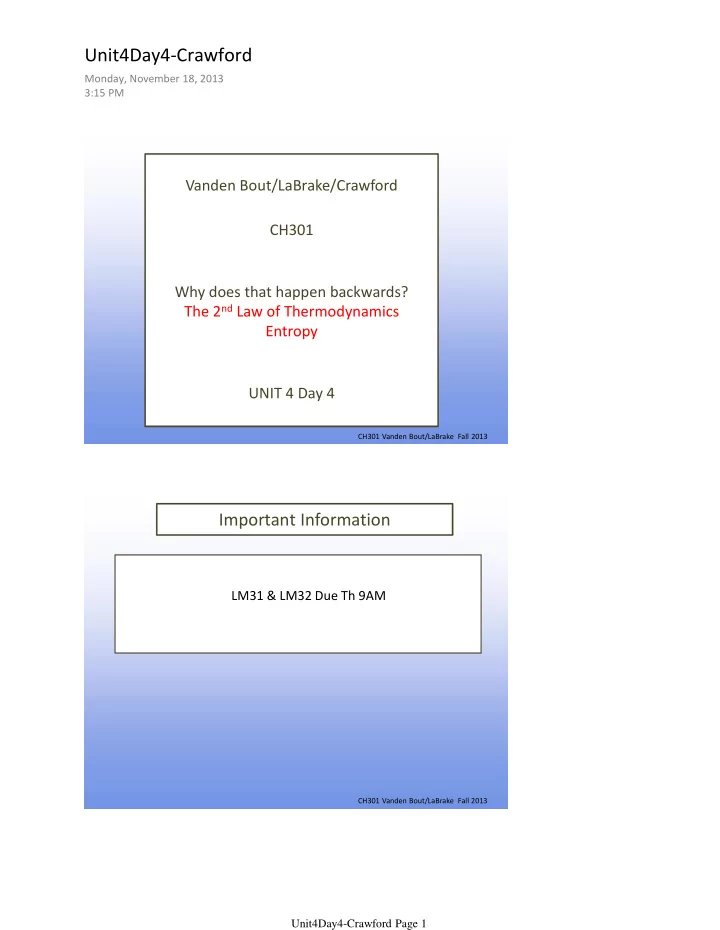
Vanden Bout/LaBrake/Crawford CH301 Why does that happen backwards? The 2nd Law of Thermodynamics Entropy UNIT 4 Day 4

CH301 Vanden Bout/LaBrake Fall 2013

Important Information

LM31 & LM32 Due Th 9AM

Unit4Day4-Crawford

Monday, November 18, 2013 3:15 PM Unit4Day4-Crawford Page 1

slide-2
SLIDE 2

CH301 Vanden Bout/LaBrake Fall 2013

What are we going to learn today?

Second Law of Thermodynamics Concept of Entropy

CH301 Vanden Bout/LaBrake Fall 2013

Which of the following is not a “formation” reaction? A) Mg(s) + ½ O2(g)  MgO(s) B) ½ N2(g) + 3/2 H2(g)  NH3(g) C) NaF(s) + Li(s)  LiF(s) + Na(s) D) Li(s) + ½ F2(g)  LiF(s)

QUIZ: iClicker Question 1

Which of the following methods would be expected to give the same value of ΔHrxn? 1. Computation from bond energy data 2. Computation from heats of formation data 3. Computation from ΔHrxn of reactions that can be manipulated by adding to get the desired net reaction using Hess’s law.

QUIZ: iClicker Question 2

Unit4Day4-Crawford Page 2

slide-3
SLIDE 3

CH301 Vanden Bout/LaBrake Fall 2013

Which of the following methods would be expected to give the same value of ΔHrxn? 1. Computation from bond energy data 2. Computation from heats of formation data 3. Computation from ΔHrxn of reactions that can be manipulated by adding to get the desired net reaction using Hess’s law. A) 1 and 2 B) 1, 2 and 3 C) 2 and 3 D) 1 and 3

CH301 Vanden Bout/LaBrake Fall 2012

Almost every process in the world happens in only one direction (in isolation = “on its own”) Imagine the following situations. Are they spontaneous? Dropping an object Burning logs A gas expanding into the room Heat flow from high T to low T Ice melting in a glass of water

Spontaneity

Unit4Day4-Crawford Page 3

slide-4
SLIDE 4

CH301 Vanden Bout/LaBrake Fall 2013

We will refer to any process that happens in isolation as

  • spontaneous. The forward reaction will happen but the reverse

reaction will never happen. (i.e. The movie played backward doesn’t make sense) How might these processes be reversed? Dropping an object Burning logs A gas expanding into the room Heat flow from high T to low T Ice melting in a glass of water

Spontaneity

CH301 Vanden Bout/LaBrake Fall 2013

The Second Law of Thermodynamics states that any process that happens spontaneously will lead to an increase in the entropy of the universe

The Second Law of Thermodynamics

The entropy of the universe is the total entropy of the system and surroundings.

Entropy

Spontaneous

Unit4Day4-Crawford Page 4

slide-5
SLIDE 5

CH301 Vanden Bout/LaBrake Fall 2013

The entropy of the universe is the total entropy of the system and surroundings. Spontaneous

CH301 Vanden Bout/LaBrake Fall 2013

What is Entropy? What words or ideas pop into your head with respect to Entropy?

Entropy

Entropy is related to the dispersal of energy at a given temperature. The more energy dispersed, the greater the entropy change. The wider the energy dispersal, the greater the entropy change. The lower the temperature, the greater the entropy change for a given amount of energy.

Entropy

Unit4Day4-Crawford Page 5

slide-6
SLIDE 6

CH301 Vanden Bout/LaBrake Fall 2013

lower the temperature, the greater the entropy change for a given amount of energy.

CH301 Vanden Bout/LaBrake Fall 2013

When we drop an object, identify the System Surrounding Initial State Final State

Entropy Examples

CH301 Vanden Bout/LaBrake Fall 2013

When we drop an object, ∆Stotal is A.> 0

  • B. = 0
  • C. < 0

D.No way to know

POLL: iClicker Question 3

Unit4Day4-Crawford Page 6

slide-7
SLIDE 7

CH301 Vanden Bout/LaBrake Fall 2013

For a process that is spontaneous

Spontaneity

CH301 Vanden Bout/LaBrake Fall 2013

When a gas expands in a vacuum, ∆Stotal > 0 and ∆Ssystem is A.> 0

  • B. = 0
  • C. < 0

D.No way to know

POLL: iClicker Question 4

Unit4Day4-Crawford Page 7

slide-8
SLIDE 8

CH301 Vanden Bout/LaBrake Fall 2013

When a gas expands in a vacuum, identify the System Surrounding Initial State Final State

Entropy Examples

CH301 Vanden Bout/LaBrake Fall 2013

A container of gas was opened and the gas was allowed to fill the

  • room. In this example, the system is the gas and the surroundings

is the room. Increasing volume leads to an increase in entropy. The process was spontaneous The surroundings are unchanged The expansion led to an increase in the entropy of the system

Entropy Examples

Unit4Day4-Crawford Page 8

slide-9
SLIDE 9

CH301 Vanden Bout/LaBrake Fall 2013

Why does the increase in volume lead to an increase in entropy? We must use a microscopic view of dispersal of energy. Unfortunately, it is difficult to “visualize” energy, but it is easy to visualize molecules. States of highest entropy are simply the most likely to happen

Entropy

CH301 Vanden Bout/LaBrake Fall 2013

Let’s imagine the gas in our previous example, where the gas is in a container with a left-hand side and a right-hand side What if we only had one gas particle? There are two possibilities, both of which are equally likely

Microstates

What if we only had two gas particles?

Microstates

Unit4Day4-Crawford Page 9

slide-10
SLIDE 10

CH301 Vanden Bout/LaBrake Fall 2013

What if we only had two gas particles? There are four possibilities, but they are no longer equally likely A microstate is the specific way in which we can arrange the energy of a system.

Microstates

CH301 Vanden Bout/LaBrake Fall 2013

What if we only had four gas particles? There are five possibilities. It is highly unlikely that we will find all the molecules entirely on the left or right side. The most likely situation will have two particles on each side.

Microstates

Ω = 1 Ω = 4 Ω =6 Ω =4 Ω Unlikely Likely Very Likely

Microstates

Unlikely Likely Very Likely Unlikely Likely Very Likely Unlikely Likely Very Likely

Unit4Day4-Crawford Page 10

slide-11
SLIDE 11

CH301 Vanden Bout/LaBrake Fall 2013

Ω Ω = 4 Ω =6 Ω =4 Ω =1 Unlikely Likely Very Likely Unlikely Likely Very Likely Unlikely Likely Very Likely Unlikely Likely Very Likely

CH301 Vanden Bout/LaBrake Fall 2013

What if we only had Avogadro’s number of particles? It is extremely unlikely that we will find all the molecules entirely

  • n the left or right side. The most likely situation will have half of

the particles on each side.

Microstates

Unit4Day4-Crawford Page 11

slide-12
SLIDE 12

CH301 Vanden Bout/LaBrake Fall 2013

Entropy is measure of the number of equivalent microstates. More volume more microstates more entropy More molecules more microstates more entropy Higher temperature more microstates more entropy Higher Energy more microstates more entropy

Entropy and Microstates

CH301 Vanden Bout/LaBrake Fall 2013

It is harder to visualize microstates for energy, but it is the same idea, where more microstates means higher entropy Macroscopically, we can quantify this with heat flow The heat will always be the reversible heat for the processes we investigate in this course

Entropy and Microstates

When ice melts, identify the System Surrounding

Entropy Examples

Unit4Day4-Crawford Page 12

slide-13
SLIDE 13

CH301 Vanden Bout/LaBrake Fall 2013

When ice melts, identify the System Surrounding Initial State Final State

Entropy Examples

CH301 Vanden Bout/LaBrake Fall 2013

When ice melts, identify the System – water (solid + liquid), T = 273 K Surrounding – the room, T = 298 K Initial State – solid Final State – liquid

Entropy Examples

When ice melts,

  • A. | ∆Ssys| > | ∆Ssurr|
  • B. | ∆Ssys| < | ∆Ssurr|
  • C. | ∆Ssys| = | ∆Ssurr|
  • D. Not enough information

POLL: iClicker Question 5

Unit4Day4-Crawford Page 13

slide-14
SLIDE 14

CH301 Vanden Bout/LaBrake Fall 2013

∆ > | ∆

  • B. | ∆Ssys| < | ∆Ssurr|
  • C. | ∆Ssys| = | ∆Ssurr|
  • D. Not enough information

CH301 Vanden Bout/LaBrake Fall 2013

We typically define heat from the perspective of the system. Therefore, when we look at changes for the surroundings, we see the relationship is

Entropy of the Surroundings

CH301 Vanden Bout/LaBrake Fall 2013

When methanol is burned, identify the System Surrounding Initial State Final State

Entropy Examples

Unit4Day4-Crawford Page 14

slide-15
SLIDE 15

CH301 Vanden Bout/LaBrake Fall 2013

When methanol is burned, identify the System – reactants and products Surrounding – the room, T = 298 K Initial State – Methanol and Oxygen Final State – Carbon Dioxide and Water

Entropy Examples

CH301 Vanden Bout/LaBrake Fall 2013

POLL: iClicker Question 6

When methanol is burned, ∆Ssurroundings is A.> 0

  • B. = 0
  • C. < 0

D.No way to know

POLL: iClicker Question 7

When methanol is burned, ∆Ssystem is A.> 0

  • B. = 0
  • C. < 0

Unit4Day4-Crawford Page 15

slide-16
SLIDE 16

CH301 Vanden Bout/LaBrake Fall 2013

POLL: iClicker Question 7

When methanol is burned, ∆Ssystem is A.> 0

  • B. = 0
  • C. < 0

D.No way to know

CH301 Vanden Bout/LaBrake Fall 2013

Ba(OH)2 • 4H2O(s) + NaNO3(s)  Liquid

Demonstration

Unit4Day4-Crawford Page 16

slide-17
SLIDE 17

CH301 Vanden Bout/LaBrake Fall 2013

POLL: iClicker Question 8

In the demonstration, ∆Ssystem is A.> 0

  • B. = 0
  • C. < 0

D.No way to know

CH301 Vanden Bout/LaBrake Fall 2013

Stretched vs. Relaxed Rubber Bands

Demonstration

Unit4Day4-Crawford Page 17

slide-18
SLIDE 18

CH301 Vanden Bout/LaBrake Fall 2013

POLL: iClicker Question 9

For the process of releasing a stretched rubber band to a relaxed rubber band, ∆Ssys is A.> 0

  • B. = 0
  • C. < 0

D.No way to know

CH301 Vanden Bout/LaBrake Fall 2013

Understand the concept of entropy, S, and change in entropy ΔS. Understand the concept of change in entropy of a system, surroundings and universe.

Learning Outcomes

Unit4Day4-Crawford Page 18