Unit 3 Binary Representation ANALOG VS. DIGITAL 3.3 3.4 Analog - - PowerPoint PPT Presentation

unit 3
SMART_READER_LITE
LIVE PREVIEW

Unit 3 Binary Representation ANALOG VS. DIGITAL 3.3 3.4 Analog - - PowerPoint PPT Presentation

3.1 3.2 Unit 3 Binary Representation ANALOG VS. DIGITAL 3.3 3.4 Analog vs. Digital Analog vs. Digital The analog world is based on Q. Which is better? continuous events. A. Depends on what you are trying to do. Observations


slide-1
SLIDE 1

3.1

Unit 3

Binary Representation

3.2

ANALOG VS. DIGITAL

3.3

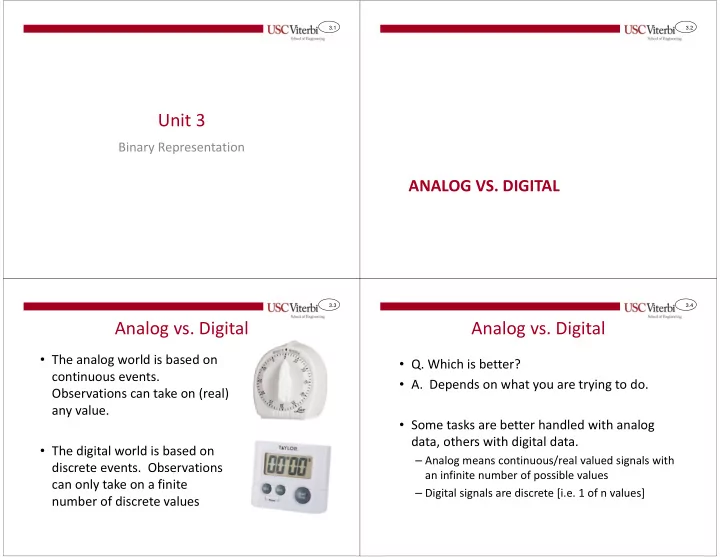
Analog vs. Digital

  • The analog world is based on

continuous events. Observations can take on (real) any value.

  • The digital world is based on

discrete events. Observations can only take on a finite number of discrete values

3.4

Analog vs. Digital

  • Q. Which is better?
  • A. Depends on what you are trying to do.
  • Some tasks are better handled with analog

data, others with digital data.

– Analog means continuous/real valued signals with an infinite number of possible values – Digital signals are discrete [i.e. 1 of n values]

slide-2
SLIDE 2

3.5

Analog vs. Digital

  • How much money is in my checking account?

– Analog: Oh, some, but not too much. – Digital: $243.67

3.6

Analog vs. Digital

  • How much do you love me?

– Analog: I love you with all my heart!!!! – Digital: 3.2 x 10³ MegaHearts

3.7

The Real (Analog) World

  • The real world is inherently analog.
  • To interface with it, our digital systems need

to:

– Convert analog signals to digital values (numbers) at the input. – Convert digital values to analog signals at the

  • utput.
  • Analog signals can come in many forms

– Voltage, current, light, color, magnetic fields, pressure, temperature, acceleration, orientation

3.8

Digital is About Numbers

  • In a digital world, numbers are used to represent all

the possible discrete events (i.e. ______ possibilities)

– Numerical values (5.7, 1923.8, …) – Computer instructions (ADD, SUB, BLE, …) – Characters ('a', 'b', 'c', …) – Conditions (on, off, ready, paper jam, …)

  • Numbers allow for easy manipulation

– Add, multiply, compare, store, …

  • Results are repeatable

– Each time we add the same two number we get the same result

slide-3
SLIDE 3

3.9

DIGITAL REPRESENTATION

3.10

Interpreting Binary Strings

  • Given a string of 1’s and 0’s, you need to know the

representation system being used, before you can understand the value of those 1’s and 0’s.

  • ______________________________________

01000001 = ?

6510 ‘A’ASCII 41BCD

Unsigned Binary system ASCII system BCD System

3.11

Binary Representation Systems

  • Integer Systems

– Unsigned

  • Unsigned (Normal) binary

– Signed

  • Signed Magnitude
  • 2’s complement
  • Excess-N*
  • 1’s complement*
  • Floating Point*

– For very large and small (fractional) numbers

  • Codes

– Text

  • ASCII / Unicode

– Decimal Codes

  • BCD (Binary Coded Decimal)

/ (8421 Code)

* = Not fully covered in this class

3.12

OVERVIEW

slide-4
SLIDE 4

3.13

4 Skills

  • We will teach you 4 skills that you should

know and be able to apply with confidence

– Convert a number in any base (base r) to decimal (base 10) – Understand the finite number of combinations that can be made with n bits (binary digits) and its implication for codes including ASCII and Unicode – Convert a decimal number (base 10) to binary – Use the shortcut for conversion between binary (base 2) and hexadecimal (base 16)

3.14

BASE R TO BASE 10

Using positional weights/place values

3.15

Number Systems

  • Number systems consist of
  • 1. ________________
  • 2. ___ coefficients [__________]
  • Human System: Decimal (Base 10):

0,1,2,3,4,5,6,7,8,9

  • Computer System: Binary (Base 2): 0,1
  • Human systems for working with computer systems

(shorthand for human to read/write binary)

– _____________________________________ – _____________________________________

3.16

Skill 1: Converting Base r to Decimal

  • 934.710 = 9 3 4 . 7 =
  • 1101.12 = 1 1 0 1 . 1 =
  • 3B.42 = 3 B . 4 =

Main Point: To convert any base to decimal (base 10), apply the implicit place values (weights) which are just the powers of the base and sum each digit times its place value.

slide-5
SLIDE 5

3.17

General Conversion From Base r to Decimal

  • A number in base r has place values/weights

that are the powers of the base

  • Denote the coefficients as: ai

Left-most digit = Most Significant Digit (MSD) Right-most digit = Least Significant Digit (LSD)

Nr => _______=> D10

(a3a2a1a0.a-1a-2)r = a3*r3 + a2*r2 + a1*r1 + a0*r0 + a-1*r-1 + a-2*r-2

Number in base r Decimal Equivalent

(1001.01)r = 1*23 + 0*22 + 0*21 + 1*20 + 0*2-1 + 1*2-2

Generalized approach: Example:

3.18

Examples

(746)8 = (1A5)16 = (AD2)16 =

3.19

Binary Examples

(1001.1)2 = (10110001)2 =

3.20

Powers of 2

512 256 128 64 32 16 8 4 2 1 1024

  • It helps to memorize the first 11 powers of 2

20 = 1 21 = 2 22 = 4 23 = 8 24 = 16 25 = 32 26 = 64 27 = 128 28 = 256 29 = 512 210 = 1024

slide-6
SLIDE 6

3.21

Skill 2: Unique Combinations

  • Given n digits of base r, how many unique numbers can be

formed? __ What is their range? [__________]

  • Use the examples below to generalize the relationship:

Main Point: Given n digits of base r, ___ unique numbers can be made with the range [________]

2-digit, decimal numbers (r=10, n=2) 3-digit, decimal numbers (r=10, n=3) 4-bit, binary numbers (r=2, n=4) 6-bit, binary numbers (r=2, n=6)

0-9 0-9 0-1 0-1 0-1 0-1 3.22

Approximating Large Powers of 2

  • Often need to find decimal

approximation of a large powers of 2 like 216, 232, etc.

  • Use following approximations:

– 210 ≈ _________________ – 220 ≈ _________________ – 230 ≈ _________________ – 240 ≈ _________________

  • For other powers of 2, decompose

into product of 210 or 220 or 230 and a power of 2 that is less than 210

– 16-bit half word: 64K numbers – 32-bit word: 4G numbers – 64-bit dword: 16 million trillion numbers

216 = 26 * 210 ≈ 224 = 228 = 232 =

3.23

BASE 10 TO BASE 2 OR BASE 16

"Making change"

3.24

Skill 3: Decimal to Base r

  • To convert a decimal number, x, to binary:

– Only coefficients of 1 or 0. So simply find place values that add up to the desired values, starting with larger place values and proceeding to smaller values and place a 1 in those place values and 0 in all others – Similar to how one would _____________________

16 8 4 2 1

2510 =

32
slide-7
SLIDE 7

3.25

Decimal to Unsigned Binary

7310=

128 64 32 16 8 4 2 1 .5 .25 .125 .0625 .03125

8710= 14510= 0.62510=

3.26

Decimal to Another Base

  • To convert a decimal number, x, to base r:

– Use the place values of base r (powers of r). Starting with largest place values, fill in coefficients that sum up to desired decimal value without going over.

16 1

7510 =

256 hex

3.27

SHORTHAND FOR BINARY

Shortcuts for Converting Binary (r=2), Hexadecimal (r=16) and Octal (r=8)

3.28

Binary, Octal, and Hexadecimal

  • Octal (base 8 = 23)
  • 1 Octal digit ( _ )8 can

represent: ________

  • 3 bits of binary (_ _ _)2

can represent: 000-111 = ________

  • Conclusion…

__Octal digit = __ bits

  • Hex (base 16=24)
  • 1 Hex digit ( _ )16 can

represent: 0-F (_____)

  • 4 bits of binary

(_ _ _ _)2 can represent: 0000-1111= ______

  • Conclusion…

__ Hex digit = ___ bits

slide-8
SLIDE 8

3.29

Skill 4: Binary to Octal or Hex

  • Make groups of 3 bits

starting from radix point and working outward

  • Add 0’s where necessary
  • Convert each group of 3

to an octal digit

101001110.11 101001110.11

  • Make groups of 4 bits

starting from radix point and working outward

  • Add 0’s where

necessary

  • Convert each group of 4

to an octal digit

4 2 1 4 2 1 4 2 1 8 4 2 1 8 4 2 1

3.30

Octal or Hex to Binary

  • Expand each octal digit

to a group of 3 bits

  • Expand each hex digit

to a group of 4 bits 317.28 D93.816

4 2 1 8 4 2 1 4 2 1 4 2 1 4 2 1 8 4 2 1 8 4 2 1 8 4 2 1

3.31

Hexadecimal Representation

  • Since values in modern computers are many bits, we

use hexadecimal as a shorthand notation (4 bits = 1 hex digit)

– 11010010 = D2 hex or 0xD2 if you write it in C/C++ – 0111011011001011 = 76CB hex or 0x76CB if you write it in C/C++

3.32

BINARY CODES

ASCII & Unicode

slide-9
SLIDE 9

3.33

Binary Representation Systems

  • Integer Systems

– Unsigned

  • Unsigned (Normal) binary

– Signed

  • Signed Magnitude
  • 2’s complement
  • 1’s complement*
  • Excess-N*
  • Floating Point*

– For very large and small (fractional) numbers

  • Codes

– Text

  • ASCII / Unicode

– Decimal Codes

  • BCD (Binary Coded Decimal)

/ (8421 Code)

* = Not covered in this class

3.34

Binary Codes

  • Using binary we can represent any kind of

information by coming up with a code

  • Using n bits we can represent 2n distinct items

Colors of the rainbow:

  • Red = 000
  • Orange = 001
  • Yellow = 010
  • Green = 100
  • Blue = 101
  • Purple = 111

Letters:

  • ‘A’ = 00000
  • ‘B’ = 00001
  • ‘C’ = 00010

. . .

  • ‘Z’ = 11001

3.35

BCD (If Time Permits)

  • Rather than convert a decimal number to binary which may lose

some precision (i.e. 0.110 = infinite binary fraction), BCD represents each decimal digit as a separate group of bits (exact decimal precision)

– Each digits is represented as a ___________ number (using place values 8,4,2,1 for each dec. digit) – Often used in financial and other applications where decimal precision is needed

(439)10

BCD Representation:

This is the Binary Coded Decimal (BCD) representation of 439

Important: Some processors have specific instructions to operate on #’s represented in BCD Unsigned Binary Rep.:

1101101112

This is the binary representation of 439 (i.e. using power of 2 place values) 3.36

ASCII Code

  • Used for representing text characters
  • Originally 7-bits but usually stored as 8-bits = 1-

byte in a computer

  • Example:

– "Hello\n"; – Each character is converted to ASCII equivalent

  • ‘H’ = 0x48, ‘e’ = 0x65, …
  • \n = newline character is represented by either one or two ASCII

character

slide-10
SLIDE 10

3.37

ASCII Table

LSD/MSD 1 2 3 4 5 6 7 NULL DLW SPACE @ P ` p 1 SOH DC1 ! 1 A Q a q 2 STX DC2 “ 2 B R b r 3 ETX DC3 # 3 C S c s 4 EOT DC4 $ 4 D T d t 5 ENQ NAK % 5 E U e u 6 ACK SYN & 6 F V f v 7 BEL ETB ‘ 7 G W g w 8 BS CAN ( 8 H X h x 9 TAB EM ) 9 I Y i y A LF SUB * : J Z j z B VT ESC + ; K [ k { C FF FS , < L \ l | D CR GS

  • =

M ] m } E SO RS . > N ^ n ~ F SI US / ? O _

  • DEL

'M' = 0x4D = 0100 1101

3.38

UniCode

  • ASCII can represent only the English

alphabet, decimal digits, and punctuation

– 7-bit code => 27 = _____ characters – It would be nice to have one code that represented more alphabets/characters for common languages used around the world

  • Unicode

– Up to 32-bit Code => _______ combinations – 137,000 character defined for many languages – Used by Java as standard character code

Unicode hex value (i.e. FB52 => 1111101101010010)

3.39

Summary

  • Convert Base r to Base 10

– Apply place values (powers of r) – Nr => Σi(ai*ri) => D10

  • Convert Base 10 to Base r

– "Make change" using powers of r as the weights/denominations

  • Base 2 (Bin)  Base 16 (Hex)

– Group or expand 1 hex digit to/from 4 bits – Start at binary point and work outward

3.40

UNUSED

slide-11
SLIDE 11

3.41

Anatomy of a Decimal Number

  • A number consists of a string of explicit coefficients (digits).
  • Each coefficient has an implicit place value depending on its

position in the number and is a ___________ of the base.

  • The value of a decimal number (a string of decimal

coefficients) is the sum of each coefficient times it place value

Explicit coefficients Implicit place values

radix (base)

(934)10 = 9*___ + 3*___ + 4*____ = _____ (3.52)10 = 3*____ + 5*____ + 2*____ = ____

3.42

Anatomy of a Binary Number

  • Same as decimal but now the coefficients

are 1 and 0 and the place values are the powers of 2 (1011)2 = 1*__ + 0*_ + 1*__ + 1*__

Least Significant Bit (LSB) Most Significant Digit (MSB) coefficients place values = powers of 2 radix (base)