Unifying the mechanics of continua, cracks, and particles Stewart - - PowerPoint PPT Presentation

β–Ά
unifying the mechanics of continua cracks and particles
SMART_READER_LITE
LIVE PREVIEW

Unifying the mechanics of continua, cracks, and particles Stewart - - PowerPoint PPT Presentation

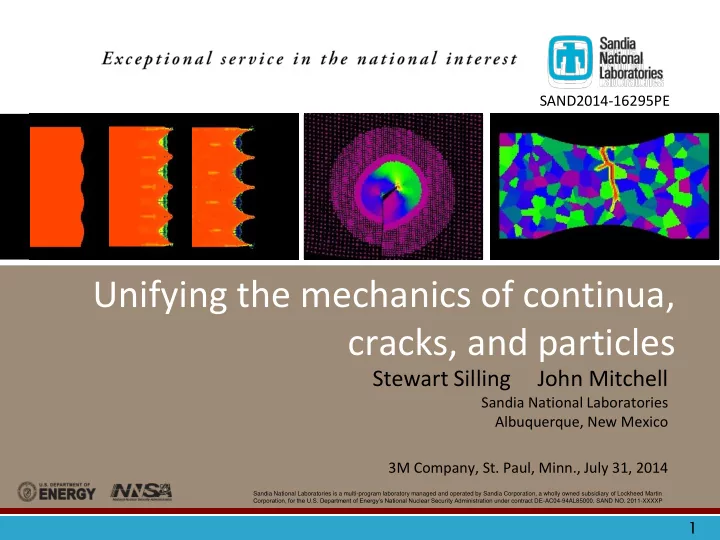
SAND2014-16295PE Photos placed in horizontal position with even amount of white space between photos and header Unifying the mechanics of continua, cracks, and particles Stewart Silling John Mitchell Sandia National Laboratories


slide-1
SLIDE 1

Photos placed in horizontal position with even amount of white space between photos and header

Sandia National Laboratories is a multi-program laboratory managed and operated by Sandia Corporation, a wholly owned subsidiary of Lockheed Martin Corporation, for the U.S. Department of Energy’s National Nuclear Security Administration under contract DE-AC04-94AL85000. SAND NO. 2011-XXXXP

Unifying the mechanics of continua, cracks, and particles

Stewart Silling John Mitchell

Sandia National Laboratories Albuquerque, New Mexico 3M Company, St. Paul, Minn., July 31, 2014 SAND2014-16295PE 1

slide-2
SLIDE 2

Outline

  • Purpose of peridynamics
  • Basic equations
  • Examples
  • Mesoscale damage modeling
  • Mechanics of membranes and adhesion
  • Impact and penetration
  • Software (JM)
  • Material models (JM)

2

slide-3
SLIDE 3

What should be modeled as a classical continuum?

3

Augustin-Louis Cauchy, 1840 (image: Library of Congress)

  • Commercial finite element codes approximate the equations of classical continuum mechanics.
  • Assumes a continuous body under smooth deformation.
  • When is this the right approximation?

Carbon nanotubes (image: nsf.gov) Fragmented glass (image: Washington Glass School) Hypervelocity impact onto ceramic fabric (image: 3m.com)

𝛼 βˆ™ 𝜏 + 𝑐 = 0

slide-4
SLIDE 4

Purpose of peridynamics

  • To unify the mechanics of continuous and discontinuous media within a single, consistent

set of equations.

Continuous body Continuous body with a defect Discrete particles

  • Why do this?
  • Avoid coupling dissimilar mathematical systems (A to C).
  • Model complex fracture patterns.
  • Communicate across length scales.

4

slide-5
SLIDE 5

Peridynamics: Who’s interested?

  • Research has been conducted at:
  • MIT
  • Caltech
  • Harvard University
  • University of Illinois, Urbana-Champaign
  • University of New Mexico
  • University of Arizona
  • University of California, Berkeley
  • University of Texas, San Antonio
  • University of Texas, Austin
  • Penn State University
  • Columbia University
  • University of Alabama
  • Louisiana State University
  • Carnegie Mellon University
  • Michigan State University
  • Florida State University
  • University of Nebraska, Lincoln
  • … others worldwide

5

  • Sponsors include:
  • Army
  • Air Force
  • Navy
  • Department of Energy
  • Boeing
  • Big oil companies
  • Intel
  • Raytheon
  • NSF
  • Orica USA Corp

Papers Year 2014 2000 380 Total papers citing the first paper on peridynamics

slide-6
SLIDE 6

Peridynamics basics: Horizon and family

6

slide-7
SLIDE 7

Strain energy at a point

7 Continuum Discrete particles Discrete structures Deformation

  • Key assumption: the strain energy density at 𝐲 is determined by the

deformation of its family.

slide-8
SLIDE 8

Potential energy minimization yields the peridynamic equilibrium equation

8

slide-9
SLIDE 9

Material modeling: What determines bond forces?

9

In state notation: 𝐠 𝐫. 𝐲 = 𝐔 𝐲 𝐫 βˆ’ 𝐲 βˆ’ 𝐔[𝐫] 𝐲 βˆ’ 𝐫

slide-10
SLIDE 10

Bond based materials

  • If each bond response is independent of the others, the resulting material model is

called bond-based.

  • The material model is then simply a graph of bond force density vs. bond strain.
  • Main advantage: simplicity.
  • Main disadvantage: restricts the material response.
  • Poisson ratio always = 1/4.

Bond force density Bond strain

10

slide-11
SLIDE 11

Damage due to bond breakage

  • Recall: each bond carries a force.
  • Damage is implemented at the bond level.
  • Bonds break irreversibly according to some criterion.
  • Broken bonds carry no force.
  • Examples of criteria:
  • Critical bond strain (brittle).
  • Hashin failure criterion (composites).
  • Gurson (ductile metals).

Bond strain Bond force density Bond breakage

Critical bond strain damage model 11

slide-12
SLIDE 12

Bond breakage leads to autonomous crack growth

Broken bond Crack path

  • When a bond breaks, its load is shifted to its neighbors, leading to progressive failure.
slide-13
SLIDE 13

EMU numerical method

13

  • Integral is replaced by a finite sum: resulting method is meshless and Lagrangian.
slide-14
SLIDE 14

Practical issues caused by nonlocality

14

  • Material properties change near free surfaces.
  • Solutions: correction factor, position-dependent material models.
  • Zero energy modes in certain material models.
  • Solution: apply correction forces.
  • Large number of interactions result in slow computations.
  • Solutions: better quadrature, local-nonlocal coupling.

Crack Peridynamic Standard finite elements

slide-15
SLIDE 15

Examples of validation for peridynamics

15

  • Single crack brittle energy balance
  • 3-point bend test
  • Dynamic fracture
  • Crack growth velocity
  • Trajectory
  • Branching
  • Impact into concrete and aluminum
  • Residual velocity
  • Penetration depth
  • Crater size
  • Fatigue
  • S-N curves for aluminum and epoxy
  • Paris law curves for aluminum
  • Composite impact, damage, and fracture
  • Delaminations (compare NDE)
  • Residual strength in OHC, OHT
  • Stress concentration profile in OHT
  • Bird strike loading
  • Lamina tensile fracture

EMU Experiment

slide-16
SLIDE 16

Polycrystals: Mesoscale model*

Large  favors trans-granular fracture.

* * g i

s s ο€½ Ξ²

 = 1  = 4  = 0.25

  • Bonds between grains have properties that characterize the interface.

Bond strain Bond force

* i

s

* g

s

Bond within a grain Interface bond

* Work by F. Bobaru & students (University of Nebraska – Lincoln)

slide-17
SLIDE 17

Dynamic fracture in membranes

17

Early high speed photograph by Harold Edgerton (MIT collection)

http://mit.edu/6.933/www/Fall2000/edgerton/edgerton.ppt

EMU model of a balloon penetrated by a fragment

slide-18
SLIDE 18

Examples: Membranes and thin films

Oscillatory crack path Aging of a film Video 18 Video Environmental fatigue in coatings

slide-19
SLIDE 19

Fracture and debonding of membranes

19

Debond Fracture Substrate Membrane

  • Simulation of peeling illustrates interplay between fracture (tearing) and debonding (peeling).
slide-20
SLIDE 20

Fracture and debonding of membranes

20

  • Debond precedes fracture front.

VIDEOS Two views of the same simulation

slide-21
SLIDE 21

Fracture and debonding of membranes

21

  • Direction of pull strongly affects the amount of debonding ahead of the fracture.

Pull straight up Pull up, forward, and sideways Pull up and forward

Boundary motion

slide-22
SLIDE 22

Modeling impact and penetration: Small arms round into a brittle plate

22

Copper Lead Mild steel

slide-23
SLIDE 23

Small arms round into a brittle plate

23 VIDEO

  • Peridynamic model reproduces large deformation and fragmentation of target.
slide-24
SLIDE 24

Small arms round into a brittle plate

24

77πœˆπ‘‘ 31πœˆπ‘‘ 0πœˆπ‘‘ 13πœˆπ‘‘

slide-25
SLIDE 25

Small arms round into a brittle plate

25 Crater shape and debris Peridynamic damage (broken bonds)

  • Method predicts a reasonable crater shape and crack distribution.
slide-26
SLIDE 26

Multiple hits on a target

26 Crater shape

  • Damage from first hit affects the second.

Damage VIDEO

slide-27
SLIDE 27

Some current research areas

27

  • Penetration mechanics
  • Heirarchical multiscale method and coarse graining
  • Local-nonlocal coupling
  • Material modeling
  • Progressive failure in composites
  • Ductile failure
  • Transition to a production software method
  • Calibration of a peridynamic damage model using molecular dynamics
  • Eulerian version of peridynamics for fluids and fluid-structure interaction
  • Better numerical discretization method
slide-28
SLIDE 28

Summary

28

  • Peridynamics a generalization of traditional continuum mechanics.
  • Equations are compatible with the physical nature of cracks and long-range forces.
  • Cracks nucleate and grow spontaneously.
  • The standard theory (PDEs) is a special case of peridynamics.
  • Applications include:
  • Fracture and fragmentation.
  • Mechanics of membranes and adhesion.
  • Mesoscale & nanoscale.
  • Impact and penetration.
  • Not yet a production tool – users need to understand how it behaves.