Undiagnosed Diseases Network (UDN) Background In 2008, the NIH - - PDF document

undiagnosed diseases network udn
SMART_READER_LITE
LIVE PREVIEW

Undiagnosed Diseases Network (UDN) Background In 2008, the NIH - - PDF document

February 25, 2016 Undiagnosed Diseases Network (UDN) Background In 2008, the NIH established an intramural Undiagnosed Diseases Program (UDP) to aid individuals plagued by longstanding medical conditions that elude medical diagnosis. Since then,


slide-1
SLIDE 1

February 25, 2016

Undiagnosed Diseases Network (UDN)

Background

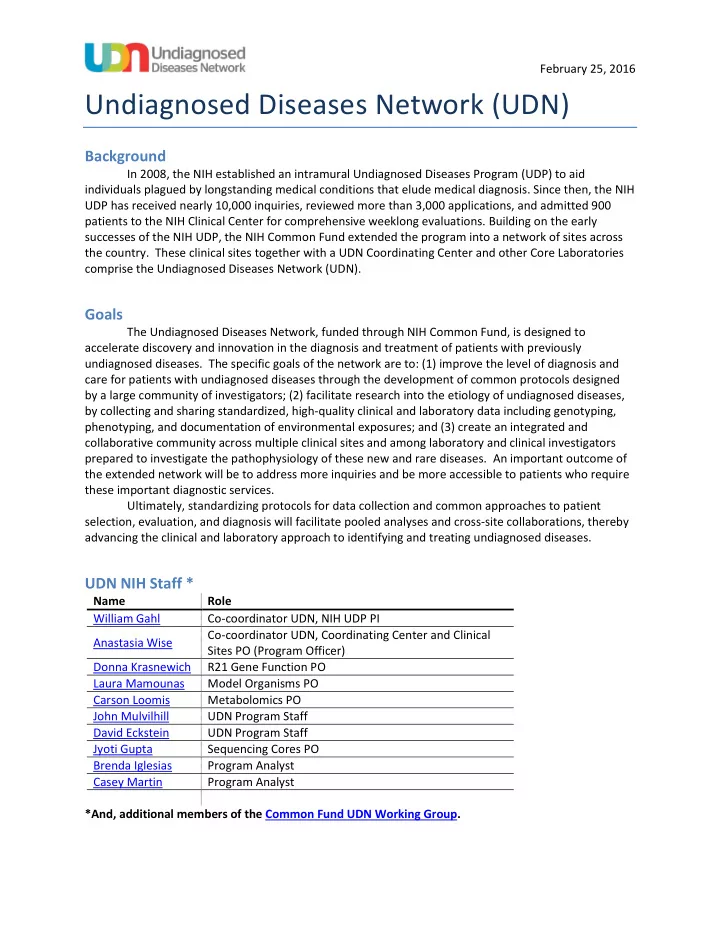
In 2008, the NIH established an intramural Undiagnosed Diseases Program (UDP) to aid individuals plagued by longstanding medical conditions that elude medical diagnosis. Since then, the NIH UDP has received nearly 10,000 inquiries, reviewed more than 3,000 applications, and admitted 900 patients to the NIH Clinical Center for comprehensive weeklong evaluations. Building on the early successes of the NIH UDP, the NIH Common Fund extended the program into a network of sites across the country. These clinical sites together with a UDN Coordinating Center and other Core Laboratories comprise the Undiagnosed Diseases Network (UDN).

Goals

The Undiagnosed Diseases Network, funded through NIH Common Fund, is designed to accelerate discovery and innovation in the diagnosis and treatment of patients with previously undiagnosed diseases. The specific goals of the network are to: (1) improve the level of diagnosis and care for patients with undiagnosed diseases through the development of common protocols designed by a large community of investigators; (2) facilitate research into the etiology of undiagnosed diseases, by collecting and sharing standardized, high-quality clinical and laboratory data including genotyping, phenotyping, and documentation of environmental exposures; and (3) create an integrated and collaborative community across multiple clinical sites and among laboratory and clinical investigators prepared to investigate the pathophysiology of these new and rare diseases. An important outcome of the extended network will be to address more inquiries and be more accessible to patients who require these important diagnostic services. Ultimately, standardizing protocols for data collection and common approaches to patient selection, evaluation, and diagnosis will facilitate pooled analyses and cross-site collaborations, thereby advancing the clinical and laboratory approach to identifying and treating undiagnosed diseases.

UDN NIH Staff *

Name Role William Gahl Co-coordinator UDN, NIH UDP PI Anastasia Wise Co-coordinator UDN, Coordinating Center and Clinical Sites PO (Program Officer) Donna Krasnewich R21 Gene Function PO Laura Mamounas Model Organisms PO Carson Loomis Metabolomics PO John Mulvilhill UDN Program Staff David Eckstein UDN Program Staff Jyoti Gupta Sequencing Cores PO Brenda Iglesias Program Analyst Casey Martin Program Analyst *And, additional members of the Common Fund UDN Working Group.

slide-2
SLIDE 2

Common Fund UDN Working Group co-chairs: Eric Green (NHGRI) and Walter Koroshetz (NINDS); Mary Perry (Office of the Director) is the Common Fund liaison.

UDN at a Glance

 Funding: 11 U-grants, $117.34 M from FY13-17; 20 gene function studies funded (R21s, administrative supplements, and contracts)  UDN Working Groups (WG) and Committees meet regularly to establish communication and provide guidance for efficient operation for the network: 7 WGs (Billing, Biospecimen & Biorepository, Clinical Protocol with Utility and Utilization, Site Operations, and Surveys as subgroups, Genetic Counseling & Testing, Metabolomics, Model Organisms, and Sequencing) 2 Committees (Case Review and Publications)  NIH Press releases:

  • HMS to Oversee Undiagnosed Diseases Network (1/7/14)
  • NIH names new clinical sites in Undiagnosed Diseases Network (7/1/14)
  • Baylor College of Medicine, Medical College of Wisconsin to conduct DNA sequencing

for Undiagnosed Diseases Network (9/29/14)

  • Undiagnosed Diseases Network launches online application portal (9/16/15)

 Coordinating Center press releases:

  • UDN Webpage

 UDN Patient Assistance Fund: NORD

Funding

Funding for the UDN comes from the Common Fund and includes establishment of training programs, the establishment of the network comprising seven clinical sites (including support for the

  • ngoing intramural NIH UDP), a coordinating center, centralized core lab services, and gene function

studies conducted by external scientific collaborators. Initiative FY2013 FY2014 FY2015 FY2016 FY2017 Total Intramural NIH UDP* $9.68 M $9.37 M $8.52 M $7.90 M $7.45 M $42.92 M Coordinating Center $0.00 M $2.44 M $2.59 M $2.50 M $2.50 M $10.03 M Clinical Sites $0.00 M $4.80 M $10.28 M $14.0 M $14.0 M $43.08 M Model Organisms Screening Center $0.00 M $0.00 M $1.00 M $0.75 M $0.75 M $2.50 M Metabolomics Core $0.00 M $0.00 M $0.90 M $0.50 M $0.50 M $1.9 M DNA Sequencing Core $0.00 M $0.88 M $3.72 M $1.40 M $1.40 M $7.40 M Gene Function Studies $0.39 M $1.33 M $2.31M $3.06 M $2.26 M $9.35 M Central Biorepository $0.00 M $0.00 M $0.00 M $0.07 M $0.09 M $0.16 M TOTAL $10.07 M $18.82 M $29.32 M $30.18 M $28.95 M $117.34 M * “Intramural NIH UDP” captures all intramural funds including the NIH Clinical Site, Gene Function Studies, and training. All other initiatives are extramural funds only.

slide-3
SLIDE 3

RFAs

Name ID

Undiagnosed Diseases Gene Function Research (R21) RFA-RM-15-004 Metabolomics Core for the Undiagnosed Diseases Network (UDN) (U01) RFA-RM-15-001 Model Organisms Screening Center for the Undiagnosed Diseases Network (UDN) (U54) RFA-RM-14-016 Undiagnosed Diseases Gene Function Research (R21) RFA-RM-14-005 DNA Sequencing Core for an Undiagnosed Diseases Network (UDN) (U01) RFA-RM-13-018 Clinical Sites for an Undiagnosed Diseases Network (UDN) (U01) RFA-RM-13-004 Undiagnosed Diseases Gene Function Research (R21) RFA-RM-13-003 Coordinating Center for an Undiagnosed Diseases Network (UDN) (U01) RFA-RM-12-020 Gene Function Studies to Investigate Rare and Undiagnosed Diseases (Admin Supplement) PA-13-076

UDN sites

Principal Investigator Institution Title Role Mechanism Isaac Kohane, Rachel Ramoni, and Alexa McCray Harvard Medical School Coordinating Center for the Undiagnosed Diseases Network Coordinating Center U01 Brendan Lee Baylor College of Medicine BCM Clinical Site for an Undiagnosed Diseases Network Clinical Site U01 Vandana Shashi and David Goldstein Duke University with Columbia University An Integrated and Diverse Genomic Medicine Program for Undiagnosed Diseases Clinical Site U01 Joseph Loscalzo Harvard Teaching Hospitals (including Boston Children’s Hospital, Brigham and Women’s Hospital, and Massachusetts General) Center for Integrated Approaches to Undiagnosed Diseases Clinical Site U01 Euan Ashley, Jonathan Bernstein and Paul Fisher Stanford University Stanford Center for Undiagnosed Diseases Clinical Site U01 Eric Vilain, Katrina Dipple, Stanley Nelson and Christina Palmer University of California, Los Angeles UCLA Clinical Site for the Investigation of Undiagnosed Disorders Clinical Site U01 John Phillips and John Newman Vanderbilt University Medical Center Vanderbilt Center for Undiagnosed Diseases Clinical Site U01 William Gahl and Cynthia Tifft National Institutes of Health NIH UDP for the Undiagnosed Diseases Network Clinical Site Intramural Christine Eng Baylor College of Medicine Clinical Sequencing Core Facility for the Undiagnosed Diseases Network Sequencing Core U01 Howard Jacob Hudson Alpha with Ilumina Clinical Genome Wide Sequencing Core for the Undiagnosed Disease Network Sequencing Core U01 Thomas Metz and David Koeller Battelle Pacific Northwest Lab with Oregon Health and Science University Metabolomics for the Undiagnosed Diseases Network Metabolomics U01 Hugo Bellen Baylor College of Medicine Model Organisms Screening MOSC U54

slide-4
SLIDE 4

Center for the Undiagnosed Diseases Network John Phillips and Joy Cogan Vanderbilt University Medical Center Vanderbilt Center for Undiagnosed Diseases Central Biorepository Administrative supplement

Accomplishments

The overall goal of the UDN is to expand the success of the NIH Undiagnosed Diseases Program into the Undiagnosed Diseases Network, composed of a Coordinating Center, seven Clinical Sites including the NIH UDP, and five cores (Sequencing, Model Organisms, Metabolomics, and Central Biorepository). The network will aid in the diagnosis of rare and new diseases, advance laboratory and clinical research, enhance collaboration among laboratory and clinical researchers, and share resulting data and approaches throughout the scientific and clinical communities. Coordinating Center: Harvard Medical School  Serves as a resource to assist in the creation, support, inter-site communication and management of the UDN  Developed Gateway website for patients to apply to the UDN  Assigns patients to a Clinical Site to receive a UDN clinical evaluation  Promotes collaboration and data sharing by posting cases in dbGaP and other relevant databases Clinical Sites: Harvard Teaching Hospitals, Duke University, NIH-UDP, Vanderbilt University Medical Center, University of California Los Angeles, Stanford Medicine, Baylor College of Medicine  Accept patients regardless of insurance, pediatrics, specialty, or residence  Conduct intensive phenotypic 1-week clinical evaluation with cross-disciplinary communication  Collect samples for additional research by other UDN cores or outside investigators Sequencing Cores: Baylor College of Medicine and Hudson Alpha with Illumina  Centralize DNA sequencing for the UDN  Perform exome or genome sequencing, and provide analytic clinical reports for Clinical Sites Model Organisms Screening Center: Baylor College of Medicine with Oregon Health and Science University  Evaluates the pathogenicity and function of gene variants identified by the UDN  Established a screening platform with Drosophila and zebrafish Metabolomics: Battelle Pacific Northwest Laboratories with Oregon Health and Science University  Augments clinical and laboratory capacity of the UDN and assists in the diagnosis of patients  Provides expertise with comprehensive biochemical analytic methods, analyses, technologies, and metabolomics to the UDN  Provides untargeted metabolomics tools to identify quantitative and qualitative changes in metabolites Central Biorepository: Vanderbilt University Medical Center  Facilitates research by UDN and non-UDN investigators  Provides easy and controlled access to biospecimens for UDN and non-UDN investigators R21 Gene Function  Conducts molecular, cell biologic or model organism studies of individual genes or gene networks identified by clinical sequencing of well phenotyped individuals from the NIH UDP.  Eight Gene Function administrative supplements (PA-13-076) have been funded; three by the NIH Common Fund, one each by NINDS and NIMH and three by contract from UDP. Twelve Gene Function Developmental Research Grant Awards (RFA-RM-13-003 and RFA-RM-14-005) have also been funded, 11 by the Common Fund and one by NINDS.

slide-5
SLIDE 5

External Scientific Advisors

External scientific advisors will provide guidance to NIH staff. External Scientific Advisors Institution Catherine DeAngelis Johns Hopkins University Kimberly Doheny Johns Hopkins University Stephen Kingsmore Rady Children’s Hospital Johnathon Mink University of Rochester Medical Center Maren Scheuner Veteran’s Administration-Greater Los Angeles Healthcare System Marc Williams Geisinger Health System

UDN Timeline

Site FOA release date Budget: start/end dates Coordination Center November 2012 Dec 20, 2013 – Nov 30, 2017 Clinical Sites January 2013 July 1, 2014 – March 31, 2018 Sequencing Cores August 2013 August 2014 – August 31, 2018 Metabolomics January 2015 Sept 20, 2015 – July 31, 2018 Model Organisms Screening Center September 2014 Sept 15, 2015 – Aug 31, 2018 Gene Function Research PA: January 2013 R21s: April 2013, 2014, 2015 June 2013 Aug/Sept 2014, Apr-June 2015, not awarded yet Central Biorepository Administrative Supplement Oct 1, 2015 – March 31, 2016

Websites & Bibliography

 Common Fund UDN Website: http://commonfund.nih.gov/diseases/  UDN Website: http://undiagnosed.hms.harvard.edu/apply/  NHGRI UDN Website: http://www.genome.gov/27550959  NHGRI UDP Website: http://www.genome.gov/27544402  Office of Rare Disease Research UDP Website: http://rarediseases.info.nih.gov/Resources.aspx?PageID=31  UDN Publications: http://undiagnosed.hms.harvard.edu/updates/publications/

Additional information

Please see background supplement for:  Patient Pipeline  UDN Acceptances  UDN Site Map